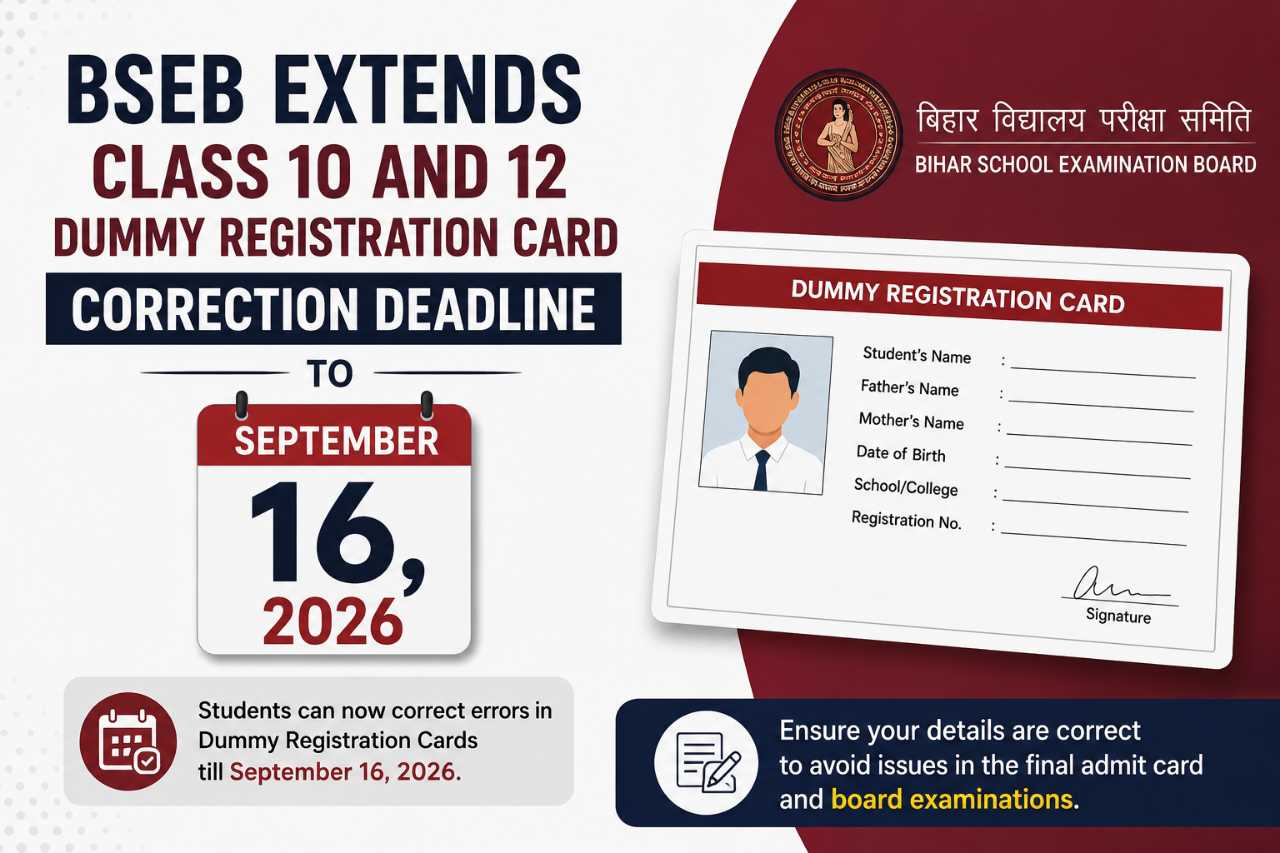

The Bihar School Examination Board (BSEB) has given schools and students more time to fix mistakes on dummy registration cards for the Class 10 (Matric) and Class 12 (Intermediate) board examinations scheduled for 2027. According to an official notice reported on August 28, 2026, the earlier deadline of August 22, 2026 has now been extended to September 16, 2026.
For lakhs of Bihar board students, the dummy registration card is not a formality it is the first official document that confirms how your name, photograph, subjects, category, and other details will appear on the final registration record. A small spelling error today can become a major problem during college admission, scholarship verification, or government job document checks tomorrow. This guide explains what the extension means, who must act, how corrections work on the official portals, and what students should do before the new deadline passes.
What Is the BSEB Dummy Registration Card?
Before BSEB finalises student enrolment for board exams, affiliated schools receive a dummy registration card (also called a prefilled registration preview) for each registered student. This document shows the data the board currently holds, including:
- Student name (as entered during online registration)
- Father's and mother's name
- Date of birth and gender
- Category (General, OBC, SC, ST, EWS, etc.)
- Subject combination and optional papers
- School code, roll number allotment status, and photograph
- Contact details linked to the registration
Students and guardians must read this card carefully. If anything is wrong, the school must correct it on the BSEB portal before the board locks the data. Once the final registration is confirmed, fixing errors becomes slower, costlier, and sometimes impossible without special approval.
Why the Board Uses a Dummy Card System
State boards like BSEB register tens of thousands of students across urban and rural schools. A preview-and-correction stage reduces last-minute chaos during admit card release and result publication. It also protects students from carrying forward errors into marksheets, migration certificates, and higher-education applications.
Think of the dummy registration card as a draft copy of your board identity. Treat it with the same seriousness you would give an Aadhaar correction or a passport application.
In previous Bihar board cycles, students who ignored dummy card review often discovered errors only when downloading admit cards or applying for post-matric scholarships. By then, correction windows had closed and schools were flooded with urgent requests. The 2027 extension gives families a clear, time-bound opportunity to avoid that stress.
BSEB Extends Correction Deadline to September 16, 2026
BSEB Chairman Tyagarajan SM announced that the date for issuing dummy registration cards and uploading signed declarations has been extended. Schools must now complete this process by September 16, 2026 (16.09.2026) without fail.
The extension applies to both:
- Matric (Class 10) board exam 2027
- Intermediate (Class 12) board exam 2027
According to the official notice, heads of educational institutions must upload the dummy registration card along with a declaration signed by the student or guardian on the Samiti's website by the revised date. The board has stressed that this must be done "at any cost," signalling that no further routine extension should be assumed.
Earlier Registration Window: August 18–22, 2026
Alongside the dummy card process, BSEB had also offered a special and final opportunity for Matric and Intermediate students to complete registration and permission applications between August 18 and August 22, 2026. Students who missed regular registration windows should confirm with their school principal whether their online registration and fee payment were successfully completed during this period.
Official Portals for Class 10 and Class 12 Corrections
BSEB uses separate online systems for Matric and Intermediate registrations. School authorities not students directly typically log in and upload corrected documents.
| Exam Level | Portal | Primary User |
|---|---|---|
| Class 10 (Matric) 2027 | biharboardonline.org | School head / designated staff |
| Class 12 (Intermediate) 2027 | intermediate.biharboardonline.com | School head / designated staff |
Students should collect a printed or digital copy of the corrected dummy card from their school after upload. Keep at least two photocopies and one scanned PDF safely at home.
Who Must Take Action Before September 16?
1. School Heads and Registration Coordinators
Principals and exam in-charges must upload signed dummy registration cards for every eligible student. Delay by even a few students can hold up the entire school's final registration batch.
2. Students Whose Fee Is Paid but Declaration Is Pending
The board has clarified that for students whose online registration and fee have already been deposited by the school but whose prefilled declaration form has not been submitted, schools must submit the declaration on the portal by September 16. Only after this step will the dummy registration card become visible for those students.
3. Students and Parents
Even though uploading is done by schools, verification is the student's responsibility. Visit your school, compare the dummy card with your birth certificate, Aadhaar, previous marksheet, and caste or income certificate (if applicable). Report discrepancies immediately in writing.
Common Errors to Check on Your Dummy Registration Card
Based on past BSEB exam cycles, these are the mistakes most often found during dummy card review:
- Name mismatch: Spelling differences between board records and government ID
- Date of birth errors: Especially DD/MM/YYYY format confusion
- Wrong subject codes: Science vs Commerce streams, optional language, or vocational papers
- Category or special status: Incorrect SC/ST/OBC/EWS marking affects reservation benefits later
- Photograph issues: Blurry, outdated, or non-compliant images
- Parent name errors: Can create problems during document verification for scholarships
- School code or medium of instruction: Hindi, Urdu, or ENglish medium must match actual study pattern
Correcting these now takes a few minutes at school. Correcting them after the final registration may require affidavits, gazette notifications, or court orders in extreme cases.
Understanding the Signed Declaration Form
The declaration form is a critical link between student verification and dummy card display. BSEB prefills this form using registration data entered by the school. The student or guardian must read it, confirm accuracy, and sign it before the school submits it online.
The declaration typically confirms that:
- The student is a bona fide candidate of the listed school
- Personal details shown on the registration are correct to the best of the signatory's knowledge
- The student meets eligibility conditions for the chosen examination and subject combination
- Any false information may lead to cancellation of registration or results
If a student signs the declaration without reading the dummy card, the board treats the data as accepted. That is why parents should insist on seeing both documents together before signing. Schools should display dummy cards in batches class-wise or section-wise to ensure no student is missed, especially in large government and aided institutions across districts like Patna, Muzaffarpur, Gaya, Bhagalpur, and Darbhanga.
Scholarships and Government Schemes Linked to Board Data
Accurate dummy registration data directly affects access to financial support after board results. Several Central and state schemes cross-check student name, category, income details, and bank account holder name against board records.
- Post-Matric Scholarship (SC/ST/OBC/Minority): Mismatch in category or name blocks fund disbursement
- Bihar state scholarship portals: Require board registration number and marksheet alignment
- Central Sector Scheme and NMMS follow-ups: Prior academic records must connect cleanly to Class 10 and 12 data
- Fee reimbursement programmes: Depend on correct school code and examination level
Students from economically weaker sections should verify that EWS or income-related fields match certificates submitted during school admission. Even a one-letter difference between the dummy card and caste or income certificates can stall verification for months.
Step-by-Step: What Happens After Dummy Card Upload?
Understanding the full workflow helps students plan ahead for 2027 board exams and beyond.
- Online registration and fee payment by the school on the BSEB portal
- Prefilled declaration form submission (student/guardian signature required)
- Dummy registration card generation and review at school level
- Correction window currently extended until September 16, 2026
- Upload of signed dummy card with declaration to the Samiti portal
- Final online examination form submission for students whose signed dummy card is accepted
- Admit card and exam conduct in 2027 using locked registration data
Chairman Tyagarajan SM has stated that the online examination form must be submitted for students whose dummy registration card containing the signed declaration is uploaded on the portal. Skipping any intermediate step can block admit card download later.
Impact on Future Admissions and Competitive Exams
Board registration details feed directly into many higher-education pathways. Incorrect Class 12 subject lists can disqualify you from engineering, medical, law, or design entrances even if you score well in the board exam.
Class 10 Students: Choosing the Right Stream
Matric students moving to Class 11 should use this correction period to confirm that school records reflect their intended stream Science, Commerce, Arts, or vocational tracks. A wrong subject mapping at Class 10 level sometimes creates confusion when schools allocate Class 11 sections.
Class 12 Students: Board Data and Entrance Exams
Intermediate students eyeing national-level entrances must ensure their board registration matches eligibility rules. Entrance bodies cross-check name, date of birth, category, photograph, and qualifying examination details against board records at multiple stages application, admit card, result, and counselling.
Similar alignment is needed for JEE Main, NEET UG, CLAT, CUET UG, and state-level engineering and medical tests. A single mismatch between dummy card data and entrance application can lead to rejection at document verification stage after months of preparation.
How Board Subject Choices Affect CUET and State Admissions
Since CUET UG became a major route to central universities, Intermediate students must ensure their registered subjects match university eligibility lists. A student who wants B.Sc programmes may need specific combinations Physics, Chemistry, Mathematics, or Biology clearly reflected on board records. Arts and Commerce students targeting B.A., B.Com, or integrated law programmes should confirm language and core subject codes now rather than during CUET form filling in 2027.
Bihar state universities and private colleges also rely on intermediate registration data during spot admission and counselling. Keeping dummy card information consistent with your career plan reduces friction when cut-offs are announced and seats fill quickly.
Design, Fashion, and Creative Career Pathways
Students exploring careers in fashion, textile design, accessory design, or related creative fields often prepare for specialised entrances alongside board exams. Beyond general eligibility, these exams require consistent personal and academic records across multiple stages application, admit card, studio test, and final admission. Checking dummy card accuracy early gives you one less variable to worry about while building portfolios and preparing for aptitude tests. If design is on your radar, cross-check age and qualification criteria when reviewing board data so your profile stays aligned with exams like the NIFT Entrance Exam from the very first application step.
Challenges Faced by Rural and First-Generation Learners
In many Bihar villages, parents may not be familiar with online board processes. First-generation college aspirants often depend entirely on school staff for registration. While teachers do their best, high student-to-teacher ratios mean proactive families get faster corrections.
If you study in a rural or remote school:
- Request the dummy card in your preferred language and ask a trusted teacher to explain each field
- Use Digilocker or mobile photocopies to store certificates when originals cannot be carried daily
- Form a small peer group in your class to compare cards many errors repeat across batches and are easier to spot collectively
- Contact the district education office helpline if your school is unresponsive, keeping copies of your fee receipt and admission number
Digital literacy gaps should not become permanent data errors on your marksheet. The September 16 extension is especially important for schools in connectivity-challenged blocks where initial upload attempts may have failed or remained incomplete.
What School Administrators Should Do Before the Deadline
School heads carry legal and procedural responsibility for timely upload. A practical school-level checklist includes:
- Prepare a master list of all registered Matric and Intermediate 2027 candidates with fee payment status
- Identify students whose declaration forms are pending and collect signatures within one week
- Assign one trained computer operator per shift to avoid portal login conflicts
- Run a name-and-DOB audit against admission registers before bulk upload
- Maintain a correction register signed by parents for audit purposes
- Submit final upload report to the district education officer before September 16
Institutions that batch-process corrections early reduce student anxiety and minimise last-minute portal downtime. Transparent communication a notice on the school board, SMS to parents, or a short class announcement can dramatically improve compliance.
Actionable Tips for Students and Parents in Bihar
Do Not Wait for the Last Day
September 16, 2026 is the deadline, not the start date. Server load on official portals often spikes in the final 48 hours. Visit your school this week with all supporting documents.
Carry Original Documents to School
Bring birth certificate, Aadhaar, previous year marksheet, caste certificate (if applicable), income certificate (for fee concessions), and passport-size photographs matching board specifications.
Get Written Acknowledgement
Ask the school office for confirmation that your corrected dummy card and signed declaration have been uploaded. A dated receipt or screenshot from the school coordinator adds protection if disputes arise later.
Double-Check Subject Codes for Intermediate
Science students need the correct combination of Physics, Chemistry, Mathematics or Biology. Commerce students must verify Accountancy, Business Studies, and Economics codes. Arts students should confirm optional subjects tied to future CUET or university eligibility.
Plan Your 2027 Exam Calendar Early
Board exams are only one milestone. Use accurate registration data now to register timelines for mock tests, sample paper practice, and entrance exam forms in 2026–27.
Keep a Personal Registration File at Home
Create one folder physical or digital with your dummy registration card, signed declaration copy, fee receipt, Aadhaar, birth certificate, and previous marksheets. When you apply to colleges across India, from Bihar to Delhi, Mumbai, Bengaluru, or Kolkata, you will reuse these documents repeatedly. Organised records save hours during admission season.
Talk to Seniors and Counsellors
Students who appeared in BSEB 2025 or 2026 exams can share practical lessons about dummy card mistakes they witnessed. School counsellors and coaching mentors can also flag subject-code issues early if they know your target exams.
What If Errors Are Found After September 16?
The current notice emphasises strict compliance by September 16, 2026. Historically, BSEB occasionally opens short special correction windows for exceptional cases, but these are neither guaranteed nor free. Students should assume that September 16 is the practical final date for routine corrections.
If you discover an error after the deadline, contact your school principal immediately, escalate to the district education officer if needed, and keep copies of all communication. For legal name changes or major data corrections, consult the board's official grievance channels listed on biharboardonline.bihar.gov.in.
BSEB Matric and Intermediate 2027: Key Dates at a Glance
- August 18–22, 2026: Special/final registration and permission application window (as announced)
- August 22, 2026 (original): Previous dummy card upload deadline now superseded
- September 16, 2026: Extended deadline for dummy registration card correction and signed declaration upload
- 2027: Scheduled BSEB Class 10 and Class 12 board examinations (exact timetable to be released later)
Conclusion
The BSEB extension to September 16, 2026 is a valuable second chance for schools and students to ensure Matric and Intermediate 2027 registration data is accurate before it is locked for examination and result processing. Treat the dummy registration card as the foundation of your academic identity: verify every field, submit the signed declaration on time, and follow up until your school confirms portal upload.
Whether you are a Class 10 student choosing a stream or a Class 12 student preparing for board exams and national entrances, acting now prevents painful corrections later. Visit your school, cross-check documents, and secure your corrected dummy registration card before the extended deadline expires.