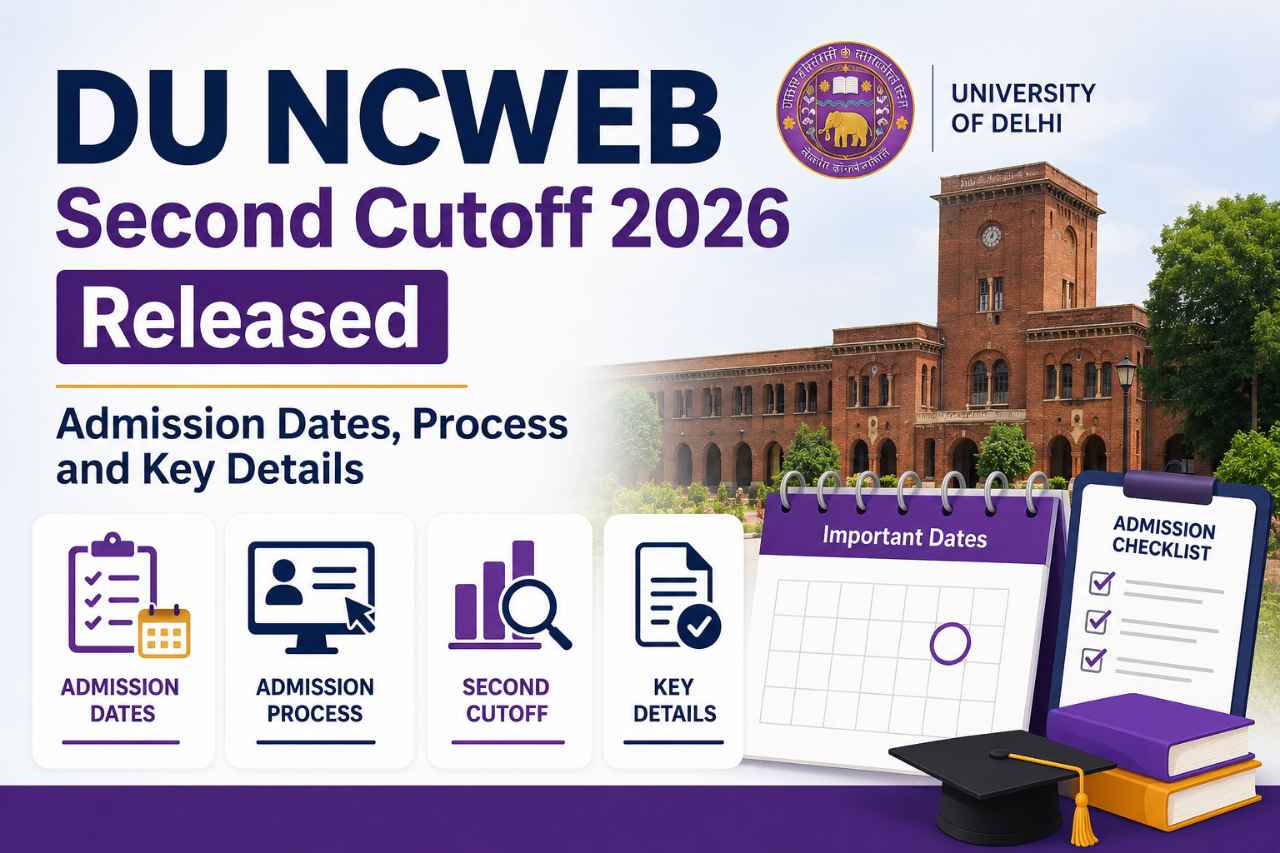

The University of Delhi has released the NCWEB second cutoff list for 2026 for undergraduate admissions to BA (Programme) and B.Com courses. If you registered on the NCWEB portal and missed the first round—or your marks now meet the revised thresholds—this is your next window to secure a seat at one of Delhi University's weekend teaching centres. Admissions against the second list run from 4 to 6 August 2026, with fee payment due by 8 August 2026.
This guide explains what the second cutoff means, how to check it on admission.uod.ac.in, the complete admission timeline, documents you need, and practical tips so you do not miss a deadline. Whether you are a first-time applicant or a parent helping a daughter navigate DU admissions, the information below is structured for clarity, accuracy, and quick action.
DU NCWEB Second Cutoff 2026: Key Highlights at a Glance
The Non-Collegiate Women's Education Board (NCWEB) is a unique University of Delhi initiative that allows women residents of the National Capital Territory (NCT) of Delhi to pursue a regular DU degree through weekend classes at affiliated colleges. Unlike mainstream DU undergraduate admissions—which are largely routed through CUET-UG and CSAS—NCWEB admissions are merit-based, calculated from Class 12 board marks.
The second cutoff was published on 3 August 2026. Eligible candidates can complete online admission formalities from 4 August (10:00 AM) to 6 August 2026 (11:59 PM). Colleges must approve admissions by 7 August 2026, and candidates must pay the admission fee by 8 August 2026.
- Courses covered: BA (Programme) and B.Com for academic session 2026–27
- Admission mode: Fully online via the NCWEB admission portal
- Basis of selection: Class 12 merit against Centre-wise and category-wise cutoffs
- No CUET required: NCWEB does not use CUET-UG scores for seat allocation
- Approximate intake: Around 12,000 seats across teaching centres, with over 21,000 applications reported this cycle
Reports indicate that some teaching centres have marked certain categories as "Closed" in the B.Com second list, meaning no further admissions will be accepted for those category-centre combinations even if the cutoff appears on the chart. Always verify live status on the portal before proceeding.
What Is NCWEB and Who Can Apply?
NCWEB was established to expand access to higher education for women who cannot attend regular weekday college due to work, family responsibilities, or distance constraints. Classes are held on weekends at designated DU-affiliated centres across Delhi, and students receive the same University of Delhi degree as regular college students upon successful completion.
Eligibility Criteria for NCWEB 2026
Before you act on the second cutoff, confirm that you meet every eligibility condition. Incomplete or ineligible applications are rejected even when marks exceed the cutoff.
- Gender: Only women candidates are eligible
- Residence: You must be a resident of NCT Delhi with valid proof in your own name (Aadhaar, Voter ID, Passport, Driving Licence, or Ration Card)
- Academic qualification: Passed Class 12 or equivalent from a recognised board
- Merit requirement: Class 12 percentage must meet or exceed the cutoff for your category at your preferred teaching centre
- Registration: You must have completed NCWEB online registration during the application window (registration for 2026 opened in July and closed on 24 July 2026)
Actionable tip: Choose a teaching centre close to your home. NCWEB rules do not permit centre transfer after admission is confirmed. Picking a distant centre because the cutoff is slightly lower often creates long-term attendance and commute problems.
How Merit Is Calculated
NCWEB evaluates candidates on their Class 12 board examination performance. For most programmes, the university considers a "Best of Four" percentage derived from your top four academic subjects, though specific calculation rules may vary by course and are defined in the official Bulletin of Information. Compare your calculated percentage against the cutoff published for your exact category—not the general (UR) list unless you belong to the unreserved category.
DU NCWEB Second Cutoff 2026: Important Dates and Schedule
Missing a single deadline in the NCWEB admission cycle can cost you a seat. Treat the dates below as non-negotiable—the university and affiliated centres do not grant extensions.
| Event | Date |
|---|---|
| NCWEB registration window (2026) | 8 July – 24 July 2026 |
| First cutoff list released | 27 July 2026 |
| Admission against first cutoff | 28 – 30 July 2026 |
| College approvals (first list) | By 31 July 2026 |
| Last date for fee payment (first list) | 1 August 2026 |
| Second cutoff list released | 3 August 2026 |
| Admission against second cutoff | 4 – 6 August 2026 |
| College approvals (second list) | By 7 August 2026 |
| Last date for fee payment (second list) | 8 August 2026 |
Example scenario: Priya scored 78% in Class 12 (OBC category) and missed the first cutoff at Lakshmibai college for B.Com, which closed at 80%. When the second list dropped the OBC cutoff to 76%, she logged in on 4 August, selected the centre, uploaded documents, and paid the fee before midnight on 6 August. Her college approved the application on 7 August, and she completed the final fee step by 8 August—securing her seat without waiting for a third list.
How to Check the DU NCWEB Second Cutoff 2026 Online
The cutoff is published separately for BA (Programme) and B.Com, with centre-wise and category-wise percentages. Use only official university websites to avoid outdated or misleading information.
Official Portals to Use
- admission.uod.ac.in — main DU admission portal
- ncwebadmission.uod.ac.in — NCWEB registration and admission login
- ncweb.du.ac.in — NCWEB information and cutoff links
- du.ac.in — university homepage with NCWEB section
Steps to Download the Second Cutoff PDF
- Visit du.ac.in or ncweb.du.ac.in
- Navigate to the NCWEB or Admissions section
- Click the link for the Second Cutoff List 2026–27 for BA (Programme) or B.Com
- Open the programme-specific PDF and locate your preferred teaching centre
- Check the cutoff percentage for your category: UR, OBC, SC, ST, EWS, or PwD/PwBD
- Download and save the PDF for reference during admission
Featured-snippet tip: The DU NCWEB second cutoff 2026 was released on 3 August 2026. Eligible candidates can apply online from 4 to 6 August 2026 through ncwebadmission.uod.ac.in, with the last fee payment date on 8 August 2026.
How to Complete Admission Against the Second Cutoff
Meeting the cutoff alone does not guarantee a seat. You must actively claim admission within the three-day window. The process is entirely online, but document accuracy is critical.
Step-by-Step Admission Process
- Log in to ncwebadmission.uod.ac.in using your registered email ID and password
- Verify eligibility by comparing your Class 12 percentage with the second cutoff at your chosen centre and category
- Select programme and centre from available options (closed combinations will not be selectable)
- Upload scanned documents—marksheets, Delhi residence proof, category certificate (if applicable), photograph, and signature
- Submit the admission form and pay the applicable admission fee online
- Track approval status—your allotted college must approve by 7 August 2026
- Complete final fee payment by 8 August 2026 if a separate payment step is required
- Save confirmation—download the admission receipt and note your allotted centre details
Actionable tip: Do not wait until 6 August night to begin. Portal traffic spikes on the last day, and payment gateway failures are common. Complete your application on 4 or 5 August to leave buffer time for re-uploads or technical issues.
Documents Required for Verification
Keep high-quality scanned copies (PDF or JPG as specified) ready before you log in:
- Class 10 marksheet and passing certificate (date of birth proof)
- Class 12 marksheet and passing certificate
- Proof of NCT Delhi residence in the candidate's name
- Category certificate (OBC-NCL issued on or after 1 April 2026, SC/ST, EWS, or PwD certificate if applicable)
- Recent passport-size photograph and signature
- Character certificate from the school last attended
- Anti-ragging undertaking (as per portal format)
Any mismatch between uploaded documents and original records can lead to cancellation of provisional admission. Carry originals to the centre if physical verification is scheduled.
Understanding Centre-Wise and Category-Wise Cutoffs
The second cutoff is not a single number for all of Delhi University. It is a matrix of 26 teaching centres (for B.Com) and corresponding centres for BA (Programme), each with separate percentages for six reservation categories.
Sample Cutoff Reading Framework
When you open the PDF, you will typically see rows for centres such as Aditi Mahavidyalaya, Bhagini Nivedita College, Daulat Ram College, Lakshmibai College, Maitreyi College, Miranda House (evening/weekend centre allocations vary by year—always refer to the official list), Sri Guru Gobind Singh College of Commerce, and others. Columns show UR, OBC, SC, ST, EWS, and PwD cutoffs.
Example: If the B.Com second cutoff at Vivekananda College shows UR: 82%, OBC: 78%, SC: 72%, and your OBC percentage is 79%, you qualify for that centre. If the same row shows "Closed" for UR, unreserved candidates cannot apply there even if their marks are above the printed figure.
BA (Programme) vs B.Com: Which to Choose?
- BA (Programme): Flexible subject combinations; suited for students planning civil services, teaching, social sciences, or further specialisation through MA programmes
- B.Com: Commerce-focused curriculum; suited for CA, MBA, banking, finance, and corporate careers
Cutoffs for B.Com are often higher than BA (Programme) at the same centre due to demand. If your marks fall short for B.Com, check BA cutoffs at the same or nearby centres before exploring options outside Delhi.
First Cutoff vs Second Cutoff: What Typically Changes?
The first NCWEB cutoff (released 27 July 2026) reflects initial seat filling based on the highest merit applicants. The second list adjusts thresholds as some candidates withdraw, fail document verification, or do not pay fees—vacating seats and lowering cutoffs at select centres.
- Seat vacancy: Centres with unfilled seats often reduce cutoffs by 1–5 percentage points
- Category variation: SC, ST, and EWS seats may remain open longer than UR seats
- Closed status: High-demand centres may close popular categories in the second round while keeping others open
- No guarantee of a third list: If all seats fill, further cutoffs may not be released—treat the second round as potentially your last chance
Actionable tip: Even if you were above the first cutoff but did not apply, you may still apply in the second round if seats remain open and your category is not marked closed.
NCWEB Teaching Centres: Seats and Selection Strategy
NCWEB operates through DU-affiliated colleges across Delhi. Each centre offers a fixed number of seats—typically around 230 for B.Com and 355 for BA (Programme) per centre, though exact numbers are listed in the official seat matrix.
Popular centres in North, South, East, and West Delhi fill quickly. When selecting preferences during admission:
- Shortlist three to five centres within reasonable commute distance
- Compare second cutoff percentages across those centres for your category
- Prioritise proximity and attendance feasibility over marginal cutoff differences
- Check whether any centre is marked closed for your category before ranking preferences
Remember: NCWEB requires a minimum of 67% attendance per session. Choosing an accessible centre directly supports your ability to meet this requirement and complete your degree.
Fee Structure and Payment Guidelines
NCWEB fees are significantly lower than many private institutions, making it one of the most affordable routes to a DU degree. During registration, candidates paid an approximate registration fee of ₹250. Admission against the cutoff requires payment of the course fee as displayed on the portal after centre selection.
Critical deadline: All fee payments against the second cutoff must be completed by 8 August 2026. Unpaid seats are released and may be offered to waitlisted or subsequent-round applicants.
- Use only the payment gateway integrated into the official NCWEB portal
- Save transaction ID, receipt, and bank confirmation
- If payment fails, retry immediately—do not assume the seat is held without confirmed payment
- Contact NCWEB helpline (011-27667866) or email ncweb@du.ac.in for payment-related queries
Common Mistakes Candidates Must Avoid
Each admission cycle, hundreds of eligible applicants lose seats due to preventable errors. Avoid these pitfalls:
- Checking the wrong category cutoff—always use your reservation category column
- Ignoring "Closed" labels—a printed cutoff does not mean seats are available
- Uploading blurred or cropped documents—leads to rejection during verification
- Residence proof not in candidate's name—parent's Aadhaar alone is insufficient
- Expired OBC-NCL certificate—must be issued on or after 1 April 2026
- Waiting until the last hour on 6 August—technical failures can block submission
- Assuming CUET scores matter—NCWEB is Class 12 merit only
What If You Miss the Second Cutoff Round?
If your marks fall below the second cutoff, or you miss the 4–6 August admission window, monitor the official NCWEB website for announcements regarding a third cutoff list. The university releases additional lists only when vacant seats remain after the current round.
While waiting, consider these parallel options:
- Other DU rounds: If you appeared for CUET-UG, explore remaining CSAS rounds for regular DU programmes
- State and private universities: Many institutions offer merit-based UG admissions through July and August
- Distance and open learning: IGNOU and SOL (School of Open Learning, DU) provide flexible alternatives
- Entrance-based programmes: Design aspirants can prepare for exams such as NID DAT, while engineering candidates explore state and national engineering entrance routes
Exploring colleges beyond Delhi can also widen your choices. For instance, students researching institutions across India may compare options like MD Mission College Kota for affordable undergraduate programmes in Rajasthan, or DMI College of Engineering Chennai for technical education pathways in Tamil Nadu. These are not NCWEB substitutes, but they illustrate how merit-based and entrance-based admissions coexist across India's higher education landscape.
NCWEB vs Regular DU Admission: Quick Comparison
| Parameter | NCWEB | Regular DU (CSAS) |
|---|---|---|
| Entrance exam | Not required (Class 12 merit) | CUET-UG required |
| Class schedule | Weekend classes | Regular weekday classes |
| Gender | Women only | Open to all genders |
| Residence | NCT Delhi mandatory | No Delhi residence requirement |
| Degree awarded | University of Delhi degree | University of Delhi degree |
| Attendance rule | Minimum 67% per session | As per college norms |
Expert Tips for a Smooth NCWEB Second-Round Admission
Based on admission patterns from previous NCWEB cycles, the following strategies improve your chances of securing and retaining a seat:
- Calculate your merit percentage today using the official Best of Four rules in the Bulletin of Information
- Print or save the second cutoff PDF and highlight eligible centres before logging in
- Prepare documents in a single folder labelled clearly for quick upload
- Use a stable internet connection and complete the process during off-peak hours
- Read the anti-ragging and attendance undertaking carefully before signing electronically
- Attend the NCWEB orientation programme when announced—it covers academic calendar, exam pattern, and centre rules
- Keep helpline numbers saved: NCWEB Tutorial Building, Faculty of Arts, University of Delhi—011-27667866
Conclusion
The DU NCWEB second cutoff 2026 opens a vital three-day admission window for women residents of Delhi seeking a University of Delhi degree through weekend learning. Released on 3 August 2026, the list covers BA (Programme) and B.Com programmes across multiple teaching centres with category-wise merit thresholds. If your Class 12 marks meet the revised cutoff and your category is not marked closed, act immediately—log in at ncwebadmission.uod.ac.in, complete document upload and fee payment between 4 and 6 August 2026, and ensure final payment by 8 August 2026.
Success in this round depends on accurate document submission, careful centre selection, and strict adherence to deadlines. Cross-check every detail against the official Bulletin of Information, save all payment receipts, and monitor your approval status through 7 August. Whether NCWEB is your first choice or a well-planned backup after CUET-UG, this second cutoff represents a genuine opportunity to begin your DU journey—provided you move quickly and avoid the common mistakes outlined above.