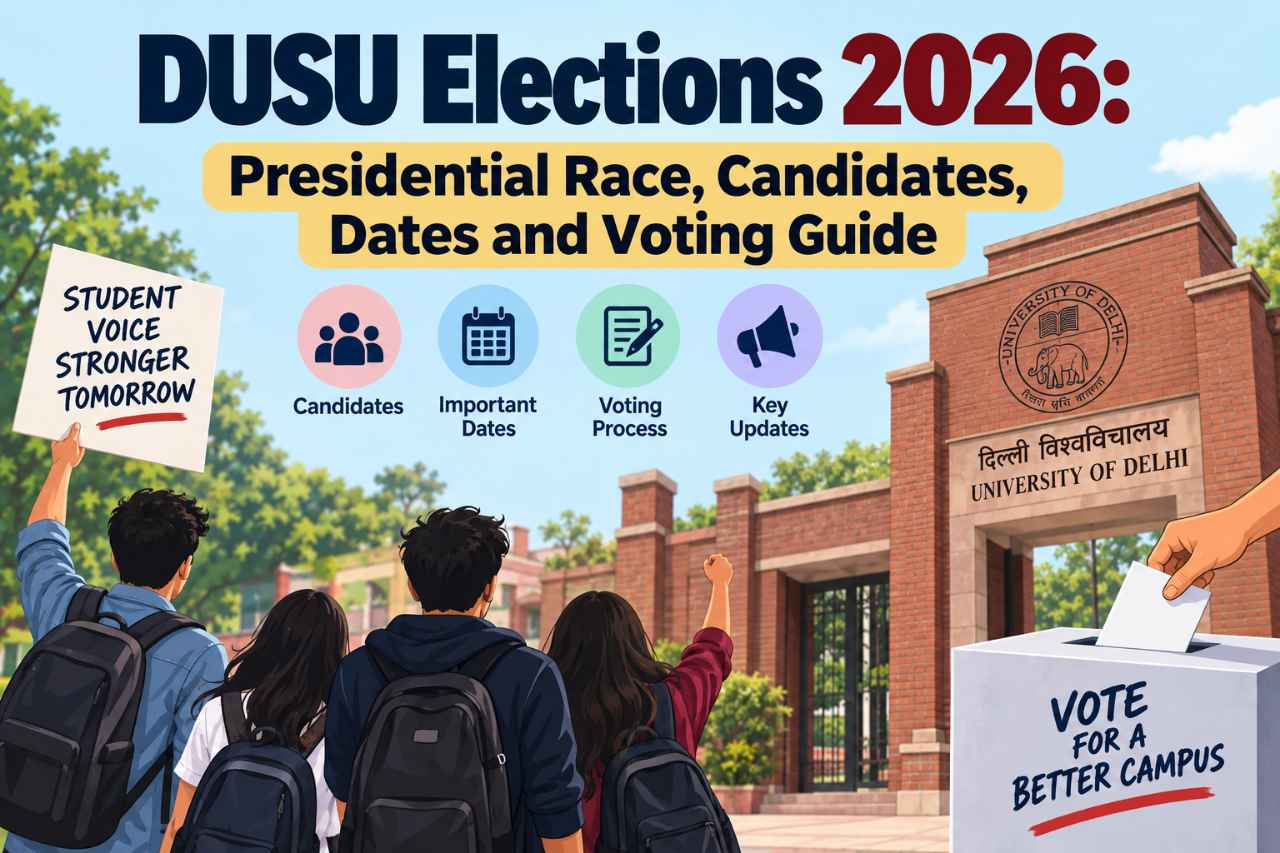
The Delhi University Students' Union (DUSU) elections 2026 have entered their decisive phase. On Friday, September 12, 2026, major student organisations announced their central panel candidates for the four key posts president, vice-president, secretary, and joint secretary ahead of polling scheduled for September 18, 2026. Vote counting is set for September 19, 2026.
For lakhs of Delhi University (DU) undergraduates and postgraduates, DUSU is more than a campus poll. It shapes fee debates, hostel policies, library hours, placement cell access, and the broader voice students carry before university administration. Whether you are a first-year student at a North Campus college or a final-year learner completing a BA programme, understanding who is contesting, how the process works, and what each alliance stands for helps you vote with clarity not confusion.
This guide explains the 2026 presidential race featuring Yash Dabas (ABVP), Vijay Shankar Meena (NSUI), and Ananya Raturi (AISA-SFI), breaks down full central panels, and offers practical steps to participate responsibly in one of India's most closely watched student elections. Updated with verified candidate details from the September 12 nomination scrutiny, this article helps students, parents, and education observers navigate the 2026 poll with confidence.
What Is DUSU and Why Does It Matter?
The Delhi University Students' Union is the elected representative body for students across DU's affiliated colleges, departments, and campuses. Unlike purely academic bodies, DUSU holds real influence: it raises grievances with the varsity, organises protests and cultural events, and often serves as a launchpad for public life in India.
Historically, DUSU elections have drawn national attention because outcomes reflect wider political currents. Student wings of major parties ABVP (linked with the RSS ecosystem), NSUI (Congress-affiliated), and Left-aligned groups such as AISA and SFI compete fiercely. For students planning higher studies beyond Delhi whether at Pt Ravishankar Shukla University Raipur, Kuvempu University Shankaraghatta Shimoga, or professional institutes like Shankara Institute Of Technology Jaipur watching DUSU offers a practical lesson in campus democracy and student leadership.
Key Posts in the Central Panel
DUSU's central panel comprises four offices:
- President – Leads the union, represents students officially, and sets the political tone.
- Vice-President – Supports the president and often coordinates college-level units.
- Secretary – Handles documentation, communication, and organisational work.
- Joint Secretary – Assists the secretary and bridges college unions with the central body.
In 2026, seven candidates are contesting for president, five for vice-president, and four each for secretary and joint secretary, according to lists released after nomination scrutiny and withdrawals on September 12.
DUSU Elections 2026: Important Dates
Mark these dates if you are an eligible DU student voter:
| Event | Date (2026) |
|---|---|
| Nomination scrutiny and withdrawals | September 12 (Friday) |
| Polling day | September 18 |
| Vote counting | September 19 |
Final candidate lists remain provisional and may undergo further verification by the chief election officer. Students should confirm official notices on the Delhi University website and their college notice boards before election day.
Presidential Race 2026: Three Front-Runners Explained
The president's post attracts the most media coverage. Three alliances have fielded high-profile candidates with distinct backgrounds and campaign narratives.
Yash Dabas – ABVP Candidate for President
The Akhil Bharatiya Vidyarthi Parishad (ABVP) has nominated Yash Dabas for president. Dabas hails from Kanjhawala in Delhi and is pursuing a master's degree from DU's Department of Buddhist Studies.
ABVP's campaign material highlights his profile as an international-level tennis player who has competed in ITF tournaments in Spain, Australia, and Serbia, apart from representing Delhi University in university-level competitions. For students who admire sports excellence alongside academics similar to how athletes balance rigour at universities such as Yashwantrao Chavan Maharashtra Open University Dabas represents a blend of athletic discipline and campus activism.
ABVP typically emphasises nationalist student politics, infrastructural demands, and organisational strength across colleges. Dabas enters the race with the backing of ABVP's established college network.
Vijay Shankar Meena – NSUI Candidate for President
The National Students' Union of India (NSUI), the student wing of the Indian National Congress, has fielded Vijay Shankar Meena for the top post. Meena is originally from Rajasthan. He completed graduation from Rajasthan University and is currently enrolled in the Department of Buddhist Studies at Delhi University.
NSUI's statement describes Meena as having a strong understanding of academic and student-related concerns, with active involvement in student rights, social justice, and democratic representation. Students from Rajasthan and other states who migrated to DU for postgraduate study much like learners choosing Vijayanagara Sri Krishnadevaraya University Bellary or Vijaybhoomi University for specialised programmes may find his inter-state academic journey relatable.
NSUI has stated its campaign will prioritise "student interests first" and work toward a "prosperous, safe and better" Delhi University.
Ananya Raturi – AISA-SFI Joint Candidate for President
The Left-aligned alliance of the All India Students' Association (AISA) and Students' Federation of India (SFI) has nominated Ananya Raturi for president. The alliance describes its panel as representing "alternative politics" and pledges to build a student-led DUSU while opposing "money and muscle politics."
Raturi, an AISA member, has been associated with campus movements on issues including sexual harassment and institutional accountability. For students concerned with gender safety, transparent grievance redressal, and ideological independence from mainstream parties, the AISA-SFI panel offers a distinct choice.
Other Presidential Contenders
Beyond the three major alliances, additional candidates remain in the fray, taking the total presidential field to seven. Independent and smaller-group candidates often focus on local college issues, anti-corruption pledges, or single-issue campaigns. Voters should read all manifestos not just high-decibel speeches before choosing.
Full Central Panels: ABVP, NSUI, and AISA-SFI
Understanding the complete panel helps voters assess team strength, not just the presidential face.
ABVP Central Panel 2026
- President: Yash Dabas
- Vice-President: Ishu Maurya
- Secretary: Riya Chhawadi
- Joint Secretary: Lakshya Raj Singh
Ishu Maurya, from Varanasi, is a law student at Campus Law Centre and has been with ABVP since 2021. He served as president of the Satyawati College (Morning) unit and as co-convener of Students for Seva.
Riya Chhawadi is a fourth-year BA Programme student at Sri Aurobindo College and an inter-college basketball player reflecting the diversity of DU students pursuing general degrees alongside co-curricular excellence.
Lakshya Raj Singh, also at Campus Law Centre, has represented India in handball at the Asian Games and World Championship, according to ABVP.
NSUI Central Panel 2026
- President: Vijay Shankar Meena
- Vice-President: Vir Chatrath
- Secretary: Namrata Chaudhary
- Joint Secretary: Gopal Choudhary
Vir Chatrath, a Delhi resident, is pursuing an MA from the Department of Buddhist Studies. Notably, three NSUI central panel members including Meena, Chatrath, and Gopal Choudhary share Buddhist Studies as their academic base, suggesting deep department-level mobilisation.
Namrata Chaudhary completed graduation from SPM College, University of Delhi.
Gopal Choudhary, from Rajasthan, graduated from Satyawati College and is pursuing an MA in Buddhist Studies. NSUI credits him with active work on student welfare and democratic campus culture.
AISA-SFI Central Panel 2026
- President: Ananya Raturi
- Vice-President: Akshat Shikhar
- Secretary: Stanzin Deskyong
- Joint Secretary: B Parijaat
Akshat Shikhar, an AISA member from Motilal Nehru College, was linked with protests at Jantar Mantar.
Stanzin Deskyong is a first-year MSc Mathematics student at Hindu College and previously served as vice-president of the Ramjas College Students' Union.
B Parijaat is a first-year MA English student at Hansraj College with involvement in literary and theatre activities.
Candidate Comparison at a Glance
Use this quick reference to compare the three major presidential contenders:
| Alliance | Presidential Candidate | Academic Background | Key Campaign Theme |
|---|---|---|---|
| ABVP | Yash Dabas | MA Buddhist Studies, DU | Organisational strength, sports excellence, campus infrastructure |
| NSUI | Vijay Shankar Meena | MA Buddhist Studies, DU; grad from Rajasthan University | Student interests first, safe and prosperous campus |
| AISA-SFI | Ananya Raturi | AISA activist | Alternative politics, anti money-muscle politics, accountability |
How DUSU Elections Work: Process and Eligibility
DUSU follows Delhi University's election regulations, typically aligned with Lyngdoh Committee guidelines that aim to limit excessive spending, violence, and outside interference in student polls.
Lyngdoh Committee Guidelines: What Students Should Know
The Supreme Court-backed Lyngdoh Committee recommendations shape most Indian university student elections. Key principles include caps on campaign spending, restrictions on printed publicity material, prohibition of vehicles for campaigning, and barring candidates who exceed a specified age limit or have incomplete academic records. DU publishes its own election handbook each year building on these norms. Knowing these rules empowers students to report violations and expect a fairer contest.
Who Can Vote?
Generally, regular students enrolled in DU-affiliated colleges and departments who meet age and enrollment criteria specified in official election notifications can vote. Final-year students, first-year entrants, and postgraduate researchers should verify eligibility through their college election committee.
How Is Voting Conducted?
Polling usually takes place on designated campuses with ballot papers or electronic mechanisms as notified by the chief election officer. Students must carry valid identity proof often their college ID and follow queue and security instructions.
What Happens After Polling?
Votes are counted on September 19, 2026. Results determine not only the central panel but also the political momentum each organisation carries into the academic year.
North Campus vs South Campus: Election Dynamics
Delhi University's geographic split influences campaigning. North Campus colleges Ramjas, Hindu, Hansraj, Miranda House, and others traditionally see heavy footfall during election week. South Campus institutions such as Sri Venkateswara, Motilal Nehru, and Aurobindo College host parallel rallies. Winning DUSU requires cross-campus appeal, not dominance in one cluster alone.
First-year students admitted through CUET and other routes often encounter DUSU campaigning within weeks of joining. Observing how panels engage with freshers through help desks, orientation support, or aggressive poster wars offers early insight into campus culture before committing to a college for the full degree.
Issues Likely to Shape the 2026 Campaign
While manifestos vary, several themes recur in DUSU elections:
- Fee hikes and scholarships – Affordability remains central for middle-class and outstation students.
- Hostel and PG safety – Especially for women students and those from distant states.
- Library, Wi-Fi, and lab infrastructure – Daily academic quality-of-life concerns.
- Placement and internship support – Connecting degrees to employability.
- Campus democracy and transparency – Grievance cells, harassment committees, and union accountability.
- Clean elections – The AISA-SFI alliance explicitly targets "money and muscle politics."
Students evaluating candidates should ask: Which issues affect my degree and daily life most? A law student at Campus Law Centre may prioritise different demands than a science undergraduate or a BA Programme learner.
DUSU Elections and Indian Student Politics: A Broader View
DUSU is one node in India's vast student-politics map. Universities such as Raja Shankar Shah Universitychhindwara, Shri Shankaracharya Professional University, and Rajmata Vijayaraje Scindia Krishi Vishwa Vidyalaya Gwalior conduct their own student representative elections with local rules. DU's scale dozens of colleges across North and South Campus magnifies every debate.
For aspirants eyeing professional courses, comparing campus culture matters. A student choosing between liberal arts at DU and professional tracks at Dr Ntr University Of Health Sciences Vijaywada or School Of Planning Architecture Vijaywada should weigh academic outcomes alongside campus governance quality.
Why the Department of Buddhist Studies Features Prominently in 2026
An interesting pattern in the 2026 race is the concentration of candidates from DU's Department of Buddhist Studies. Both ABVP's presidential nominee Yash Dabas and three NSUI central panel members Vijay Shankar Meena, Vir Chatrath, and Gopal Choudhary are enrolled in this department. This reflects how postgraduate departments, often smaller than large colleges, can become organisational hubs where student leaders build networks before contesting central posts.
Prospective MA applicants should note that department-level engagement can open pathways to union politics, but academic merit and research focus should remain the primary reason for choosing any programme.
Actionable Tips for DU Students Before September 18
- Read official candidate lists on the DU website after final verification not only social media posts.
- Attend open forums where panels answer questions on fees, safety, and facilities.
- Compare track records – Prior union work, college-level posts, and consistency matter more than slogans.
- Avoid intimidation – Lyngdoh norms prohibit coercion; report violations to college authorities.
- Vote on issues – Choose the panel whose priorities align with your academic and personal needs.
- Carry required documents – College ID and any slip notified by the election office.
- Stay informed on counting day – September 19 results affect immediate campus policy conversations.
E-E-A-T Perspective: Why Trustworthy Election Information Matters
During DUSU season, misinformation spreads quickly fake candidate lists, doctored manifestos, and rumour-driven WhatsApp forwards. Reliable information comes from Delhi University's chief election officer, official college notices, and verified statements from ABVP, NSUI, AISA, and SFI.
Parents and students from states such as Telangana, Karnataka, or Maharashtra where institutions like Professor Jayashankar Telangana Agricultural University Pjtau, Vidyashilp University, and Punyashlok Ahilyadevi Holkar Solapur University Solapur attract national applicants should help their wards distinguish verified news from campaign propaganda.
What Happens After DUSU Results Are Declared?
Once counting concludes on September 19, 2026, the elected central panel assumes office and begins coordinating with college-level units. Typical early priorities include addressing immediate student grievances delayed mark sheets, hostel allotment disputes, and library access and preparing for the annual budget dialogue with the university administration. Outgoing panels hand over records, and newly elected office-bearers often hold open meetings within the first fortnight to gather fresh feedback.
For students who did not vote, the outcome still matters. Fee revision proposals, festival funding, and representation on disciplinary committees all flow through DUSU channels. Staying engaged through college unions even without holding a central post keeps accountability alive throughout the year.
Advice for Prospective DU Applicants Watching From Outside
If you are a Class 12 student or a graduate elsewhere in India considering Delhi University admission, DUSU election coverage offers a live preview of campus energy. High-decibel campaigns can feel overwhelming, but they also signal an institution where student voice remains structurally important. Compare this with campuses that lack elected unions, and decide what environment suits your temperament and academic goals.
Use CollegeDwar resources to cross-check college cut-offs, course structures, and city-wise options before you arrive on campus. Informed applicants make better voters and better students when election season rolls around in their first semester.
Conclusion
As September 18 approaches, every eligible DU student holds a direct stake in shaping campus governance for the year ahead.
The DUSU elections 2026 bring a competitive presidential contest among Yash Dabas (ABVP), Vijay Shankar Meena (NSUI), and Ananya Raturi (AISA-SFI), with fully declared central panels and polling on September 18 and counting on September 19. Seven presidential candidates and crowded vice-presidential and secretary fields reflect high stakes and diverse student aspirations.
Whether you are a DU voter or a prospective applicant tracking campus life, these elections offer a window into how India's largest central university balances student voice, political affiliation, and academic priorities. Vote with information, question manifestos critically, and treat DUSU as what it is meant to be a student union serving learners first.
For broader guidance on choosing universities and programmes nationwide including women's colleges such as Shri Ana Sagar Mahila Shiksha Shastri Mahavidyalaya Kota and institutions like Kanyashree University explore CollegeDwar's college and course pages alongside campus news updates like this one.