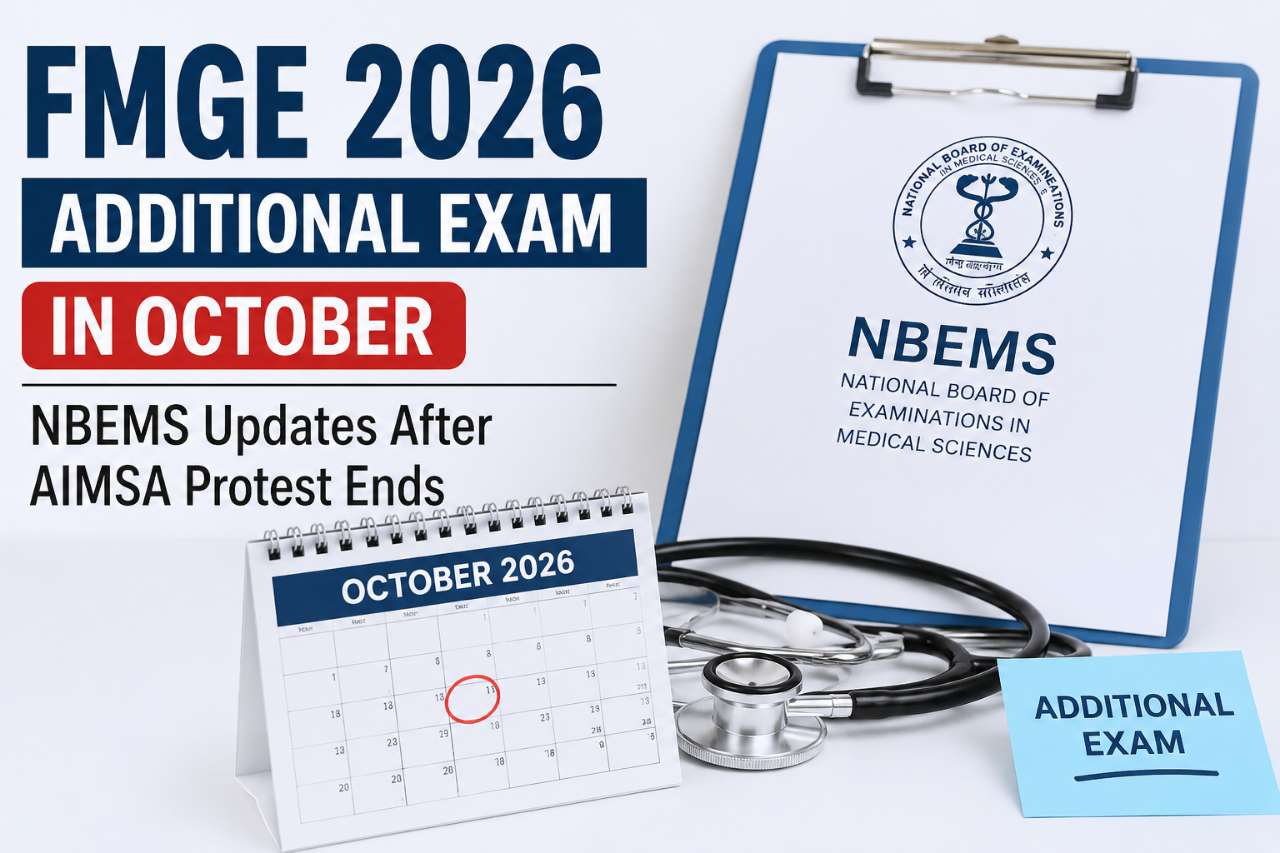
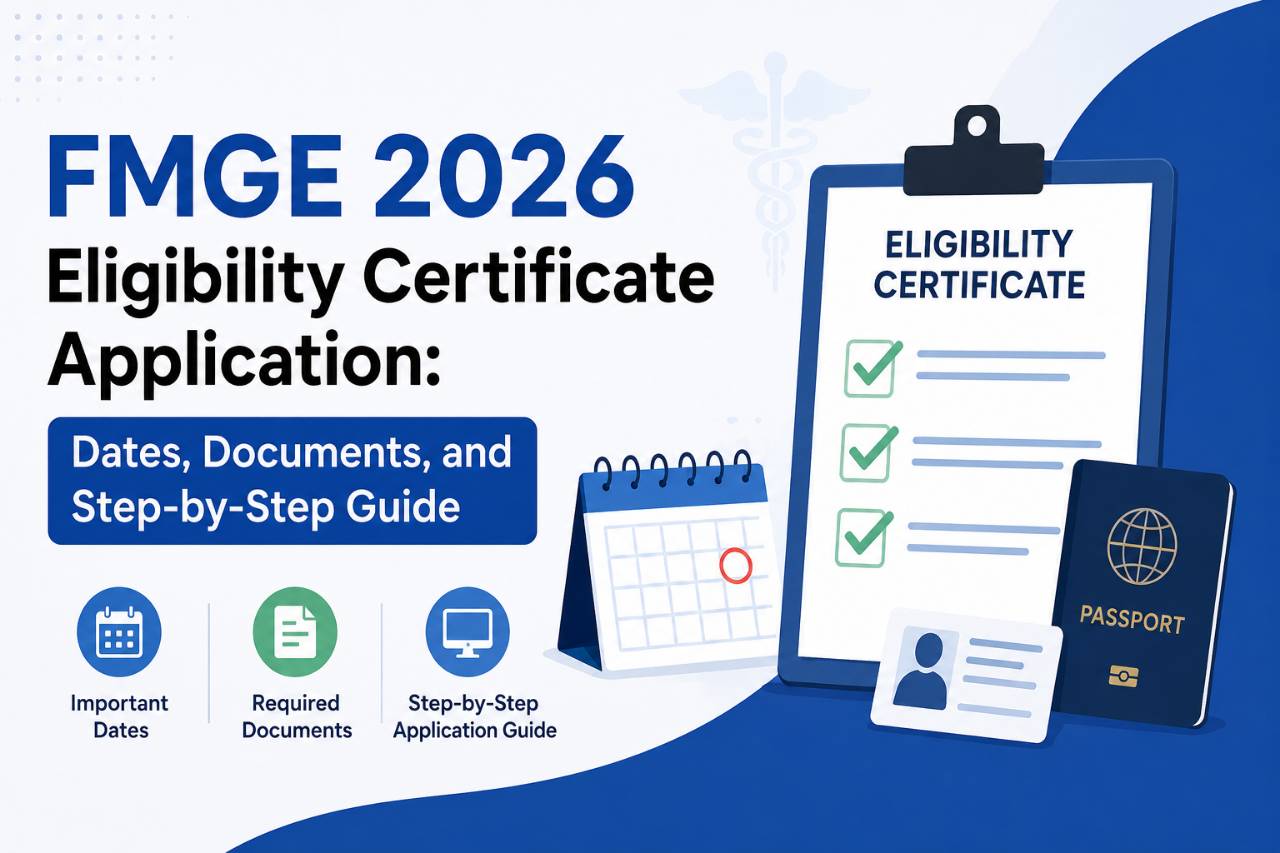
If you studied medicine outside India and plan to practise here, the Foreign Medical Graduate Examination (FMGE) is the mandatory licensing screening test. Before you can even register for FMGE 2026, the National Medical Commission (NMC) requires an Eligibility Certificate (EC). From September 1, 2026, at 10:00 AM, NMC opens the online window to apply for this certificate at application.nmc.org. The deadline is September 30, 2026, at 6:00 PM. Missing this window can delay your entire medical career in India by months. This guide explains who needs the certificate, how to apply without errors, what documents to keep ready, and what happens after approval written in simple language for Indian students, parents, and foreign medical graduates (FMGs).
What Is FMGE and Why Does NMC Issue an Eligibility Certificate?
The Foreign Medical Graduate Examination (FMGE) is a national screening test conducted by the National Board of Examinations in Medical Sciences (NBEMS). Indian citizens and Overseas Citizens of India (OCI) who earned an MBBS or equivalent degree from a medical institution outside India must clear FMGE to obtain provisional or permanent registration with a State Medical Council and practise modern medicine in India.
The NMC Eligibility Certificate is not the same as FMGE registration. Think of it as a pre-check: NMC verifies that your foreign medical qualification, institution, and candidature meet current regulations before NBEMS accepts your FMGE application. Without a valid EC, your FMGE 2026 form will not proceed even if you are otherwise qualified.
India's medical licensing pathway sits alongside other high-stakes entrance systems. While FMGE tests clinical knowledge for overseas-trained doctors, exams like the CAT gateway lead toward management careers, and design aspirants prepare for tests such as the NIFT Entrance Exam or NID DAT. FMGE remains unique because it directly determines whether an FMG can join India's healthcare workforce.
FMGE 2026 Eligibility Certificate: Important Dates
According to the latest NMC notification reported on August 30, 2026, the eligibility certificate application schedule for FMGE 2026 is as follows:
| Event | Date and Time |
|---|---|
| EC application window opens | September 1, 2026, 10:00 AM (IST) |
| EC application window closes | September 30, 2026, 6:00 PM (IST) |
| Official application portal | application.nmc.org |
| FMGE 2026 exam schedule | To be announced by NBEMS in upcoming months |
Action tip: Do not wait until September 29. Server load, document uploads, and deficiency corrections take time. Apply in the first week of September if your documents are ready.
Who Must Apply for the FMGE 2026 Eligibility Certificate?
You should apply for the NMC Eligibility Certificate if you fall under any of these categories:
- Indian citizens who completed MBBS or equivalent primary medical qualification abroad
- OCI cardholders with a foreign medical degree seeking registration in India
- FMGs planning to appear for FMGE 2026 who do not already hold a valid, unexpired EC issued under current NMC rules
- Candidates whose earlier EC has lapsed or was issued under superseded regulations and NMC requires fresh verification
You typically do not need a separate EC application if NMC has already issued a valid certificate covering your qualification and you are applying for the same FMGE cycle under unchanged eligibility norms. When in doubt, email NMC before the deadline.
Basic Eligibility Conditions (Overview)
While exact criteria follow NMC's Foreign Medical Graduate Regulations and related notifications, applicants generally must satisfy conditions such as:
- Completion of MBBS or equivalent course from a recognised foreign medical institution
- Minimum duration and curriculum standards as prescribed by NMC for the country of study
- Valid passport, proof of nationality or OCI status, and authentic academic records
- Compliance with any screening or internship requirements applicable to your batch year
Always cross-check the latest NMC gazette notifications. Regulations for FMGs have been updated several times since 2021, and small differences in internship completion or medium of instruction can affect approval.
NMC Guidelines for a Smooth Eligibility Certificate Application
NMC has issued explicit guidance for FMGE 2026 EC applicants. These points are designed to reduce rejections and processing delays:
- Keep original documents ready before you start. Scan clear, colour copies where required. Blurred uploads are a common reason for deficiency notices.
- Match every entry with original records. Names, dates of birth, university spelling, course duration, and year of passing must align exactly with certificates and passport.
- Provide an active mobile number and working email. NMC sends alerts about deficiencies; delayed responses can push you past the September 30 deadline.
- Rectify deficiencies immediately. Once NMC flags an error, log in and correct it without waiting for reminders.
- Verify details before final submission. Edits after submission may not always be permitted.
For status enquiries, NMC has listed: eligibility.regn@nmc.org.in and eligibility@nmc.org.in. Use a clear subject line with your application number and registered name.
Common Mistakes That Delay EC Approval
- Spelling mismatch between passport and degree certificate (including father’s name formats)
- Uploading password-protected PDF files
- Submitting provisional degree without required bonafide or transcript
- Using an inactive email or phone number
- Selecting wrong country of institution or incorrect course duration
- Waiting until the last day to respond to deficiency emails
Example: A candidate who studied in a CIS country listed course duration as 5 years on the form but the degree certificate mentions 5 years including internship while NMC expects 54 months of academic study plus separate internship proof. Such mismatches trigger manual review. Compare your documents line by line before clicking submit.
Documents Checklist for FMGE 2026 Eligibility Certificate
Document requirements may vary slightly based on nationality and country of study. Prepare the following before September 1:
- Valid passport (Indian citizens) or OCI card plus passport (OCI applicants)
- Primary medical qualification degree certificate (provisional or final, as applicable)
- Detailed mark sheets or academic transcripts for all professional years
- Internship completion certificate, if completed abroad or in India as applicable
- University bonafide or course completion letter stating course duration and medium of instruction
- Passport-size photograph as per portal specifications
- Digital signature or other uploads as specified on application.nmc.org
- Proof of payment of prescribed EC fee (if applicable during the window)
Organise files in a single folder on your laptop and phone. Label them clearly Degree.pdf, Transcript.pdf so you do not upload the wrong file under time pressure.
Step-by-Step: How to Apply for FMGE 2026 Eligibility Certificate Online
The EC application is fully online through the NMC portal. Follow this sequence for a clean submission:
Step 1: Register on the NMC Portal
Visit application.nmc.org when the window opens on September 1. Create an applicant account using an email and mobile number you check daily. Save login credentials securely.
Step 2: Select Eligibility Certificate for FMGE 2026
Choose the correct application category for foreign medical graduates seeking FMGE screening test eligibility. Read the declaration and eligibility clauses carefully before proceeding.
Step 3: Fill Personal and Academic Details
Enter passport name, date of birth, nationality, contact details, foreign university name (exact spelling), country, course start and end dates, and year of award of degree. Cross-verify each field against original documents.
Step 4: Upload Scanned Documents
Upload documents in the prescribed format and file size. Ensure scans are legible and uncropped. Avoid mobile photos with glare.
Step 5: Pay Fees and Submit
Complete online payment if required, review the preview page, and submit. Download and print the acknowledgement receipt and application summary.
Step 6: Track Status and Respond to Deficiencies
Log in periodically to check approval status. If NMC issues a deficiency notice, upload corrections promptly and email the helpline only if the portal does not reflect updates after 48 hours.
After EC Approval: Preparing for FMGE 2026 with NBEMS
Once NMC approves your Eligibility Certificate, you become eligible to apply for the FMGE 2026 screening test when NBEMS opens registration on its official FMGE portal. NBEMS has indicated that the FMGE 2026 schedule will be announced in the coming months. Recent policy discussions also point toward multiple FMGE sessions in a calendar year, helping reduce backlog for FMGs watch the NBEMS website for session dates, city choices, and fee structure.
Your preparation should align with the FMGE syllabus: pre-clinical, para-clinical, and clinical subjects based on the MBBS curriculum. Use previous years' recall papers, subject-wise MCQ banks, and timed mock tests. Join a structured revision plan at least 16–20 weeks before your target session.
FMGE Preparation Tips That Work
- Prioritise high-yield subjects: Medicine, Surgery, OBG, Paediatrics, Pathology, Pharmacology, and PSM carry significant weight.
- Revise Indian guidelines: FMGE often tests India-specific treatment protocols and national health programmes.
- Practice negative marking discipline: Avoid guessing; FMGE uses MCQs where incorrect answers may cost marks.
- Simulate exam conditions: 300 marks, 150 minutes build stamina with full-length mocks.
- Track weak areas weekly: Maintain an error log and revisit it before expanding to new topics.
FMGE vs Other Career Pathways: Know Your Options
Not every student who considers medicine abroad ultimately pursues clinical practice in India. Some FMGs explore alternate fields after graduation, while others parallel-prepare for different sectors. Understanding options reduces anxiety if FMGE timelines shift.
Students pivoting to technology may explore programmes such as Bachelor of Computer Application (BCA) or broader Computer Applications courses at institutions like Laxminarayan Innovation Technological Lit University. Others with creative aptitude target design entrances including the NIFT Entrance Exam and NID DAT, while business-oriented graduates may later sit for the CAT. If your core goal remains clinical medicine in India, treat the EC and FMGE as non-negotiable milestones not optional paperwork.
What Happens After You Clear FMGE?
After qualifying FMGE, candidates typically undergo:
- Provisional registration with the State Medical Council
- Compulsory rotating medical internship (CRMI) in India if not already completed as per NMC norms
- Permanent registration upon satisfactory completion of internship and council requirements
Only then can you legally practise as a registered medical practitioner in India (subject to state rules). Plan finances and relocation for internship well in advance, especially if your home state has limited seat availability.
Expert Tips for Parents and First-Time Applicants
Parents supporting FMGs abroad should help verify document authenticity early. Fake or attestation errors from foreign universities can take weeks to fix. Set a shared calendar for September 1–30 EC tasks and NBEMS registration later. Avoid third-party agents promising guaranteed EC approval apply only through application.nmc.org.
If your child is still in school and exploring careers, understanding how licensing works for foreign degrees prevents costly planning mistakes. Medicine abroad is viable for many, but the return-to-India pathway always passes through NMC compliance and FMGE.
Understanding the FMGE Screening Test Format (Quick Overview)
While the Eligibility Certificate is an administrative prerequisite, most applicants begin academic preparation long before September. Knowing the exam structure helps you plan revision alongside EC paperwork. FMGE is a computer-based test with multiple-choice questions drawn from the MBBS curriculum. Candidates typically face a single paper covering pre-clinical, para-clinical, and clinical subjects within a fixed time limit with negative marking for incorrect responses.
Because FMGE is a qualifying screening examination not a rank-based admission test like NEET UG the focus is on meeting the minimum qualifying criteria set by NBEMS for each session. Cut-offs can vary between sessions depending on paper difficulty and regulatory decisions. Treat every attempt seriously; even if multiple sessions are offered in 2026, each requires separate registration, fee payment, and exam-day compliance with NBEMS admit card instructions.
Key Differences: Eligibility Certificate vs FMGE Admit Card
- Eligibility Certificate: Issued by NMC after verifying your foreign qualification; required before FMGE registration.
- FMGE registration: Completed on the NBEMS portal once EC is valid and the application window is open.
- Admit card: Released by NBEMS closer to the exam date for a specific session; allows entry to the test centre.
Confusing these stages is a frequent error among first-time FMGs. Complete the EC in September, then monitor NBEMS for registration not the other way around.
Country-Wise Tips for Popular FMG Destinations
Document expectations can differ based on where you studied. Use these practical pointers while preparing your September application:
Russia, Ukraine, and CIS Countries
Ensure your degree and transcript clearly mention total course duration, language of instruction, and internship period. If your university issued documents in a local language, provide certified English translations aligned with passport spellings.
Philippines, Caribbean, and Southeast Asia
Verify that your institution appears on NMC's recognised list for your year of admission. Keep admission letters and visa stamps if requested to establish continuity of study.
China and Central Asia
Maintain bonafide letters showing you completed the full on-campus curriculum. Any gap years or transfer between universities should be documented with official transfer certificates to avoid manual scrutiny delays.
Europe and UK Pathways
Graduates from European MBBS or MD programmes should upload ECTS summaries or detailed transcripts if semester-wise marks are not consolidated in a single mark sheet.
Universal rule: When NMC reviewers cannot verify a fact from uploaded papers, they issue deficiency notices. Proactive documentation saves weeks.
Timeline Planner: September to FMGE Exam Day
Use this sample timeline to stay organised after the EC window opens:
- September 1–7: Submit EC application; save acknowledgement PDF.
- September 8–20: Respond to any deficiency within 48 hours; follow up via email if status stalls.
- September 21–30: Final corrections; avoid new submissions unless necessary.
- October onward: Watch NBEMS for FMGE 2026 registration; begin or intensify mock tests.
- 4–6 weeks before exam: Focus on revision cycles, not new textbooks.
- Exam week: Carry EC reference, NBEMS admit card, and valid ID as per instructions.
Students juggling internship abroad should coordinate leave and travel early. FMGE centres in India fill quickly in metro cities during popular sessions.
Legal and Regulatory Context: Why NMC Tightened EC Rules
The Eligibility Certificate mechanism exists because India must ensure that foreign qualifications meet national standards for patient safety. NMC periodically updates the list of recognised foreign institutions and adjusts internship requirements. The September 2026 EC window aligns FMGs with the upcoming NBEMS screening cycle, preventing unqualified registrations at the exam stage rather than after candidates invest in travel and preparation.
Staying informed through official NMC notifications not social media rumours protects you from misinformation about pass rates, exam cancellations, or alleged shortcuts. Regulatory bodies have emphasised transparent processing when applicants submit accurate, complete files.
Conclusion
The FMGE 2026 Eligibility Certificate application window from September 1 to September 30, 2026 is a critical gateway for foreign-trained doctors aiming to practise in India. NMC has made the process online and transparent, but success depends on accurate data entry, complete documents, and quick response to deficiencies. Apply early, double-check every detail against originals, and monitor official communications from NMC and NBEMS. Once your EC is approved, shift focus to disciplined FMGE preparation and post-qualification internship planning. Timely action in September protects months of career progress and keeps your dream of serving patients in India firmly on track.