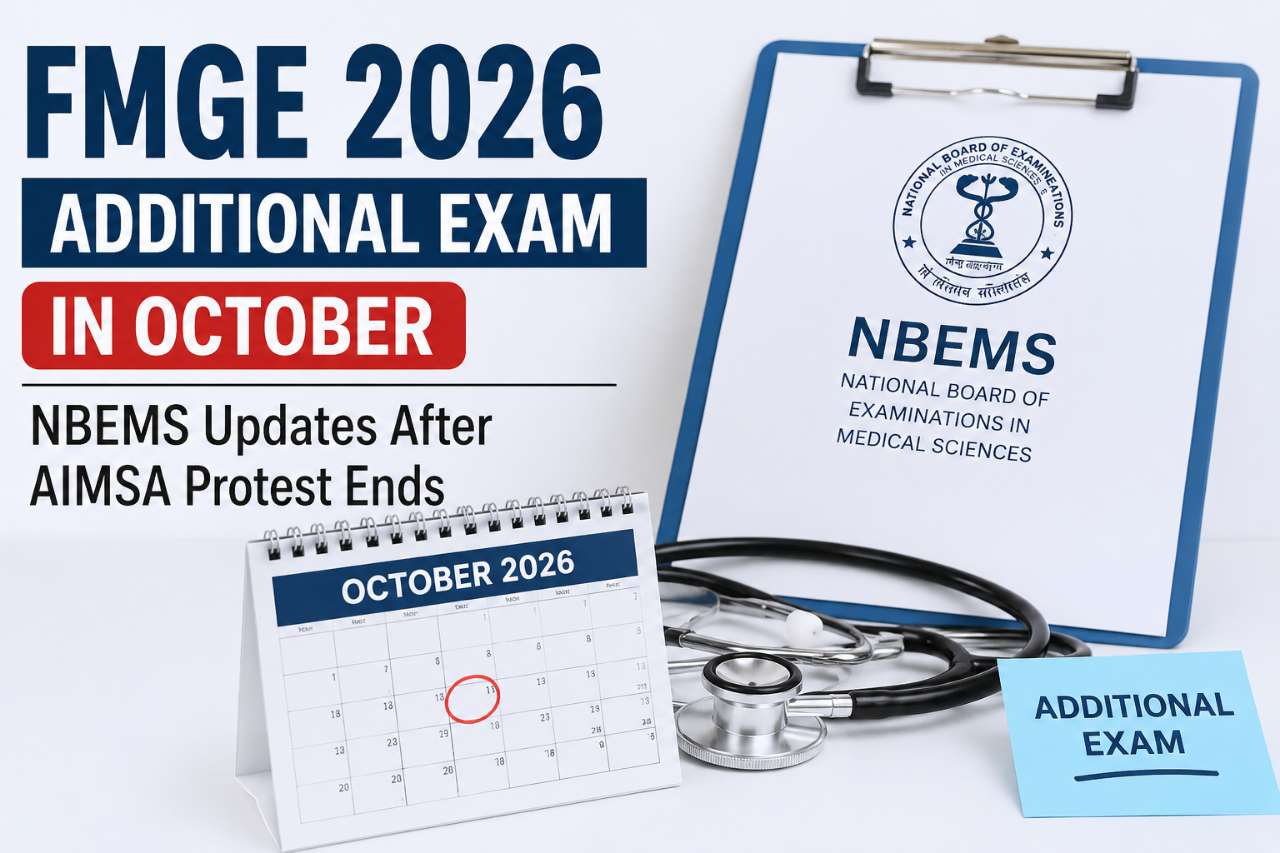

The National Board of Examinations in Medical Sciences (NBEMS) has confirmed that it will conduct an additional FMGE in October 2026, giving foreign medical graduates (FMGs) a fresh opportunity without waiting for the next regular cycle. The decision follows days of protest by the All India Medical Student Association (AIMSA) Foreign Medical Student Wing (FMSW), which has now called off its agitation after discussions with the examination authority.
For thousands of Indian students who completed MBBS abroad and must clear the Foreign Medical Graduate Examination to practise medicine in India, this update marks a significant shift. The June 2026 session drew intense scrutiny after only 12.38% of candidates passed 4,636 out of 37,448 examinees. Whether you appeared in June or are planning your first attempt, this article explains what changed, what did not, and how to move forward with clarity.
What Is FMGE and Why Does It Matter for Indian Students?
The Foreign Medical Graduate Examination (FMGE) is a licensure screening test conducted by NBEMS for Indian citizens and Overseas Citizens of India (OCI) who hold a primary medical qualification from a medical institution outside India. Clearing FMGE is mandatory before such graduates can register with the National Medical Commission (NMC) and pursue internship or clinical practice in the country.
Unlike domestic MBBS graduates who enter the system through NEET UG and complete internship at recognised Indian medical colleges, FMGs face a separate, high-stakes screening pathway. Institutions such as All india Institute of Medical Sciences Delhi (AIIMS Delhi) and newer AIIMS campuses including AIIMS Bhopal, AIIMS Jodhpur, and AIIMS Patna train domestic medical students under a different admission and licensing route. FMGs, by contrast, must prove clinical competence through this single national screening exam.
Because FMGE results directly affect career timelines, internship placements, and family investment in foreign medical education, even small policy changes generate nationwide attention. The October 2026 additional exam is therefore not merely a scheduling update it is a response to sustained student advocacy and public debate over examination fairness.
FMGE 2026 Latest Update: Additional Exam by October-End
In an official communication on social media platform X, NBEMS stated that the additional FMGE will be held by the end of October 2026. The board described this as one of several candidate-friendly measures aimed at addressing genuine concerns raised by foreign medical graduates.
Key points candidates should note immediately:
- Earlier second chance: Eligible candidates who failed or missed the June 2026 session can attempt the exam sooner rather than waiting months for the next regular window.
- Official notification pending: NBEMS has not yet released the exact exam date, registration start date, application fee, or centre list for the additional session.
- No automatic re-evaluation of June results: The announcement of an extra exam does not alter June 2026 scores or outcomes.
- Protest withdrawn: AIMSA-FMSW called off its protest after the board's assurances, ending a seven-day agitation that included hunger strikes by some candidates.
Students should treat every detail not published on the NBEMS applicant portal as provisional. Rumours on social media about exact dates or reduced cut-offs should be verified only through official channels.
Why Did AIMSA-FMSW Protest and What Changed?
The AIMSA Foreign Medical Student Wing launched protests over multiple concerns linked to the June 2026 FMGE. By August 26, 2026, the agitation had entered its seventh day, with demonstrations and hunger strikes drawing media and political attention.
Main Issues Raised by Protestors
- Exam difficulty: Candidates argued that the June paper was unusually tough compared with previous sessions.
- Video-based questions: Fourteen video-format items appeared in the June exam a format many students felt was unfamiliar and poorly communicated in advance.
- Exam centre facilities: Complaints included inadequate infrastructure, technical glitches, and conditions not comparable to large national exams.
- Transparency: Students demanded clearer answer keys, response sheets, and grievance mechanisms.
- Relief for low pass rates: With only 12.38% clearing the exam, many sought grace marks or compensatory measures.
Outcome of Discussions with NBEMS
Following meetings between NBEMS officials and AIMSA-FMSW representatives, the student body withdrew its protest. NBEMS committed to structural reforms rather than retroactive mark adjustments. An expert committee constituted by the board did not recommend grace or compensatory marks for the June 2026 examination, meaning individual results stand as declared.
While this disappointed some candidates, the board paired its decision with forward-looking reforms additional exam timing, increased exam frequency from the next cycle, fee reduction, and enhanced transparency that aim to reduce future friction.
June 2026 FMGE Results: Pass Rate and What It Means
The June 2026 FMGE result shocked many stakeholders. Of 37,448 candidates who appeared, only 4,636 qualified a pass percentage of approximately 12.38%. For context, FMGE pass rates have historically fluctuated but rarely dipped to this level, intensifying debate about paper setting, candidate preparedness, and examination administration.
Important clarifications for students:
- Failed candidates may register for the October 2026 additional exam once NBEMS opens applications, subject to standard eligibility rules.
- Qualified candidates do not need to reappear; they should proceed with NMC registration and internship planning.
- No result revision is expected for June 2026 based on current NBEMS and expert committee positions.
The low pass rate also underscores why structured preparation matters. FMGs competing for limited internship slots at hospitals affiliated with premier institutions whether AIIMS Guwahati, AIIMS Gorakhpur, or AIIMS Raipur benefit from clearing FMGE at the earliest possible attempt.
Major FMGE Reforms From the Next Examination Cycle
Beyond the October 2026 additional exam, NBEMS and AIMSA-FMSW discussions produced a roadmap of changes effective from upcoming regular cycles. These reforms address systemic concerns rather than one-off grievances.
FMGE to Be Held Three Times a Year
Starting from the next academic cycle, FMGE will be conducted three times annually in the following windows:
- December/January
- April/May
- August/September
More frequent exam windows reduce the cost of failure candidates no longer wait half a year or longer between attempts. This aligns FMG screening somewhat closer to the multiple-attempt culture seen in other competitive exams, though FMGE remains a demanding licensure test rather than a typical entrance examination like the NIFT Entrance Exam or Amity Entrance Test, which serve different academic purposes.
Rationalised Question Difficulty Distribution
NBEMS agreed to standardise difficulty levels across future papers. The target distribution will be:
- 30% low difficulty
- 50% moderate difficulty
- 20% high difficulty
This 30:50:20 framework aims to prevent papers skewed excessively toward advanced clinical scenarios that disproportionately penalise recent graduates. Candidates should still prepare comprehensively, as "low difficulty" items in a medical licensure exam remain clinically rigorous.
Reduced Examination Fee
The board indicated that FMGE fees will be reduced from the next examination cycle onward. Exact revised amounts will appear in official information bulletins. Given that many FMGs already bear substantial overseas tuition costs, fee relief combined with more frequent exam dates lowers the financial barrier to multiple attempts.
Enhanced Transparency on Question and Response Data
One of the most significant transparency measures involves publishing detailed response analytics on the applicant portal. NBEMS will release:
- Question IDs
- Correct answer IDs
- Candidate response IDs
- Marks awarded for each question
This level of disclosure helps candidates identify subject-wise weaknesses and supports evidence-based challenges through official grievance channels rather than informal speculation.
Video-Based Questions and Delhi High Court Disclosure
NBEMS confirmed that 14 video-based questions were included in the June 2026 FMGE. The board will inform the Delhi High Court about this in an ongoing case related to examination conduct. Future sessions may continue multimedia formats, so candidates should incorporate video-style clinical vignettes into preparation plans.
Extra Time for Biometric Procedures
To address time lost during biometric attendance, candidates will receive an additional one minute per section, capped at a maximum of three minutes per shift. While modest, this adjustment acknowledges administrative delays that previously compressed actual answering time.
Improved Examination Centre Standards
NBEMS committed to upgrading centre facilities and issuing stricter instructions to its technology partner. Students who faced technical disruptions in June should document any future incidents immediately through official reporting mechanisms on exam day.
FMG Representation on Grievance Committees
AIMSA-FMSW requested representation of foreign medical graduates on NBEMS grievance redressal committees handling FMGE matters. The NBEMS governing body will examine this proposal, while the examination authority agreed to increase direct engagement with FMG stakeholders a step toward better communication before conflicts escalate to public protest.
FMGE Eligibility and Exam Pattern: Quick Reference
While waiting for the October 2026 notification, candidates should confirm they meet baseline eligibility and understand the exam structure.
Eligibility Criteria (General)
- Indian citizen or Overseas Citizen of India (OCI)
- Primary medical qualification from a medical institution outside India recognised as per NMC guidelines
- Documentary proof of qualification and internship completion (where applicable) as specified in the information bulletin
Exam Pattern Overview
FMGE is a computer-based test comprising two parts conducted in a single day:
- Part A: 100 questions (100 marks) pre-clinical and para-clinical subjects
- Part B: 100 questions (100 marks) clinical subjects
- Total: 200 multiple-choice questions, 200 marks
- Duration: 150 minutes (2.5 hours), with sectional timing adjustments as notified
- Qualifying criteria: As prescribed by NBEMS in the official bulletin (historically around 50% aggregate; always verify current rules)
There is no negative marking in FMGE, which means candidates should attempt all questions while prioritising accuracy on moderate-difficulty items that will form the bulk of future papers under the 30:50:20 model.
How to Prepare for the FMGE 2026 Additional Exam
Whether you are reattempting after June 2026 or appearing for the first time, a disciplined study plan improves outcomes more than last-minute speculation about paper leaks or grace marks.
Subject-Wise Preparation Strategy
- Pre-clinical and para-clinical (Part A): Revise anatomy, physiology, biochemistry, pathology, pharmacology, microbiology, and forensic medicine using standard Indian MBBS textbooks.
- Clinical (Part B): Focus on medicine, surgery, obstetrics and gynaecology, paediatrics, community medicine, ophthalmology, ENT, orthopaedics, dermatology, psychiatry, and anaesthesiology.
- Image and video-based questions: Practise ECG strips, X-rays, histology slides, and clinical video scenarios.
- Previous year trends: Analyse recent FMGE papers and NBEMS mock formats once response data from June 2026 is published.
Actionable Tips for October 2026 Attempt
- Register immediately when NBEMS opens the application window centres fill quickly in metropolitan areas.
- Cross-check eligibility documents before payment to avoid rejection.
- Take full-length timed mock tests simulating the 150-minute CBT environment.
- Join structured revision groups but verify all content against standard textbooks.
- Monitor the NBEMS applicant portal and official social media for date and centre updates.
- Prepare for multimedia questions by reviewing clinical examination videos and diagnostic sequences.
- Plan travel and accommodation early if your preferred centre is outside your home city.
- On exam day, report biometric or technical issues to invigilators and retain proof of complaints.
Students comparing medical pathways should remember that domestic NEET-qualified candidates enter colleges such as AIIMS New Delhi, AIIMS Nagpur, or AIIMS Kalyani without FMGE. FMGs, however, can still build strong careers in India's healthcare system after clearing this screening step and completing mandatory internship requirements.
FMGE vs Other Medical and Professional Entrance Exams
Understanding where FMGE fits in India's examination landscape helps candidates set realistic expectations.
- NEET UG: Entrance exam for MBBS/BDS admission in India; taken before medical graduation.
- FMGE: Post-qualification licensure screening for foreign MBBS graduates; not an admission test.
- NEET PG / INI CET: Postgraduate medical entrance for Indian graduates; separate from FMGE though FMGs follow different PG pathways after registration.
- Other university exams: Tests like the Amity Entrance Test gatekeep specific private university programmes in fields such as engineering and management distinct from national medical licensure.
FMGs sometimes explore alternative career routes in healthcare management, public health, or allied fields if licensure timelines extend. Institutions offering management programmes such as DIT University Management, IMS Management College, or broader campuses like DIT University and IMS Unison University represent different pathways. Engineering-focused institutions such as DIT University Engineering and IMS Engineering College serve entirely separate admission streams. Clinical practice in India, however, still requires FMGE clearance for foreign MBBS holders.
Government Response and Expert Committee Findings
The FMGE June 2026 controversy also reached Parliament and the judiciary. The Union Health Ministry, responding to concerns in the Lok Sabha, stated that NBEMS had made adequate arrangements for the examination and noted that the pass rate among fresh graduates exceeded 35%, a figure cited to counter narratives that the entire cohort underperformed uniformly. Critics, however, maintained that aggregate pass rates and centre-level experiences still warranted independent review.
The expert committee NBEMS constituted to examine June 2026 concerns reviewed paper difficulty, video-based question formats, and administrative procedures. Its key finding that no grace or compensatory marks should be awarded effectively closed the door on retroactive relief while pushing the board toward preventive reforms. For candidates, this distinction matters: advocacy succeeded in changing future exam policy, not past scores.
The Delhi High Court case involving FMGE conduct remains active, with NBEMS set to disclose details about the 14 video-based questions included in June 2026. Legal proceedings may influence how multimedia content is introduced and communicated in future bulletins. FMGs should therefore read every information bulletin carefully rather than assuming continuity with past exam formats.
FMGE 2026 Timeline at a Glance
Keeping track of confirmed and pending milestones helps candidates plan study schedules and avoid misinformation.
- June 2026: Regular FMGE conducted; results declared with 12.38% pass rate.
- August 2026: AIMSA-FMSW protest enters seventh day; hunger strikes reported at demonstration sites.
- August 27, 2026: NBEMS announces additional FMGE by October-end; AIMSA-FMSW calls off protest.
- October 2026 (expected): Additional FMGE session exact date awaiting official notification.
- From next cycle: Three FMGE sessions per year, reduced fees, 30:50:20 difficulty ratio, and enhanced portal transparency.
Candidates preparing for the October window should allocate at least four to six weeks of focused revision after registration opens, assuming notification arrives in early September. Delayed registration announcements compress preparation time, making an early subject-wise revision plan essential even before formal application dates are confirmed.
After Clearing FMGE: Registration and Internship Pathway
Qualifying FMGE is only the first regulatory step. Foreign medical graduates must complete provisional registration with the NMC or relevant state medical council, undergo a compulsory rotating internship at an NMC-approved institution in India, and fulfil any additional documentation requirements before obtaining permanent registration.
Internship competition can be intense in metropolitan areas where premier hospitals attract large applicant pools. Graduates who clear FMGE early gain flexibility in choosing internship locations and aligning subsequent NEET PG or INI CET preparation timelines with domestic peers. Those who delay reattempts risk falling behind batchmates who entered Indian colleges through NEET and progressed uninterrupted through internship and postgraduate planning.
Understanding this downstream pathway motivates disciplined FMGE preparation. The October 2026 additional exam is not merely another test date it is a chance to re-enter the standard medical career pipeline without losing an entire academic year.
What FMG Candidates Should Do Right Now
Given the fluid situation, a practical checklist keeps you ahead of official announcements:
- Bookmark the NBEMS FMGE portal and enable email alerts for notifications.
- Do not rely on protest timelines shared informally; the October exam date will come from NBEMS only.
- Accept June 2026 results as final and channel energy into preparation for the additional attempt.
- Collect academic transcripts and internship certificates needed for registration.
- Review June 2026 response data once NBEMS publishes question and answer IDs.
- Consult NMC eligibility lists to confirm your foreign medical college remains recognised.
- Seek legitimate coaching or mentorship rather than paid "guaranteed pass" schemes.
Regional AIIMS institutions continue expanding India's medical education capacity campuses at Bathinda, Bibinagar, Bilaspur, Deoghar, Jammu, Raebareli, Bhubaneswar, Madurai, Mangalagiri, Rajkot, and Rishikesh train domestic students who bypass FMGE entirely. FMGs should view licensure screening as a gateway to joining this broader healthcare ecosystem not as an isolated hurdle.
Conclusion
The FMGE 2026 story reflects a broader tension in Indian medical education: rising numbers of students graduating from foreign universities, intensifying scrutiny of examination standards, and growing demand for transparent, candidate-friendly administration. NBEMS announcement of an additional exam by October-end 2026, combined with AIMSA-FMSW decision to call off its protest, offers foreign medical graduates a timely second chance while preserving the integrity of June 2026 results.
Looking ahead, three annual FMGE sessions, reduced fees, rationalised difficulty levels, published response analytics, and improved centre infrastructure signal meaningful reform provided implementation matches policy intent. Until the official notification arrives, focus on eligibility verification, structured revision, and credible information sources. Clearing FMGE remains challenging, but the expanded exam calendar and transparency commitments give FMGs a fairer, more predictable path toward practising medicine in India.