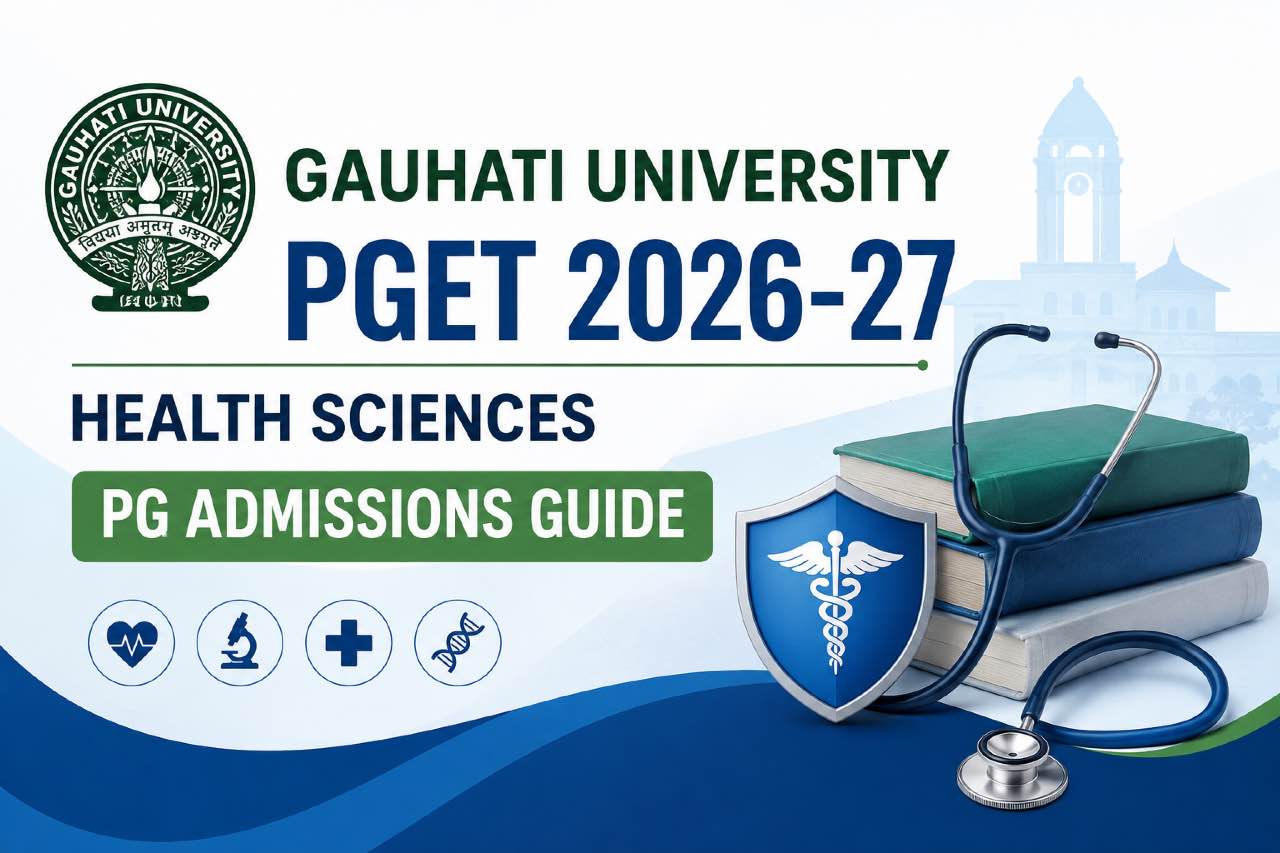

Gauhati University has opened online applications for the Post Graduate Entrance Test (PGET) 2026-27, giving health sciences graduates across Assam and the Northeast a structured pathway into four specialised master's programmes on the Jalukbari campus. If you hold a B.Sc. Nursing, post-basic nursing qualification, or a BMLS/BMLT degree with internship, this admission cycle is one of the most important windows for building a clinical career in psychiatric nursing or medical laboratory science without leaving the region.
Applications are accepted only through the official Samarth portal at gauhatiadmission.samarth.edu.in/pg, with notices and schedules consolidated at admissions.gauhati.ac.in. The last date to submit the form and pay the fee is 15 June 2026 (11:59 PM). The offline entrance test runs on 3, 4, and 5 July 2026, followed by rank lists and departmental admissions in late July 2026.
This guide explains the four health sciences PG programmes, eligibility norms, exam pattern, reservation policy, document checklist, and step-by-step application process—written for students, working nurses, and lab technologists who need clear, actionable information before the deadline passes.
What Is Gauhati University PGET 2026-27?
The Gauhati University Post Graduate Entrance Test (PGET) is the central offline entrance examination used to shortlist candidates for master's programmes offered by Gauhati University and its affiliated colleges for the academic session 2026-27. Unlike some national-level tests that cover only select streams, GU PGET spans traditional departments (such as Botany, Chemistry, and History) and interdisciplinary professional programmes, including health sciences.
For health sciences applicants, PGET is mandatory. There is no separate merit-only route for these four programmes during this cycle. Your rank in the subject-specific paper determines provisional selection, after which departments verify original certificates at the time of admission. Merely appearing in the test does not guarantee a seat if eligibility documents fail verification.
Key Features of PGET 2026 at a Glance
- Mode: Offline (pen-and-paper) multiple-choice examination
- Duration: 2 hours per paper
- Questions: 100 MCQs with four options each
- Marking: +1 for every correct answer; −0.25 for every incorrect answer
- Programme choice limit: Up to 3 papers—one traditional subject and two interdisciplinary subjects
- Application fee: ₹800 for one programme; ₹1,600 for two; ₹2,400 for three
- Payment: Online only via debit card, credit card, or net banking
Gauhati University, established in 1948, remains the oldest state university in Northeast india and hosts more than 200 programmes across 40+ departments, with over 250 affiliated colleges. For paramedical and nursing professionals, GU offers a rare combination of university accreditation, regional accessibility, and hospital-linked training environments in Guwahati.
Four Health Sciences PG Programmes Open Under PGET 2026-27
The health sciences cluster under PGET 2026-27 comprises one nursing programme and three Master in Medical Laboratory Science (MMLS) specialisations. Together, they address two high-demand areas of the Indian healthcare workforce: mental-health nursing and advanced diagnostic laboratory services.
1. M.Sc. in Psychiatric Nursing
Department: Nursing (Psychiatric Nursing specialisation)
Intake at GU campus: 20 seats
Typical eligibility: B.Sc. Nursing or Post-Basic B.Sc. Nursing with at least one year of clinical experience after registration
Psychiatric nursing postgraduates work in mental-health hospitals, de-addiction centres, community psychiatry units, and tertiary-care psychiatry departments. With rising awareness of mental health in India, this programme trains nurses to assess psychological conditions, manage therapeutic communication, administer psychotropic medication under protocol, and support rehabilitation. Graduates often pursue roles as psychiatric nurse specialists, ward in-charges, or faculty in nursing colleges.
2. Master in Medical Laboratory Science — Clinical Biochemistry
Intake: 5 seats
Typical eligibility: BMLS or BMLT with completed internship from a recognised institution
Clinical biochemistry specialists analyse blood, serum, and tissue samples to detect metabolic disorders, liver and kidney dysfunction, cardiac markers, and endocrine abnormalities. In modern hospitals, biochemistry labs feed directly into emergency, ICU, and outpatient decision-making. This two-year programme builds advanced skills in automated analysers, quality control, method validation, and interpretation of complex panels.
3. Master in Medical Laboratory Science — Haematology and Blood Banking
Intake: 5 seats
Typical eligibility: BMLS or BMLT with completed internship
Haematology and immuno-haematology (blood banking) specialists manage complete blood counts, coagulation studies, bone-marrow reporting support, cross-matching, component separation, and transfusion safety. Given chronic blood shortages and strict NABH/NABL compliance norms in Indian hospitals, trained haematology technologists are in steady demand at medical colleges, blood banks, and corporate diagnostic chains.
4. Master in Medical Laboratory Science — Medical Microbiology
Intake: 5 seats
Typical eligibility: BMLS or BMLT with completed internship
Medical microbiology postgraduates culture and identify bacteria, viruses, fungi, and parasites; perform antimicrobial susceptibility testing; and support infection-control committees. Post-COVID, hospital-acquired infection surveillance and antimicrobial stewardship have made microbiology labs strategically important. This specialisation suits graduates aiming for roles in tertiary hospitals, public-health laboratories, or research settings.
Quick Comparison Table: Health Sciences Programmes
| Programme | Seats (GU Campus) | Base Qualification | Core Career Outcome |
|---|---|---|---|
| M.Sc. Psychiatric Nursing | 20 | B.Sc. Nursing / P.B. B.Sc. Nursing + 1 yr experience | Psychiatric nurse specialist, educator |
| MMLS — Clinical Biochemistry | 5 | BMLS / BMLT + internship | Biochemistry lab supervisor |
| MMLS — Haematology & Blood Banking | 5 | BMLS / BMLT + internship | Transfusion medicine technologist |
| MMLS — Medical Microbiology | 5 | BMLS / BMLT + internship | Microbiology & infection-control specialist |
Actionable tip: Because MMLS specialisations have only five seats each, treat PGET as highly competitive. Prioritise your first-choice specialisation as Paper 1 if you are applying for only one health sciences programme, and begin subject-specific revision at least eight weeks before the exam.
Important Dates for GU PGET 2026-27
Missing a single deadline can disqualify an otherwise strong candidate. Mark these dates on your calendar and enable SMS or email alerts on the Samarth portal.
- Application portal opens: 6 June 2026
- Last date to apply and pay fee: 15 June 2026 (11:59 PM)
- Admit card: From 20 June 2026 onwards
- PGET examination (offline): 3, 4, and 5 July 2026
- Provisional rank lists: 20 July 2026
- Admission — traditional programmes: 27 July 2026
- Admission — interdisciplinary programmes: 28 July 2026
- HoD admission approval window: 27–29 July 2026
- Orientation: 3 August 2026 (common); 4 August 2026 (departmental)
- Commencement of classes: 5 August 2026
Affiliated colleges may announce separate admission dates for their PG seats. Always cross-check the official notice PDF on the GU website if you are targeting a college outside the main campus.
Eligibility Criteria for Health Sciences Applicants
General Eligibility Rules
- Candidates must hold a recognised bachelor's degree in the relevant discipline (nursing or medical laboratory sciences).
- For nursing: B.Sc. Nursing or Post-Basic B.Sc. Nursing with minimum one year of post-registration clinical experience is typically required.
- For MMLS: BMLS or BMLT with a completed internship is the standard entry qualification.
- Candidates awaiting final-year or 6th-semester results may apply provisionally but must submit mark sheets within seven days of result declaration; backlogs in earlier semesters are permitted under the official notice, subject to final clearance.
- All admissions remain provisional until original certificates are verified at the department.
Category-Wise Relaxations
Reserved-category candidates benefit from seat reservations and, where applicable, relaxed minimum marks as per Government of Assam and Gauhati University norms. Categories include SC (7%), ST Plains (10%), ST Hills (5%), OBC/MOBC non-creamy layer (27%), differently abled (3%), and EWS (10%). Community-wise sub-reservations exist within OBC/MOBC for Ahom, Tea Tribe, Koch Rajbongshi, Chutia, Moran, and Matak communities.
Keep valid category certificates issued by competent authority ready before counselling. EWS candidates need a certificate from an officer not below the rank of Circle Officer, as per Assam government norms.
Application Fee Structure and Programme Selection Rules
The fee you pay depends on how many PGET papers you select:
- One PG programme: ₹800
- Two PG programmes: ₹1,600
- Three PG programmes: ₹2,400
You may sit for a maximum of three subjects: one traditional programme and two interdisciplinary programmes. You cannot choose two papers scheduled in the same session on the same date. Plan combinations carefully—many nursing graduates also consider M.Sc. Psychology or related interdisciplinary options, but health sciences papers should remain your priority if clinical placement is the goal.
The application is considered submitted only after successful online payment and receipt generation. Save the receipt PDF immediately.
PGET Exam Pattern and Preparation Strategy
Each PGET paper follows a uniform structure: 100 MCQs, four options per question, two hours, +1/−0.25 marking. There is no sectional time limit, so you can revisit flagged questions within the overall duration.
Subject Focus Areas (Health Sciences)
Psychiatric Nursing: Nursing foundations, psychiatric assessment, therapeutic modalities, psychopharmacology basics, mental-health laws and ethics, community psychiatry, and clinical case scenarios.
Medical Laboratory Science (all specialisations): Core lab techniques, instrumentation, quality assurance, biomedical ethics, basic pathology, and specialisation-specific topics—biochemistry analytes, haematology morphology, or microbiological identification and sterilisation protocols.
Preparation Tips That Actually Work
- Download the official PGET notification PDF and note your programme code.
- Revise your B.Sc. Nursing or BMLS/BMLT syllabus thoroughly; GU papers are usually rooted in undergraduate professional content.
- Practice 100-question timed mocks to build speed for the two-hour window.
- Account for negative marking—avoid blind guessing; eliminate options first.
- Join a small peer study group for viva-style case discussions, especially for psychiatric nursing.
Selection, Counselling, and Admission Process
Selection is based solely on PGET scores. Higher marks earn higher preference during seat allocation. After rank lists publish on 20 July 2026, shortlisted candidates attend departmental admission on the notified dates. Bring original documents, passport photographs, and fee payment capability.
Interdisciplinary health sciences programmes are generally open to candidates from all universities—unlike some traditional GU programmes that reserve 50% seats for GU graduates. This makes the health sciences cluster accessible to nursing and lab graduates from Assam's private colleges, other Northeast states, and beyond.
Documents to Carry for Verification
- PGET admit card and score/rank printout
- Class 10 and 12 certificates
- Bachelor's degree mark sheets and provisional/final degree certificate
- Internship completion certificate (MMLS applicants)
- Nursing registration and experience certificate (psychiatric nursing applicants)
- Category/EWS/differently abled certificates, if applicable
- Government photo ID (Aadhaar, passport, or voter ID)
- Passport-size photographs
PGET 2026 Exam Centres
PGET is conducted across 18 centres, reducing travel burden for Northeast candidates:
- Guwahati — Gauhati University (GUPGET-01)
- Barpeta, Dibrugarh, Jorhat, Dhemaji, Lakhimpur, Tezpur, Nagaon, Bongaigaon, Diphu, Dhubri (Assam)
- Shillong (Meghalaya), Kohima (Nagaland), Aizawl (Mizoram), Imphal (Manipur), Agartala (Tripura)
- Siliguri (West Bengal), Itanagar (Arunachal Pradesh)
Select your centre carefully during application; changes after the deadline are usually not permitted.
Career Scope After Health Sciences PG from Gauhati University
Graduates from these programmes typically join government medical colleges, district hospitals, private multi-speciality chains, diagnostic laboratories, blood banks, and academic institutions. Psychiatric nursing postgraduates are eligible for specialist postings under state health missions; MMLS graduates can lead NABL-accredited lab units or pursue PhD and NET-based faculty careers.
Starting salaries vary by employer—government posts follow Assam pay scales, while corporate hospital roles for experienced lab supervisors often exceed entry-level clinical staff packages. Many graduates also prepare simultaneously for state PSC health-service exams or hospital-administration certifications.
How GU Compares With Other Health Sciences Institutions in India
While Gauhati University serves the Northeast, several institutions elsewhere offer parallel pathways worth understanding for context:
- Rajasthan University of Health Sciences (RUHS), Jaipur coordinates paramedical and nursing admissions across
Rajasthan through a dedicated health-sciences framework—useful to compare if you are weighing interstate options. - Mahatma Gandhi University of Medical Sciences, Jaipur offers integrated medical and allied-health education in a private university setting.
- University College of Medical Sciences (UCMS), Delhi represents the tier of Delhi University-affiliated medical institutions where allied programmes compete with national-level talent pools.
- Jamia Hamdard University in Delhi is known for pharmacy, nursing, and Unani medicine programmes with strong hospital linkages.
- Guru Gobind Singh Indraprastha University (GGSIPU) conducts centralised counselling for paramedical and nursing courses across the NCR.
For Assam-based candidates, GU's regional advantage—lower relocation cost, familiar licensing environment, and Assam Public Service Commission alignment—often outweighs the brand pull of metro institutions, especially when seat counts in MMLS are extremely limited nationwide.
Common Mistakes to Avoid During PGET Application
- Uploading blurry certificates: Rejected uploads delay verification.
- Choosing conflicting exam sessions: The portal may block incompatible combinations.
- Ignoring the 15 June midnight deadline: No late fee window is announced.
- Applying without internship proof (MMLS): Leads to cancellation at admission.
- Skipping experience certificate (nursing): Psychiatric nursing seats require documented clinical service.
- Not printing the payment receipt: Required during counselling disputes.
Who Should Apply in This Cycle?
Apply now if you are a registered nurse with one year of experience seeking specialisation in psychiatric care, or a BMLS/BMLT graduate aiming for supervisory laboratory roles. This cycle also suits candidates who missed other national PG entrances and want a regionally recognised master's degree with manageable exam competition relative to pan-India nursing entrances.
Defer only if you cannot produce internship or experience certificates before counselling, or if your final-year result will not arrive within the seven-day post-result submission window.
Seat Reservation Policy for PGET 2026-27 Admissions
Understanding reservations helps you estimate realistic cut-offs and prepare category certificates in advance. Gauhati University follows Government of Assam reservation rules for all PG programmes, including health sciences.
Statutory Reservations
- Scheduled Caste (SC): 7% of seats
- Scheduled Tribe — Plains (ST-P): 10%
- Scheduled Tribe — Hills (ST-H): 5%
- OBC/MOBC (non-creamy layer): 27%, with community-wise sub-quotas for Ahom, Tea Tribe, Koch Rajbongshi, Chutia, Moran, and Matak communities within this pool
- Differently abled (benchmark disability ≥40%): 3% per faculty discipline
- Economically Weaker Sections (EWS): 10% per programme
Non-Statutory and Special Quotas
Additional provisions may apply for sports quota, NCC, and other categories as notified in the official admission notice. Differently abled candidates must submit a medical certificate from the Joint Director of Health Services and appear before a university medical board when called.
For interdisciplinary health sciences programmes—including psychiatric nursing and all MMLS specialisations—seats remain open to graduates from any recognised university. This differs from several traditional GU departments that reserve 50% of seats for GU alumni. If you completed your B.Sc. Nursing or BMLS/BMLT from a private college in Assam or another Northeast state, you compete on equal footing for these health sciences seats based on PGET score alone.
Why Health Sciences PG at Gauhati University Matters for Northeast India
Northeast India faces a documented shortage of specialised psychiatric nurses and advanced laboratory technologists. Many graduates historically migrated to Delhi, Bengaluru, or Kolkata for PG diplomas. GU's master's programmes reduce that outflow by offering university-granted degrees within Assam's capital, connected to teaching hospitals and public-health infrastructure.
For nursing professionals, psychiatric specialisation aligns with expanded mental-health services under the National Mental Health Programme and district-level counselling centres. For laboratory graduates, NABL accreditation requirements in diagnostic chains mean employers prefer PG-qualified supervisors who understand internal quality audits, equipment calibration, and biosafety levels.
Students comparing alternatives may also explore health-focused universities such as Vardhman Mahaveer Open University, Kota for distance paramedical education, or clinical institutions like Amity University, Noida for private-sector hospital tie-ups. However, for Assam domicile candidates planning state government service, a GU degree often integrates more smoothly with Assam Health Department recruitment patterns and in-service promotion norms.
Conclusion
Gauhati University PGET 2026-27 opens a focused, time-bound opportunity for four health sciences postgraduate programmes—M.Sc. Psychiatric Nursing and three MMLS specialisations in Clinical Biochemistry, Haematology & Blood Banking, and Medical Microbiology. With applications live from 6 June 2026 and the deadline set for 15 June 2026, candidates should register on the Samarth portal, pay the applicable fee, and shift immediately to subject-specific revision for the 3–5 July offline examination.
Success in this cycle depends on three things: accurate documentation, disciplined MCQ practice under negative marking, and timely attendance at departmental admission after rank lists publish on 20 July 2026. Track all updates on admissions.gauhati.ac.in, keep originals ready, and treat each of the five MMLS seats as a competitive target worth serious preparation.