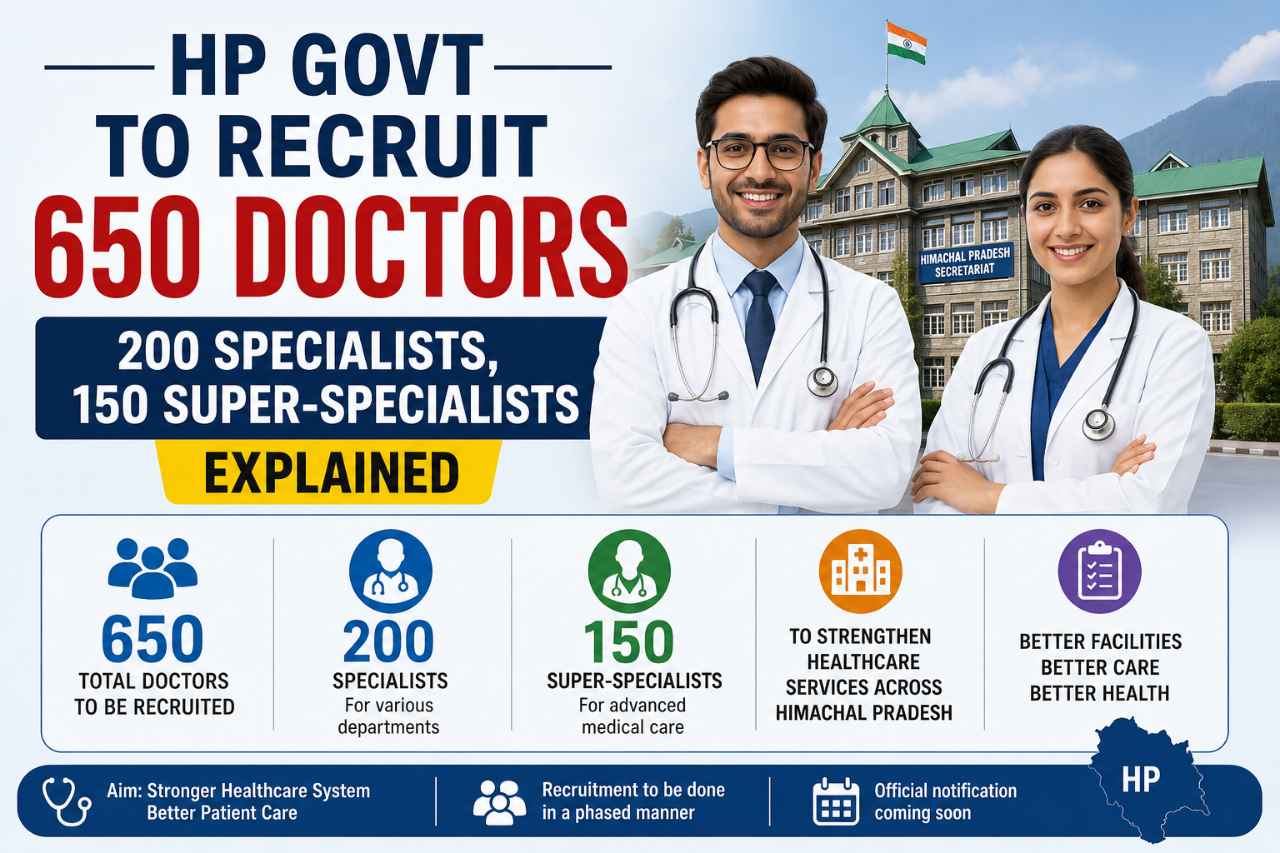
The Himachal Pradesh government has announced one of its largest healthcare staffing drives in recent years, with plans to recruit 650 doctors across medical officer, specialist, and super-specialist categories. Chief Minister Sukhvinder Singh Sukhu made the announcement while inaugurating a public health camp in the Kangu area of Nadaun Assembly constituency in Hamirpur district on Sunday, August 30, 2026.
Alongside hiring, the state is investing approximately Rs 500 crore in modern diagnostic equipment at medical colleges and expanding specialist coverage at 70 Adarsh Medical Institutions. For MBBS graduates, PG specialists, and super-specialists exploring government service, this move signals stronger public healthcare infrastructure in Himachal Pradesh and new career opportunities in both urban medical colleges and rural health centres.
What Did the Himachal Pradesh Government Announce?
At the core of the announcement is a dual strategy: upgrade diagnostic capacity at medical colleges and fill critical human-resource gaps across the state health network. CM Sukhu stated that installing advanced technology at government medical colleges would make diagnostic services more accurate and help patients receive timely, appropriate treatment without unnecessary delays or referrals outside the state.
The recruitment breakdown, as reported, is structured as follows:
- 300 medical officers — general duty doctors for hospitals, community health centres, and primary care settings
- 200 specialist doctors — consultants in disciplines such as medicine, surgery, paediatrics, obstetrics and gynaecology, anaesthesia, radiology, and other PG-level specialties
- 150 super-specialist doctors — DM/MCh-qualified faculty and consultants in advanced fields like cardiology, neurology, nephrology, gastroenterology, and surgical super-specialties
In addition to medical colleges, the government plans to appoint specialist doctors at all 70 Adarsh Medical Institutions, a network aimed at improving secondary and tertiary care access in district and sub-district hospitals. Doctors have already been posted at facilities in Nadaun, Kangu, Galore, and Dhaneta as part of this broader push.
Rs 500 Crore Diagnostic Upgrade at Medical Colleges
Modern healthcare depends as much on infrastructure as on personnel. The Rs 500 crore equipment plan targets government medical colleges across Himachal Pradesh, enabling advanced imaging, laboratory diagnostics, and interventional capabilities at the institutional level. For patients in hill districts who previously travelled to Chandigarh, Delhi, or other metros for CT scans, MRI, advanced pathology, or specialised interventions, upgraded in-state facilities can reduce cost, travel burden, and treatment delays.
For doctors, better equipment also means better clinical decision-making, stronger teaching environments for undergraduate and postgraduate trainees, and improved retention — a recurring challenge in hill states where isolation and limited resources often push specialists toward private sector or out-of-state opportunities.
Why Himachal Pradesh Is Scaling Up Medical Recruitment Now
Himachal Pradesh faces a familiar challenge seen across many Indian states: uneven distribution of doctors between urban medical colleges and remote primary health centres. Seasonal tourism, ageing populations in rural pockets, and the geographic spread of villages make continuous medical coverage difficult without sustained government hiring and infrastructure investment.
Several factors make the 2026 announcement particularly significant:
- Medical college expansion — New and upcoming institutions increase the need for faculty, resident doctors, and super-specialists who can teach, operate, and supervise clinical services.
- Adarsh Medical Institutions network — Posting specialists at all 70 facilities moves care closer to patients in constituencies like Nadaun and neighbouring blocks.
- Allied health sciences push — The planned allied health sciences institution in Hamirpur will create an ecosystem requiring clinical mentors, lab supervisors, and hospital-based trainers.
- Public health outreach — Health camps in Kangu and upcoming camps in Nadaun and other parts of Hamirpur reflect a community-centred approach that depends on adequate staffing at nearby hospitals.
States that invest simultaneously in equipment and recruitment tend to see faster improvements in health indicators than those that upgrade buildings alone. Himachal Pradesh’s combined approach aligns with National Health Mission goals of strengthening district hospitals and reducing out-of-pocket expenditure on diagnostics.
Geographically, Himachal Pradesh’s dispersed population centres — from Kangra and Mandi valleys to remote tribal blocks — make a one-size-fits-all staffing model ineffective. Targeted specialist deployment at Adarsh Medical Institutions allows the government to prioritise facilities with high patient load or long referral distances, while the medical officer cadre maintains daily OPD and emergency coverage at smaller centres. This layered model mirrors successful strategies used in other hill and northeastern states where retaining super-specialists has historically been difficult without paired investments in housing, equipment, and academic appointments.
Breakdown of the 650 Doctor Posts
Understanding the three categories helps candidates assess where they fit and what qualifications they need. The numbers below reflect the government’s stated hiring plan as of August 2026.
| Category | Number of Posts | Typical Qualification | Likely Posting |
|---|---|---|---|
| Medical Officers | 300 | MBBS with valid registration | CHCs, district hospitals, medical colleges |
| Specialists | 200 | MD/MS/DNB or equivalent PG degree | Adarsh Medical Institutions, medical colleges |
| Super-Specialists | 150 | DM/MCh or equivalent super-specialty degree | Medical colleges, tertiary care centres |
Medical Officers (300 Posts)
Medical officers form the backbone of India’s public health system. In Himachal Pradesh, they manage outpatient departments, emergency care, maternal and child health programmes, National Health Mission schemes, and referral coordination. MBBS graduates who complete internship and obtain state medical council registration are typically eligible for such posts, subject to experience norms and reservation rules in the official notification.
Many medical officers later pursue NEET PG or INI CET to specialise. Government service in Himachal can offer job stability, rural posting allowances in eligible areas, and exposure to diverse clinical cases — from high-altitude medicine concerns to trauma cases on hill roads.
Specialist Doctors (200 Posts)
Specialists bring postgraduate expertise to disciplines that require dedicated consultants. Posting 200 specialists across Adarsh Medical Institutions means districts may finally have full-time anaesthetists for surgeries, radiologists for imaging, paediatricians for neonatal and child care, and physicians for non-communicable disease management.
Candidates usually need a recognised MD, MS, or DNB qualification in the relevant specialty, along with registration with the Himachal Pradesh Medical Council or a reciprocally recognised state council. Teaching hospitals may additionally prefer candidates with research publications or prior faculty experience.
Super-Specialist Doctors (150 Posts)
Super-specialists represent the highest tier of clinical training in India’s medical education ladder. DM (Doctor of Medicine) and MCh (Master of Chirurgie) degrees prepare consultants for complex cardiology interventions, neurosurgical procedures, transplant-related care, and other advanced services. Recruiting 150 super-specialists suggests Himachal Pradesh intends to retain high-end care within the state’s medical colleges rather than relying on visiting faculty or patient referrals alone.
These roles often combine clinical duties with teaching MBBS and PG students, supervising thesis work, and establishing sub-specialty OPD and IPD services. For DM/MCh holders seeking government careers outside metro cities, this expansion opens meaningful options in a state known for quality-of-life advantages.
Dr Radhakrishnan GMC Jolsappar and the Hamirpur Allied Health Sciences Institute
CM Sukhu also highlighted two institutional milestones that connect directly to the recruitment drive:
- Dr Radhakrishnan Government Medical College, Jolsappar — Scheduled for inauguration shortly, this medical college will require a full cadre of faculty, residents, and support clinicians. New medical colleges typically recruit in phases: core departments first, then sub-specialties as patient load grows.
- Allied health sciences institution in Hamirpur — Described as the first of its kind in north India, this Institute will train professionals in paramedical and allied health disciplines. The vice-chancellor has been directed to ensure admissions begin in the current academic year.
Allied health programmes — including medical laboratory technology, radiography, physiotherapy, and operation theatre technology — depend on hospital-linked training. The new Hamirpur institution will need affiliated clinical exposure, much like established universities that integrate professional courses with teaching hospitals. Students exploring allied health pathways in northern India may also compare options at institutions such as Mohammad Ali Jauhar University Rampur, which offers diverse professional and degree programmes under a university framework.
Health Camps, Rural Access, and the Adarsh Medical Institutions Model
The announcement was made in the context of a public health camp at Kangu, emphasising that infrastructure and recruitment must translate into frontline service. CM Sukhu appealed to residents to use the camp fully and noted that similar camps would be organised in Nadaun and other parts of Hamirpur in the coming period.
Health camps serve multiple purposes: early detection of non-communicable diseases, immunisation drives, antenatal check-ups, and specialist consultations for those who cannot easily travel to district headquarters. However, camps work best when local hospitals — such as those in Nadaun, Kangu, Galore, and Dhaneta where doctors have already been appointed — can follow up on referrals, dispense medicines, and schedule surgeries.
The Adarsh Medical Institution framework aims to standardise staffing, equipment, and service protocols at selected government hospitals. Appointing specialist doctors at all 70 institutions is ambitious; if implemented fully, it could reduce the gap between policy announcements and what patients experience at block-level facilities.
What This Means for Medical Aspirants and Practising Doctors
For MBBS Students and Interns
If you are completing MBBS from a government or private medical college, Himachal Pradesh’s 300 medical officer vacancies represent a substantial entry point into public service. Start preparing early:
- Complete internship and permanent registration with your state medical council
- Monitor the Himachal Pradesh Public Service Commission (HPPSC) and Health Department websites for official notifications
- Keep documents ready: degree certificates, internship completion, registration certificate, category certificates if applicable, and experience proofs
- Consider learning basic Hindi and familiarity with hill-state logistics if you are applying from outside Himachal Pradesh
Medical education in India often begins in state-run or central institutions; students from Rajasthan and other states frequently study in kota-region colleges before pursuing professional degrees. While Kota is widely known for engineering and medical coaching, government degree colleges such as Govt Jdb Girls College Kota and Govt College Ramganj Mandi Kota illustrate how public institutions across states feed into broader higher-education pathways — including science graduates who later appear for NEET UG and enter MBBS programmes elsewhere.
For PG and Super-Specialty Candidates
Specialist and super-specialist posts typically require clearing state health services examinations or direct recruitment panels conducted by the medical education department. NEET PG and NEET SS remain the national gateways for PG and super-specialty seats; candidates who complete MD, MS, DM, or MCh from recognised institutions should track Himachal Pradesh’s faculty and consultant recruitment rules.
Super-specialists should note that medical colleges need both clinical excellence and teaching commitment. Maintaining logbooks, presenting academic sessions, and building department protocols are as important as OP and IPD skills. With 150 super-specialist posts planned, competition may still be stiff for popular departments, but the volume of hiring is unusually high for a hill state.
For Patients and Residents of Himachal Pradesh
Residents in Hamirpur, Nadaun, and surrounding areas stand to benefit from shorter diagnostic turnaround times, local specialist consultations, and follow-up care after health camps. When visiting upgraded medical colleges or Adarsh Medical Institutions, carry previous reports, government health scheme cards (such as Ayushman Bharat where applicable), and referral notes to ensure smooth care continuity.
Expected Recruitment Process and Where to Watch for Notifications
Although the Chief Minister announced the hiring plan, detailed recruitment rules — including application mode, age limits, reservation percentages, pay scales, and bond conditions — will appear in formal notifications from the Himachal Pradesh government. Based on standard practice for state medical recruitment in India, candidates should expect:
- An official advertisement from HPPSC or the Department of Health and Family Welfare
- Online application through the designated state recruitment portal
- Document verification of degrees, registrations, and experience certificates
- A written test and/or interview, depending on post category and department norms
- Medical examination and police verification before appointment orders
Candidates should rely only on official government websites and avoid paid agents promising guaranteed selection. Bookmark the HPPSC portal, Himachal Pradesh Health Department updates, and credible education news sources for verified announcements.
Broader Context: State Government Doctor Recruitment in India
Himachal Pradesh is not alone in expanding public-sector medical hiring. States such as Uttar Pradesh, Maharashtra, Tamil Nadu, and Karnataka regularly announce medical officer and specialist vacancies tied to new medical colleges, Ayushman Bharat empanelment, and district hospital upgrades. The difference in Himachal’s 2026 plan is the explicit scale — 650 doctors — combined with a Rs 500 crore diagnostic investment and parallel allied health education expansion.
For policy watchers, the announcement reflects a recognition that doctor shortages cannot be solved by camps or equipment alone; sustained recruitment with competitive service conditions is essential. Posting doctors at Kangu, Galore, Dhaneta, and similar locations also addresses the “last mile” problem in healthcare delivery.
Medical graduates evaluating state government careers should also compare pay scales, non-practising allowance, leave travel concession, and pension benefits under Himachal Pradesh service rules with opportunities in central institutions, defence medical services, or private corporate hospitals. Government posts in medical colleges additionally offer academic promotions, conference support, and research grants that can shape long-term career growth for specialists who wish to combine patient care with teaching.
Education and Community Developments Mentioned Alongside Healthcare
At the same event, CM Sukhu noted additional community investments in the Nadaun area. The senior secondary school at Kangu has been designated as a Rajiv Gandhi Day boarding school, with plans for a new building and modern educational facilities. Construction of a primary school building is also set to begin soon. While these are not medical recruitment items, they signal a broader development focus in Hamirpur district — improving schooling and healthcare together can reduce dropout rates and improve long-term health literacy in the region.
Actionable Tips for Candidates Preparing for HP Medical Recruitment
- Verify your registration — Ensure Himachal Pradesh Medical Council or interstate reciprocal registration is active before applying.
- Update your CV — List clinical experience, rural posting history, publications, and any NHM or government contract work.
- Prepare for state-specific exams — Review previous HPPSC medical officer and specialist question patterns if available.
- Understand posting norms — Hill-state postings may include remote assignments; check for incentives or bonds in the notification.
- Network ethically — Join official state medical officer associations and alumni groups for notification alerts, not for unfair advantage.
- Plan specialty documents — Specialists and super-specialists should keep PG and SS degree equivalency certificates from NMC-recognised institutions ready.
Conclusion
The Himachal Pradesh government’s plan to recruit 650 doctors — comprising 300 medical officers, 200 specialists, and 150 super-specialists — marks a significant step toward strengthening public healthcare in the state. Combined with Rs 500 crore in diagnostic upgrades at medical colleges, specialist appointments at 70 Adarsh Medical Institutions, and upcoming institutions such as Dr Radhakrishnan Government Medical College at Jolsappar and the allied health sciences institute in Hamirpur, the initiative addresses both infrastructure and human-resource gaps.
For MBBS graduates, PG specialists, and DM/MCh holders, the announcement opens concrete government career pathways beyond India’s largest metro hospitals. For residents of Hamirpur, Nadaun, and rural Himachal Pradesh, it promises faster diagnostics, local specialist care, and better follow-up after public health camps. Candidates should watch for official recruitment notifications, prepare documentation early, and treat this expansion as one of the most meaningful state-level medical hiring drives announced in Himachal Pradesh in 2026.