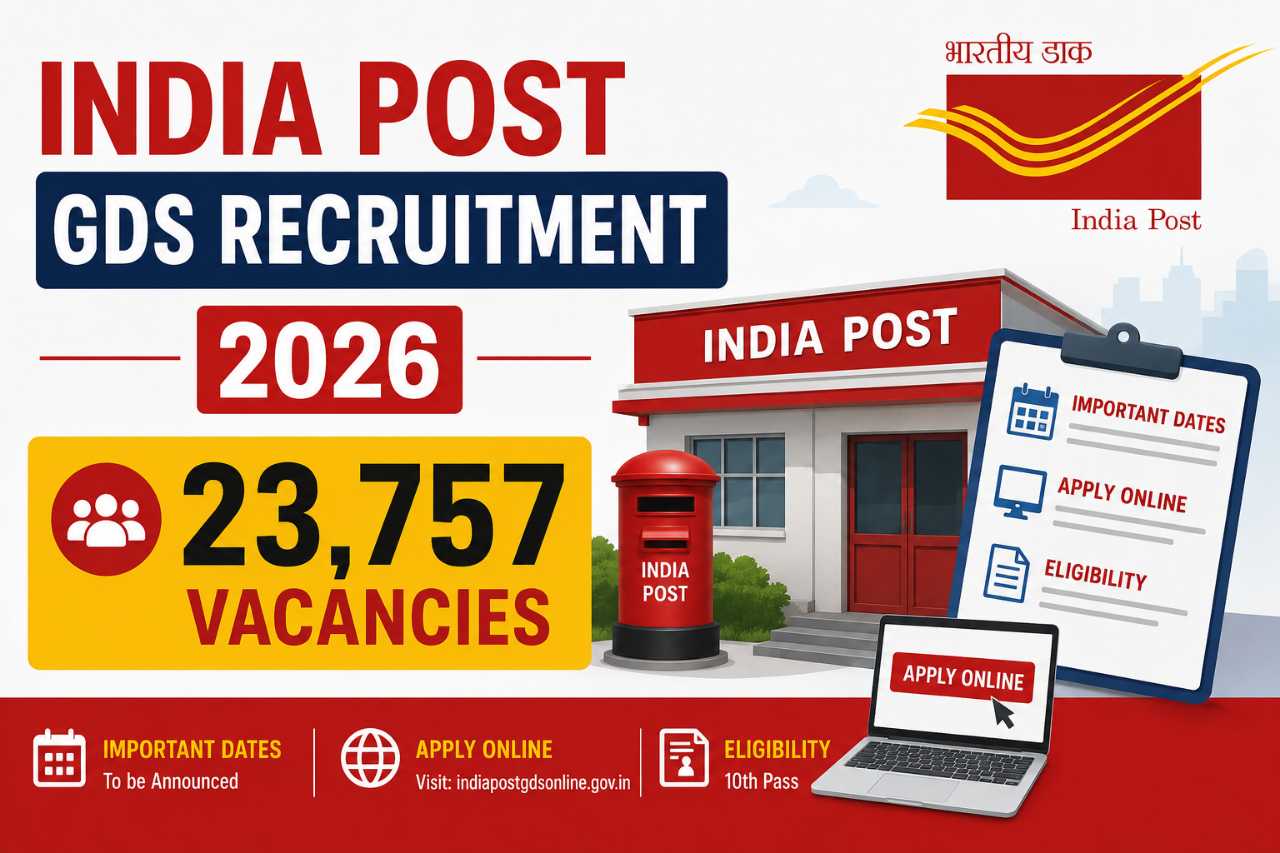
The India Post GDS Recruitment 2026 for Schedule 2 has officially opened, offering one of the largest government job opportunities at the grassroots level in recent years. With 23,757 vacancies across Branch Postmaster (BPM), Assistant Branch Postmaster (ABPM), and Dak Sevak posts, this drive is a major chance for Class 10 pass candidates seeking stable employment in India's postal network. Registration began on August 31, 2026, and candidates must complete the process on the official portal at indiapost.gov.in before the deadline.
Unlike competitive exams that require years of preparation, GDS selection is merit-based on Class 10 marks—making it accessible to lakhs of youth who have completed secondary school and want a government job close to home. Whether you are a fresh Class 10 graduate in a rural village or a student weighing GDS against higher education options at institutions like Northern India Engineering College or Lady Shri Ram College For Women LSR Delhi, this guide covers everything you need to know about dates, eligibility, the application process, and what happens after you apply.
What Is Gramin Dak Sevak (GDS)?
Gramin Dak Sevak, commonly called GDS, refers to the workforce that operates India Post's branch offices and delivery operations in rural and semi-urban areas. These are not regular central government employees in the traditional sense; GDS posts are engagement-based roles governed by specific service conditions laid down by the Department of Posts.
The three main categories under this recruitment are:
- Branch Postmaster (BPM): Manages a branch post office, oversees daily operations, handles cash transactions, and supervises delivery staff.
- Assistant Branch Postmaster (ABPM): Assists the BPM in administrative and operational tasks at the branch level.
- Dak Sevak: Primarily responsible for mail delivery, collection, and related field duties in assigned areas.
GDS workers play a critical role in India's last-mile postal connectivity. From delivering pension payments and government scheme benefits to handling savings account transactions under schemes like Sukanya Samriddhi, their work directly touches rural households. For many candidates in districts without large industrial employers, a GDS engagement offers financial stability, local posting, and the prestige associated with a government-linked role.
India Post GDS Recruitment 2026: Key Highlights at a Glance
Before diving into details, here is a quick snapshot of the most important facts about this recruitment cycle:
- Recruitment name: India Post GDS Schedule 2 Recruitment 2026
- Total vacancies: 23,757 posts
- Post categories: BPM, ABPM, and Dak Sevak
- Selection basis: Merit list based on Class 10 marks (percentage calculated to four decimal places)
- Application mode: Online only via indiapost.gov.in
- Written exam: No separate written test; selection is purely merit-based
- Document upload: Only photograph and signature required at application stage
- Application fee: Rs 100 for general category candidates; exempt for female, SC, ST, PwBD, and trans women applicants
This recruitment is particularly significant because it does not require candidates to appear for a competitive entrance examination. Your Class 10 board marks become the sole academic criterion—similar in simplicity to how some professional courses evaluate prior academic records, though institutions like National Law School Of India University Bangalore follow entirely different admission pathways through CLAT and other exams.
Important Dates for GDS Recruitment 2026
Missing a deadline in government recruitment can permanently close your opportunity for that cycle. Mark these dates carefully:
- Registration start date: August 31, 2026
- Registration last date: September 19, 2026
- Application form filling window: September 2 to September 21, 2026
- Application correction window: September 23 to September 24, 2026
Candidates should note that registration and application form filling are separate stages. You must first register on the portal, then complete the detailed application within the specified window. The two-day correction window in late September allows you to fix errors in your application—use it wisely, as this may be your only chance to correct mistakes before merit list preparation begins.
Why Acting Early Matters
Government portals often experience heavy traffic near deadlines. Server slowdowns, payment gateway failures, and OTP delays are common in the final 48 hours. Experts recommend completing your application at least five days before September 21 to avoid last-minute technical issues. Keep your mobile number, email ID, and payment details ready before you begin.
Vacancy Details: 23,757 Posts Across India
The Department of Posts has notified 23,757 vacancies distributed across states and union territories for BPM, ABPM, and Dak Sevak positions. Vacancies are allocated at the circle and division level, meaning you will apply for posts within your chosen postal circle.
Each state or circle publishes its own vacancy breakup in the official notification. Candidates must apply for GDS posts in the circle where they fulfill the local address and language requirements. The engaging authority for each post reserves the right to modify, cancel, or revise the number of posts or stop the engagement process altogether—this clause appears in most India Post GDS notifications and is important to understand before applying.
Understanding Circle-Wise Allocation
India Post operates through postal circles aligned with states or groups of states. When you apply, you typically select a specific division or branch office where vacancies exist. Rural candidates often prefer GDS because postings are usually within their home district or a nearby area—unlike central government jobs that may require relocation across the country.
For candidates in Rajasthan, for example, postal vacancies may open alongside local education opportunities at colleges such as SK Government Post Graduate College Sikar, Mahatma Gandhi Post Graduate Mahavidyalaya Sikar, and Maa Bharati Post Graduate College Kota. Many students in these regions weigh GDS against pursuing undergraduate degrees—a decision that depends on immediate financial need, long-term career goals, and academic interests.
Eligibility Criteria for GDS Recruitment 2026
Meeting eligibility requirements is non-negotiable. The Department of Posts verifies every criterion during document verification, and candidates found ineligible at any stage are disqualified—even if they appear on the provisional merit list.
Educational Qualification
Candidates must have passed the Class 10 (Secondary School Examination) from a recognised board. The marks obtained in this examination form the basis of merit list preparation. Grades are converted to percentage up to four decimal places for ranking purposes.
If you are currently in Class 11 or 12, or planning to pursue higher studies at institutions like All India institute Of Medical Sciences Delhi AIIMS Delhi or Northern India Management College, you may already hold the basic educational qualification for GDS. However, once engaged as GDS, service conditions may restrict simultaneous commitments—review the official notification carefully if you plan to study while working.
Age Limit
The standard age criteria for GDS recruitment typically require candidates to be between 18 and 40 years as on the notification date, with relaxations for reserved categories as per government rules. Always verify the exact age cut-off date in the official notification for Schedule 2, as it may vary slightly between recruitment cycles.
Other Requirements
- Candidates must fulfill local language and address requirements for the circle they apply to.
- Physical verification of original documents is mandatory before final selection.
- Candidates must provide consent for Class 10 marks verification through DigiLocker (Annexure-X of the notification).
Application Fee Structure
The application fee for GDS Recruitment 2026 is structured as follows:
- General category candidates: Rs 100
- Exempt categories: All female candidates, Scheduled Caste (SC), Scheduled Tribe (ST), Persons with Benchmark Disabilities (PwBD), and trans women applicants pay no fee
Fee payment is typically completed online during the application process. Keep a screenshot or receipt of successful payment. If your payment is debited but the application status does not update, contact the helpdesk immediately and retain your transaction reference number.
Selection Process: Merit-Based, No Written Exam
One of the most distinctive features of GDS recruitment is the absence of a written examination. Selection is entirely based on academic merit derived from Class 10 board examination marks.
How Merit Is Calculated
The merit list is prepared using marks obtained (or grade conversion) in the Class 10 secondary school examination from recognised boards. Percentages are aggregated to an accuracy of four decimal places. Higher percentage means better rank. In case of tied marks, tie-breaking rules specified in the official notification apply—these usually consider date of birth (older candidate preferred) or other criteria listed in the recruitment rules.
Document Verification and DigiLocker Integration
Shortlisted candidates must undergo physical verification of original documents at the designated office. Additionally, the Department of Posts verifies Class 10 marks through DigiLocker using the API SETU PORTAL of the Department of e-Governance, Ministry of Electronics and Information Technology. Candidates must submit the understanding and consent form given in Annexure-X of the GDS notification, authorising the department to access their marksheet for verification.
This digital verification step reduces fraud but also means your DigiLocker account should have your Class 10 marksheet linked and accessible. If your marksheet is not on DigiLocker, consider uploading it before document verification begins.
What Happens After Selection
Selected candidates receive engagement letters for GDS positions at designated branch offices. Training is provided on postal operations, financial transactions, and delivery protocols. GDS roles offer a time-bound allowance rather than a fixed salary structure identical to regular government employees, but they include benefits like leave entitlements and service continuity provisions as per GDS rules.
How to Apply for India Post GDS Recruitment 2026
Follow this step-by-step process to submit your application successfully:
- Visit the official website: Go to indiapost.gov.in and navigate to the GDS recruitment section.
- Complete registration: Register using a valid mobile number and email ID. Create a strong password and note your registration credentials.
- Fill the application form: Enter personal details, educational qualifications, category, and preferred circle or division. Double-check every entry against your Class 10 certificate.
- Upload photograph and signature: These are the only uploads required at the application stage. Follow the prescribed format and file size.
- Pay the application fee: General category candidates pay Rs 100 online. Exempt categories should verify their fee status shows as nil or exempt.
- Submit and print: Submit the application and save or print the confirmation page for your records.
- Use the correction window: If you notice errors, correct them between September 23 and 24, 2026.
Documents Required for GDS Recruitment 2026
At the online application stage, candidates are not required to attach or upload documents other than a recent passport-size photograph and signature. However, keep the following documents ready for verification if you are shortlisted:
- Class 10 mark sheet and passing certificate from a recognised board
- Class 10 marksheet linked to DigiLocker (recommended)
- Photo identity proof (Aadhaar, voter ID, passport, or driving licence)
- Category certificate (SC/ST/OBC/EWS) if applicable
- Disability certificate for PwBD candidates
- Address proof for local eligibility
- Passport-size photographs matching the uploaded image
- Annexure-X consent form for DigiLocker marks verification
Ensure that names and dates of birth match exactly across all documents. Even minor spelling differences can cause verification delays or disqualification.
GDS vs Higher Education: Making the Right Career Choice
For Class 10 pass students, GDS recruitment presents a crossroads. Taking a government-linked job offers immediate income and local stability. Pursuing higher education opens doors to professions in medicine, law, engineering, management, and research—but requires years of study and often significant expense.
Students interested in medical careers might eventually target institutions such as All India Institute Of Medical Sciences Bhopal, All India Institute Of Medical Sciences Patna, or Jawaharlal Institute Of Post Graduate Medical Education Research Puducherry through NEET and subsequent counselling. Those leaning toward law may aspire to India International University Of Legal Education And Research. Engineering aspirants explore colleges like Techno India University West Bengal after completing Class 12 with PCM.
There is no universally correct choice. GDS suits candidates who need immediate employment, prefer working in their home region, or want a stable foundation before considering further studies. Higher education suits those with clear long-term professional goals that require degrees—whether at Sanjay Gandhi Post Graduate Institute Of Medical Sciences Lucknow for post-graduate medical training or at Centre For Design Excellence Jaipur for creative fields.
Can You Do Both?
Some GDS appointees pursue distance or part-time education while working. However, GDS service rules define working hours and responsibilities that may limit study time. Read the service conditions in the official notification before assuming you can manage full-time college and GDS duties simultaneously.
Regional Opportunities: GDS Posts and Local Colleges
India Post GDS vacancies span every region, creating opportunities in states where premier educational institutions also attract national talent. Here is how regional candidates can think about their options:
North India
Candidates in Delhi-NCR may find GDS postings in nearby rural divisions while exploring admissions at Indraprastha College For Women Delhi or All India Institute Of Medical Sciences New Delhi. In Uttar Pradesh, AIIMS campuses at Raebareli and Gorakhpur represent major higher-education destinations alongside GDS openings in postal divisions across the state.
East and Northeast India
Postal vacancies in West Bengal and the Northeast often attract candidates who might also consider All India Institute Of Medical Science Kalyani, All India Institute Of Medical Sciences Guwahati, or universities such as Techno India University Tripura and The Institute Of Chartered Financial Analysts Of India University Agartala.
Central and West India
States like Madhya Pradesh, Chhattisgarh, Maharashtra, and Gujarat combine GDS opportunities with institutions including All India Institute Of Medical Sciences Nagpur, All India Institute Of Medical Sciences Raipur, and All India Institute Of Medical Sciences Rajkot. Candidates from these regions benefit from comparing postal job stability against professional courses at local colleges.
South India
Southern postal circles notify thousands of GDS posts regularly. Students in Tamil Nadu, Andhra Pradesh, and Telangana might parallel-track GDS applications with goals of entering All India Institute Of Medical Sciences Madurai, All India Institute Of Medical Sciences Mangalagiri, or All India Institute Of Medical Sciences Bhubaneswar for medical education.
Common Mistakes to Avoid During GDS Application
Thousands of eligible candidates lose their chance each year due to preventable errors. Avoid these pitfalls:
- Entering incorrect Class 10 marks: Your stated marks must match your board certificate exactly. Discrepancies discovered during DigiLocker verification can lead to rejection.
- Applying outside your eligible circle: Local address and language requirements are strictly enforced.
- Ignoring the correction window: September 23–24 is your only scheduled opportunity to fix application errors.
- Using a blurry photograph: Non-compliant images are a common reason for application rejection.
- Missing the fee payment step: An incomplete application without confirmed fee payment (where applicable) is not valid.
- Not linking DigiLocker: Proactive DigiLocker setup speeds up verification and demonstrates preparedness.
Preparation Tips to Strengthen Your Merit Position
Since there is no exam to prepare for, your Class 10 marks are fixed. However, you can still improve your overall chances:
- Verify your percentage calculation: Use the same conversion formula the notification specifies for grade-to-percentage conversion.
- Apply strategically: If multiple divisions within your circle have vacancies, research which posts had higher cut-offs in previous cycles.
- Keep documents organised: A verification-ready file folder saves time and reduces stress if you are shortlisted.
- Monitor official announcements: Merit lists and cut-offs are published circle-wise on indiapost.gov.in.
- Stay alert for fraud: India Post never asks for money beyond the official Rs 100 fee through unofficial agents or intermediaries.
What Is the Salary and Allowance for GDS Posts?
GDS employees receive a time-related allowance (TRA) that varies based on the post category (BPM, ABPM, or Dak Sevak), workload, and hours of duty. While GDS compensation differs from pay scales of regular postal departmental employees, it includes:
- Monthly time-related allowance based on prescribed rates
- Annual increase linked to completed years of service
- Leave benefits as per GDS conduct and engagement rules
- Opportunities for promotion to higher GDS categories based on vacancies and seniority
Candidates should review the latest allowance tables in the official notification for exact figures, as rates are revised periodically by the Department of Posts.
Conclusion
The India Post GDS Recruitment 2026 with 23,757 vacancies is a landmark opportunity for Class 10 pass candidates seeking government-linked employment without facing a competitive written examination. With registration already underway since August 31 and the application window open until September 21, eligible candidates should act promptly—complete registration by September 19, fill the form carefully, pay the fee if applicable, and use the September 23–24 correction window if needed.
Whether you choose the stability of a GDS career in your hometown or continue toward higher education at premier institutions across India, the key is making an informed decision aligned with your circumstances. For lakhs of youth in rural and semi-urban India, this recruitment represents more than a job—it is a chance to serve their community through one of the country's most trusted institutions while building a secure professional foundation.
Stay updated through the official India Post website, keep your documents and DigiLocker account ready, and submit your application well before the deadline to maximise your chance of appearing on the merit list.