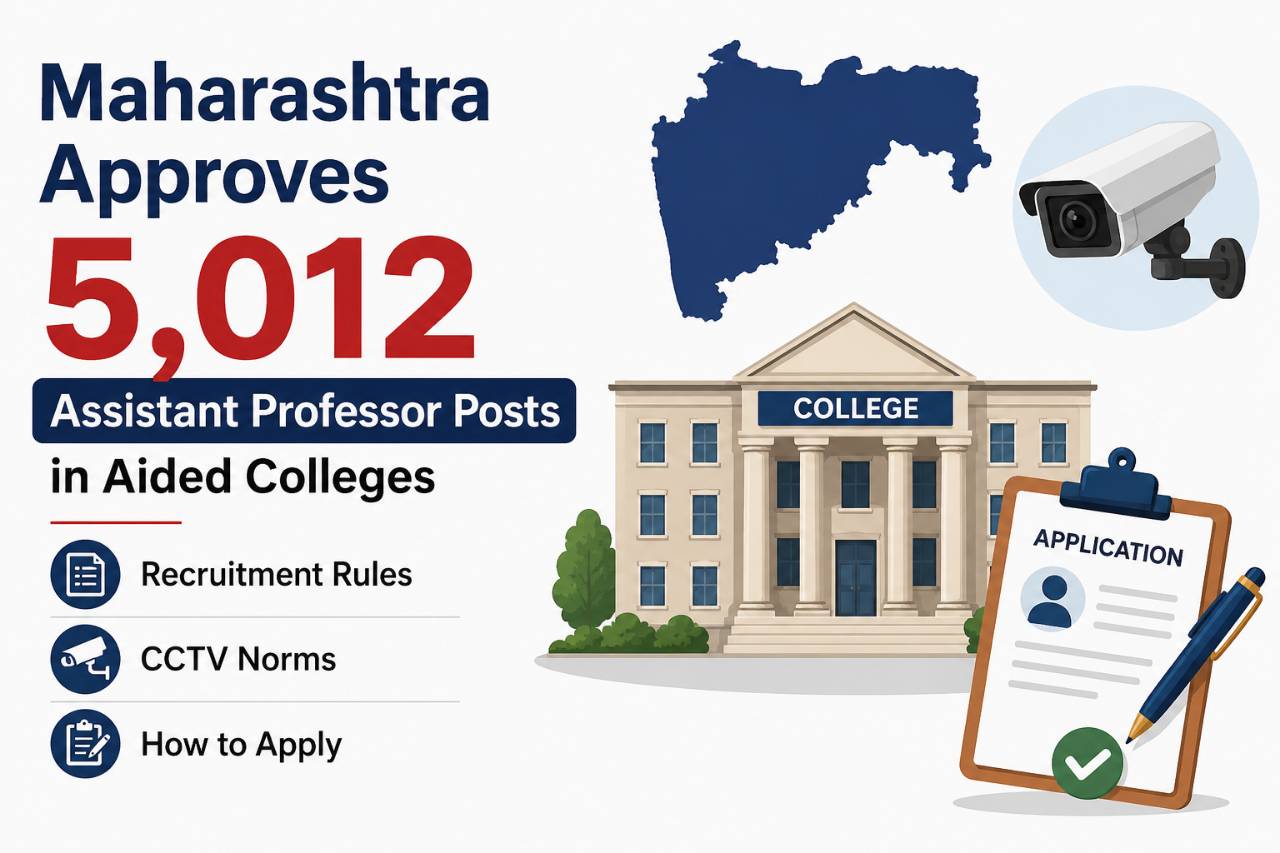

The Maharashtra Governemnt has cleared one of the largest faculty recruitment drives in recent years for higher education in the state. On Monday, August 31, 2026, the Higher and Technical Education Department issued a Governemnt Resolution (GR) approving 5,012 assistant professor posts in non-Governemnt aided senior colleges across Maharashtra. The move addresses long-standing faculty shortages that have affected teaching quality, student-teacher ratios, and timely completion of undergraduate and postgraduate programmes affiliated to state public universities.
What makes this recruitment cycle especially significant is the emphasis on transparency and accountability. For the first time at this scale, colleges must record the entire interview process on CCTV, preserve footage for at least one year, and follow University Grants Commission (UGC) shortlisting criteria along with social and parallel reservation policies. Whether you are a NET/SET-qualified academic seeking a stable teaching career, a postgraduate student planning your next step, or a parent evaluating college quality, understanding this policy matters.
This CollegeDwar guide breaks down the approval, recruitment rules, eligibility expectations, reservation framework, and practical steps candidates can take—written in clear language for students, job seekers, and college administrators across India.
What Are Non-Governemnt Aided Senior Colleges in Maharashtra?
Maharashtra's higher education landscape includes three broad categories: fully government colleges, private unaided (self-financing) institutions, and non-government aided senior colleges. Aided colleges are typically run by private or trust-based managements but receive substantial financial support from the state government. In return, they charge regulated fees, follow government recruitment and reservation norms, and affiliate with public universities such as Kavayitri Bahinabai Chaudhari North Maharashtra University, Jalgaon, Tilak Maharashtra Vidyapeeth, Pune, and Yashwantrao Chavan Maharashtra Open University.
Unlike fully government institutions—where faculty appointments are often centralised through state selection boards—aided colleges recruit teaching staff at the college level, subject to university approval and regulatory oversight. This hybrid model expands access to affordable higher education beyond pure government capacity, but it has also led to delays in permanent appointments when managements defer recruitment or rely on contractual lecturers.
How Aided Colleges Differ From Government and Private Unaided Institutions
Understanding the distinction helps candidates set realistic expectations about pay scales, job security, and interview processes:
- Government colleges (for example, state-run arts, science, and professional colleges) follow direct government pay scales and recruitment through public service commissions or dedicated boards. Institutions like Government College of Engineering, Chennai or Government Engineering College, Ajmer represent the fully public model in other states.
- Non-government aided colleges receive grants for salaries and infrastructure but are managed by trusts or societies. Faculty posts approved by the state are generally on a par with government pay scales once regularised.
- Private unaided colleges set their own recruitment terms, fee structures, and contracts. They are not covered by this 5,012-post approval.
The current Maharashtra GR applies specifically to aided senior colleges affiliated to state public universities—not to medical colleges under Maharashtra University of Health Sciences, Nashik, nor to standalone law universities such as Maharashtra National Law University, Mumbai, unless separately notified.
Key Highlights of the 5,012 Assistant Professor Approval
According to the Government Resolution issued on August 31, 2026, the Maharashtra government has formally approved 5,012 assistant professor positions based on student-strength and workload calculations as of October 2025 across colleges affiliated to state public universities. The approval is not a single combined examination; rather, it authorises individual aided colleges to initiate recruitment for sanctioned posts in specific departments—subject to university consent and adherence to the GR's transparency conditions.
Why 5,012 Posts Matter for Students and Faculty
Faculty vacancy is one of the most under-discussed issues in Indian higher education. When colleges operate with guest lecturers or overloaded permanent staff, students face inconsistent teaching, delayed internal assessments, and weaker mentorship for research and competitive exams. Approving posts at scale signals the state's intent to align staffing with enrolment growth seen after expansion of degree programmes, skill courses, and postgraduate intake in universities like Krishna Vishwa Vidyapeeth, Karad and specialised institutions such as Maharashtra State Skills University.
For job seekers, 5,012 posts represent a substantial opportunity in an academic job market that has tightened since UGC made NET/SET and PhD requirements stricter for assistant professor appointments. Candidates who have cleared eligibility tests and hold relevant postgraduate degrees should monitor college websites and university bulletin boards closely in the coming months.
Mandatory CCTV Recording of Interviews: What Colleges Must Do
The most talked-about reform in this GR is the mandatory CCTV recording of the entire interview process. Maharashtra has moved to address recurring complaints about opaque shortlisting, favouritism, and procedural irregularities in aided-college recruitments. Under the new rules:
- Colleges must install and operate CCTV coverage for the full duration of faculty interviews—not only the viva voce but the complete session as defined in college recruitment committees.
- Recordings must be treated as confidential documents and preserved securely for at least one year from the date of the interview.
- If any complaint, objection, inquiry, court case, or statutory proceeding is pending, recordings cannot be destroyed until the matter is fully resolved.
- The Higher and Technical Education Department may issue further instructions from time to time to strengthen transparency.
Why CCTV Norms Improve Trust in Academic Hiring
Faculty recruitment controversies are not unique to Maharashtra; similar debates have surfaced in universities from Rajasthan to Tamil Nadu. By requiring audiovisual records, the state creates an evidence trail that university grievance cells, the Maharashtra Public Service Commission (where applicable), and courts can review if candidates allege bias or procedural violations. For honest candidates, this is protective: merit demonstrated in the interview room can be verified independently.
College managements should budget for storage, access controls, and data protection. Simply installing cameras without secure archiving would fail the spirit of the GR. Candidates, in turn, should confirm that interviews are held in covered areas and request clarification in writing if recording policies seem unclear.
UGC Shortlisting Criteria and Academic Eligibility
The GR directs that candidates must be shortlisted according to criteria prescribed by the University Grants Commission (UGC). While the exact weightage may vary slightly by university statutes, the national baseline for assistant professor appointments generally includes:
- Educational qualifications: Master's degree with minimum 55% marks (50% for reserved categories in many notifications) in the relevant subject, along with NET/SET/SLET qualification or a PhD as per UGC regulations.
- PhD holders: Candidates with a PhD may receive weightage as per current UGC norms, including exemptions from NET in eligible cases completed before specified cut-off dates.
- Publications and research: Many universities add marks for publications, conferences, patents, and research projects during shortlisting.
- Teaching or industry experience: Prior lectureship, guest faculty service, or relevant professional experience may carry defined weightage.
Colleges must publish shortlisting criteria on their official websites before interviews and upload the list of shortlisted candidates. They must also submit relevant details to the concerned affiliating university. This publication requirement is critical: candidates should screenshot or download criteria and shortlists on the day they appear, creating a personal record if disputes arise later.
NET, SET, and PhD: What Aspiring Professors Should Prepare
If you are building an academic profile, treat eligibility as a multi-year plan. Clear NET or SET in your postgraduate subject early. Pursue a PhD from a UGC-recognised university if you aim for research-intensive departments. Maintain an ORCID profile, publish in peer-reviewed journals where possible, and document conference presentations. Faculty hiring at institutions affiliated to major universities—whether Maharashtra National Law University, Aurangabad or Professor Jayashankar Telangana Agricultural University in neighbouring states— increasingly rewards visible research output alongside basic eligibility.
Reservation Policy: Social and Parallel Reservations Explained
The GR explicitly states that colleges must follow social and parallel reservation policies. In Maharashtra, this typically includes:
- Vertical reservations for Scheduled Castes (SC), Scheduled Tribes (ST), Vimukta Jati and Nomadic Tribes (VJNT), Other Backward Classes (OBC), and Economically Weaker Sections (EWS) as per state policy.
- Horizontal reservations for persons with disabilities (PwD), ex-servicemen, and other categories where applicable.
- Parallel reservation for women candidates in certain posts, as notified in specific recruitment advertisements.
Aided colleges cannot depart from these norms while filling state-approved posts. Advertisements must clearly state category-wise vacancies, roster points, and required certificates (caste validity, non-creamy layer, disability percentage, etc.). Candidates should verify document formats accepted by the affiliating university—small errors in certificate wording have led to disqualifications in past recruitments across India.
Step-by-Step Recruitment Process Under the New GR
Although each college issues its own advertisement, the GR outlines a standard framework that reduces arbitrariness:
- Post sanction and university intimation: The college identifies approved vacant assistant professor posts from the state-approved pool and seeks university permission to recruit.
- Advertisement approval: Recruitment advertisements must obtain university approval before release.
- Publication in newspapers: Ads must appear in at least one national newspaper and one state-level newspaper, in addition to the college website.
- Application window: Colleges may accept applications both online and offline, making the process accessible to candidates in rural areas with limited internet access.
- Shortlisting: Applications are evaluated using published UGC-aligned criteria; shortlists are posted online and shared with the university.
- Interview with CCTV: Interviews are conducted under video recording, with selection committees constituted as per university statutes.
- Final appointment: Selected candidates undergo verification of documents, medical examination if required, and formal appointment orders through college management with university reporting.
Candidates comparing opportunities across states—for instance, faculty openings in Rajasthan at Govind Guru Government College, Jaipur or Government Science College, Sikar—will notice that aided-college recruitment in Maharashtra now carries unusually explicit transparency safeguards. That makes this cycle worth tracking even for applicants outside the state who are open to relocation.
Who Should Apply: Ideal Candidate Profile
This recruitment drive suits candidates who meet UGC eligibility and are willing to work in affiliated arts, science, commerce, and multidisciplinary colleges across urban and semi-urban Maharashtra. Ideal applicants typically include:
- NET/SET-qualified postgraduates seeking permanent positions with government-aided pay scales.
- PhD scholars nearing completion or recent graduates with thesis submitted and defence completed.
- Current guest lecturers or contractual faculty in aided colleges aiming to regularise their service.
- Industry professionals transitioning to academia with required postgraduate qualifications and NET/PhD credentials.
Posts will span departments from languages and social sciences to commerce, computer science, and emerging skill areas linked to vocational education. Keep department-wise lists ready: a single college may advertise only two or three posts even though the statewide approval covers 5,012 positions distributed across hundreds of institutions.
Impact on College Quality and Student Outcomes
Permanent faculty stabilises academic planning. Colleges can assign course coordinators, NAAC accreditation teams, examination work, and mentorship for internships with confidence. Students benefit from consistent syllabi coverage, better laboratory supervision, and stronger guidance for competitive exams such as GATE, NET, and state-level eligibility tests.
For management, filling sanctioned posts also reduces legal and audit risks. Operating without approved faculty against high enrolment has triggered university warnings and accreditation penalties in the past. The 5,012 approvals, combined with CCTV-backed interviews, aim to close that gap systematically rather than through ad hoc hiring.
What Students and Parents Should Ask Colleges
Before admission season, students can ask aided colleges direct questions: How many assistant professor posts are vacant in my department? Are current lecturers permanent or contractual? Has the college received university approval to advertise new posts under the August 2026 GR? Transparency on staffing is as important as infrastructure and placement data when choosing between institutions affiliated to universities such as Maharashtra National Law University, Nagpur or regional multi-faculty universities.
Common Mistakes Candidates Must Avoid
- Missing advertisement deadlines: Aided-college ads often have shorter windows than large PSC exams. Subscribe to university RSS feeds and local employment newspapers.
- Incomplete applications: Offline submissions especially suffer from missing attested copies, experience certificates, or NET scorecards.
- Ignoring university-specific statutes: Affiliating universities may add requirements beyond UGC minima; read the fine print.
- Weak interview preparation: Shortlisting is merit-based, but interviews test teaching aptitude, subject depth, and communication. Practice micro-teaching sessions.
- Not verifying CCTV compliance: If a college refuses to confirm recording arrangements, note the grievance channel mentioned in the advertisement.
Timeline Expectations: When Will Hiring Begin?
The GR approval is effective immediately, but decentralised recruitment takes time. Expect a rolling schedule over the 2026–27 academic year: larger colleges in Mumbai, Pune, Nagpur, and Nashik may advertise within weeks after obtaining university nod, while smaller institutions may batch recruitment with academic council meetings. Candidates should check affiliating university websites alongside individual college portals at least weekly from September 2026 onward.
Unlike a centralised exam with a single result date, this model requires patience and persistence. Many successful faculty careers in aided colleges begin with applying to multiple advertisements across districts—not waiting for one prestigious institution.
Comparison: Maharashtra Aided Faculty Recruitment vs Other States
Faculty hiring models vary widely across India, and understanding those differences helps candidates plan a national search. In Rajasthan, many permanent teaching posts in government colleges flow through the Rajasthan Public Service Commission or direct state orders, with institutions such as Sawai Man Singh Government College, Jaipur and Government Commerce College, Kota operating under fully government administration. Tamil Nadu and Karnataka also run large-scale government college systems with periodic PSC notifications.
Maharashtra's aided-college model sits in the middle: posts are state-sanctioned and follow government pay and reservation rules, but recruitment is decentralised at the college level with university oversight. The August 2026 GR strengthens that decentralised model by standardising transparency tools—CCTV, public shortlists, and dual newspaper advertising—that were previously applied inconsistently. For academics comparing Maharashtra with opportunities at Professor Rajendra Singh Rajju Bhaiya University, Prayagraj or central universities, the trade-off is clear: Maharashtra offers volume and aided pay scales, while central universities may offer different research ecosystems and funding structures.
Quick Reference: Maharashtra GR Requirements at a Glance
Use this summary when evaluating an advertisement or preparing documents:
- Total posts approved statewide: 5,012 assistant professor positions
- Basis of sanction: Student strength and workload as of October 2025
- Institution type: Non-government aided senior colleges under state public universities
- Advertisement: University approval required; one national + one state newspaper + website
- Applications: Online and offline modes permitted
- Shortlisting: UGC criteria; criteria and shortlist published on college website
- Interview: Full CCTV recording mandatory; preserve minimum one year
- Reservation: Social and parallel reservation policies mandatory
Document Checklist for Applicants
Prepare a master folder—physical and digital—before the first advertisement appears. Missing papers cause more rejections than weak academic records in decentralised recruitments:
- Postgraduate and graduation mark sheets and degree certificates (originals plus attested copies)
- NET/SET/SLET scorecard or PhD degree/provisional certificate with thesis submission proof
- Caste certificate with validity, non-creamy layer certificate, EWS certificate, or PwD certificate as applicable
- Experience certificates from previous colleges or universities on official letterhead
- Publication list with ISSN/ISBN details, reprints, and proof of conference participation
- Passport-size photographs, identity proof, and domicile or address proof if required
- Application fee payment receipt for offline submissions
Organising documents early is especially useful for candidates currently working as guest faculty in colleges across districts like Pune, Aurangabad, or Amravati who may need to apply to multiple advertisements within the same academic year to secure a permanent post under this 5,012-position sanction.
Conclusion
Maharashtra's approval of 5,012 assistant professor posts in non-government aided senior colleges marks a meaningful step toward fixing faculty shortages while embedding stronger transparency through mandatory CCTV interviews, public shortlisting, dual newspaper advertising, and strict UGC and reservation compliance. For eligible NET/SET and PhD holders, this opens one of the most significant state-level faculty opportunities in recent years. For students, it promises more stable teaching and better academic support if colleges execute recruitment promptly and fairly.
Stay updated through official college and university websites, prepare documentation early, and treat each advertisement as a distinct recruitment event governed by the August 2026 Government Resolution. CollegeDwar will continue tracking major faculty recruitment and higher-education policy updates that affect admissions, exams, and academic careers across India.