If you are preparing for engineering admission in India, staying updated on JEE Main news is not optional it is essential. On 16 September 2026, the National Testing Agency (NTA) released the official exam date notification for JEE Main 2027 Session 1, confirming that the test will be held across six days in January 2027. For lakhs of Class 12 students, droppers, and repeaters, this single announcement sets the timeline for registration, revision, mock tests, and counselling planning.
This guide by CollegeDwar brings together the latest NTA updates, eligibility rules on age and attempts, how to follow official announcements on social media, and practical steps you can take today. Whether you are targeting NITs, IIITs, GFTIs, or planning to qualify for JEE Advanced, read this page carefully and bookmark the official portals: jeemain.nta.nic.in and nta.ac.in.
JEE Main 2027 Latest News: What NTA Announced on 16 September 2026
The biggest headline from the September 2026 notification is the confirmed schedule for Session 1. According to NTA, JEE Main 2027 Session 1 will be conducted on:
- 22 January 2027
- 23 January 2027
- 24 January 2027
- 28 January 2027
- 29 January 2027
- 30 January 2027
NTA typically assigns each candidate one specific date and shift rather than allowing free choice on exam day. The multi-day window helps the agency manage lakhs of applications across hundreds of cities while reducing infrastructure pressure in any single slot.
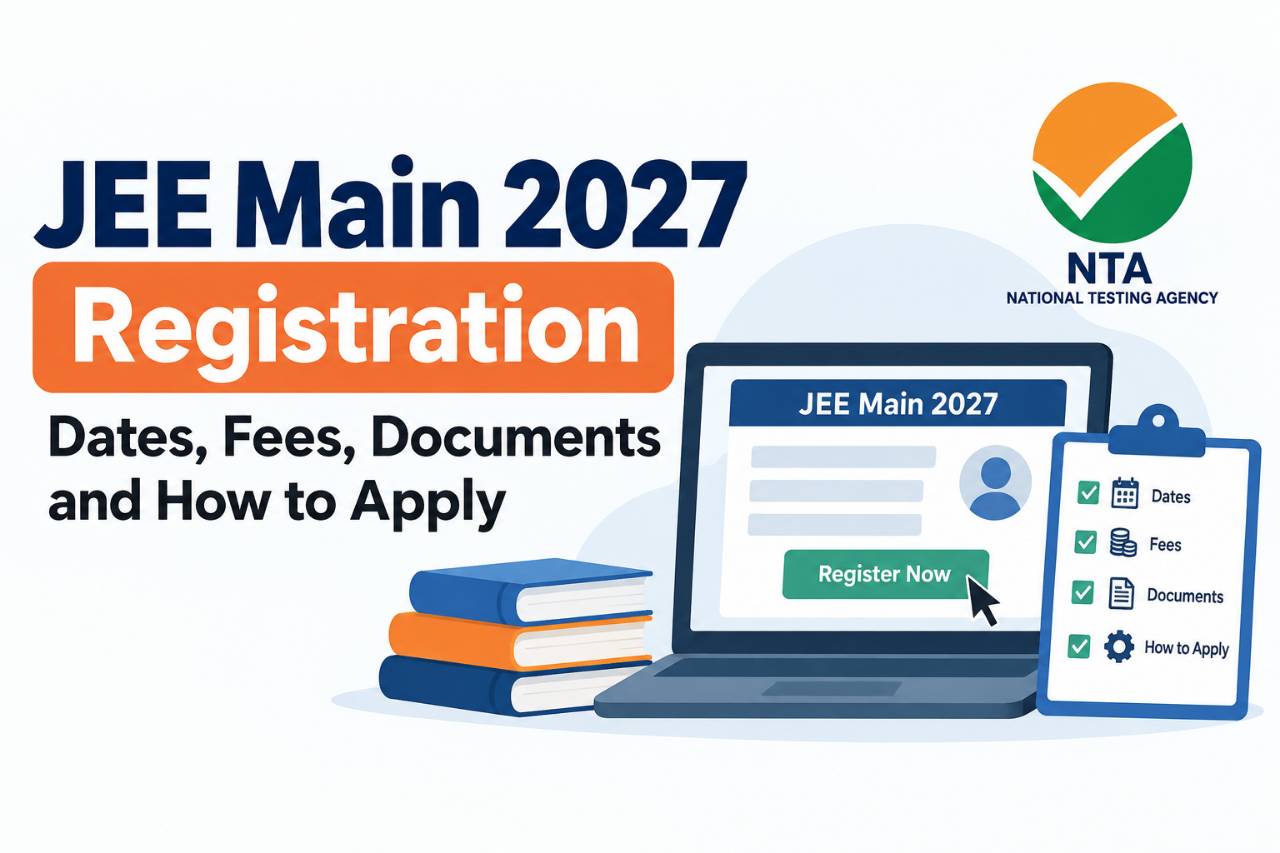
Along with exam dates, NTA indicated that Session 1 registration will open in October 2026, with the application window expected to close in November 2026. Form correction is likely in December 2026, while admit cards, city intimation slips, and photo verification deadlines are expected in January 2027, closer to the exam.
Why the Early Date Notification Matters for Aspirants
When NTA publishes dates months in advance, it gives students a fixed target for syllabus completion. Instead of guessing whether Session 1 will fall in late January or early February, you can now plan backward: finish the full JEE Main syllabus by November, dedicate December to revision and mock tests, and use January exclusively for accuracy, speed, and exam-day simulation.
Early clarity also helps students who are simultaneously preparing for other entrance exams. For instance, if you are exploring design through NID DAT or hospitality through NCHMCT JEE, knowing your JEE calendar prevents last-minute clashes in preparation focus.
Complete JEE Main 2027 Timeline at a Glance
The table below summarises the expected schedule based on NTA's latest notification and historical release patterns. Always cross-check dates on the official website because NTA may revise timelines through public notices.
| Event | Expected Timeline (JEE Main 2027) |
|---|---|
| Exam date notification | 16 September 2026 (released) |
| Session 1 registration opens | October 2026 |
| Session 1 registration closes | November 2026 |
| Application form correction | December 2026 |
| Session 2 registration (reopened window) | March 2027 |
| City intimation slip | January 2027 |
| Photo verification deadline | January 2027 |
| Admit card release | January 2027 |
| Session 1 exam dates | 22, 23, 24, 28, 29, 30 January 2027 |
| Provisional answer key | February 2027 |
| Final answer key | February 2027 |
| Session 1 result | February 2027 |
Session 2 dates are usually announced later, often with the exam held in April 2027. NTA conducts JEE Main in two sessions so that candidates can improve their score; your best percentile across sessions is generally considered for ranking and admission.
How to Track JEE Main News Updates from NTA on Social Media
NTA communicates critical updates through its official website, press releases, and verified social media handles. Many students first hear about date announcements, form correction windows, or answer key releases through NTA posts on X (formerly Twitter). These short updates often called "NTA tweets on JEE" by students can spread quickly, so verifying them on the official portal remains mandatory.
Official Channels You Should Follow
- Website: jeemain.nta.nic.in for application, admit card, and results
- Parent portal: nta.ac.in for notifications and exam calendars
- Social media: NTA's verified accounts on X and other platforms for instant alerts
- Email and SMS: Register a working mobile number and email during application NTA sends reminders for admit cards and exam-day instructions
Action tip: Do not rely on unverified "JEE update" pages or forwarded WhatsApp messages. Scammers often circulate fake registration links during October–November. Type the URL manually or use bookmarks to official domains only.
Common NTA Announcements and What They Mean
- Information brochure release: Contains eligibility, syllabus, exam pattern, and fee structure read it fully before applying
- Registration opening tweet: Signals that the application portal is live; apply early to avoid server slowdowns near the deadline
- Correction window notice: Allows limited edits to photo, signature, category certificates, or exam city preferences
- Answer key notification: Opens a challenge period; review responses before the final key is published
JEE Main 2027 Eligibility: Age Limit Explained
One of the most searched topics after every NTA update is the JEE Main age limit. Here is the clear answer for 2027 aspirants:
There is no upper or lower age limit for JEE Main 2027. NTA does not restrict candidates based on age. If you meet the academic eligibility typically having passed Class 12 in 2025 or 2026, or appearing in 2027 you can register regardless of whether you are 17 or 27.
Important Distinction: JEE Main vs institute Rules
While NTA allows candidates of any age to appear, individual institutions may impose separate age criteria during admission. For example, JEE Advanced (conducted for IIT admission) follows rules set by the Joint Admission Board, which may differ from JEE Main. Always read the admission brochure of your target college.
Delhi remains one of India's biggest JEE preparation hubs. Students aiming for premier institutions in the capital whether engineering at Jamia Millia Islamia New Delhi, architecture at School of Planning Architecture New Delhi, or other specialised programmes should verify institute-specific age and eligibility norms separately from NTA's entrance criteria.
Number of Attempts for JEE Main 2027: How Many Times Can You Appear?
Another high-traffic question after every news cycle is: How many attempts are allowed in JEE Main? The current framework, which NTA has maintained in recent years, works as follows:
- Candidates can appear in JEE Main for three consecutive years from the year they first become eligible (based on Class 12 passing/appearing year)
- The exam is held in two sessions per year (January and April), so you may get up to six attempts in total across those three years
- Appearing in Session 1, Session 2, or both in the same year counts as participation within that eligibility year not as separate "years"
Strategic Use of Two Sessions
Session 1 (January) is ideal if you want an early rank for counselling or wish to assess your preparation before Session 2. Session 2 (April) suits students who need more time after board exams or want a second chance within the same academic cycle. NTA uses the best score among sessions for ranking purposes in a given year.
Example: A student who passed Class 12 in 2025 can generally attempt JEE Main in 2025, 2026, and 2027 (subject to NTA's official brochure confirmation). A 2027 first-time aspirant would typically start their three-year window from 2027 onward.
Who Cannot Appear for JEE Main 2027?
Candidates who passed Class 12 before 2025 (without meeting NTA's appearing-year conditions) or who will appear for Class 12 after 2027 are generally not eligible. Open school students from recognised boards like NIOS are eligible if they meet subject requirements. For Paper 1 (B.E./B.Tech.), Physics and Mathematics are compulsory, along with one among Chemistry, Biology, Biotechnology, or Technical Vocational subject.
75% Rule and Admission Eligibility: Beyond the Entrance Exam
Qualifying JEE Main and securing admission are related but not identical. NTA does not require a minimum Class 12 percentage simply to sit for the exam. However, for admission to NITs, IIITs, and GFTIs through JoSAA counselling, candidates generally need:
- 75% aggregate marks in Class 12 (or equivalent), or
- Position in the top 20 percentile of their respective board
- For SC/ST candidates, the aggregate threshold is typically relaxed to 65%
State engineering colleges and private universities may follow their own cut-offs. Institutions such as MIT Anna University Chennai and New Prince Shri Bhavani Engineering Chennai participate in state-level counselling processes where JEE Main scores may be considered alongside or in place of state exams, depending on the year and policy.
JEE Main 2027 Exam Pattern and Papers
Understanding the exam structure helps you interpret NTA updates correctly. JEE Main comprises multiple papers:
- Paper 1: B.E./B.Tech. (Physics, Chemistry, Mathematics)
- Paper 2A: B.Arch. (Mathematics, Aptitude, Drawing)
- Paper 2B: B.Plan. (Mathematics, Aptitude, Planning-based questions)
The exam is conducted in Computer-Based Test (CBT) mode, with the test offered in multiple languages. Negative marking applies to most multiple-choice questions, so exam-day strategy matters as much as conceptual clarity.
Recent Pattern Trends Students Should Know
Over the past few cycles, NTA has balanced numerical value questions, assertion-reason items, and standard MCQs across Physics, Chemistry, and Mathematics. The total marks and number of questions may vary slightly between sessions, but the core syllabus remains aligned with the Class 11 and 12 NCERT framework. When the information brochure is released, compare the stated pattern with your mock test series and adjust your time-management strategy accordingly.
JEE Advanced 2027: IIT Roorkee as the Organising IIT
JEE Main is the gateway; JEE Advanced is the filter for IITs. For 2027, IIT Roorkee will conduct JEE Advanced. Only candidates who meet the JEE Main cutoff percentile (category-wise) and fulfil JAB eligibility including age limits specific to Advanced can register.
If IITs are your goal, treat every NTA tweet and brochure update as a checkpoint: align mock test scores with expected cutoffs, and avoid exhausting all six JEE Main attempts without a parallel Advanced preparation plan.
Registration, Form Correction, and Admit Card: What Comes Next
Registration (October–November 2026)
When the Session 1 application window opens, keep scanned copies of your photograph, signature, Class 10 certificate, category certificate (if applicable), and PwD certificate ready. Pay the fee online and save the confirmation page. Early application reduces stress during server-heavy final days.
Form Correction (December 2026)
NTA usually allows one correction window. Typical editable fields include personal details, photograph, signature, and exam city choices. Some fields like category may require document upload. Missing the correction window can cause problems at exam centres double-check every entry.
Admit Card and Exam-Day Documents (January 2027)
Download the admit card from jeemain.nta.nic.in using your application number and date of birth. Carry a printed admit card, valid photo ID, and follow the list of prohibited items (electronic gadgets, bags, etc.). Reach the centre early late entry is not permitted.
Results, Answer Keys, and Counselling Roadmap
After Session 1, NTA releases a provisional answer key, accepts challenges for a fee, and then publishes the final key and result expected around February 2027 for the January session. Your percentile and All India Rank (AIR) determine eligibility for JoSAA, CSAB, and state counselling.
Students who miss their target rank in Session 1 should analyse subject-wise weaknesses and register for Session 2 in March 2027 when the window reopens. Even a modest improvement can significantly change college options.
From Result to Seat Allotment
Once results are out, eligible candidates register for JoSAA counselling, fill college and branch preferences, and participate in multiple rounds of seat allotment. CSAB handles vacant seats after JoSAA rounds. State counselling bodies such as those governing Tamil Nadu, Maharashtra, or Rajasthan seats may use JEE Main scores with separate registration. Build a realistic preference list mixing dream, target, and safe options based on previous year cutoffs.
Application Fee and State Code of Eligibility
When registration opens in October 2026, NTA will publish the exact fee structure in the information brochure. Historically, fees vary by category, gender, and number of papers selected, with separate rates for candidates appearing in India versus abroad. Payment is accepted only through online modes on the official portal never transfer money to individuals claiming to be NTA representatives.
During application, you must also select your state code of eligibility. This code is usually based on the state where you passed Class 12, not where you currently reside. It affects state quota seats during counselling. If you passed Class 12 in one state but appeared for improvement exams elsewhere, read the brochure carefully to determine the correct code. Errors here can limit your seat options later, even if your JEE Main score is strong.
Planning Your College List Beyond IITs and NITs
JEE Main opens doors across India's higher education landscape not only traditional B.Tech programmes. As you track NTA updates, also research institutions aligned with your career path:
- Engineering and technology: Dr Vishwanath Karad MIT World Peace University, MIT Art Design And Technology University Pune, and MIT Vishwaprayag University
- Management and allied fields: International Management Institute IMI Delhi and New Delhi Institute Of Management for students considering pathways after engineering
- Medical and health sciences (separate exams): All india institute Of Medical Sciences New Delhi and Vardhman Mahavir Medical College New Delhi VMMC Delhi require NEET, but many PCM students keep medical institutes on their long-term radar
- Hospitality: College Of Hospitality Administration CHA Jaipur for students pivoting toward hotel management via exams like NCHMCT JEE
- Research and specialised institutes in Delhi: Indian Agricultural Research Institute Krishi Pusha New Delhi, Indian Institute Of Mass Communication New Delhi, Indian Law Institute Bhagwandas Road New Delhi, Institute Of Liver And Bilary Sciences New Delhi, South Asian University New Delhi, and Teri School Of Advanced Studies New Delhi
Postgraduate pathways such as a MA degree may become relevant later for students combining technical undergraduate education with policy, communication, or humanities specialisations.
Actionable Preparation Tips While Waiting for Registration
- Lock your exam target: With Session 1 dates confirmed, set a weekly study plan through January 2027
- Master NCERT first: JEE Main remains NCERT-heavy; strengthen Class 11 and 12 textbooks before moving to advanced problem banks
- Take full-length mocks: Simulate CBT timing and analyse errors by chapter and question type
- Track official updates weekly: Check jeemain.nta.nic.in every Sunday during registration season
- Verify eligibility now: Confirm your Class 12 year, subjects, and attempt count to avoid disqualification later
- Plan finances and documents: Keep category and PwD certificates attested and scanned before October 2026
Conclusion
The 16 September 2026 NTA notification has given JEE Main 2027 aspirants what they needed most: certainty. Session 1 will run from 22 to 30 January 2027, registration will begin in October 2026, and the result pipeline will follow in February 2027. There is no age limit for JEE Main, but you must respect the three-year, six-attempt framework and the separate admission rules for NITs and IITs.
Follow NTA only through official websites and verified social media, apply early when registration opens, use both sessions strategically, and keep your college research active alongside preparation. For ongoing updates, bookmark CollegeDwar's JEE Main exam page and check jeemain.nta.nic.in before acting on any news you see online.