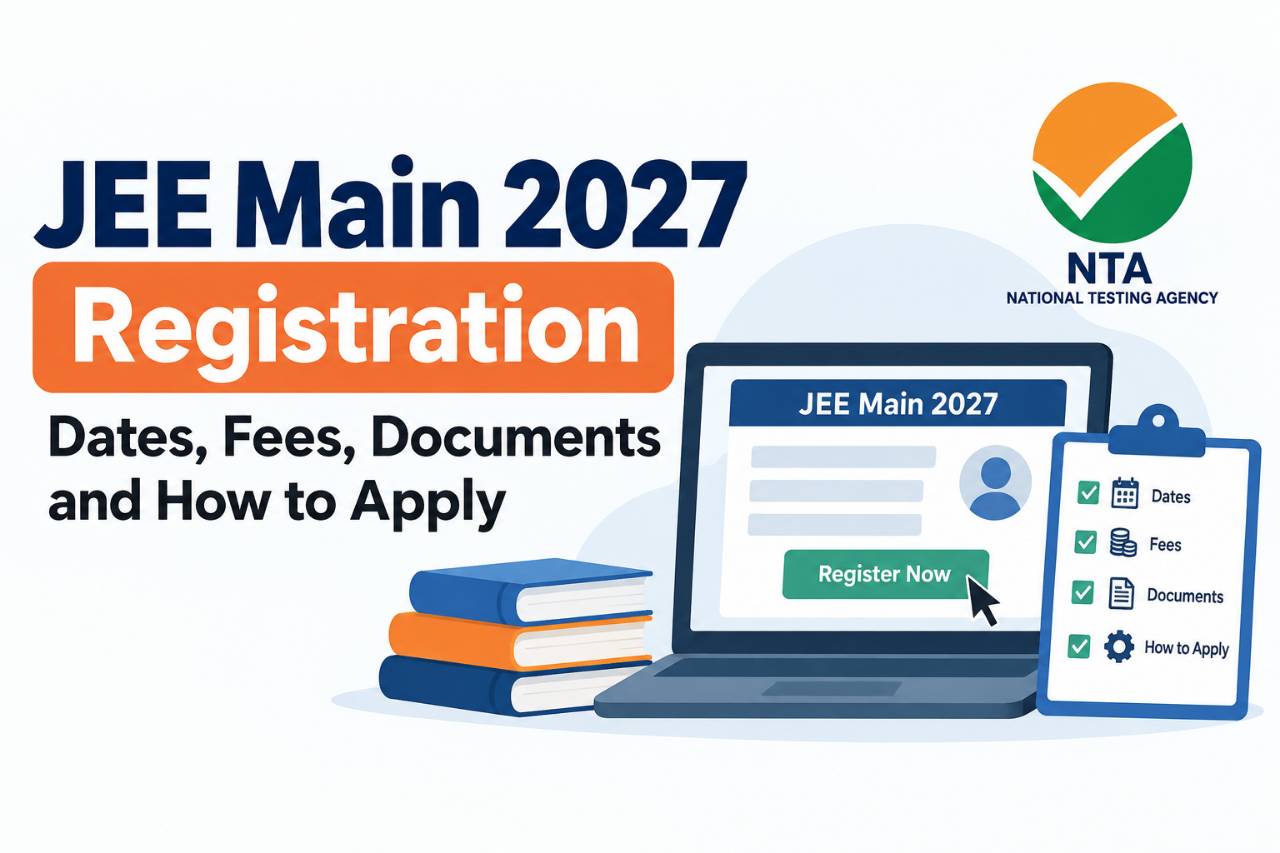
JEE Main 2027 registration is the first formal step for lakhs of Class 12 students who dream of studying engineering, architecture, or planning at India's top institutions. The National Testing Agency (NTA) is expected to open the online application window in October 2026 for Session 1, with Session 2 following in early 2027. Whether you aim for an IIT, an NIT, a state engineering college, or a B.Arch seat, your journey begins with a correctly filled form on the official portal.
This guide explains expected registration dates, eligibility, documents, fees, photo rules, step-by-step application, form correction, and what to do after you submit. Information here is based on NTA's established pattern and the latest available notices. Always cross-check details on jeemain.nta.nic.in before applying, because dates and fees can change when the official information bulletin is released.
What Is JEE Main and Why Does Registration Matter?
JEE Main is India's largest national-level engineering entrance examination. It serves as the qualifying exam for JEE Advanced (the gateway to IITs) and is also used for admission to NITs, IIITs, GFTIs, and many state and private engineering institutions through JoSAA and state counselling processes.
NTA typically conducts JEE Main in two sessions each year. For 2027, Session 1 is expected in January and Session 2 in April. You may appear in one session or both; your best score across sessions is generally considered for ranking and admission, as per the rules in the official bulletin.
Registration is not just data entry. It creates your application number, exam city preferences, category claim, and paper selection (Paper 1 for B.E./B.Tech, Paper 2 for B.Arch/B.Planning). Errors at this stage can delay admit cards, affect reservation benefits, or even lead to application cancellation. Treat registration as seriously as the exam itself.
JEE Main 2027 Registration Dates (Expected)
NTA has not always released the full calendar a year in advance, but based on previous cycles, the following timeline is widely expected for JEE Main 2027. These dates are tentative until confirmed through an official public notice on jeemain.nta.nic.in.
| Event | Session 1 (Expected) | Session 2 (Expected) |
|---|---|---|
| Application form release | October 2026 | January 2027 |
| Last date to apply | November 2026 | February 2027 |
| Form correction window | December 2026 | March 2027 |
| City intimation slip | January 2027 | March 2027 |
| Admit card release | January 2027 | March 2027 |
| Exam dates | January 2027 | April 2027 |
Actionable Tips for Managing Dates
- Apply early: Portal traffic spikes on the last day. Payment failures and slow uploads are common when everyone waits until the deadline.
- Bookmark official sources: Use only jeemain.nta.nic.in and nta.ac.in. Avoid third-party forms or paid "registration agents."
- Plan around board exams: Session 1 often falls close to Class 12 pre-boards or boards in some states. Build your study plan accordingly.
- Use both sessions strategically: If Session 1 does not go as planned, Session 2 gives you a second chance without losing an academic year.
Eligibility Criteria for JEE Main 2027
Before you start registration, confirm that you meet NTA's eligibility norms. While exact wording may appear in the 2027 information bulletin, the core requirements have remained consistent:
- Qualifying exam: You should have passed Class 12 (or equivalent) with Physics, Mathematics, and one additional subject, or be appearing in 2027.
- Year of appearance: NTA allows a limited number of consecutive attempts after Class 12. Check the latest bulletin for the exact attempt limit applicable to 2027.
- Age limit: There is generally no upper age limit for JEE Main, though IITs may have separate age criteria for JEE Advanced.
- Subject requirements: Paper 1 (B.E./B.Tech) requires PCM. Paper 2A (B.Arch) and Paper 2B (B.Planning) have distinct subject combinations read the bulletin carefully if you apply for these papers.
If you are unsure about engineering as your only path, explore related options such as Bachelor of Computer Application (BCA) or Computer Applications programmes that may admit students through university-level tests rather than JEE alone.
Documents Required for JEE Main 2027 Registration
Keep scanned copies and originals ready before opening the form. Missing or incorrect documents are among the top reasons candidates struggle during registration or correction windows.
Identity and Personal Records
- Aadhaar card or another valid photo ID accepted by NTA (such as passport, voter ID, or school ID with photograph verify current rules in the bulletin)
- Active mobile number and email ID that you will use until admission is complete
- Class 10 certificate or marksheet for name, date of birth, and board details
Academic Documents
- Class 12 marksheet or admit card (if available at the time of registration)
- Details of qualifying examination board, roll number, and year of passing/appearing
Category and Reservation Certificates
- OBC-NCL certificate (non-creamy layer) if claiming OBC reservation
- SC or ST certificate issued by competent authority
- Gen-EWS certificate if claiming Economically Weaker Section quota
- PwD certificate issued by designated medical authority, if applicable
Uploads and Payment
- Recent passport-size colour photograph (scanned as per specifications below)
- Scanned signature on white paper
- Payment method: debit card, credit card, net banking, UPI, or other options shown on the portal
NTA may also require a live photograph captured through a webcam during registration. Use a laptop or desktop with a stable internet connection and good lighting if this step is mandatory in 2027.
Photograph and Signature Specifications
Upload errors cause unnecessary stress during verification. Follow these commonly prescribed technical standards (confirm any updates in the official brochure):
| File | Size | Dimensions | Format |
|---|---|---|---|
| Photograph | 10 KB to 200 KB | 3.5 cm × 4.5 cm | JPG or JPEG |
| Signature | 10 KB to 100 KB | 3.5 cm × 1.5 cm | JPG or JPEG |
Photograph Guidelines
- Use a recent colour photo with a plain light background
- Face should be clearly visible; avoid sunglasses, caps, or heavy filters
- Ensure the photo matches your appearance on exam day to avoid issues at the centre
Signature Guidelines
- Sign with black or blue ink on white paper
- Signature must be legible not a single dot or scribble
- Do not upload a typed or digitally drawn signature unless explicitly permitted
JEE Main 2027 Application Fee (Expected)
Application fees vary by category and exam centre location. The structure below reflects recent NTA patterns and is subject to revision in the official notification:
| Category | Centres in India | Centres Outside India |
|---|---|---|
| General / OBC (Male) | ₹1,000 | ₹5,000 |
| General / OBC (Female) | ₹800 | ₹4,000 |
| SC / ST / Transgender | ₹500 | ₹2,500 |
If you opt for both Paper 1 and Paper 2, or register for multiple sessions, additional fees may apply as per the bulletin. Always pay through the official gateway embedded in the application portal. Save your payment receipt, transaction ID, and downloaded confirmation page immediately after submission.
How to Fill the JEE Main 2027 Application Form
The online process is straightforward if you prepare in advance. Below is a practical walkthrough of what you will do on jeemain.nta.nic.in.
Step 1: Visit the Official Website
Open jeemain.nta.nic.in in a updated browser. Avoid public computers for entering personal and payment details.
Step 2: New Candidate Registration
Click the JEE Main 2027 registration link and select "New Candidate Registration." Enter your name exactly as on Class 10 records, date of birth, mobile number, and email. Create a strong password and note your system-generated application number.
Step 3: Complete the Application Form
Log in with your credentials. Fill personal details, address, academic information, category, disability status (if any), and guardian details. Select your paper (B.E./B.Tech, B.Arch, B.Planning, or combinations allowed). Choose up to four exam cities in order of preference.
Step 4: Upload Documents
Upload photograph, signature, and any other required files within prescribed size limits. Preview each file before proceeding.
Step 5: Pay the Fee and Submit
Complete payment through net banking, card, or UPI. After successful payment, review the entire form, submit, and download the confirmation page. Take a screenshot or printout for your records.
JEE Main 2027 Form Correction Window
NTA usually opens a correction window after the registration deadline. During this period, you can log in and edit certain fields commonly photograph, signature, exam city preferences, and some personal details. Some fields such as name, date of birth, and category may have stricter rules or require supporting documents.
Important correction rules to remember:
- Submit only one application. Multiple forms from the same candidate may lead to cancellation of all applications.
- Do not rely entirely on correction enter accurate data the first time.
- Match every detail with your Class 10 certificate before final submission.
- Re-download the updated confirmation page after making corrections.
Choosing Exam Cities and Session Strategy
During registration, you will select preferred exam cities. NTA assigns centres based on availability, not guaranteed first preference. Choose cities where you can travel comfortably on exam day and where you have reliable accommodation if needed.
For Session 1 vs Session 2:
- Session 1 (January): Ideal if your syllabus is ready early and you want an initial rank for planning.
- Session 2 (April): Useful if you need more preparation time or want to improve your Session 1 score.
- Appearing in both sessions is a common strategy among serious aspirants from coaching hubs like Kota, where institutes such as Gurukul Institute of Engineering and Technology, Kota and Vedant College of Engineering and Technology, Kota attract JEE-focused students.
After Registration: Colleges, Counselling, and Career Paths
Successful registration is only the beginning. Your JEE Main score opens doors to hundreds of institutions. Top performers targeting IITs must also clear JEE Advanced. Others use JEE Main ranks for NITs, IIITs, and GFTIs through JoSAA counselling.
Many strong regional colleges also accept JEE Main scores or conduct their own counselling aligned with state quotas. Examples include:
- Krishna Institute of Engineering and Technology
- Galgotias College of Engineering and Technology
- SRM Institute of Science and Technology, Chennai
- Sathyabama Institute of Science and Technology, Chennai
- University of Petroleum and Energy Studies
- Imperial College of Engineering and Research, Jaipur
- Bhartiya Institute of Engineering and Technology, Sikar
If engineering through JEE does not match your interests, consider alternative pathways. Design aspirants may explore exams like NID DAT, while management-oriented students often prepare for CAT after graduation. Science and humanities students can look at programmes such as MA courses at institutions like Jesus and Mary College, Delhi.
Common Registration Mistakes to Avoid
- Name mismatch: Spelling differences between Class 10 records and the application form create long-term problems.
- Wrong category claim: OBC-NCL and EWS certificates must meet format and income criteria valid for the admission year.
- Inactive email or phone: OTPs, admit cards, and result alerts are sent to registered contacts.
- Blurry uploads: Rejected photos delay verification and may not be fixable after the correction window closes.
- Multiple applications: NTA may cancel duplicate forms one candidate, one application.
- Ignoring the bulletin: Paper pattern, marking scheme, and admission rules change occasionally. Read the full information bulletin, not just social media summaries.
Preparing While You Wait for Registration
Use the months before October 2026 productively:
- Revise Class 11 and 12 Physics, Chemistry, and Mathematics fundamentals
- Practice NTA-style mock tests in CBT format on a computer
- Shortlist target colleges and note previous years' cutoffs for realistic goal-setting
- Organise certificates in a folder physical and digital
- Discuss exam city preferences with family early to avoid last-minute confusion
Students in emerging education hubs across Rajasthan, Tamil Nadu, and NCR often combine school studies with coaching or online test series. Whether you study from Delhi, Jaipur, Sikar, or Chennai, the registration process remains the same centralised, online, and uniform nationwide.
JEE Main 2027 Paper Selection: Which Paper Should You Choose?
During registration, you must select the appropriate paper based on your target degree. Choosing incorrectly can limit your admission options later, so understand each paper before you submit.
Paper 1 – B.E./B.Tech
Paper 1 is for students seeking admission to undergraduate engineering programmes. The test covers Physics, Chemistry, and Mathematics in computer-based test (CBT) mode. This is the paper most Class 12 PCM students register for when aiming at IITs, NITs, IIITs, or private colleges such as RMK College of Engineering and Technology, Chennai and Lords Institute of Engineering and Technology, Jaipur.
Paper 2A – B.Arch and Paper 2B – B.Planning
Paper 2A is for Bachelor of Architecture programmes and includes Mathematics, Aptitude, and Drawing sections. Paper 2B targets B.Planning courses with Mathematics, Aptitude, and Planning-based questions. If you are interested in design-led careers, you may also research specialised institutes like Arch College of Design and Business, Jaipur alongside your JEE preparation.
You may register for multiple papers in the same session if you meet eligibility and pay the applicable fee. Read the information bulletin to confirm allowed combinations for 2027.
Reservation Categories and Certificate Validity
India's admission system provides reservation for eligible candidates under OBC-NCL, SC, ST, EWS, and PwD categories. Your category choice during JEE Main registration must match valid certificates you can produce during counselling.
- OBC-NCL: Certificate must be issued by a competent authority and confirm non-creamy layer status for the admission year. Outdated or incorrectly formatted certificates are rejected during verification.
- EWS: General category candidates claiming EWS quota need an income and asset certificate as per central government norms. Eligibility criteria are strict verify them before selecting EWS during registration.
- PwD: A disability certificate from a designated hospital or medical board is required. NTA provides scribe and extra time facilities for eligible candidates as per rules.
False category claims can lead to disqualification at any stage. If you are unsure about your category status, consult your school administration or a competent issuing authority before applying.
What Happens After You Submit the Application?
Registration does not end when you pay the fee. After successful submission, monitor the official portal for these milestones:
- Confirmation page: Download and save it immediately. It contains your application number and submission status.
- Form correction: Use the correction window if any editable detail needs updating.
- City intimation slip: NTA releases exam city details before the admit card. Check whether your allotted city is manageable for travel and lodging.
- Admit card: Download from jeemain.nta.nic.in using your application number and date of birth. No admit card means no entry to the exam centre.
- Exam day: Carry admit card, photo ID, and follow centre guidelines on reporting time and permitted items.
- Result and counselling: After results, JoSAA and state counselling portals open for seat allotment based on your rank and preferences.
Institutions ranging from Assam Science and Technology University to Mody University of Science and Technology, Lakshmangarh participate in various admission channels linked to JEE performance or state-level processes. Research your preferred colleges early so you can set a realistic rank target before Session 1.
Registration Checklist for JEE Main 2027
Before you click submit, run through this quick checklist:
- Name and date of birth match Class 10 certificate exactly
- Mobile number and email ID are active and accessible
- Category selected only if a valid certificate is available
- Correct paper(s) selected for your target degree
- Photograph and signature meet size and clarity requirements
- Exam cities chosen in sensible priority order
- Application fee paid and confirmation page downloaded
- Only one application submitted no duplicate forms
Parents and students in cities like Jaipur, Kota, Sikar, and Chennai often complete registration together to avoid last-minute errors. Whether you aspire to join Fairfield Institute of Management and Technology or a premier NIT, the registration discipline remains identical accuracy, timeliness, and official sources only.
Conclusion
JEE Main 2027 registration is expected to begin in October 2026 for Session 1, with Session 2 applications opening around January 2027. From documents and fee payment to city selection and form correction, each step shapes your exam experience and admission prospects. Prepare early, use only the official NTA portal, and double-check every detail against your Class 10 certificate.
Stay updated through jeemain.nta.nic.in, save your confirmation page, and plan your preparation around both sessions if needed. A careful registration today prevents avoidable stress on exam day and keeps your path open to India's best engineering and technology institutions.