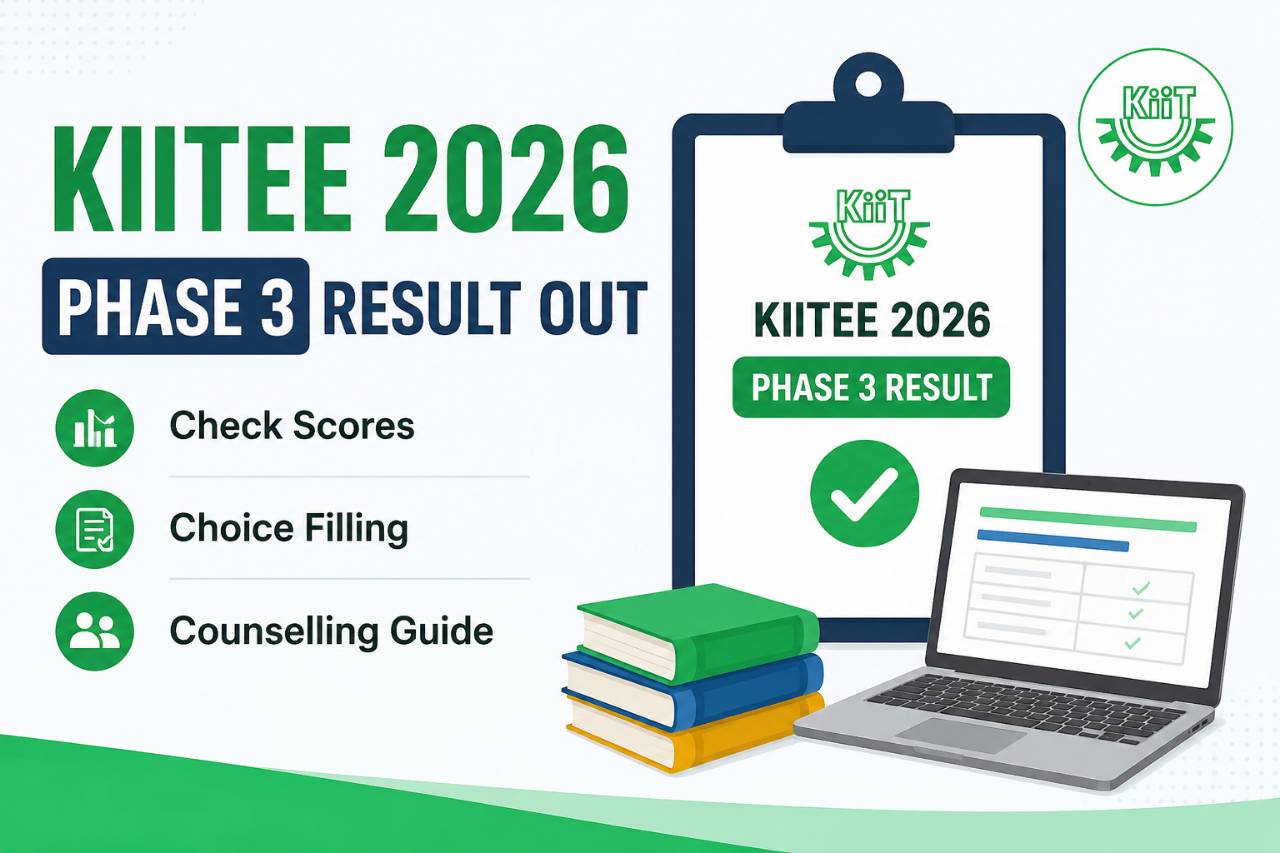

Kalinga institute of Industrial Technology (KIIT), Bhubaneswar, has released the KIITEE 2026 Phase 3 result on the official portal at kiitee.kiit.ac.in. Candidates who appeared for the third and final phase of the KIIT Entrance Examination between July 5 and July 7, 2026, can now log in with their application number and date of birth to view subject-wise scores, total marks, and All indian Rank (AIR). Along with the result, KIIT has opened online choice filling for counselling, making this a critical week for engineering and other programme aspirants targeting one of Odisha's most sought-after private universities.
Unlike national-level exams such as JEE Main, which feed into institutes like the indian institute of Technology Bombay (IIT Bombay), IIT Delhi, and IIT Madras Chennai, KIITEE is KIIT's own entrance test for admissions across B.Tech, lateral entry, undergraduate, and postgraduate programmes. Phase 3 gives students who missed earlier attempts a final opportunity within the same admission cycle. If you qualify, your next steps checking the scorecard, filling choices, and arranging the counselling fee must be completed without delay.
What Is KIITEE and Why Does Phase 3 Matter?
The KIIT Entrance Examination (KIITEE) is a computer-based test (CBT) conducted by KIIT University for admission to its campuses in Bhubaneswar and associated programmes. Each year, KIIT runs the exam in three phases to widen access for students across India. Phase 1 and Phase 2 typically attract the largest applicant pools, while Phase 3 serves candidates who need more preparation time, missed earlier registration windows, or want another attempt before the academic session begins.
Phase 3 of KIITEE 2026 was held from July 5 to July 7, 2026, across 27 states in online CBT mode. The result declaration on July 8, 2026, marks the beginning of the counselling journey for Phase 3 qualifiers. For many students, especially those comparing KIIT with state-level engineering options or private institutes in cities like Kota or Jaipur, this phase can be the deciding factor in securing a seat in a preferred branch.
How KIITEE Differs from Other Engineering Entrance Exams
Understanding where KIITEE fits in the Indian admissions landscape helps you plan better. JEE Main and JEE Advanced lead to IITs, NITs, and IIITs. State exams like OJEE, WBJEE, and MHT-CET feed regional colleges. KIITEE, by contrast, is a single-university exam your rank determines eligibility only for KIIT programmes. That focused scope means cutoffs reflect competition within the KIIT applicant pool, not the entire country.
Students who also applied to premier national institutes often keep KIITEE as a strong backup. Even if you are waiting for JoSAA or state counselling rounds, completing KIITEE choice filling preserves an admission option at a NAAC A++ accredited institution with strong placement records in core engineering and management fields.
KIITEE 2026 Phase 3 Result: Key Highlights
KIIT published the Phase 3 result on its dedicated result portal. Here are the essential details every candidate should know:
- Result date: July 8, 2026
- Official result portal: kiitee.kiit.ac.in
- Login credentials: Application number and date of birth
- Scorecard contents: Subject-wise marks, total score, and All India Rank
- Exam mode: Online CBT conducted across 27 states
- Exam dates: July 5–7, 2026
The scorecard is your primary document for counselling. Download it immediately and verify every field—name spelling, category, subject scores, and rank. Errors are rare but should be reported to KIIT's exam cell promptly if found.
What Your Scorecard Tells You
Your KIITEE scorecard is more than a marks sheet. The All India Rank (AIR) determines your position in the merit list used during seat allotment. Subject-wise breakdowns help you understand performance in Physics, Chemistry, and Mathematics (for B.Tech) or relevant sections for other programmes. While KIIT does not always publish phase-wise cutoff lists before allotment, previous years suggest that top branches like CSE and ECE require competitive ranks, while newer or specialised branches may have slightly relaxed thresholds.
Keep both digital and printed copies of the scorecard. You will need them during document verification along with Class 10 and Class 12 mark sheets, category certificates (if applicable), and identity proof.
Important Dates for KIITEE 2026 Phase 3 Counselling
Staying on top of deadlines prevents disqualification from the counselling process. Based on the official schedule released by KIIT, the following timeline applies to Phase 3 candidates:
| Event | Date |
|---|---|
| Phase 3 Examination | July 5–7, 2026 |
| Phase 3 Result Declaration | July 8, 2026 |
| Choice Filling Opens | July 8, 2026 |
| Phase 3 Seat Allotment (Tentative) | Third week of August 2026 |
Exact closing dates for choice filling are published on the counselling portal at kiitee.eduquity.com. Check the portal daily until you lock your preferences and receive allotment confirmation. Missing a deadline even by a few hours can remove you from the current round.
How to Check KIITEE 2026 Phase 3 Result Online
The Phase 3 result is hosted on a portal separate from the general counselling login. Follow these steps carefully:
- Visit the official website at kiitee.kiit.ac.in.
- On the homepage, locate and click the Phase 3 Result link.
- Enter your application number and date of birth in the prescribed format.
- Click Submit to view your scorecard on screen.
- Download the PDF and take a clear printout for counselling and record-keeping.
Actionable tip: Use the same browser and device you used during registration if possible. Clear cache or try an incognito window if the page does not load. Avoid third-party result websites they may host outdated or incorrect information.
Choice Filling for KIITEE 2026 Counselling: Complete Guide
Choice filling is the process through which qualified candidates rank their preferred courses and campuses. It is mandatory for every Phase 3 qualifier who wishes to participate in seat allotment. Skipping this step means you will not be considered for any seat, regardless of your rank.
Step-by-Step Choice Filling Process
- Log in at kiitee.eduquity.com using your application number and password or date of birth as instructed.
- Read all counselling instructions displayed on the dashboard before proceeding.
- Select your preferred programmes B.Tech branches, lateral entry options, UG courses, or PG programmes depending on your application.
- Rank choices in order of priority. Put your most desired branch first.
- Review the entire list carefully, then lock and save your choices.
- Download or screenshot the confirmation page as proof of submission.
Important: Once choices are locked, modification rules depend on KIIT's published guidelines for the current round. Assume choices are final unless the portal explicitly allows editing within a defined window.
Strategic Tips for Filling Choices Wisely
Effective choice filling balances ambition with realism. Here is how experienced counsellors advise students to approach it:
- Research branch cutoffs: Review previous years' closing ranks for CSE, IT, ECE, Mechanical, Civil, and other branches. Place a realistic option within your expected rank range at position three or four.
- Do not leave lists incomplete: Fill the maximum allowed choices. A lower-preference seat is better than no seat.
- Consider campus and hostel factors: KIIT's main campus in Bhubaneswar offers integrated residential facilities. Factor in location, fees, and programme structure.
- Match programme to schedule: KIIT publishes separate counselling schedules for B.Tech, B.Tech Lateral Entry, other UG programmes, and PG courses. Download the schedule that matches your applied stream.
- Parallel applications: If you are also tracking admissions at institutions such as the Centre for Design Excellence Jaipur or exploring education hubs in Kota through colleges like Vardhman Mahaveer Open University Kota, maintain a calendar so KIITEE deadlines are not missed.
Programmes Covered Under Phase 3 Counselling
KIIT offers a wide range of programmes, and counselling is organised stream-wise. Phase 3 qualifiers should refer to the official schedule applicable to their category:
- B.Tech: Four-year engineering programmes across multiple specialisations for Class 12 pass candidates.
- B.Tech Lateral Entry: Direct admission to the second year for diploma holders meeting eligibility criteria.
- Undergraduate (UG) Courses: Non-engineering UG programmes including law, management, and sciences.
- Postgraduate (PG) Courses: Master's level programmes for graduates seeking advanced specialisation.
Each stream may follow slightly different verification and reporting timelines. Download the relevant PDF schedule from the official portal and mark reporting dates, document checklist items, and fee payment deadlines on your calendar.
KIITEE 2026 Counselling Fee Structure and Payment
Before seat allotment is confirmed, candidates must pay a counselling fee. For KIITEE 2026, the fee structure is as follows:
| Component | Amount (INR) |
|---|---|
| Registration Fee | ₹10,000 |
| Admission Fee | ₹75,000 |
| Total Payable | ₹85,000 |
Payment mode: Demand Draft (DD) drawn in favour of KIIT, Bhubaneswar. Online payment options, if announced for specific rounds, will be listed on the official counselling portal. As of the Phase 3 notification, DD remains the specified mode—prepare it at your bank early to avoid last-minute delays.
Financial Planning Tips for Candidates and Parents
- Arrange the DD at least two to three days before the reporting deadline to account for bank processing.
- Write the applicant's name, application number, and programme on the back of the DD for easy identification.
- Keep extra copies of payment receipts and DD acknowledgment slips.
- Remember that the ₹85,000 counselling fee is separate from semester tuition, hostel, and other academic charges payable after admission.
- Compare total cost of attendance at KIIT with other options you are considering, including state universities and private colleges in Delhi, Chennai, or Rajasthan.
Understanding KIIT's Three-Phase Exam Structure
KIIT's decision to conduct KIITEE in three phases reflects a student-centric admission philosophy. Rather than limiting candidates to a single exam date, the university spreads opportunities across the admission season. Here is how the phases typically work:
- Phase 1: Early-cycle exam for proactive applicants; results and counselling begin first.
- Phase 2: Mid-cycle attempt for students who need additional preparation or missed Phase 1.
- Phase 3: Final window—often held in July—giving one last chance before the academic year intake closes.
All phases use the same exam pattern and syllabus, but seat availability in popular branches may shrink as earlier phases fill seats. Phase 3 qualifiers should therefore be flexible with branch preferences while still prioritising their top choices.
Document Verification and Post-Allotment Steps
After choice filling closes, KIIT will release the Phase 3 seat allotment result, expected during the third week of August 2026. Here is what happens next:
- Allotment publication: Log in to the counselling portal to check whether you received a seat.
- Acceptance: Follow instructions to accept the allotted seat within the given timeframe.
- Document verification: Report to the designated KIIT campus or verification centre with original documents and photocopies.
- Fee payment: Pay remaining admission charges as per the official fee structure.
- Enrollment: Complete formal enrollment to secure your seat for the 2026–27 academic session.
Documents to Keep Ready
- KIITEE 2026 Phase 3 scorecard (printout and digital copy)
- KIITEE admit card
- Class 10 mark sheet and certificate
- Class 12 mark sheet and pass certificate
- Transfer or migration certificate (where applicable)
- Category certificate (SC/ST/OBC/EWS/PwD) if applicable
- Domicile certificate if required for state quota seats
- Passport-size photographs
- Photo identity proof (Aadhaar, passport, or school ID)
- Counselling fee Demand Draft
Organise these documents in a folder labelled with your application number. Verification delays are a common reason candidates lose allotted seats—being prepared eliminates that risk.
Comparing KIIT with Other Admission Pathways
Indian students today rarely rely on a single exam. Alongside KIITEE, you may be tracking JoSAA rounds for IITs and NITs, state counselling for regional engineering colleges, or university-specific tests. Understanding how these pathways compare helps you make informed decisions.
Institutes like IIT Bombay and IIT Madras admit through JEE Advanced with highly competitive cutoffs. KIIT, as a private deemed-to-be university, offers an alternative with its own entrance exam, generally accessible to a broader rank range. For students in eastern and central India, KIIT's Bhubaneswar location also reduces relocation costs compared to moving to metro cities.
Students interested in arts, commerce, or women's colleges may simultaneously explore institutions such as Lady Shri Ram College for Women (LSR) Delhi, Indraprastha College for Women Delhi, or Bharathidasan Government College for Women Chennai through CUET or state boards. KIITEE remains relevant if your goal is specifically a professional degree at KIIT.
In Rajasthan's coaching hub, institutions like SRD Modi College for Women Kota, Shekhawati College for Education Losal Sikar, and the International Academy for Certification and Training Kota serve different academic needs. Engineering aspirants from these regions often appear for KIITEE alongside JEE Main as part of a diversified admission strategy.
Common Mistakes to Avoid During Phase 3 Counselling
Even qualified candidates lose seats due to preventable errors. Avoid these common pitfalls:
- Ignoring choice filling deadlines: Treat the closing date as non-negotiable.
- Locking choices without review: A single wrong click can place a low-priority branch above your preferred option.
- Using incorrect login credentials: Double-check application number and date of birth format (DD/MM/YYYY vs MM/DD/YYYY).
- Delaying DD preparation: Bank holidays and processing time can cause you to miss reporting dates.
- Not checking official portals: Rely only on kiitee.kiit.ac.in and kiitee.eduquity.com for authentic updates.
- Skipping document attestation: Ensure photocopies are self-attested where required.
- Assuming rank guarantees a branch: Popular branches fill quickly; always include backup choices.
What Happens If You Do Not Get Your Preferred Branch?
Seat allotment is rank-driven and subject to availability. If you receive a branch lower on your preference list, you typically have two options: accept the seat and explore branch change policies after enrollment (if KIIT permits), or decline and wait for subsequent counselling rounds if announced. Review KIIT's official withdrawal and upgrade policies before making a decision, as fee refund rules vary by round and timing.
Students who also hold offers from Indraprastha College for Women Delhi or other institutions through parallel applications should compare programme quality, fees, location, and long-term career goals not just brand name before accepting any single offer.
Why KIIT Remains a Strong Choice for Engineering Aspirants
KIIT University has built a reputation over three decades for industry-aligned curricula, campus infrastructure, and placement support. For Phase 3 qualifiers, securing a seat here means joining a community of students from across 27 states who chose KIIT for its academic environment and global partnerships. While it may not carry the national prestige label of an IIT, KIIT consistently ranks among India's top private universities and offers practical advantages including integrated campus life, research centres, and international exchange programmes.
From an E-E-A-T perspective Experience, Expertise, Authoritativeness, and Trustworthiness always cross-check information on official KIIT portals. This article summarises publicly available counselling data as of July 8, 2026, but deadlines and fee details can change. The authoritative source remains KIIT's own notifications.
Action Plan: What to Do Today
If you appeared for KIITEE 2026 Phase 3, treat the following as your immediate checklist:
- Check your Phase 3 result at kiitee.kiit.ac.in and download the scorecard.
- Note your total marks and All India Rank accurately.
- Log in to kiitee.eduquity.com and complete choice filling before the deadline.
- Lock preferences and save the confirmation page.
- Prepare a Demand Draft of ₹85,000 in favour of KIIT, Bhubaneswar.
- Gather Class 10, Class 12, and category documents for verification.
- Monitor the portal for seat allotment during the third week of August 2026.
Conclusion
The declaration of the KIITEE 2026 Phase 3 result on July 8, 2026, opens the final counselling window for candidates who tested between July 5 and July 7. With choice filling now live on kiitee.eduquity.com and seat allotment expected in August, every qualified applicant must act quickly check scores, rank preferences strategically, arrange the ₹85,000 counselling fee via Demand Draft, and prepare documents for verification. Whether KIIT is your first choice or a well-researched backup alongside exams leading to institutes like IIT Delhi, completing these steps correctly ensures you remain in the running for a seat at one of India's leading private universities. Stay updated through official portals, avoid misinformation on unofficial websites, and approach counselling with a clear priority list to maximise your admission outcome.