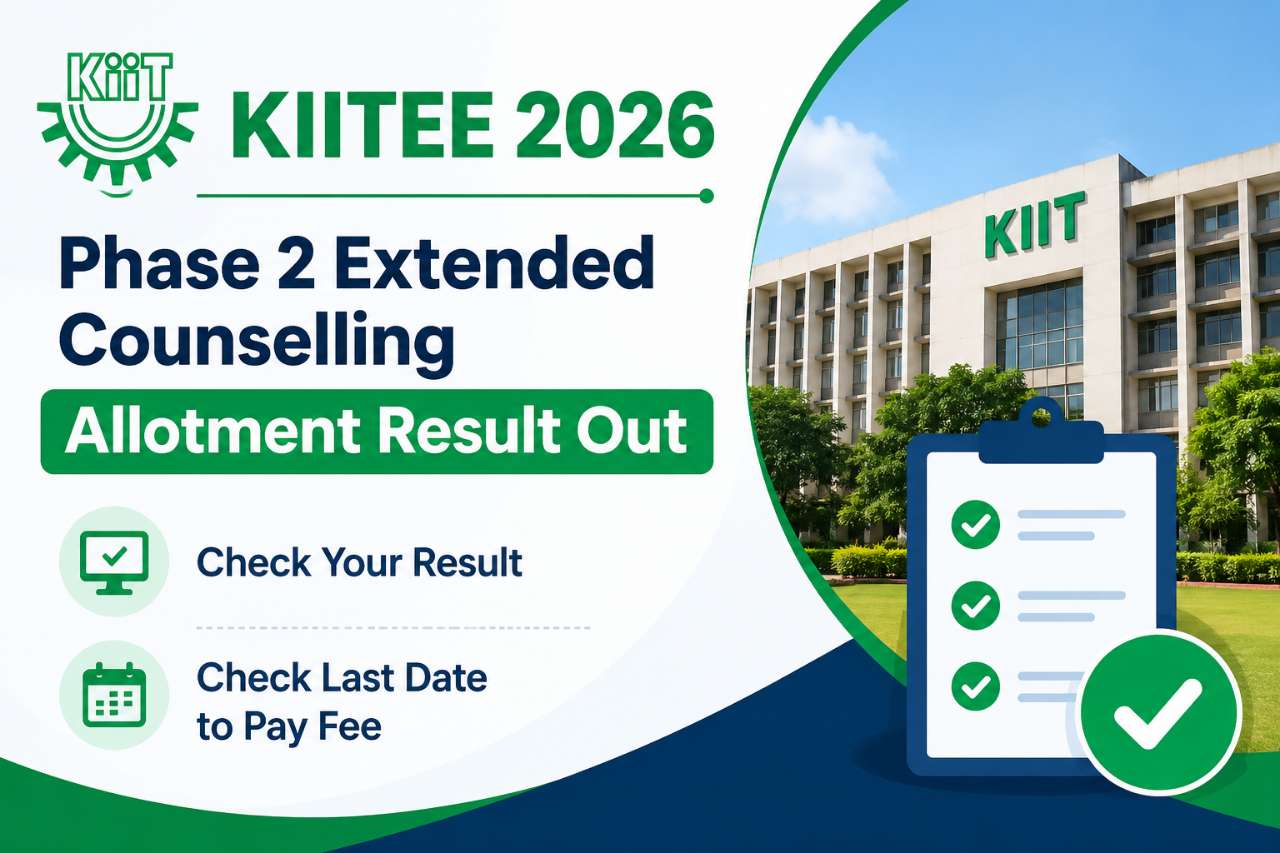

The Kalinga Institute of Industrial Technology (KIIT), Bhubaneswar, has released the provisional branch allotment result for KIITEE 2026 Phase 2 Extended Counselling. Candidates who registered for this round can now log in at the official portal, kiitee.kiit.ac.in, using their application number and date of birth to check whether they have received a seat in their preferred B.Tech programme. The extended counselling window was opened for qualified Phase 2 candidates who missed earlier rounds or wished to revise their choices before seats were finalised.
If your name appears in the allotment list, the next steps are time-sensitive. KIIT requires allotted candidates to pay the admission fee on or before July 6, 2026, report to the campus for document verification, and complete formal enrolment. Missing this deadline can lead to automatic cancellation of the allotted seat, after which the vacancy may be offered to waitlisted or subsequent-round candidates. This guide explains how to check your result, understand the allotment logic, prepare documents, pay fees, and confirm your admission without last-minute errors—whether you are a first-time counselling participant or a candidate returning after an earlier round.
What Is KIITEE 2026 Phase 2 Extended Counselling?
KIITEE (Kalinga Institute of Industrial Technology Entrance Examination) is the university-level entrance test conducted by KIIT for admission to undergraduate and postgraduate programmes across engineering, management, law, and other disciplines. For B.Tech admissions in 2026, KIIT conducts counselling in multiple phases aligned with Phase 1 and Phase 2 examination results.
Phase 2 extended counselling is a supplementary seat allocation round. It is typically announced when vacant seats remain after the regular Phase 2 counselling, or when additional eligible candidates need an opportunity to participate in choice filling. During this round, candidates submit or update their branch preferences online. The Institute then publishes a provisional branch allotment based on merit rank, locked preferences, category reservation, and real-time seat availability across departments such as Computer Science, Electronics, Mechanical, Civil, and Biotechnology.
Unlike centralized systems such as JoSAA for Indian Institute Of Technology Bombay Iit Bombay, Indian Institute Of Technology Delhi Iit Delhi, and Iit Madras Chennai, KIITEE counselling is Institute -specific. Your rank in KIITEE determines eligibility only for KIIT programmes. Students targeting national-level engineering institutes through JEE Main and JEE Advanced often keep KIIT as a strong private-university backup because of its NAAC accreditation, industry-linked curriculum, and established placement record in Odisha and eastern India.
Who Should Check the Extended Counselling Result?
Before logging in, ensure you are using the same credentials created during KIITEE registration. Candidates who changed mobile numbers or email addresses after applying should update contact details through official support channels so they receive fee reminders and reporting notifications without delay.
You should verify your allotment status immediately if you meet any of the following conditions:
- You appeared in KIITEE 2026 Phase 2 and qualified as per the published cutoff.
- You registered specifically for the Phase 2 extended counselling and completed choice filling before the deadline.
- You participated in an earlier KIITEE counselling round but did not confirm admission and re-entered extended counselling when permitted.
- You are awaiting a higher preference branch and want to confirm whether a better allotment was granted in this round.
Candidates who did not register for extended counselling or failed to lock preferences within the stipulated window will not find a fresh allotment in this result. Always cross-check your login dashboard and downloaded allotment letter rather than relying on unofficial WhatsApp forwards or third-party screenshots.
KIITEE 2026 Phase 2 Extended Counselling Allotment Result
KIIT published the Phase 2 extended counselling allotment result on its official admission portal. The result displays the candidate's name, application number, KIITEE rank, allotted B.Tech branch, campus details, and reporting instructions. The allotment is described as provisional because final admission is confirmed only after fee payment, document verification, and compliance with eligibility norms.
Seat allocation follows a transparent merit-cum-preference model. The system starts with the highest-ranked candidate and assigns the highest available preference from their locked choice list. Lower-ranked candidates are processed sequentially until seats in each branch-category combination are filled or the merit list is exhausted. If your first preference is unavailable, the algorithm moves to your next choice automatically.
Key Factors That Influence Your Allotment
- KIITEE 2026 merit rank: A better rank improves the probability of receiving high-demand branches such as CSE, IT, or ECE.
- Order of locked preferences: Listing branches realistically reduces the risk of landing an unintended programme.
- Category and reservation: Seats are distributed according to applicable reservation policies and certificates submitted during verification.
- Seat vacancy at processing time: Even strong ranks may miss a branch if all seats were filled in earlier rounds.
Students comparing KIITEE outcomes with other entrance pathways should remember that institute-specific exams serve a different admission ecosystem. While JEE Main opens doors to NITs, IIITs, and GFTIs, and JEE Advanced is mandatory for IITs including top institutions like IIT Bombay and IIT Delhi, KIITEE secures admission directly within the KIIT academic system in Bhubaneswar.
Extended counselling rounds also benefit candidates who improved their rank visibility after Phase 2 results or who needed additional time to research branch-wise career outcomes. If you listed a branch lower in your preference order but received an allotment there, evaluate the curriculum and placement data before accepting. Many students successfully build careers from branches such as Mechanical or Civil Engineering when they combine strong academic performance with internships and skill certifications.
Important Dates for KIITEE 2026 Phase 2 Extended Counselling
Staying aligned with official timelines is critical. Based on the Phase 2 extended counselling schedule, the following dates are especially relevant for allotted candidates:
| Event | Date / Timeline |
|---|---|
| Choice filling deadline (extended round) | June 27, 2026 |
| Provisional branch allotment publication | June 30, 2026 (by 5:00 PM) |
| Admission fee payment window | June 30 to July 6, 2026 |
| Last date to pay admission fee | July 6, 2026 |
| Document verification and reporting | As per schedule on allotment letter |
KIIT may issue branch-wise or rank-wise reporting slots to manage campus verification smoothly. Treat the date on your official allotment communication as final if it differs from general announcements. Enable SMS and email alerts on your registered contact details and bookmark the counselling page for updates on subsequent rounds or waitlist movement.
How to Check KIITEE 2026 Phase 2 Extended Counselling Allotment Result
The result checking process is fully online and takes only a few minutes if you keep your credentials ready. Use a laptop or smartphone with stable internet connectivity and avoid public cybercafés where login details could be compromised.
Step-by-Step Login Instructions
- Visit the official KIITEE admission website at kiitee.kiit.ac.in.
- On the homepage, locate and click the link labelled for Phase 2 Extended Counselling Result or similar wording in the counselling notifications section.
- Enter your KIITEE application number exactly as printed on your admit card or registration confirmation.
- Enter your date of birth in the format specified on the portal (typically DD/MM/YYYY).
- Submit the form and review the provisional allotment displayed on screen.
- Download and print the allotment letter for fee payment, campus reporting, and future reference.
If the portal shows "Not Allotted" or blank status, you may not have received a seat in this round. In such cases, monitor the official website for announcements regarding further extended rounds, spot counselling, or withdrawal-based vacancies. Do not pay any fee unless an official allotment is visible in your authenticated login.
Troubleshooting Common Login Issues
- Incorrect date of birth format: Retry using the format shown in the placeholder text on the login form.
- Application number mismatch: Copy the number from your admit card rather than typing from memory.
- Server timeout during peak hours: Try again after a short interval; peak traffic often occurs immediately after result publication.
- No allotment despite strong rank: Confirm that preferences were locked before the deadline and that you registered for the extended round specifically.
Last Date to Pay KIITEE 2026 Admission Fee: July 6, 2026
The most urgent action for allotted candidates is completing the admission fee payment by July 6, 2026. KIIT treats fee payment as confirmation of intent to join. Failure to pay within this window generally results in cancellation of the provisional seat, freeing it for other eligible candidates.
According to KIIT's published counselling guidelines, candidates reporting for admission must pay an initial amount of Rs. 75,000, which includes a counselling registration component of Rs. 10,000. The balance tuition and other fees as per the official fee structure are typically settled on the day of reporting or as instructed in your allotment letter. Always verify the exact payable amount on your dashboard before initiating payment, as programme-specific or category-specific variations may apply.
Accepted Payment Modes and Best Practices
- Use the online payment gateway integrated into the KIITEE portal wherever available.
- Retain the payment receipt, transaction ID, and bank confirmation screenshot.
- Complete payment at least one day before the deadline to avoid gateway failures or banking delays on the final date.
- Ensure the payer name and transaction details match KIIT's instructions; third-party payments may require additional declaration.
Paying the fee does not replace physical document verification. Both steps are mandatory. Think of fee payment as reserving your seat temporarily until the institute validates your academic and identity records on campus.
Families planning education loans should initiate bank discussions immediately after allotment, as loan disbursement timelines can extend beyond a single working day. Keep allotment letters, fee receipts, and KIIT fee structure documents ready for lender verification. Scholarships or fee concessions, if applicable, should be confirmed through the official financial aid or admission office rather than informal agents.
Admission Process After Seat Allotment
Once you have checked your allotment and paid the fee, prepare for the on-campus admission workflow. KIIT conducts document verification to confirm eligibility criteria such as age, educational qualifications, category claims, and examination performance.
Reporting to KIIT Campus
Allotted candidates must report to the designated venue—commonly the Auditorium Hall at KIIT, Bhubaneswar—on the date and time mentioned in their allotment letter. Arrive with all original documents and one set of self-attested photocopies arranged in the order specified by the admission office. Late reporting without prior approved extension may be treated as seat surrender.
Documents Required for Verification
Based on KIIT's official counselling document checklist for UG engineering admissions, carry the following:
- KIITEE 2026 admit card
- KIITEE 2026 rank card / scorecard
- Class 10 pass certificate for date of birth proof
- Class 12 mark sheet and pass certificate
- Category certificate (if applicable), issued by competent authority
- Character and transfer certificates as required by the admission office
- Passport-size photographs (keep extra copies)
- Payment receipt for admission / counselling fee
- Photo ID proof (Aadhaar, passport, or other government ID)
For lateral entry or postgraduate applicants, additional mark sheets and degree certificates apply. Any discrepancy between uploaded counselling data and original documents can lead to admission cancellation, so review spellings, board names, and category codes carefully before reporting.
Understanding KIIT B.Tech Programmes and Career Context
KIIT offers multiple B.Tech specialisations across its engineering schools. Popular branches include Computer Science and Engineering, Information Technology, Electronics and Communication, Electrical Engineering, Mechanical Engineering, Civil Engineering, and Biotechnology. Each programme combines core engineering fundamentals with elective tracks, laboratory work, internships, and placement preparation.
When evaluating whether to accept a KIITEE allotment, consider factors beyond branch name alone:
- Accreditation and curriculum: Review syllabus recency, industry partnerships, and project opportunities.
- Placement trends: Examine role types, median packages, and recruiter diversity for your specific branch.
- Campus infrastructure: Hostels, labs, libraries, and extracurricular ecosystems affect four-year learning quality.
- Location advantage: Bhubaneswar's growing IT and education hub offers internship access in eastern India.
Students who also appeared for national exams can compare outcomes holistically. Admission to IITs through JEE Advanced represents one trajectory; KIITEE represents a focused route into a deemed-to-be university with integrated campus life. Similarly, medical aspirants tracking All India Institute Of Medical Sciences Delhi Aiims Delhi through NEET follow a different counselling chain, while design candidates may pursue Nid Dat for creative programmes. Understanding these parallel pathways helps families make informed decisions instead of viewing one result in isolation.
What Happens If You Miss the Deadline or Decline the Seat?
If you do not pay the admission fee by July 6, 2026, KIIT is likely to cancel your provisional allotment. The seat may then be reallocated in a subsequent counselling iteration or offered to waitlisted candidates based on merit. There is usually no guarantee that the same branch will remain available later.
Candidates who receive an allotment but prefer another institute should formally decline or simply refrain from paying within the deadline, depending on KIIT's published policy for that round. Before making this decision, confirm whether counselling registration fees are refundable and whether non-payment affects future participation in spot rounds.
Options After Non-Allotment or Seat Surrender
- Monitor KIIT's website for additional extended counselling or spot admission notices.
- Explore state-level engineering counselling if you have valid exam scores elsewhere.
- Re-evaluate private and deemed universities with open application windows.
- Consider a planned gap year only with a structured retake strategy for the next admission cycle.
Actionable Tips for a Smooth KIITEE Admission Confirmation
Use this practical checklist to avoid common mistakes during the final admission phase:
- Verify allotment authenticity only through your personal login at kiitee.kiit.ac.in.
- Pay fees early rather than waiting until July 6, 2026.
- Organize documents in a folder with originals, photocopies, and digital scans.
- Align travel plans with your reporting slot to Bhubaneswar.
- Communicate with parents or guardians about branch acceptance, fee structure, and backup options.
- Save every receipt from online payments and counselling downloads.
- Ask official help desks for clarification instead of unverified social media groups.
Admissions season generates anxiety, but procedural discipline resolves most issues. Candidates who treat the allotment letter as a binding action plan—rather than a tentative notification—typically complete verification faster and secure hostel and academic registration without delays.
Parents and students should also note that hostel allocation, library registration, and orientation schedules often begin shortly after document verification. Confirming admission early within the July 6, 2026 fee window gives you better access to campus services and reduces the risk of missing introductory academic sessions at the start of the semester.
Conclusion
The release of the KIITEE 2026 Phase 2 Extended Counselling allotment result marks a decisive stage for thousands of engineering aspirants aiming to join KIIT Bhubaneswar. If you have been allotted a branch, your immediate priorities are clear: confirm the result online, pay the admission fee by July 6, 2026, and report for document verification with complete paperwork. The allotment reflects your KIITEE merit and preferences, but only timely fee payment and verified eligibility convert it into a confirmed seat.
Stay updated through the official KIITEE portal for any revisions to reporting schedules, fee instructions, or follow-up counselling rounds. Whether KIIT is your first choice or a strategic backup after national exams, handling this phase with accuracy and punctuality ensures you do not lose a earned seat due to administrative oversight. For the latest official announcements, continue monitoring kiitee.kiit.ac.in and prepare for a structured start to your B.Tech journey at KIIT.