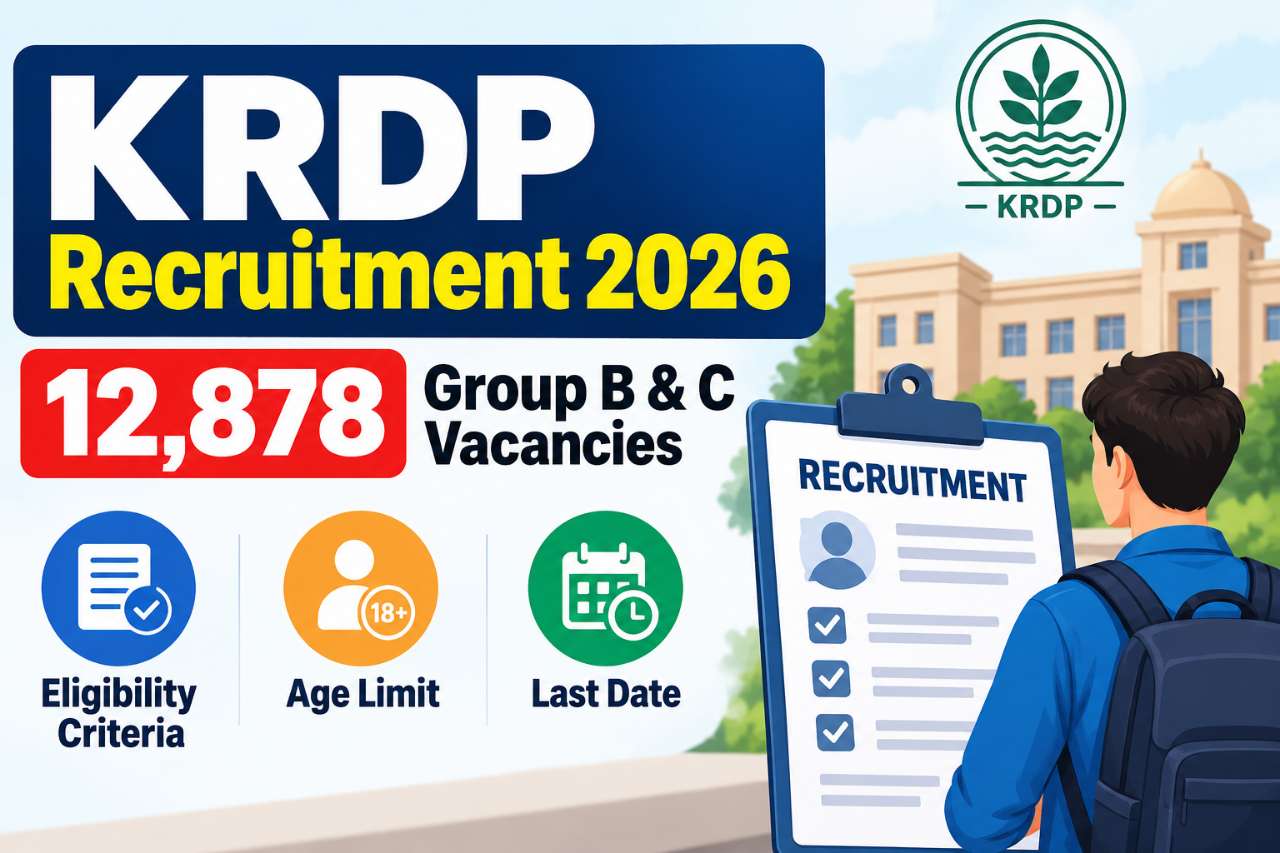
The Khadi Reforms and Development Programme (KRDP), functioning under the Ministry of Micro, Small and Medium Enterprises (MSME), Government of India, has opened one of the largest direct recruitment drives in the khadi and village industries sector for 2026–27. More than 12,878 Group B and Group C vacancies are advertised under Advertisement No. Adm.-I/NGR/KRDP/2 (117)/2026-27, covering officer-level roles, clerical posts, field staff, drivers, and multi-tasking staff across India.
If you are a final-year graduate, a diploma holder, or a Class 10 or 12 pass-out exploring stable public-sector careers beyond mainstream univeristy placements, this notification deserves a close read. Applications are accepted only through the official KRDP portal. The window runs from 26 October 2026 through structured Step-I registration and Step-II final submission, with the crucial closing date for age and qualification calculation being 30 November 2026 (6:00 PM).
This guide explains what KRDP is, post-wise eligibility, age limits, reservation, selection stages, and practical preparation tips written for Indian students and job seekers who want clear, actionable information aligned with official rules.
What Is KRDP and Why Is the 2026 Recruitment Significant?
KRDP the Khadi Reform and Development Programme is described in the official notification as a long-running initiative to modernize khadi and village industries, support rural artisans, and expand employment in traditional sectors. The programme works with government departments and implementing agencies on skill development, market linkages, and infrastructure. Strengthening its permanent workforce through direct recruitment is a logical step as khadi and village industries scale production, branding, and digital outreach.
For candidates, the scale of this drive matters: 12,878 tentative vacancies spread across 13 post categories, with reservation for SC, ST, OBC (NCL), EWS, and UR categories as per Central Government norms. Unlike many competitive exams that hire in hundreds, KRDP 2026 offers multiple entry points from master's degree holders targeting Khadi Development Officer posts to ITI-trained candidates eyeing Multi Tasking Staff (MTS) roles.
Geographically, postings may be anywhere in KRDP offices in India; the computer-based test (CBT) is planned in 21 cities including Delhi NCR, Mumbai, Bangalore, Hyderabad, Jaipur, Pune, Thiruvananthapuram, Lucknow, Patna, Ranchi, Ahmedabad, Jammu, Bhubaneswar, Varanasi, and Shillong. You choose three exam cities in order of preference at the time of application, and that choice typically cannot be changed later.
KRDP Recruitment 2026: Important Dates at a Glance
Missing a deadline can disqualify an otherwise eligible candidate. Mark these dates from the official recruitment notice:
- Step-I Online registration: 26 October 2026 to 25 November 2026 (up to 6:00 PM)
- Step-II Final application submission: 26 November 2026 to 30 November 2026 (up to 6:00 PM)
- Application form correction window: 2 December 2026 to 4 December 2026 (up to 6:00 PM)
- Computer-based examination: To be notified later on the official website
KRDP explicitly advises candidates not to wait until the last hour. Server congestion near deadlines is a recurring issue in large government recruitments. Complete Step-I early, then use the Step-II window to review post codes, exam city preferences, and personal details before final lock-in.
Crucial cut-off date for age and qualifications
Your age and educational qualification are assessed as on 30 November 2026. Degrees still in progress, appearing candidates, or incomplete experience (where required) generally do not meet eligibility. If you are completing a degree this semester, ensure the result is published and certificates are available before the closing date.
Vacancy Breakdown: Group B and Group C Posts
The recruitment bundles executive and supervisory roles under Group B and operational cadres under Group C. Tentative vacancy numbers from the notification include:
Group B posts (officer and executive cadre)
- Khadi Development Officer (KDO): 410 vacancies Master's degree in any subject; Pay Level 7 (₹44,900–₹1,42,400)
- Khadi Inspector (KI): 421 Graduation or Diploma in Handloom & Textile; Pay Level 6
- Account Officer (AO): 405 B.Com or M.Com; Pay Level 6
- Technical Officer (TO): 596 B.E./B.Tech in Textile, Mechanical, Chemical, or Khadi and Village Industries Engineering; Pay Level 6
- Field Officer (FO): 1,026 Graduation, B.E., or Diploma in Textiles & Handicraft; Pay Level 6
- Executive Khadi (EK): 308 B.E./B.Tech in Textile Engineering, Textile Technology, or Fashion Technology; Pay Level 6
- Executive Village Industries (EVI): 436 B.E./B.Tech, M.Sc., or MBA with B.Sc.; Pay Level 6
Engineering graduates from institutions such as Government Engineering College Ajmer or Rajiv Gandhi Government Engineering College Alwar should map their branch carefully to Technical Officer and Executive Khadi eligibility. Commerce graduates can target Account Officer; arts and science postgraduates fit Khadi Development Officer.
Group C posts (support and field cadre)
- Supervisor Grade-III (SG3): 834 Graduation plus two years of supervisor/field experience; Pay Level 5
- Junior Assistant (JA): 1,206 12th pass, typing (Hindi 25 WPM / English 30 WPM), basic computer knowledge; Pay Level 4
- Village Industries Worker (VIW): 2,140 12th pass; Pay Level 3
- Lower Division Clerk (LDC): 1,232 12th pass, typing (Hindi 30 WPM / English 35 WPM), basic computer knowledge; Pay Level 2
- Driver (DRV): 152 10th pass, valid LMV/HMV licence, three years' driving experience; Pay Level 2
- Multi Tasking Staff (MTS): 3,712 10th pass or ITI (NCVT); Pay Level 1
Junior Assistant and LDC are popular among intermediate pass-outs who have invested in typing and basic IT skills. A structured programme like Bachelor of Computer Application (BCA) is not mandatory for these posts, but the "basic computer knowledge" clause makes short-term digital literacy courses valuable during preparation.
Eligibility Criteria: Education, Age, and Nationality
Educational qualification (post-wise)
There is no single qualification for all posts. You must match the mandatory minimum for the post code you select:
- Postgraduate level: Khadi Development Officer requires a master's degree from a recognized univeristy.
- Graduation: Khadi Inspector, Field Officer, Supervisor Grade-III, and several Group B roles accept bachelor's degrees; some allow equivalent diplomas in textile or handloom disciplines.
- Professional degrees: Account Officer needs B.Com/M.Com; Technical and Executive posts need relevant B.E./B.Tech or combinations such as MBA with B.Sc. for Executive Village Industries similar in rigour to pathways pursued by candidates preparing for exams like CAT for management admissions at institutes such as International Management Institute (IMI) Delhi, though KRDP selects through its own CBT merit list.
- Class 12: Junior Assistant, Village Industries Worker, and LDC.
- Class 10 or ITI: Driver and MTS.
Candidates who completed degrees through open and distance learning should confirm that their university is recognized and that the notification's requirement of full-time regular courses (unless otherwise specified) does not exclude their mode of study. Many aspirants use state open universities for example Indira Gandhi National Open University (IGNOU), Vardhman Mahaveer Open University Kota, or Tamil Nadu Open University Chennai to finish graduation while working; verify document acceptance at verification stage.
Age limit (as on 30 November 2026)
The standard age band is 18 to 40 years. Relaxations apply as per Government of India rules, including:
- SC/ST: 5 years upper age relaxation
- OBC (Non-Creamy Layer): 3 years
- Persons with Benchmark Disabilities (40% and above): 10 years (UR), with higher relaxations for PwBD-OBC and PwBD-SC/ST categories
- Ex-Servicemen: As per central guidelines
- Government servants: Upper limit relaxable up to 45 years subject to applicable recruitment rules
- J&K domicile (1980–1989 period): 5 years as per notified guidelines
OBC candidates in the Creamy Layer must apply under the General category and are not entitled to OBC age or fee concessions where applicable.
Other eligibility conditions
- Indian citizenship is mandatory.
- Supervisor Grade-III requires two years of relevant experience; experience certificates are needed at document verification if the post demands it.
- Driver posts require a valid licence and three years of driving experience.
- Government/PSU employees need a No Objection Certificate (NOC) from the employer at verification/joining; apply only after employer approval.
- Selected candidates face a two-year probation before regularization under KRDP rules.
Application Fee and How to Apply Online
According to the official notification and application portal summary, the application fee is Nil for all categories across advertised posts removing a common barrier for SC/ST and EWS applicants. Still, keep payment-related fields ready if the portal displays post-specific instructions during your session.
Apply only at portal.krdp.org.in or through links from krdp.org.in/recruitment.php. Do not use third-party "apply on your behalf" services that may misuse personal data.
At this stage, upload of marksheets and degree certificates is not required; however, every detail in the form must match originals you will produce later. False declarations lead to cancellation.
Important: You cannot change the post after final submission. Choose one post code carefully after comparing qualifications and vacancy numbers.
Selection Process: CBT, Skill Test, and Document Verification
Computer-based test (CBT)
Selection is primarily through a 2-hour online examination with 120 objective questions for advertised Group B and Group C posts (scheme as per notification). The paper is broadly split into:
- Part-I (40 questions): General Knowledge/Awareness, Numerical Ability, and General English
- Part-II (80 questions): Professional Knowledge related to the discipline/post
Each question carries one mark; there is no negative marking for wrong answers in the described scheme. Question papers are bilingual (English and Hindi); if there is a discrepancy in Hindi text, the English version prevails.
Merit lists are drawn from CBT performance. Shortlisted candidates proceed to document verification according to merit, vacancies, and reservation rules not an open interview for all applicants.
Skill test / typing test (Junior Assistant and LDC)
For Junior Assistant and Lower Division Clerk, a qualifying computer-based skill test follows the CBT:
- English typing: 35 words per minute for 10 minutes
- Hindi typing: 30 words per minute for 10 minutes
Marks in the skill test do not count toward final merit, but failing to meet qualifying standards disqualifies you from appointment. Daily typing practice is non-negotiable for these codes.
Document verification, medical examination, and appointment
Carry original certificates and one set of self-attested copies for age, education, caste/EWS/PwBD certificates, experience, and NOC if employed. Medical fitness is required before joining. Tie-breaking uses date of birth (older candidate ranked higher) and then higher percentage in the qualifying examination.
Reservation and Category-Wise Vacancies
Tentative category distribution for the total 12,878 posts includes approximately 2,520 SC, 285 ST, 3,428 OBC (NCL), 1,441 EWS, and 5,204 UR vacancies subject to change if KRDP revises requirements. PwBD reservation follows central rules. Claim reservation only if you hold valid certificates in the prescribed format; discrepancies at verification are a common reason for candidature cancellation.
Preparation Strategy for KRDP 2026
For Group B (professional knowledge heavy)
Allocate roughly two-thirds of study time to Part-II. Textile engineering graduates should revise fiber science, spinning, weaving, and quality standards; commerce candidates should brush up GST basics, accounting, and audit fundamentals for Account Officer posts; general graduates targeting Field Officer or Khadi Inspector should study khadi history, KVIC/KRDP schemes, and rural development programmes.
For Group C (balanced aptitude and typing)
Part-I rewards consistent practice in arithmetic, reading comprehension, and static GK covering Indian economy, MSME policies, and government schemes. For JA/LDC, parallel typing drills to notification speeds save last-minute stress.
Study resources and parallel education paths
If you lack a degree for higher posts, planning admissions through reputable colleges remains a long-term lever institutions in Rajasthan such as Poddar Group of Institution Jaipur, Shekhawati Group of Institutions Sikar, or engineering groups like KIET Group of Institutions and Dronacharya Group of Institutions serve regional students who later compete for graduate-level government jobs. Open universities including Madhya Pradesh Bhoj Open University Bhopal and Nalanda Open University Patna help working professionals close qualification gaps before future recruitment cycles.
Common Mistakes to Avoid
- Applying under the wrong post code and discovering qualification mismatch after final submit
- Ignoring typing/skill test requirements for clerical posts
- Choosing exam cities casually all three preferences matter for allotment
- Waiting until 30 November evening for first-time registration
- Employed in government service without securing NOC before applying
- Assuming experience waivers apply without reading SC/ST relaxation notes in the notification
Who Should Consider KRDP 2026?
This recruitment suits candidates who want Central-sector-style pay levels tied to khadi and village industries missions not metro corporate roles, but meaningful public work with nationwide posting flexibility. Recent graduates from textile and commerce streams, experienced supervisors, clerical staff with typing skills, licensed drivers, and ITI holders each have dedicated vacancy pools. With zero application fee and large vacancy counts, KRDP 2026 is among the more accessible large-scale government recruitment notifications this season.
Pay Scale, Probation, and Career Outlook After Selection
Each post in the KRDP notification is mapped to a Central pay level under the applicable pay matrix. Group B roles such as Khadi Development Officer start at Pay Level 7 with a scale of ₹44,900 to ₹1,42,400, while most other Group B posts sit at Pay Level 6 (₹35,400–₹1,12,400). Group C posts range from Pay Level 1 for MTS up to Pay Level 5 for Supervisor Grade-III. Selected candidates also receive allowances as per KRDP rules governed under CDA norms.
Appointment comes with a two-year probation. Performance during probation determines regularization in the cadre. Because KRDP may post you to any office in India, treat mobility as part of the job profile rather than an exception. For young professionals comparing this path with private-sector campus placements from colleges such as CBS Group of Institutions or management campuses like KIET Group of Management, KRDP offers pay stability, pension-era benefits under government rules, and sector-specific expertise that can compound over a full career in rural industry development.
Documents Checklist for Verification Stage
Although documents are not uploaded during online registration, start collecting them now to avoid last-minute gaps:
- Photo identity proof (Aadhaar, passport, voter ID, driving licence, or PAN as accepted in exam instructions)
- Proof of date of birth (10th certificate or equivalent)
- Educational certificates from matriculation onward, including degree/provisional degree and mark sheets
- Caste/EWS/PwBD certificates in central format if claiming reservation
- Experience certificates for Supervisor, Driver, or any post requiring prior service
- NOC from current employer for government/PSU/autonomous body staff
- Passport-size photographs matching the application
Keep both originals and self-attested photocopies in a single folder labeled with your registration number. KRDP does not grant extra time if you arrive without a required certificate.
KRDP vs Other Government Jobs: Quick Comparison
Aspirants often apply to SSC, railway, banking, and state PSC exams in parallel. KRDP differs in three practical ways: sector focus (khadi and village industries), a single CBT with heavy professional weightage for technical posts, and clerical skill tests for JA/LDC. There is no interview stage for all candidates merit is CBT-driven followed by verification. If your goal is textile, rural MSME, or handicraft policy work, KRDP aligns closely with your domain. If you prefer generalist administrative exams, you may still apply here when your qualification matches a high-vacancy code such as Village Industries Worker or MTS while continuing broader exam preparation.
Students in design and technology ecosystems whether at MIT Art Design and Technology University Pune or preparing for creative entrance exams like NID DAT may find Executive Khadi and textile-linked Group B posts a complementary public-sector option that values production knowledge and traditional craft modernization.
After You Apply: Admit Card, Exam Day, and Result
Once the CBT schedule is published, download the e-admit card from the official portal and check exam city, reporting time, and instructions. Carry a printed admit card plus original photo ID; electronic gadgets including calculators, phones, smartwatches, and Bluetooth devices are prohibited inside the centre. Attempt all 120 questions strategically without negative marking, educated guesses on Part-I can lift totals if Part-II feels difficult.
Results and document verification call letters will be posted on krdp.org.in. Monitor the site and the email or mobile number registered in Step-I. Retain your registration number until joining; it is the primary key for all KRDP correspondence.
Conclusion
The KRDP application window for 2026–27 opens a rare mass hiring channel into India's khadi and village industries ecosystem, with 12,878 Group B and C positions, online applications until 30 November 2026, and an age window of 18–40 years (with standard relaxations). Success depends on choosing the correct post code, meeting the 30 November cut-off for degrees and age, preparing for a 120-question CBT plus clerical skill tests where applicable, and keeping verification documents ready.
Re-read the official advertisement on krdp.org.in before you submit, register early in Step-I, and treat professional knowledge and typing practice as equally important. For broader higher-education and exam planning beyond this notification, explore courses and institutions on CollegeDwar to align your qualifications with the next government recruitment cycle.