Every year, lakhs of medical graduates wait anxiously after NEET PG for one number that reshapes their career: their All India Rank. With more than 2.65 lakh candidates appearing for NEET PG 2026 on August 30 across 338 cities, competition for postgraduate seats in MD, MS, PG Diploma, and DNB programmes remains intense. The Medical Counselling Committee (MCC) will conduct centralised counselling for 50% All India Quota (AIQ) seats in government medical colleges, central universities, deemed universities, ESIC institutions, and selected DNB institutes.
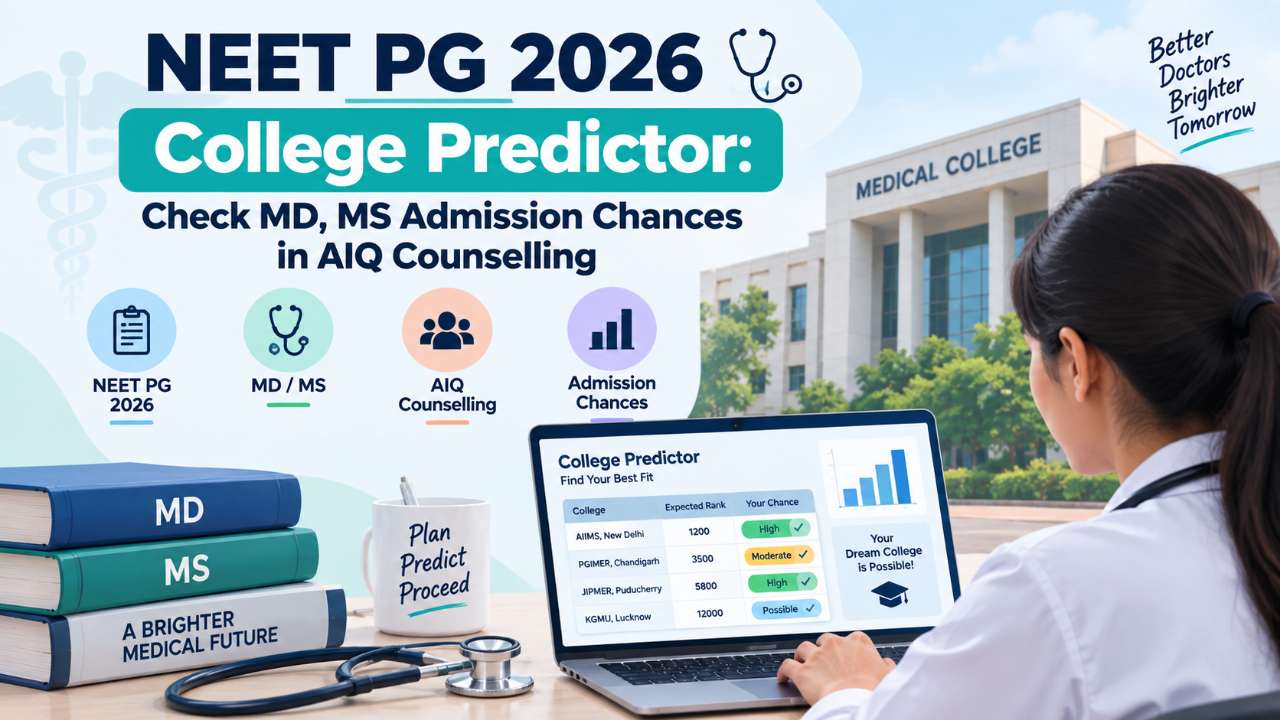
Before MCC opens registration, a NEET PG college predictor helps you translate expected rank into realistic college and speciality options. Instead of guessing whether Radiodiagnosis at a top Delhi Institute is within reach or if Orthopaedics at a government college in another state fits your profile, you can use historical cutoff data to build a data-backed shortlist. This article explains how AIQ college predictors work, what inputs matter, how to read closing ranks, and how to plan counselling choices with confidence aligned with what serious PG aspirants need in 2026.
What Is NEET PG 2026 and AIQ Counselling?
NEET PG is the national entrance examination for admission to postgraduate medical courses in India. The National Board of Examinations in Medical Sciences (NBEMS) conducts the exam; MCC handles counselling for the All India Quota and several centrally administered institutions.
Under the 50% AIQ system, half the seats in participating government medical colleges are filled through MCC's online counselling. The remaining 50% plus state quota seats are filled through respective state counselling authorities. Deemed universities, central universities, AIIMS (through separate processes in some cycles), ESIC, and AFMS also follow MCC-led or MCC-notified routes depending on the admission year.
Who Should Use a College Predictor?
A college predictor is useful if you:
- Have appeared for NEET PG 2026 and are awaiting the official result
- Want to estimate admission chances before the answer key and result are published
- Need a speciality-wise list of colleges based on category (General, OBC, SC, ST, EWS) and quota (AIQ, sometimes PwD)
- Plan to compare institutes on location, stipend, bond conditions, and seat availability
- Intend to participate in MCC Round 1, Round 2, mop-up, and stray vacancy rounds strategically
Predictors do not guarantee admission. They estimate probability using past counselling trends. Treat output as guidance for choice filling, not a final admission letter.
Why Use a NEET PG College Predictor Before MCC Counselling?
PG medical counselling is high-stakes and irreversible in many rounds once you accept a seat. A single poorly ranked choice can lock you into a speciality or location you did not want. Predictors reduce uncertainty by answering practical questions early:
- Which specialities match my expected rank? Clinical branches like General Medicine, General Surgery, Paediatrics, Orthopaedics, Dermatology, Anaesthesiology, Obstetrics and Gynaecology, and Radiodiagnosis have very different closing ranks.
- Which colleges are realistic vs ambitious? Separating dream, target, and safe options prevents blank choices during counselling.
- How does my category affect cutoffs? Reserved category cutoffs often differ significantly from General category closing ranks.
- Should I wait for subsequent rounds? Historical trends show whether certain colleges fill only in mop-up or stray rounds.
Using a predictor weeks before choice filling gives you time to verify college details stipend structure, bond years, hostel facilities, and patient load rather than making rushed decisions on counselling day.
Think of the predictor as the first layer in a three-step admission strategy: estimate rank, map colleges, then validate through official MCC documents. Candidates who follow this sequence enter counselling with clearer priorities and fewer costly errors during freeze, float, and reporting decisions.
How NEET PG College Predictors Work
Most reputable NEET PG college predictors use structured historical data from previous MCC counselling rounds. The logic is straightforward: if your expected rank is better (numerically lower) than last year's closing rank for a given college-speciality-category combination, you likely have a reasonable chance subject to seat matrix changes and competition shifts.
Data Sources Behind Predictions
Predictor engines typically analyse:
- Round-wise closing ranks from prior NEET PG counselling cycles
- Category-wise cutoff trends (General, OBC, SC, ST, EWS, PwD where applicable)
- Speciality-wise seat intake variations
- Institute type: government medical colleges, central universities, deemed universities, ESIC, DNB
- Counselling round behaviour Round 1 vs mop-up closing rank differences
Advanced tools may factor in rank inflation or deflation based on exam difficulty, number of candidates, and changes in seat matrix. Always check whether the tool specifies which years' data it uses recent cycles (NEET PG 2023, 2024, 2025) are more relevant than older datasets.
Limitations You Must Understand
No predictor is perfect. Admission chances can change because of:
- Increase or decrease in AIQ seats for a speciality
- New colleges joining or leaving the MCC matrix
- Unexpected rank shifts after a difficult or easy exam
- Policy updates in reservation or quota rules
- Candidate preference shifts toward specific branches like Radiodiagnosis or Dermatology
Use predictors for planning. Confirm final eligibility, seat matrix, and cutoffs on the official MCC website when counselling begins.
Key Inputs for Accurate Predictions
Garbage in, garbage out. Predictor accuracy depends on the inputs you provide.
1. Expected or Actual NEET PG Rank
Your All India Rank (AIR) is the primary variable. If the result is not out, use a rank predictor based on expected marks from memory-based answer keys. NEET PG 2026 consisted of 180 MCQs for 720 marks, with +4 for each correct answer and −1 for each incorrect response. Even a 10-mark swing can shift rank by thousands depending on overall performance distribution.
2. Category
Select your exact category as per your NEET PG application and certificate. Category changes not supported by valid documentation will invalidate counselling participation.
3. Quota
Most AIQ predictors focus on the 50% All India Quota. State quota counselling follows separate rules through state authorities. Do not mix AIQ closing ranks with state quota cutoffs they are not interchangeable.
4. Speciality Preference
Some tools allow filtering by preferred branches. If you are flexible say, open to Anaesthesiology or ENT run multiple simulations to widen your options.
Understanding Cutoffs, Closing Ranks, and Seat Matrix
Aspirants often confuse cutoff marks with closing rank. For MCC counselling, closing rank is the more reliable metric because marks alone do not account for exam scaling and yearly difficulty variation.
What Is Closing Rank?
Closing rank is the All India Rank of the last candidate allotted a seat in a particular college, speciality, category, and quota in a given counselling round. If the closing rank for General Medicine at a college was 2,500 in Round 1 last year, candidates ranked better than 2,500 had a seat opportunity in that round.
Sample Illustrative Comparison (Past Trend Style)
The table below uses simplified, illustrative numbers to show how specialities differ in competition level. Always verify live data during counselling.
| Speciality | Typical Competition Level | Illustrative General AIQ Closing Rank Range* |
|---|---|---|
| Radiodiagnosis | Very High | Top 500–1,500 |
| Dermatology | Very High | Top 800–2,000 |
| General Medicine | High | 1,500–5,000 |
| Orthopaedics | High | 2,000–6,000 |
| Paediatrics | Moderate to High | 3,000–8,000 |
| Anaesthesiology | Moderate | 5,000–15,000 |
| ENT | Moderate | 8,000–20,000 |
| Pathology | Relatively Lower | 15,000–35,000+ |
*Illustrative ranges only; actual NEET PG 2026 cutoffs will depend on seat matrix, exam difficulty, and candidate preferences.
Round-Wise Behaviour
Closing ranks often become less favourable (higher numerically) in later rounds as top candidates exit the pool. Some premium college seats that did not fill in Round 1 may appear in mop-up. Tracking round-wise history helps you decide whether to float or freeze choices.
Popular MD and MS Specialities: What to Expect in 2026
Branch preference drives cutoffs as much as college reputation. Clinical branches with strong outpatient or diagnostic appeal tend to close earliest.
High-Demand Branches
- Radiodiagnosis: Consistently among the most competitive due to work-life balance perceptions and diagnostic focus.
- Dermatology: Limited seats and high preference keep closing ranks very low.
- General Medicine and General Surgery: Broad career pathways; heavy competition at metro institutes.
- Orthopaedics and Paediatrics: Strong demand in both government and deemed setups.
Moderate-Demand Branches
- Anaesthesiology, ENT, Ophthalmology, and Emergency Medicine often offer relatively better chances at similar rank bands compared with Radiodiagnosis.
- Non-clinical branches such as Pathology, Microbiology, and Pharmacology may suit candidates prioritising academic careers or specific locations.
When running a predictor, test both your dream branch and adjacent alternatives. Many candidates discover viable paths by simulating cross-speciality options early.
Top Medical Colleges Under MCC AIQ Counselling
Delhi remains one of the most searched destinations for PG medical education because of clinical exposure, faculty strength, and alumni networks. Premier institutes frequently referenced in cutoff discussions include:
- Vardhman Mahavir Medical College (VMMC), New Delhi attached to Safdarjung Hospital; highly competitive across clinical branches.
- Maulana Azad Medical College (MAMC), Delhi among India's oldest and most reputed government medical colleges.
- University College of Medical Sciences (UCMS), Delhi strong academic culture with GTB Hospital affiliation.
Beyond Delhi, AIQ counselling covers government medical colleges nationwide from established state capitals to newer institutes. Deemed universities and ESIC medical colleges add further options with separate fee and bond structures. Use your predictor output to map geography: some candidates prefer a slightly lower-tier college in a preferred city over a higher-ranked college in an unfamiliar state.
Delhi's wider higher-education ecosystem also supports interdisciplinary growth. While PG medical admissions run through NEET PG and MCC, the capital hosts renowned institutions across disciplines from St Stephens College Delhi and Hindu College Delhi for undergraduate excellence to specialised postgraduate centres making the city a long-term academic hub for healthcare professionals who later pursue teaching, research, or hospital administration.
NEET PG 2026 Result, Answer Key, and Timeline
NEET PG 2026 was conducted in a single shift on August 30 at 1,111 examination centres. NBEMS is expected to release results by around September 30, 2026, though candidates should monitor nbe.edu.in for official notifications.
Answer Key for the First Time
Notably, NBEMS will publish the NEET PG 2026 answer key along with recorded responses a transparency measure that helps candidates estimate scores before the final result. Cross-check the provisional key, note discrepancies, and follow the official challenge window if announced.
Recommended Timeline for Aspirants
- Immediately after exam: Note memory-based questions and estimate raw scores.
- After answer key: Refine expected marks; run rank predictor, then college predictor.
- After result: Lock actual AIR; regenerate college lists; download MCC information bulletin.
- Before Round 1: Finalise choice order; verify documents; complete MCC registration and fee payment.
- During counselling: Track allotment lists; decide on reporting, upgradation, or seat resignation rules.
MCC NEET PG Counselling Process: Quick Overview
While exact dates vary each year, MCC counselling generally follows this structure:
Registration and Fee Payment
Candidates register on the MCC portal, pay counselling fees, and fill choices online. Only registered candidates are considered for seat allotment.
Choice Filling and Locking
You rank preferred college-speciality combinations. Order matters enormously MCC allotments follow your preference list subject to rank and availability. Lock choices before the deadline; unlocked lists may not be processed.
Seat Allotment and Reporting
Round 1 allotment results are published online. Candidates must report to allotted colleges within specified dates with original documents. Understand freeze, float, and withdraw options each round these decisions affect whether you can participate in upgradation.
Subsequent Rounds
Round 2, mop-up, and stray vacancy rounds absorb vacant seats. Predictors based on earlier years can hint which institutes historically had mop-up availability, but live vacancy lists are authoritative.
How to Use a NEET PG AIQ College Predictor: Step-by-Step
Follow this practical workflow for best results:
- Gather your expected or actual AIR from NEET PG result or rank predictor tools.
- Confirm category and PwD status exactly as in your application.
- Select AIQ quota unless you are specifically analysing deemed or central university seats as offered by the tool.
- Enter details into the predictor and generate your college-speciality list.
- Segment results into three buckets: Dream (stretch), Target (realistic), Safe (high probability).
- Research each institute: annual stipend, bond in years, penalty amount, hostel, and case load.
- Re-run after official result if you used estimated marks earlier.
- Align output with MCC choice filling predictor lists should map directly to your preference order.
Actionable Tips to Maximise Your Admission Chances
Build a Tiered Choice List
Include at least 20–40 well-researched preferences mixing specialities and locations. A list with only top five Radiodiagnosis seats in metro cities is a common reason for round-wise exit without allotment.
Compare Stipend and Bond Policies
A lower-ranked college with no bond and higher stipend may offer better long-term value than a prestigious institute with a five-year rural bond and penalty clause.
Monitor Official MCC Notices
Seat matrix PDFs, institute lists, and counselling schedules on mcc.nic.in override any third-party predictor output.
Prepare Documents Early
Registration certificates, internship completion, category certificates, and photo IDs should be ready before Round 1 to avoid last-minute disqualification.
Discuss With Mentors and Senior Residents
Ground reality on workload, academic environment, and exit opportunities often differs from brochure claims. Alumni insights complement predictor data.
Documents and Eligibility Checklist Before Counselling
Predictor output is useful only if you meet MCC eligibility requirements. Keep these documents ready and cross-check institute-specific rules on the official portal:
- NEET PG 2026 scorecard and admit card
- MBBS degree certificate and provisional or permanent registration with State Medical Council or MCI/NMC
- Internship completion certificate with clear start and end dates
- Category certificate (OBC, SC, ST, EWS) in prescribed format and PwD certificate if applicable
- Valid government photo ID, passport-size photographs, and domicile documents if required by allotted institute
- Migration and character certificates as requested during reporting
Any mismatch between your NEET PG application details and uploaded certificates can lead to cancellation of allotment. Run your predictor profile using the same category and quota you can legally substantiate.
Common Mistakes to Avoid
- Confusing AIQ with state quota cutoffs separate processes, separate ranks.
- Ignoring round-wise dynamics Round 1 closing ranks differ from mop-up.
- Over-relying on one speciality flexibility improves allotment odds.
- Wrong category selection in tools always match official category.
- Missing choice-lock deadlines technical errors cost a counselling year.
- Accepting seats without reading bond terms financial penalties can run into tens of lakhs.
Planning Beyond the First Allotment
If Round 1 does not bring your desired match, do not panic. Many successful PG residents enter through Round 2 or mop-up. Update your predictor inputs with your exact rank, prune unrealistic choices, and add institutes that historically had vacant seats.
Candidates exploring postgraduate options outside central counselling for example, management or healthcare administration programmes sometimes evaluate institutions such as St Wilfreds PG College Jaipur or professional colleges in other cities. These paths are separate from NEET PG MD/MS admission but reflect how medical graduates diversify careers after internship.
Similarly, cities like Jaipur and Kota remain important education hubs. While College of Hospitality Administration, Jaipur serves a different domain, the broader point stands: map your counselling outcomes against long-term career geography, not just rank prestige alone.
Conclusion
NEET PG 2026 counselling for MD, MS, PG Diploma, and DNB seats under MCC's All India Quota rewards preparation beyond the examination hall. A NEET PG college predictor turns historical cutoff patterns into a personalised shortlist helping you approach choice filling with clarity rather than guesswork. Combine predictor insights with official MCC data, verified rank, disciplined choice ordering, and thorough institute research to maximise your admission chances.
Start early: estimate your rank after the answer key, simulate college options by category, refine your list when results declare, and enter Round 1 with dream, target, and safe choices already mapped. In a competitive field of over 2.65 lakh aspirants, structured planning is often the difference between a missed round and a seat that launches your postgraduate medical career.