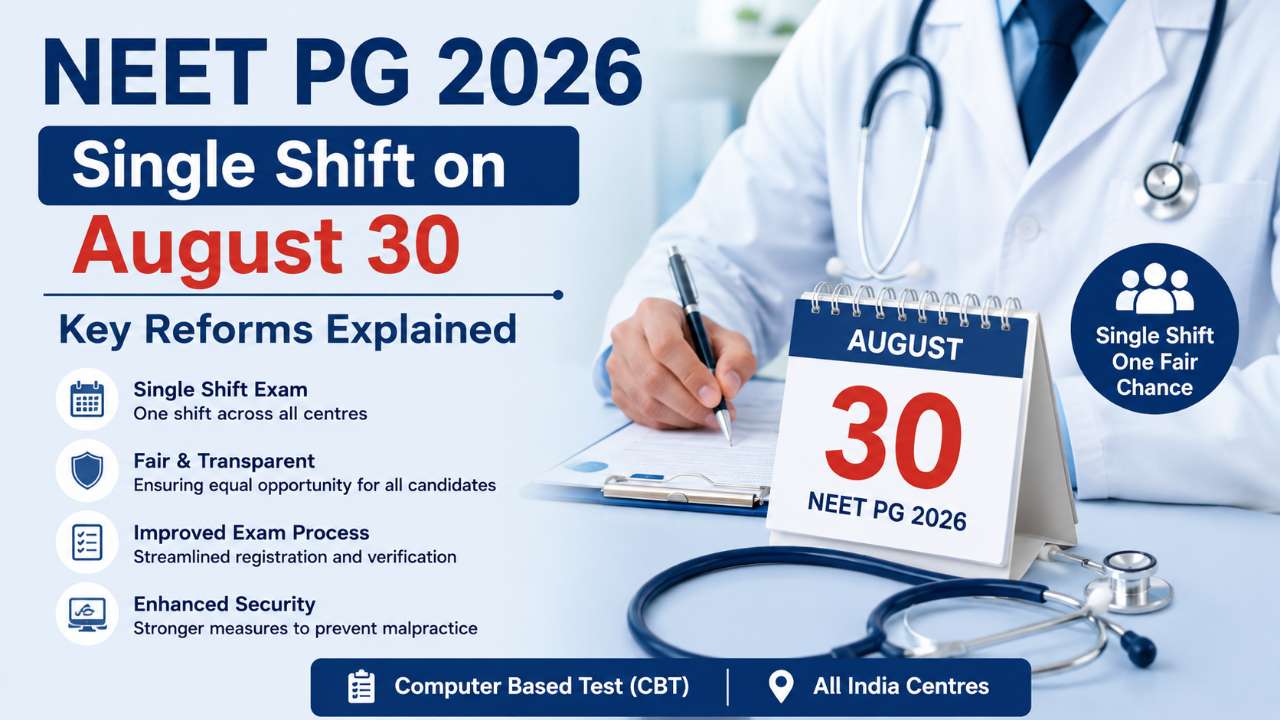
If you are a medical graduate preparing for postgraduate specialisation in India, NEET PG 2026 is the gateway exam that will shape your next career move. The National Board of Examinations in Medical Sciences (NBEMS) has announced that the examination will be held on August 30, 2026, in a single shift across roughly 340 cities and more than 1,300 centres nationwide. For lakhs of doctors who cleared NEET UG years ago and completed their MBBS internship, this edition brings meaningful reforms aimed at fairness, convenience, and security.
Unlike recent years when multi-shift conduct and score normalisation drew criticism, NEET PG 2026 returns to one uniform session for all candidates. Question count drops from 200 to 180 while duration stays at 210 minutes. Centre allocation no longer follows a first-come-first-served race. Aadhaar authentication, iris biometrics, encryption-led paper delivery, and live monitoring form a tighter security framework. Union Health Minister J P Nadda recently reviewed preparations and urged candidates to ignore paper-leak rumours while focusing on verified official updates.
This guide explains every major reform, the revised exam pattern, centre allotment rules, security measures, and practical preparation tips written in simple language for Indian PG medical aspirants. For ongoing exam updates, also bookmark our dedicated NEET PG page on CollegeDwar.
NEET PG 2026 at a Glance: Date, Scale, and Conducting Body
The NEET family of examinations governs medical admissions at undergraduate and postgraduate levels in India. NEET PG specifically determines seat allocation for MD, MS, PG Diploma, and certain other postgraduate medical courses under the All India Quota and state counselling processes.
Key Facts for NEET PG 2026
- Exam date: August 30, 2026
- Conducting body: NBEMS (National Board of Examinations in Medical Sciences)
- Mode of exam: Computer-Based Test (CBT) in a single shift
- Registered candidates: Over 2.73 lakh (approximately 12.5% higher than the previous year)
- Exam centres: 1,300+ centres across ~340 cities
- Examination functionaries: More than 60,000 staff deployed nationwide
- Total duration: 3 hours 30 minutes (210 minutes)
- Total questions: 180 MCQs (reduced from 200)
The single-shift format is among the most significant structural changes. When all candidates sit for the same paper at the same time, there is no need for inter-shift score normalisation a process that previously caused anxiety over perceived difficulty differences between sessions.
Why NEET PG 2026 Reforms Matter for Medical Graduates
Postgraduate medical entrance in India is intensely competitive. A small change in exam logistics can affect travel costs, mental readiness, and ultimately performance. The 2026 reforms respond to long-standing candidate concerns in four broad areas:
- Uniform assessment: Single-shift conduct ensures every candidate faces the same question paper under comparable conditions.
- Reduced travel stress: State-based centre preferences and scrapping of the FCFS rush aim to place candidates closer to home where possible.
- Better time management in the exam: Fewer questions with unchanged duration gives roughly 70 seconds per question instead of about 63 seconds earlier.
- Stronger integrity: Multi-layer security from Aadhaar verification to encrypted paper delivery addresses malpractice concerns that have affected public trust in national medical exams.
For context, the journey to NEET PG begins much earlier. Students who once competed through NEET UG to secure MBBS seats now face a different but equally demanding filter at the PG level. Cities known for intensive coaching ecosystems such as Kota, where institutes like the International Academy for Certification and Training Kota support competitive exam preparation remain part of the broader medical education landscape, even though NEET PG preparation is largely clinical and subject-driven rather than school-level coaching.
Single-Shift Examination: What Changed and Why
In several recent NEET PG editions, the exam was conducted in two shifts or rescheduled across multiple sessions due to operational or emergency reasons. That approach required statistical normalisation to compare scores across shifts a method candidates often found opaque and unfair.
Benefits of the Single-Shift Model
- No normalisation debate: Raw scores reflect performance on one common paper.
- Equal difficulty: Every candidate answers identical questions on the same day.
- Simpler result processing: Faster, more transparent ranking for counselling.
- Unified exam-day experience: Standard reporting time, instructions, and environment nationwide.
NBEMS and the Union Ministry of Health and Family Welfare have positioned the return to a single session as a deliberate move to restore confidence in the examination system. Health Minister Nadda's review meeting emphasised that agencies must deliver a smooth, secure, transparent, and technology-enabled process signalling that operational readiness is being monitored at the highest level.
What Candidates Should Expect on Exam Day
On August 30, 2026, lakhs of candidates will log in at roughly the same hour across India. Expect strict gate-closing rules, mandatory biometric checks, assigned computer terminals, and instructions read aloud by centre staff. Carry your admit card, Aadhaar, and any other documents listed in the official call letter. Arrive at least 60–90 minutes before reporting time to accommodate verification queues. Mobile phones, smartwatches, bags, and study material are prohibited inside the hall. Familiarise yourself with the CBT interface during mock tests so navigation does not consume precious minutes on exam day.
Revised NEET PG 2026 Exam Pattern: 180 Questions, Same Duration
Understanding the pattern change is essential for recalibrating your mock-test strategy. Previously, NEET PG carried 200 multiple-choice questions in 210 minutes for a maximum of 800 marks. From 2026 onward, the paper will contain 180 MCQs, while the total time remains 210 minutes.
Pattern Comparison Table
| Parameter | Earlier Pattern | NEET PG 2026 Pattern |
|---|---|---|
| Number of questions | 200 | 180 |
| Exam duration | 210 minutes | 210 minutes |
| Approximate time per question | ~63 seconds | ~70 seconds |
| Maximum marks | 800 | To be confirmed in official information bulletin |
| Question type | MCQ (single correct response) | MCQ (single correct response) |
| Negative marking | Yes (as per NBEMS rules) | Expected to continue; verify in official bulletin |
How to Adapt Your Preparation
- Practise 180-question full-length mocks instead of 200-question papers to build accurate pacing.
- Use the extra seconds per question for clinical vignettes that require two-step reasoning not for overthinking straightforward recalls.
- Revise high-yield subjects (Medicine, Surgery, OBG, Paediatrics, Pathology, Pharmacology, PSM) with equal weightage awareness; fewer questions does not mean fewer topics.
- Track accuracy over speed in the final month; the pattern rewards thoughtful answers within a still-tight timeline.
The syllabus continues to draw from MBBS-level subjects tested in postgraduate entrance. Align your notes with the latest NBEMS information bulletin once released or updated on the official portal.
Test Centre Allocation Reforms: End of First-Come-First-Served
One of the most practical changes for 2026 candidates involves how exam cities are assigned. For years, applicants rushed to submit forms immediately after registration opened, believing that early submission secured preferred cities. NBEMS has explicitly ended this practice.
New Three-State Preference System
Instead of selecting specific test cities on a first-come-first-served basis, candidates must now choose three preferred test states during application:
- First preference: Must be your correspondence state as declared in the application form.
- Second and third preferences: Should be neighbouring states to your correspondence state.
NBEMS will attempt to allot a test city within one of your preferred states, following your order of preference, subject to infrastructure, security, and administrative feasibility. However, the board reserves the right to assign a centre anywhere in India if unavoidable circumstances arise.
Critical Rules Candidates Must Not Miss
- Early application gives no advantage for centre allotment take time to verify every detail before final submission.
- Correspondence address and test state preferences cannot be edited after final submission, even during the correction window.
- Valid address proof for the correspondence address must be uploaded as prescribed in the information bulletin.
- Chandigarh candidates: Since no test centre exists in the UT of Chandigarh, candidates with a Chandigarh correspondence address are treated as belonging to Punjab for allocation purposes.
This reform is designed for equitable geographical distribution, reduced long-distance travel, and better infrastructure planning not to create a new race on registration day.
Enhanced Security Measures for NEET PG 2026
Medical entrance exams in India operate under intense public scrutiny. NBEMS has layered multiple security protocols for 2026 to deter impersonation, paper leaks, and organised malpractice.
Identity Verification
- Aadhaar-based authentication is mandatory during registration and on exam day.
- Biometric verification at the centre; if fingerprint authentication fails, iris-based biometric verification will be used.
- Recent photograph requirements (typically within three months) to match live identity checks.
Exam Centre and Paper Security
- Advance sealing and verification of examination centres
- Continuous CCTV surveillance and live monitoring through central and regional command centres
- Signal jammers to block unauthorised communication
- Candidate frisking and strict item restrictions inside the hall
- Dynamic computer allocation at centres
- Independent observers and appraisers for real-time supervision
- Multi-layer encryption for question paper preparation and delivery
- Secure offline paper preparation with time-bound finalisation shortly before the exam
- Controlled digital decryption only at scheduled test commencement
NBEMS has also operationalised a dedicated email channel for reporting impersonation, touting, and other unfair practices, alongside regular advisories warning candidates against fraudsters claiming access to leaked papers. Minister Nadda specifically cautioned aspirants not to believe rumours or fall prey to misinformation campaigns on social media.
Registration and Documentation Checklist
While exact registration dates should always be verified on the official NBEMS website, the documentation expectations for 2026 are clearer than before because of Aadhaar integration and non-editable correspondence details.
Documents and Details Typically Required
- Valid Aadhaar linked to mobile number for OTP authentication
- MBBS degree or provisional pass certificate (as applicable)
- Internship completion certificate or proof of eligibility
- Registration certificate from National Medical Commission or State Medical Council
- Category certificate (if applicable)
- PwBD certificate (if applicable)
- Recent passport-size photograph meeting NBEMS specifications
- Valid correspondence address proof (as listed in the information bulletin may include Aadhaar, passport, utility bill, bank statement, etc.)
- Three test state preferences planned in advance
Before clicking submit, cross-check spelling of your name, date of birth, category status, and correspondence address against official records. Errors that cannot be corrected later may affect centre allotment or admit card details.
Preparation Strategy for NEET PG 2026 Under the New Pattern
Reforms change logistics; they do not reduce the depth of knowledge required. A structured plan remains the best defence against uncertainty.
Phase-Wise Study Plan (Actionable Framework)
Phase 1 Foundation (Months 1–3): Complete one full syllabus pass using standard PG prep resources (Marrow, PrepLadder, DAMS, or equivalent notes aligned to your learning style). Focus on concept clarity in Medicine and Surgery.
Phase 2 Integration (Months 4–6): Subject-wise MCQ drills with emphasis on previous years' NEET PG and INI-CET patterns. Maintain an error log for recurring weak areas.
Phase 3 Simulation (Final 8–10 weeks): Attempt full-length 180-question timed mocks every 3–4 days. Analyse percentile trends, not just raw scores. Revise image-based questions (radiology, histology, instruments).
Phase 4 Exam Week: Light revision only. Prioritise sleep, confirm travel to your allotted city, carry required ID and Aadhaar, and reach the centre well before reporting time.
Subject-Wise High-Yield Tips
- Medicine and Surgery: Anchor your score; integrate guidelines (API, standard textbooks) with clinical scenarios.
- Pathology and Pharmacology: Expect mechanism-based questions; use tables for comparatives.
- PSM: National health programmes, biostatistics, and epidemiology formulas appear frequently.
- Paediatrics and OBG: Age-specific presentations and management algorithms are favourites.
- Short subjects (Anatomy, Physiology, Biochemistry, Microbiology, Forensic, Ophthalmology, ENT, Psychiatry, Orthopaedics, Radiology, Anaesthesia, Dermatology): High return per hour invested do not neglect them in the final sprint.
Eligibility and Who Can Appear for NEET PG 2026
NEET PG is open to candidates who have completed or are completing the mandatory rotating internship and hold a recognised MBBS degree. Provisional registration with the NMC or a state medical council is typically required at the time of application, with permanent registration expected before admission. Foreign medical graduates must meet equivalency norms prescribed by NBEMS. Candidates who have previously qualified but seek a better rank may reappear, subject to attempt and age rules in the official bulletin. Understanding eligibility early prevents wasted application fees and last-minute disqualification during document verification at counselling. Always download the latest NBEMS information bulletin for authoritative eligibility criteria.
Whether you are a fresh intern in Delhi, a house officer in Rajasthan, or revising between duties at a tertiary hospital, these reforms affect everyone equally. Treat official communication from NBEMS and the Ministry of Health as your single source of truth throughout the 2026 cycle.
Timeline: Important Milestones Leading to NEET PG 2026
Staying ahead of official deadlines reduces last-minute panic. While NBEMS publishes exact dates in its information bulletin, the typical sequence for NEET PG follows a predictable rhythm each year. Registration and fee payment open on the official portal first, followed by an edit window for certain fields though correspondence address and test state preferences are now locked after submission in 2026. Admit cards appear roughly one to two weeks before the exam. The CBT is held on the announced date (August 30, 2026), after which provisional answer keys, objection windows, and final results follow. Counselling through MCC and state authorities begins once ranks are declared. Mark each milestone on your calendar and subscribe to official NBEMS notifications rather than relying on unverified social media forwards.
What Happens After NEET PG 2026: Counselling Overview
Your NEET PG score determines rank, which feeds into centralized counselling for All India Quota seats and subsequent state-level rounds. While counselling notifications follow separately, understanding the pipeline helps you plan finances and preferences early.
- All India Quota (AIQ) counselling conducted by MCC for participating states and central institutions
- State counselling for respective domicile rules and seat matrices
- Deemed and central university processes where applicable
- Reporting and document verification at allotted institutes before joining
Keep scanned copies of internship records, registration certificates, and category documents ready in the post-result phase to avoid last-minute delays. Research institutes and specialisations in advance so choice filling during counselling is strategic rather than reactive.
Common Mistakes to Avoid in NEET PG 2026
- Rushing registration on day one without verifying correspondence address and state preferences
- Assuming normalisation will compensate for a weak attempt single shift means your score stands as attempted
- Ignoring official advisories and relying on Telegram or WhatsApp "leak" channels
- Practising outdated 200-question mocks without adjusting timing for the 180-question format
- Neglecting biometrics readiness ensure Aadhaar details match and fingers are clean for scanning on exam day
- Over-traveling unnecessarily wait for official city allotment before booking non-refundable tickets unless policy allows changes
Conclusion: Staying Informed and Exam-Ready
NEET PG 2026 represents a thoughtful reset: one shift for all, fewer questions with more breathing room, fairer centre allocation without an FCFS scramble, and security infrastructure designed to protect candidate effort and public trust. For the more than 2.73 lakh registered doctors, the exam on August 30 is not just a test of clinical knowledge it is a test of calm planning under reformed rules.
Verify every detail on the official NBEMS portal and our updated NEET PG resource page on CollegeDwar. Ignore leak rumours, double-check your application before submission, adapt mocks to the 180-question format, and treat the single-shift conduct as an opportunity for a level playing field. With disciplined preparation and awareness of the new reforms, you can walk into the examination hall focused on what truly matters: demonstrating the competence you built through years of medical training.