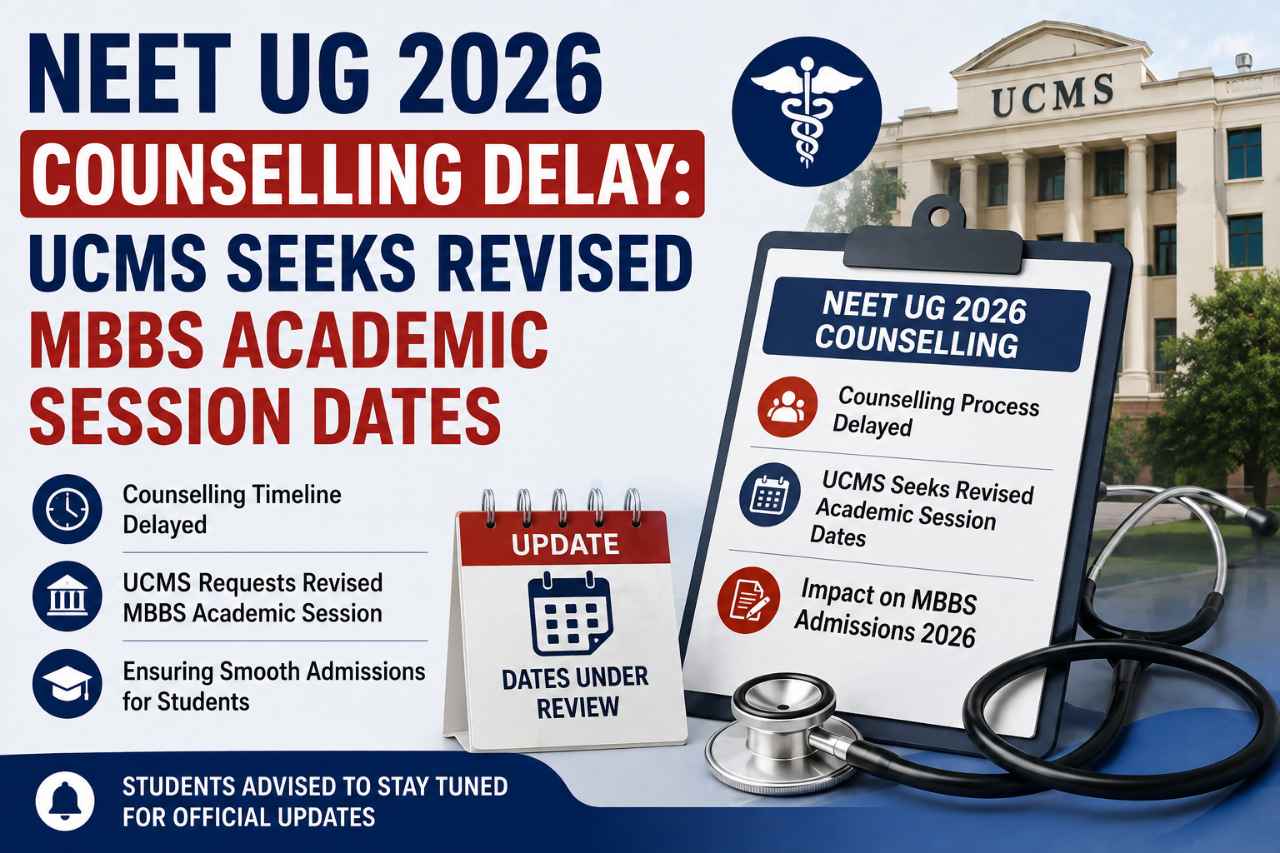

The NEET UG 2026 admission cycle has entered a critical phase where counselling schedules and academic calendars no longer align smoothly. On September 1, 2026, the University College of Medical Sciences (UCMS), Delhi, publicly raised concerns about delays in central counselling and asked the Medical Counselling Committee (MCC) and National Medical Commission (NMC) to announce revised dates for the MBBS academic session 2026–27. For thousands of medical aspirants who cleared NEET, this is not merely an administrative detail—it directly affects when classes begin, how orientation is conducted, and whether every admitted student gets an equal start to medical education.
UCMS, affiliated with the University of Delhi and attached to Guru Teg Bahadur (GTB) Hospital, is among India's established government medical colleges. When an institution of this stature flags planning difficulties, it signals a nationwide challenge affecting AIIMS-like centres, state medical colleges, and deemed universities alike. This article explains what UCMS has communicated, why the September 8 commencement date creates practical problems, and what students and parents should do while awaiting official clarification.
Background: NEET UG 2026 and the Central Counselling Timeline
NEET UG 2026 remains the single gateway examination for admission to MBBS, BDS, AYUSH, and other undergraduate medical programmes across India. After results are declared, the MCC conducts online counselling for All India Quota (AIQ) seats, central institutions, deemed universities, and other categories. State counselling authorities handle respective state quota seats in parallel or sequential rounds.
For the 2026–27 session, the originally notified academic commencement for MBBS was September 8, 2026. However, the revised central counselling calendar tells a different story. According to the letter sent by UCMS, Round 2 counselling is scheduled from September 3 to September 11, 2026, and the last date for joining after Round 2 allotment extends to September 18, 2026. Subsequent rounds—including mop-up and stray vacancy rounds—are expected to continue until October 2026.
This overlap means many students will still be accepting seats, reporting to colleges, and completing document verification while institutions are expected to have already started the academic year. Colleges in Delhi such as Vardhman Mahavir Medical College (VMMC), New Delhi, and All india Institute of Medical Sciences (AIIMS), New Delhi, face the same structural challenge even if they have not issued public statements: how do you run a fixed foundation course when your batch is still forming?
What UCMS Has Asked MCC and NMC to Clarify
Dr Satendra Singh, Chairperson of the Foundation Course at UCMS and GTB Hospital, addressed a formal communication to the MCC and NMC seeking two outcomes:
- A revised commencement date for the MBBS academic session 2026–27 that reflects the full counselling and admission schedule.
- Explicit permission for medical colleges to begin the Foundation Course and Phase 1 MBBS teaching only after the relevant counselling and admission process for their intake is substantially complete.
- A uniform revised academic calendar applicable across institutions so that no college is forced to start classes prematurely while others wait for batch finalisation.
The request is procedural but important. Without central clarity, each medical college must interpret NMC regulations independently, creating inconsistency between institutions and confusion for students moving between states or rounds.
Why a Uniform Calendar Matters Nationwide
India has more than 700 MBBS colleges. Some finish admissions early through internal or state rounds; others depend heavily on MCC stray vacancies. A uniform calendar prevents a situation where students admitted in October in one state join classes that began in early September elsewhere, then struggle to catch up on anatomy dissections, professionalism modules, and clinical exposure hours mandated under the Competency-Based Medical Education (CBME) framework.
The Clash Between September 8 Start and Ongoing Counselling
Medical colleges plan their academic year months in advance. Faculty rosters, laboratory batches, lecture hall slots, and hospital posting rotations are allocated based on expected student strength. When the notified session start is September 8 but Round 2 joining continues until September 18—and later rounds stretch into October—colleges encounter a scheduling impossibility.
UCMS highlighted that treating September 8 as the official commencement date while counselling remains active creates significant practical difficulty. Institutions cannot freeze timetables if seat allotments are still changing. A student vacating a seat in Round 2 may trigger redistribution, which alters section sizes and teaching group assignments overnight.
Key Dates at a Glance
Based on the counselling timeline referenced in UCMS's communication, aspirants should note the following approximate milestones for NEET UG 2026 MBBS admissions:
- Original MBBS session start: September 8, 2026
- Round 2 counselling window: September 3–11, 2026
- Last date to join after Round 2: September 18, 2026
- Further rounds including stray vacancy: Expected through October 2026
Students should verify exact dates on the official MCC website (mcc.nic.in) and their state counselling portal, as minor revisions can occur. Treat UCMS's letter as context for understanding systemic delay—not as a substitute for official notifications.
NMC Requirements Before MBBS Classes Can Begin Properly
Under NMC's undergraduate medical education regulations, colleges cannot simply gather students in a lecture hall and begin subject teaching without preparatory steps. Several mandated activities must be scheduled before and during the early weeks of MBBS:
15-Day Foundation Course
The Foundation Course is a structured introduction to medical professionalism, communication, ethics, basic life support, orientation to the campus and hospital, and study skills. It typically runs for about 15 days before Phase 1 subjects such as Anatomy, Physiology, and Biochemistry begin in earnest. Colleges must publish the foundation course schedule on their institutional website before commencement.
Phase 1 Teaching Timetable
Phase 1 spans the first year (and part of the second year under CBME) with integrated competencies, small-group tutorials, laboratory sessions, and early clinical exposure. Preparing this timetable requires knowing exact batch strength, creating teaching groups of manageable size, assigning faculty mentors, and booking laboratories and skills labs.
Parent–Faculty Interaction
NMC mandates at least one of two required Parent–Faculty Interaction sessions during the first year. Colleges need confirmed student lists and parent contact details to organise this meaningfully. Late admissions after the session date mean some families miss a key touchpoint designed to build trust and clarify academic expectations.
UCMS noted that preparing these schedules requires colleges to know the likely strength and composition of the admitted batch, allocate teaching groups, assign faculty, reserve lecture theatres, and coordinate departments ranging from Anatomy to Community Medicine. All of this becomes unstable when admissions remain open.
How Counselling Delay Affects Students, Parents, and Colleges
Impact on Students
For NEET qualifiers, the delay extends a period of uncertainty that begins after the exam and continues through multiple counselling rounds. Specific student-level consequences include:
- Missing mandatory orientation: Students joining after the foundation course has started may skip ice-breaking sessions, campus tours, and introductory modules on medical ethics.
- Unequal academic footing: Early joiners get extra days of dissection hall practice and tutorial exposure; late joiners compress the same competencies into shorter windows.
- Travel and relocation stress: Families booking accommodation near colleges in Delhi, Mumbai, Chennai, or other hubs face last-minute changes if allotments shift across rounds.
- Repeated timetable revisions: Batch reshuffling mid-course disrupts study groups and mentor assignments, affecting academic continuity.
Impact on Parents
Parents invest significant time and resources in the admission process—counselling registration, choice filling, fee payment, and relocation. Delayed clarity on session dates makes financial planning harder. Those who miss the Parent–Faculty Interaction lose an opportunity to meet educators responsible for their child's formative medical training years.
Impact on Medical Colleges
From an institutional perspective, UCMS outlined several operational difficulties:
- Finalising faculty and departmental teaching schedules without confirmed headcount
- Arranging laboratories, skills training facilities, and clinical rotation slots
- Publishing a definitive timetable on the website before the academic year—a regulatory expectation
- Managing inequity between students admitted in earlier versus later counselling rounds
- Coordinating hostel allotment, ID card generation, and library access for a batch arriving in waves
These are not unique to UCMS. Any MBBS college conducting MCC or state counselling during September and October faces parallel constraints. The letter effectively voices a sector-wide administrative bottleneck.
Delhi Medical Colleges and the Broader Admission Ecosystem
Delhi hosts several premier medical institutions beyond UCMS, including VMMC, AIIMS New Delhi, Maulana Azad Medical College, and Lady Hardinge Medical College. Delhi University-affiliated colleges draw high rank holders from across India. When UCMS requests a revised calendar, it reflects pressure on the capital's medical education infrastructure during peak admission season.
Meanwhile, other Delhi universities such as Jamia Millia Islamia, New Delhi, have faced separate admission-related controversies in 2026, reminding students that counselling fairness and timeline transparency matter across disciplines. Medical aspirants should focus on official MCC notices and college admission cells rather than social media rumours.
Students exploring postgraduate pathways after MBBS should separately track NEET PG schedules, which follow a different calendar and do not resolve undergraduate admission delays.
What Should NEET UG 2026 Aspirants Do Right Now?
While MCC and NMC respond to UCMS's request, students can take practical steps to protect their admission and academic readiness:
- Monitor official portals daily: Check mcc.nic.in for round-wise schedules, seat acceptance deadlines, and reporting instructions.
- Complete document folders early: Keep NEET scorecard, admit card, Class 10 and 12 certificates, category certificates, domicile proof, passport photographs, and allotment letters ready in original and photocopy sets.
- Avoid assuming fixed class dates: Do not book non-refundable travel or long-term hostel agreements until your allotted college confirms reporting and orientation dates in writing.
- Track college websites: After seat allotment, visit your college's official site for foundation course notices rather than relying on unofficial WhatsApp forwards.
- Use resignation and upgradation windows carefully: MCC's seat resignation facility affects seat matrix for later rounds; understand rules before vacating a seat for upgradation.
- Plan academically: If classes begin late, use the interim period to revise NCERT Biology, Physics, and Chemistry basics—they overlap with early MBBS Phase 1 topics.
Actionable Tip for First-Year MBBS Students
If you join after the foundation course has partially concluded, request your college's Foundation Course coordinator for a catch-up schedule. NMC expects competency attainment, not merely attendance on specific calendar days. Document every orientation module you complete so academic records remain compliant.
What Officials Are Expected to Decide
UCMS has not asked to cancel counselling or bypass NMC regulations. The institution seeks aligned scheduling—a revised start date and permission to commence regulated teaching after admissions for each round are complete. Possible outcomes include:
- Notification of a new uniform MBBS session start date (for example, late September or early October 2026)
- Guidance allowing colleges to run a compressed or staggered foundation module for late joiners without penalising students
- Extension of reporting timelines coordinated with academic commencement across central and state quotas
- Clarification on Parent–Faculty Interaction deadlines when batch composition changes through October
Until such notification is published, colleges remain in a planning grey zone. Students should watch for updates from NMC (nmc.org.in) and MCC alongside individual institutional announcements.
Central Counselling vs State Counselling: Why Timelines Diverge
Understanding the dual counselling structure helps explain why UCMS and other colleges face unpredictable batch sizes late into September. The MCC manages All India Quota seats, central university seats, deemed university seats, and seats in institutions like AIIMS and JIPMER. State counselling bodies—such as the Directorate of Medical Education in Tamil Nadu, Uttar Pradesh NEET counselling cell, or the Delhi University medical admission process—conduct separate rounds for 85% state quota seats in government colleges and management quota seats in private colleges.
These parallel systems rarely finish on the same date. A student may hold a state quota seat while waiting for an AIQ upgradation through MCC. When that student vacates the state seat after Round 2, the vacancy enters a later mop-up round, further extending the admission window. Colleges affiliated with state universities cannot start Phase 1 teaching confidently if they know stray vacancies will bring ten to twenty additional students three weeks after the notified session start.
Deemed universities and private medical colleges under MCC often experience the longest delays because stray vacancy rounds consolidate unfilled seats from across the country. Government institutions like UCMS, VMMC, and AIIMS New Delhi typically fill most seats in early rounds but still depend on MCC's overall calendar for AIQ reporting deadlines and seat matrix updates.
Competency-Based Medical Education and the Cost of a Rushed Start
India's MBBS curriculum operates under the NMC's Competency-Based Medical Education (CBME) model, which replaced the older annual examination system. CBME emphasises measurable skills—communicating with patients, performing basic clinical examinations, handling cadaveric dissection safely, and demonstrating professional behaviour—rather than rote memorisation alone. The Foundation Course exists specifically to introduce these competencies before students enter high-workload Phase 1 subjects.
Rushing into Anatomy lectures before the batch is settled creates downstream problems. Teaching groups in dissection halls are capped for safety and learning effectiveness; adding students later forces groups to be reconstituted, wasting scheduled cadaver sessions. Skills lab rotations for basic life support and clinical simulation require equipment ratios that assume fixed group sizes. Faculty mentors assigned under CBME's early clinical exposure modules must know their mentee list in advance to schedule hospital visits and community postings.
UCMS's letter implicitly argues that CBME compliance is incompatible with a fixed September 8 start when counselling continues through October. Regulators who designed CBME's onboarding requirements must now align calendar notifications with the admission realities colleges face every year.
Why This Issue Reflects a Recurring NEET Admission Challenge
Counselling delays have surfaced in previous NEET cycles as well, often due to court cases, seat matrix revisions, fee policy changes, or overlapping state and central rounds. The 2026 cycle illustrates a persistent structural tension: exam results and counselling are increasingly compressed, while NMC's CBME framework demands careful, sequential onboarding of medical students.
In past years, colleges have improvised with bridge orientation sessions, weekend catch-up classes, and staggered foundation modules for late joiners. These workarounds add faculty workload and rarely achieve full parity between early and late entrants. A central revised calendar—precisely what UCMS is requesting—would replace ad hoc fixes with a planned, equitable start for the entire batch.
Long-term reforms may include earlier exam dates, faster result processing, synchronized state-central counselling calendars, and buffer weeks built into the academic schedule. Policy discussions around common counselling windows and reduced inter-round gaps could also shorten the admission tail that currently stretches into October. For now, UCMS's intervention highlights the need for proactive communication from regulators rather than colleges improvising at the last minute.
Conclusion
The NEET UG 2026 counselling delay has moved from a background administrative issue to a front-page concern for medical education after UCMS, Delhi flagged the mismatch between ongoing MCC admission rounds and the September 8, 2026 MBBS academic session start. With Round 2 joining extending to September 18 and stray vacancy rounds continuing into October, colleges cannot reasonably finalise foundation course schedules, Phase 1 timetables, or Parent–Faculty Interaction plans.
For aspirants, the priority is to stay updated through official channels, keep documents ready, and prepare for a potentially revised academic calendar. For regulators, UCMS's letter is a clear call to publish uniform guidance so that every MBBS student—whether admitted in Round 1 or the stray vacancy round—begins medical education on equitable terms. Until that clarity arrives, patience, careful choice filling, and flexible planning remain every NEET UG 2026 candidate's best strategy.