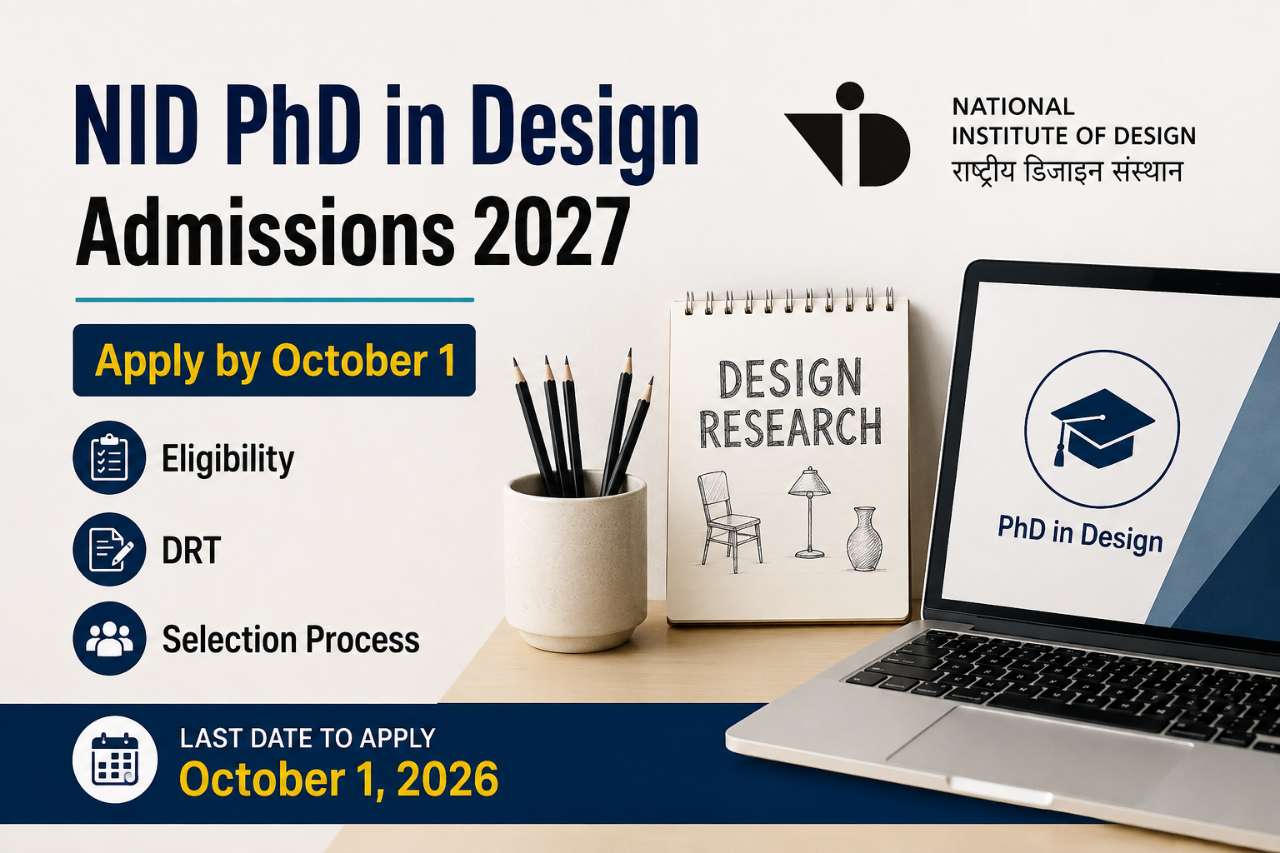
The National Institute of Design (NID) has opened applications for its Doctor of Philosophy (PhD) in Design programme for the academic session 2027. If you are a design researcher, educator, or industry professional aiming to contribute original knowledge to India's growing design ecosystem, this is one of the most respected doctoral pathways in the country. Applications must be submitted online at admissions.nid.edu before the deadline of October 1, 2026. Shortlisted candidates will appear for the Doctoral Research Test (DRT) on October 22, 2026, followed by an interview round.
This guide explains eligibility, admission modes, the multi-stage selection process, important dates, document requirements, and practical preparation tips—written in simple language for Indian students and working professionals planning research careers in design, innovation, and design-led policy. All information is based on the official NID admissions notification and brochure for the 2027 session, updated as of August 2026.
What Is the NID PhD in Design Programme?
The PhD in Design at NID is a research-intensive doctoral programme that trains scholars to investigate design theory, practice, education, and industry application. Unlike a professional design degree focused on studio skills and portfolio building, the PhD emphasises rigorous research methodology, critical inquiry, and publication-quality work.
NID, established as India's premier design institution, offers doctoral study across its campuses including Ahmedabad (main campus), National Institute of Design Andhra Pradesh, National Institute of Design Assam, National Institute of Design Haryana, and National Institute of Design NID Madhya Pradesh. The PhD credential from NID carries strong recognition among design schools, research organisations, and creative industries in India and abroad.
Who Should Apply?
The programme suits candidates who want to:
- Teach design at university level and build an academic career
- Lead research in human-centred design, sustainability, or design for social impact
- Bridge design practice with policy, technology, and business innovation
- Develop deep expertise after a master's-level design qualification or NID diploma
If your goal is primarily a studio career or early industry placement, a postgraduate diploma or master's in design may be more appropriate. Explore options at institutions like World University of Design, MIT Art Design and Technology University Pune, or Sir J J School of Art Architecture and Design for professional design pathways.
NID PhD Design Admissions 2027: Important Dates
Missing a deadline can disqualify an otherwise strong application. Mark these dates on your calendar:
| Event | Date |
|---|---|
| Application window opens | August 2026 (ongoing) |
| Last date to apply | October 1, 2026 |
| Application correction window | October 2 to 4, 2026 |
| Doctoral Research Test (DRT) | October 22, 2026 |
| Interview (for DRT qualifiers) | To be announced |
Application Correction Window: What You Can Edit
Registered candidates may edit their applications from October 2 to 4, 2026. However, the following fields cannot be modified during correction:
- Programme applied for
- Candidate's name
- Date of birth
- Registered mobile number
- Registered email ID
Actionable tip: Double-check your contact details and programme choice before submitting the initial application. Use the correction window to refine your research proposal summary, academic details, or supporting document uploads—not core identity fields.
Eligibility Criteria for NID PhD in Design 2027
Eligibility requirements differ slightly between full-time and part-time modes, but the academic baseline for full-time admission is clearly defined in the official brochure.
Full-Time PhD Eligibility
Candidates must hold any one of the following qualifications:
- A master's degree in design from an accredited institution or recognised university
- A Post Graduate (PG) diploma in design from the National Institute of Design
- NID's Advanced Entry Programme
- The 5.5-year School Leavers' Professional Education Programme diploma in design from NID
Candidates with backgrounds in allied fields—such as architecture, fine arts, or technology-led design—should verify specific requirements on the official portal, as NID may assess equivalence case by case during screening.
Part-Time PhD Eligibility
Part-time admission is intended for working professionals who can fulfil periodic on-campus requirements. While the brochure specifies campus presence for coursework, seminars, and declared in-person academic activities, candidates typically need a relevant postgraduate design qualification and professional experience that supports their research area. Always refer to admissions.nid.edu for the latest part-time eligibility annex.
Work Experience Exemption from DRT
Candidates with more than 15 years of work experience are exempt from appearing for the Doctoral Research Test (DRT). They proceed directly to the interview stage after application and research proposal screening—provided they meet all other eligibility norms.
Full-Time vs Part-Time: Which Mode Should You Choose?
NID allows the PhD in Design in both full-time and part-time formats. Your choice affects residency expectations, programme duration, and how you balance employment.
| Parameter | Full-Time | Part-Time |
|---|---|---|
| Campus presence | Throughout doctoral study | For coursework, seminars, and declared in-person requirements |
| Maximum duration | 3 years | 5 years |
| Extension possible | Up to 5 years | Up to 7 years |
| Ideal candidate | Recent postgraduates, full-time researchers | Working design professionals and educators |
Full-Time Mode
- Campus presence: Required throughout the doctoral study period
- Maximum duration: 3 years, extendable up to 5 years with formal application and guide/co-guide endorsement
- Best for: Recent postgraduates, research fellows, and candidates seeking uninterrupted academic immersion
Part-Time Mode
- Campus presence: Required for scheduled coursework, seminars, and other declared in-person academic requirements
- Maximum duration: 5 years, extendable up to 7 years with formal application and guide/co-guide endorsement
- Best for: Design professionals, educators, and industry leaders continuing careers while pursuing doctoral research
Actionable tip: Discuss your mode preference with a potential research guide before applying. A strong alignment between your research topic, professional schedule, and campus requirements improves acceptance chances at the interview stage.
Documents Required for NID PhD Application 2027
While the exact checklist appears on admissions.nid.edu, applicants should generally keep these documents ready in scanned PDF format:
- Passport-size photograph and signature
- Identity proof (Aadhaar, passport, or other government ID)
- Master's degree or NID diploma certificates and mark sheets
- Research proposal (as per brochure word limit and format)
- Work experience certificates (especially if claiming DRT exemption for 15+ years)
- Category or PwD certificates, if applicable
- Any additional publications, portfolios, or research outputs supporting your application
Ensure file sizes and formats match portal specifications. Blurry scans or incomplete mark sheets are a common reason for application delays during screening.
Selection Process: Stages Explained
Admission to NID PhD in Design 2027 follows a structured, multi-stage process designed to evaluate both research readiness and design thinking depth.
Stage 1: Application Submission and Screening
Candidates submit the online application along with academic credentials and a research proposal. The admissions committee screens applications for eligibility compliance, proposal clarity, and alignment with NID's research strengths.
Stage 2: Research Proposal Evaluation
Your research proposal is among the most critical components. Evaluators assess:
- Originality and relevance of the research question
- Clarity of objectives and methodology
- Feasibility within the programme timeline
- Potential contribution to design knowledge
Stage 3: Doctoral Research Test (DRT)
Candidates who clear initial screening (and are not exempt due to 15+ years of experience) must appear for the DRT on October 22, 2026. The test evaluates:
- Design aptitude and research orientation
- General awareness
- Basic numeric ability
- Design-related analytical skills
Stage 4: Interview
Candidates who qualify in the DRT—or who are exempt from it—proceed to the final interview. The panel typically explores your research intent, academic background, professional experience, and fit with available faculty expertise.
How to Prepare for the NID Doctoral Research Test (DRT)
The DRT is not a conventional design entrance exam like undergraduate admissions tests. It blends research sensibility with design awareness. Here is a focused preparation plan:
Build Design General Awareness
Stay updated on Indian and global design movements, NID's historical contributions, sustainable design frameworks, and contemporary debates in design education. Reading design journals and following institutional research outputs helps.
Strengthen Research Fundamentals
Review basic research terminology: hypothesis, methodology, qualitative vs quantitative inquiry, ethics in research, and literature review structure. Your proposal should reflect this understanding.
Practice Numeric and Analytical Questions
Basic numeracy and logical reasoning questions may appear. Brush up on data interpretation, proportions, and simple analytical puzzles—not advanced engineering mathematics.
Refine Your Research Proposal
A coherent 800–1500 word proposal with a clear title, problem statement, objectives, methodology, expected outcomes, and bibliography demonstrates seriousness. Avoid overly broad topics like "design in India"; instead, narrow to a specific context, user group, or material system.
Interview Preparation Tips for NID PhD Candidates
The final interview often determines admission after DRT qualification. Prepare to discuss:
- Your research rationale: Why this topic, and why now?
- Methodological choices: How will you collect and analyse data?
- Faculty alignment: Which NID research areas connect to your proposal?
- Career vision: How will the PhD support your academic or professional goals?
- Prior work: Publications, design projects, teaching, or industry assignments relevant to your research
Dress professionally, carry printed copies of your proposal, and be ready to respond to critical feedback. Panels value clarity of thought over memorised answers.
Research Proposal Writing Tips for NID PhD Applicants
Strong proposals share common traits. Use this checklist before submission:
- Define a precise research gap: What existing knowledge is incomplete?
- State clear research questions: What exactly will you investigate?
- Choose appropriate methods: Ethnography, case study, participatory design, or mixed methods—justify your choice.
- Identify potential guides: Mention faculty whose work aligns with your topic (without guaranteeing supervision).
- Show societal or industry relevance: Explain who benefits from your research.
- Include a preliminary bibliography: Cite 8–12 credible sources.
Example research areas that align with NID's ecosystem include craft revival and digital documentation, design for rural healthcare, inclusive product systems, design pedagogy reform, and sustainable material innovation. Scholars at research-focused institutes such as Ramakrishna Mission Vivekananda Educational And Research Institute Howrah and Vinayaka Missions Research Foundation Salem often pursue similar interdisciplinary research models that blend social relevance with academic rigour.
NID Campuses and the Design Research Landscape in India
While NID Ahmedabad remains the flagship, the expansion to multiple states strengthens regional design research. Candidates may explore campus-specific research clusters when drafting proposals.
Beyond NID, India's design education map includes specialised institutions such as the Footwear Design and Development Institute, Indian Institute of Information Technology Design And Manufacturing Kurnool, and Indian Institute of Information Technology Design Manufacturing Kancheepuram—each with distinct research cultures.
Jaipur has emerged as a major design hub with colleges like Centre For Design Excellence Jaipur, Arch College Of Design And Business Jaipur, Ellen College Of Design Jaipur, International School Of Design Jaipur, Banasthali Institute Of Design Jaipur, and Seedling Academy Of Design Jaipur. Many graduates from these programmes eventually pursue postgraduate and doctoral study at premier institutes like NID.
Career Outcomes After NID PhD in Design
A doctoral degree from NID opens diverse career pathways:
- Academia: Assistant professor and research roles at design institutes and universities
- Research organisations: Leading design research labs in public and private sectors
- Industry R&D: Strategic design, innovation consulting, and design leadership positions
- Policy and social sectors: Design thinking roles in government missions, NGOs, and development agencies
- Entrepreneurship: Design-led startups grounded in evidence-based innovation
Doctoral scholars often publish in peer-reviewed journals, present at international conferences, and contribute to curriculum development—building the expertise that search engines and AI overviews recognise through experience, expertise, authoritativeness, and trustworthiness in specialised domains.
Alternatives and Complementary Pathways in Design Education
Not every design aspirant needs a PhD immediately. Consider these pathways:
- Master's in Design (M.Des): Ideal for specialisation before doctoral study
- BDes Fashion Design and other undergraduate programmes: Foundation for early-career designers
- Technology-design hybrids: Programmes blending design with digital skills, complementing areas like Computer Applications or Bachelor Of Computer Application BCA for UX and interaction design careers
- Other universities: World University Of Design Engineering, World University Of Design Management, and University Of Design Innovation And Technology Haryana offer postgraduate routes that can lead to research careers
For distance learners exploring academic foundations before doctoral applications, open universities such as Indira Gandhi National Open University, Karnataka State Open University Mysore, and Tamil Nadu Open University Chennai provide flexible study options—though NID PhD itself requires rigorous on-campus research engagement.
Common Mistakes to Avoid During NID PhD Admission 2027
- Submitting a generic research proposal not tailored to design research methodology
- Missing the October 1 deadline assuming late applications will be accepted
- Ignoring the correction window limits on name, email, and programme fields
- Underestimating the DRT by preparing only for portfolio-style assessments
- Choosing part-time mode without employer support for campus attendance requirements
- Failing to verify eligibility for specific diploma routes from NID
- Uploading incomplete documents that delay screening or lead to rejection
Why Pursue a PhD in Design at NID?
India's design sector is expanding rapidly across consumer products, digital services, public infrastructure, and cultural heritage. Yet credible design research remains limited compared to engineering or management disciplines. An NID PhD positions you to fill that gap.
Key advantages include access to experienced faculty guides, studio and research facilities, peer networks across NID campuses, and credibility when applying for UGC NET-based academic roles or international fellowships. For professionals already working in design consultancies or corporate innovation teams, the part-time route makes doctoral study feasible without leaving the workforce entirely.
Design research also supports national priorities—from Make in India and craft export promotion to accessible healthcare products and sustainable packaging. A well-designed doctoral study can influence policy briefs, industry standards, and curriculum reform across India's growing network of design colleges.
Month-by-Month Preparation Timeline for NID PhD 2027
Starting early improves both application quality and DRT performance. Use this suggested timeline:
- August 2026: Download the brochure, shortlist research topics, and contact potential mentors for informal feedback.
- Early September 2026: Draft and revise your research proposal; collect academic documents and experience certificates.
- Mid to late September 2026: Register on admissions.nid.edu and complete the application form.
- October 1, 2026: Submit the application before the deadline; save payment and confirmation receipts.
- October 2–4, 2026: Use the correction window for non-core field updates if required.
- October 5–21, 2026: Intensive DRT preparation covering design awareness, research concepts, and analytical practice.
- October 22, 2026: Appear for the Doctoral Research Test (unless exempt).
- Post-DRT: Prepare for the interview with mock discussions and updated literature review notes.
Following a structured timeline reduces last-minute errors and gives you space to refine your research focus—a factor that often distinguishes successful applicants from those with generic submissions.
Conclusion
The NID PhD in Design admissions 2027 cycle is now open, offering a prestigious pathway for scholars who want to advance design knowledge in India. With applications closing on October 1, 2026 and the DRT scheduled for October 22, 2026, prospective candidates should prioritise a well-crafted research proposal, confirm eligibility for their chosen mode, and prepare holistically for the selection stages.
Whether you aim to teach at a leading design school, lead innovation research, or influence design policy, NID's doctoral programme provides the academic rigour and institutional credibility to support long-term impact. Start your application early at admissions.nid.edu, seek feedback on your proposal from mentors, and treat the DRT as a test of research-minded design thinking—not just creative talent.
For broader exploration of design colleges, courses, and admission pathways across India, continue browsing resources on CollegeDwar to compare programmes and plan your education journey with confidence.