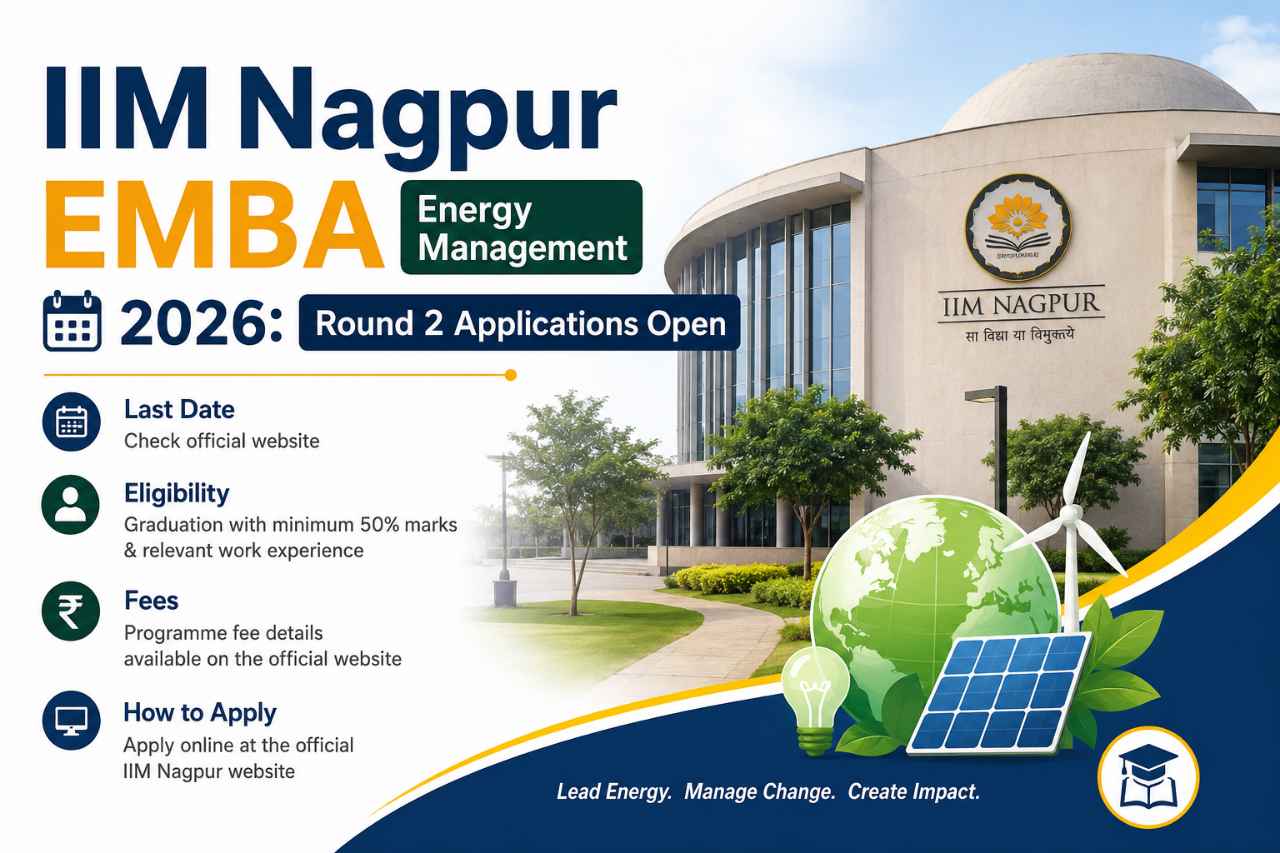
Working professionals in India's power, oil and gas, renewable energy, and utilities sectors often reach a career ceiling where technical expertise alone is not enough. Leadership roles demand strategic thinking, financial acumen, and the ability to navigate policy shifts, decarbonisation goals, and global energy transitions. The Executive MBA in Energy Management (EMBA-EM) at Indian Institute of Management Nagpur addresses exactly this gap and for the 2026–28 batch, Round 2 applications are now open on the official portal at admissions.iimnagpur.ac.in.
Offered in collaboration with the National Power Training Institute (NPTI), this two-year hybrid programme lets you earn an MBA degree from an IIM without leaving your full-time job. Round 1 admission offers have already been released, with selected candidates required to accept by 31 August 2026. If you missed the first window or were not selected, Round 2 gives you a fresh opportunity but the deadline of 27 September 2026 is firm. This guide covers everything you need to know: eligibility, fees, selection process, class schedule, documents, and a step-by-step application walkthrough.
What Is the IIM Nagpur EMBA in Energy Management?
The Executive MBA in Energy Management at IIM Nagpur is a specialised postgraduate management programme designed exclusively for mid-career professionals already working in energy and allied industries. Unlike a general MBA, every course module from supply chain management to corporate finance is contextualised for the energy sector, covering thermal power, hydropower, renewables, oil and gas, coal, and emerging areas like green hydrogen and energy storage.
The programme runs for two years across eight academic terms and follows a hybrid delivery model: most classes are conducted online during evenings and weekends, supplemented by four mandatory on-campus modules held at IIM Nagpur and NPTI centres. Upon successful completion, graduates receive a Master of Business Administration (MBA) degree from IIM Nagpur a credential that carries significant weight in boardrooms across India's energy ecosystem.
Why Energy Management Needs a Dedicated MBA Today
India's energy sector is undergoing its most significant transformation in decades. The country aims for 500 GW of non-fossil fuel capacity by 2030, is expanding its nuclear and hydropower base, and is investing heavily in solar, wind, and battery storage. At the same time, conventional power utilities must manage ageing assets, regulatory compliance, and the integration of intermittent renewable sources into the grid.
Professionals who understand both the technical and managerial dimensions of these challenges are in short supply. An energy-focused executive MBA equips you to:
- Lead cross-functional teams spanning operations, finance, and regulatory affairs
- Evaluate capital expenditure decisions for new power projects or renewable installations
- Navigate India's evolving energy policy framework, including carbon markets and renewable purchase obligations
- Transition from functional roles (engineering, operations, finance) to general management and C-suite positions
- Build networks with peers from NTPC, POWERGRID, state electricity boards, oil majors, and renewable developers
For professionals comparing options, programmes at institutions like the University of Petroleum and Energy Studies Management also focus on energy sector education, but an IIM-branded MBA carries distinct prestige and alumni access across India's corporate landscape.
IIM Nagpur EMBA Energy Management 2026: Round 2 Application Timeline
Admission for the 2026–28 batch is conducted in multiple rounds. Understanding where Round 2 fits in the overall calendar helps you plan your preparation and document collection.
Key Dates for the 2026–28 Batch
The following timeline is based on the official admission cycle announced for the EMBA-EM programme:
- Round 1 application deadline: 2 August 2026 (closed)
- IIM Nagpur Admission Test (IIMNAT): 9 August 2026 (Round 1 candidates)
- Personal Interview (Round 1): 15 August 2026
- Round 1 result and offer letters: 23 August 2026
- Round 1 offer acceptance deadline: 31 August 2026
- Round 2 application deadline: 27 September 2026
- Round 2 shortlist, IIMNAT, and interviews: To be announced after 27 September 2026
Actionable tip: Do not wait until the last week of September to begin your application. Document scanning, employer experience letters, and payment gateway issues can cause delays. Aim to submit at least seven to ten days before the 27 September 2026 deadline.
Eligibility Criteria for IIM Nagpur EMBA-EM 2026
Before investing time in the application, confirm that you meet every eligibility requirement. IIM Nagpur strictly verifies academic credentials and work experience during the admission process.
Academic Requirements
- A Bachelor's degree in any discipline from a recognised university
- Minimum 50% marks (or equivalent CGPA) at the graduation level
- Professional qualifications such as CA, ICWA (CMA), or CS are also accepted in lieu of or alongside a bachelor's degree, subject to institute norms
Work Experience Requirements
- Minimum three years of full-time work experience after completing graduation
- Candidates must be currently employed in a full-time role at the time of application
- Experience in energy, power, oil and gas, renewables, utilities, or related sectors is advantageous but not always mandatory professionals from consulting, finance, and infrastructure who work with energy clients are also strong applicants
Who Should Apply?
This programme is ideal for:
- Assistant General Managers and Deputy General Managers in power generation and distribution companies
- Engineers and project managers at renewable energy developers and EPC contractors
- Finance and commercial professionals at oil and gas companies
- Regulatory and policy professionals at central and state energy bodies
- Mid-level managers at equipment manufacturers and energy technology firms
If you are a recent graduate with less than three years of experience, consider building your profile through a general management programme at institutions such as the Management Development Institute or Birla Institute of Management Technology before applying to an executive MBA.
Programme Structure, Curriculum, and Class Schedule
One of the most common questions working professionals ask is whether they can realistically manage classes alongside a demanding job. IIM Nagpur has designed the EMBA-EM schedule specifically for this audience.
Delivery Mode and Campus Modules
The programme uses a blended learning model:
- Online live sessions during evenings and weekends no need to relocate or take extended leave
- Four on-campus modules spread across the two-year period at IIM Nagpur and NPTI training centres
- Case-based learning, group projects, and industry interaction sessions integrated throughout
Travel and accommodation costs for campus modules are not included in the programme fee and must be borne by the participant. Factor this into your financial planning typically four trips over two years.
Year-Wise Class Timetable
First Year (Terms 1–4):
- Wednesday and Saturday evenings: 7:00 PM to 10:15 PM
- Sunday: Two sessions 9:30 AM to 12:45 PM and 2:30 PM to 5:45 PM
Second Year (Terms 5–8):
- Monday to Saturday evenings: 8:00 PM to 9:30 PM
- Sunday: Same two-session format as Year 1
The second-year schedule is slightly lighter on individual session duration but covers more weekday evenings. Discuss your employer's flexibility early many energy PSUs and large corporates support executive education with adjusted work hours or study leave for campus modules.
Core Curriculum Areas
While the exact course list may vary by term, the EMBA-EM curriculum typically covers:
- Energy Economics and Policy: Tariff structures, power purchase agreements, and regulatory frameworks
- Financial Management: Project finance, valuation of energy assets, and risk management
- Operations and Supply Chain: Fuel logistics, grid management, and asset lifecycle management
- Strategic Management: Competitive positioning in deregulated energy markets
- Leadership and Organisational Behaviour: Managing large, distributed teams in capital-intensive industries
- Technology and Innovation: Smart grids, energy storage, carbon capture, and digital transformation in utilities
- Sustainability and ESG: Environmental compliance, carbon accounting, and stakeholder management
The curriculum is benchmarked against international energy management programmes and adapted for the Indian context a significant advantage over generic executive MBAs offered by many private colleges.
Fees, Payment Schedule, and Return on Investment
Understanding the full cost of the programme helps you negotiate employer sponsorship and plan personal finances.
Fee Breakdown for the 2026–28 Batch
- Application fee: ₹2,000 (non-refundable, payable at the time of online application)
- Total programme fee: ₹12,00,000 for the two-year duration
- What the fee covers: Tuition, books, reading materials (including case studies), and institute facilities
- What the fee excludes: Travel and accommodation for on-campus modules, personal laptops/internet, and any optional international immersion components
The programme fee is payable in instalments according to a pre-determined schedule set by IIM Nagpur you do not need to pay the entire amount upfront. Many candidates secure partial or full sponsorship from their employers, particularly in public sector undertakings (PSUs) where executive education is part of leadership development pipelines.
Is the Investment Worth It?
At ₹12 lakh for an IIM MBA with energy specialisation, the EMBA-EM sits in a competitive position. General executive MBAs from top private institutions in Delhi NCR such as programmes at the Fore School of Management Delhi, Lal Bahadur Shastri Institute of Management, or the International Management Institute IMI Delhi often cost ₹12–18 lakh without sector specialisation. The IIM brand, NPTI partnership, and energy-specific curriculum add measurable value for professionals targeting leadership roles in the sector.
Graduates commonly move into roles such as Business Head, Chief Operating Officer, Vice President (Operations), Head of Strategy, and Board-level advisory positions at energy companies where compensation increments often recover the programme fee within two to four years.
Selection Process for Round 2 Applicants
Round 2 follows a structured admission process similar to Round 1. Knowing each stage in advance allows you to prepare systematically rather than scrambling after submitting your form.
Stage 1: Online Application and Document Verification
All Round 2 applicants must complete the online application on the official portal, upload required documents, and pay the ₹2,000 application fee before 27 September 2026. Incomplete applications or those missing mandatory documents will not be considered.
Stage 2: IIM Nagpur Admission Test (IIMNAT)
Shortlisted candidates will be required to appear for the IIM Nagpur Admission Test (IIMNAT), conducted in online mode. Unlike the CAT-based admission for IIM Nagpur's full-time MBA, the EMBA-EM uses IIMNAT a test designed to assess aptitude, analytical reasoning, and general awareness relevant to working professionals.
Preparation tips for IIMNAT:
- Review quantitative aptitude fundamentals percentages, ratios, data interpretation, and basic algebra
- Read daily business and energy news from sources covering power sector reforms, renewable energy tenders, and oil price movements
- Practice reading comprehension with passages on economics and industry policy
- Take timed mock tests to build speed working professionals often struggle with time management after years away from formal exams
Stage 3: Personal Interview (PI)
Candidates who clear IIMNAT will be invited for a Personal Interview, typically conducted online or at designated centres. The PI panel evaluates:
- Your career trajectory and leadership potential in the energy sector
- Clarity of purpose for pursuing an energy management MBA at this stage of your career
- Domain knowledge expect questions on current trends like India's green hydrogen mission, UDAY scheme outcomes, or renewable energy integration challenges
- Ability to contribute to and benefit from peer learning in a diverse cohort
Interview preparation tip: Prepare a concise two-minute career narrative, research IIM Nagpur's EMBA-EM differentiators (NPTI partnership, hybrid model, faculty), and be ready to discuss one significant professional challenge you solved and what you learned from it.
Final Selection and Offer Letters
Final selection is based on a composite evaluation of your application profile, IIMNAT performance, and personal interview. Successful Round 2 candidates will receive offer letters with a specified acceptance deadline and fee payment schedule. Monitor your email and the admission portal regularly after submitting your Round 2 application.
Documents Required for Round 2 Application
Keep the following documents scanned and ready in the prescribed format (typically PDF, under the size limit mentioned on the portal):
- Recent passport-size photograph
- Government-issued photo ID (Aadhaar, PAN, passport, or driving licence)
- Bachelor's degree certificate and consolidated marksheet
- Professional qualification certificates (CA/ICWA/CS), if applicable
- Class 10 and Class 12 mark sheets (may be required for profile evaluation)
- Work experience certificates or relieving letters from all employers
- Current employment proof appointment letter, latest salary slip, or employer certificate confirming full-time employment
- Category certificate (SC/ST/OBC/EWS/PwD), if applicable
Ensure that name spellings match across all documents. Discrepancies are a common reason for application rejection during verification.
How IIM Nagpur EMBA-EM Compares with Other Programmes
Before committing to Round 2, it is worth understanding how this programme stacks up against alternatives.
IIM Nagpur EMBA-EM vs. Other IIM Executive Programmes
Several IIMs offer executive education, though not all have energy specialisation. For instance, Indian Institute of Management Udaipur IIM Udaipur offers executive programmes with different focus areas. IIM Nagpur's EMBA-EM is distinctive because of its NPTI collaboration, energy-specific curriculum, and hybrid format tailored for professionals who cannot attend a fully residential programme.
IIM Nagpur EMBA-EM vs. General Executive MBAs in Delhi NCR
Delhi NCR hosts numerous management institutes offering part-time and executive MBAs including the New Delhi Institute of Management, Delhi School of Management, and Guru Gobind Singh Indraprastha University Management. These programmes serve working professionals well for general management careers. However, if your goal is specifically to lead in India's energy sector, a specialised IIM degree with NPTI backing provides deeper domain relevance and sector-specific networking.
Career Outcomes After IIM Nagpur EMBA in Energy Management
Graduates of the EMBA-EM programme have moved into leadership positions across the energy value chain. Typical career trajectories include:
- Power generation: Plant Head, Regional Director, VP Operations at thermal, hydro, and nuclear plants
- Transmission and distribution: Chief Engineer, Director (Grid Operations) at state and central transmission utilities
- Renewable energy: Country Head, Director of Project Development at solar and wind developers
- Oil and gas: Senior management roles in upstream, midstream, and downstream operations
- Consulting and advisory: Partner and Principal roles at firms serving energy and infrastructure clients
- Policy and regulation: Senior positions at CERC, SERCs, and central ministry advisory bodies
- Energy finance: Vice President at infrastructure funds, NBFCs, and project finance divisions of banks
The IIM Nagpur alumni network, combined with NPTI's pan-India training centre connections, creates a professional ecosystem that extends well beyond graduation day.
Practical Tips for Round 2 Applicants
Based on common patterns in executive MBA admissions across India, here are actionable recommendations to strengthen your Round 2 application:
- Start your application early: Portal traffic increases sharply in the final 48 hours before any deadline. Technical glitches and payment failures are harder to resolve under time pressure.
- Secure employer support in writing: A letter from your HR or department head confirming support for executive education even if they are not sponsoring the fee strengthens your profile and signals that you can manage the schedule.
- Quantify your work experience: Instead of listing job titles, highlight measurable outcomes megawatts commissioned, cost savings achieved, team size managed, or regulatory approvals secured.
- Prepare for IIMNAT immediately after applying: Do not wait for the shortlist announcement. Begin daily aptitude practice and energy sector reading now.
- Craft your PI narrative around impact: Interview panels remember candidates who articulate a clear vision where they are today, where the EMBA-EM fits, and where they intend to be in five years.
- Budget for hidden costs: Beyond the ₹12 lakh programme fee, account for campus module travel, books, a reliable laptop, and high-speed internet for live online classes.
- Connect with current students and alumni: LinkedIn is a useful tool to find EMBA-EM alumni and ask about their experience with the schedule, faculty, and career outcomes.
- Verify all documents before upload: Re-scan blurry marksheets and ensure file sizes meet portal requirements to avoid last-minute re-uploads.
Conclusion
The IIM Nagpur Executive MBA in Energy Management for the 2026–28 batch represents a rare opportunity to earn an IIM MBA while continuing to work in one of India's most critical and fast-evolving sectors. With Round 1 offers already released and the acceptance window closing on 31 August 2026, Round 2 is the final admission window for this batch and applications must be submitted by 27 September 2026 through the official portal at admissions.iimnagpur.ac.in/exmba-em/login.
Whether you are an engineer at a power plant, a finance manager at an oil company, or a project lead at a renewable energy developer, this programme can accelerate your transition from functional expert to strategic leader. The combination of IIM Nagpur's academic rigour, NPTI's industry training infrastructure, and a curriculum built for India's energy transition makes the EMBA-EM one of the most targeted executive education options available today.
If you meet the eligibility criteria a bachelor's degree with at least 50% marks and a minimum of three years of full-time work experience do not let Round 2 pass without applying. Prepare your documents, complete your online form, and begin IIMNAT preparation today. For broader context on management education options across India, explore programmes at IIM Nagpur and compare with other institutes on CollegeDwar to make the most informed decision for your career.