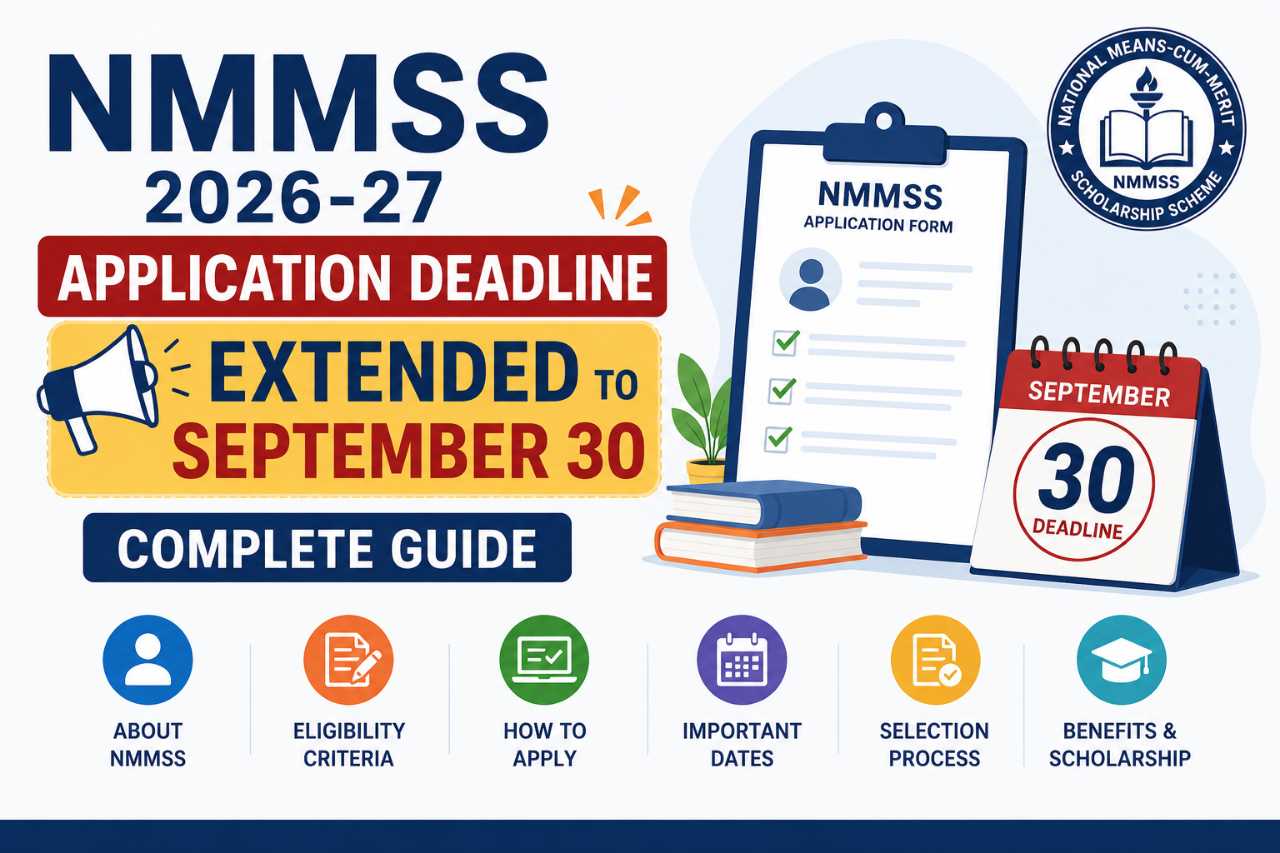
The Ministry of Education has extended the application deadline for the National Means-cum-Merit Scholarship Scheme (NMMSS) 2026-27 to September 30, 2026. If you are a meritorious student from a government, government-aided, or local body school in India, this extension gives you extra time to complete your One Time Registration (OTR) and submit your application on the National Scholarship Portal (NSP) at scholarships.gov.in.
NMMSS is one of India's most important school-level scholarships. It supports economically weaker but academically strong students so they can continue studying from Class 9 through Class 12 without dropping out after middle school. Every year, one lakh fresh scholarships are awarded. This guide explains the extended dates, eligibility rules, selection process, verification timeline, and what happens after Class 12 when you plan for college and higher education.
What Is the NMMSS Scholarship Scheme?
The National Means-cum-Merit Scholarship Scheme was launched by the Department of School Education and Literacy, Ministry of Education, Government of India. Its main goal is simple: identify bright students from low-income families early and keep them in the school system through senior secondary education.
Many talented students leave school after Class 8 because of financial pressure at home. NMMSS addresses this gap by offering a fixed annual scholarship that is credited directly to the student's bank account. The scheme is not open to students in private unaided schools. It applies only to students enrolled in:
- State Government schools
- Government-aided schools
- Local body schools (such as municipal or panchayat-run institutions)
Students who qualify in the state-level selection test receive the scholarship from Class 9 onward. The award continues through renewal mode in Classes 10, 11, and 12, provided the student maintains the required academic standards and continues in an eligible school category.
Why NMMSS Matters for Indian Students
For families earning below Rs 3.50 lakh per year, every rupee counts. School fees, books, transport, and exam costs add up quickly in Classes 9 to 12. A scholarship of Rs 12,000 per year may seem modest compared to professional degree fees, but at the school level it can cover textbooks, stationery, coaching support, or reduce the burden on parents who also hope to send their child to college later.
Students who stay in school through Class 12 gain access to board exams, entrance tests, and diploma or degree pathways. Whether you later pursue B.Ed. at an institution like Tirupati College of Education Jaipur, a professional course at Delhi Metropolitan Education, or a science programme at Indian institute of Science Education Research (IISER) Berhampur, completing senior secondary education is the foundation.
NMMSS 2026-27 Deadline Extension: Key Dates
According to the official notification reported on September 1, 2026, the Ministry of Education has revised the NMMSS 2026-27 timeline as follows:
| Activity | Revised Last Date |
|---|---|
| Student application on NSP | September 30, 2026 |
| Institute Nodal Officer (INO) verification | October 15, 2026 |
| District Nodal Officer (DNO) verification | October 31, 2026 |
The extension is significant because many students and school nodal officers were still completing document uploads and verifications. As of the announcement date, around 79,398 fresh applications had been submitted for NMMSS 2026-27, along with more than 1.87 lakh renewal applications from continuing scholars.
If you have not yet applied, treat September 30 as a firm cutoff. Late submissions are generally not accepted once the portal closes for the academic year. Parents and teachers should remind eligible Class 8 and renewal-category students immediately so that no deserving candidate misses out because of a last-minute delay.
Eligibility Criteria for NMMSS 2026-27
Before you register on the National Scholarship Portal, confirm that you meet every eligibility condition. Incomplete or incorrect applications are often rejected during INO or DNO verification.
Academic Eligibility
- You must be studying in Class 8 (for the selection test cycle leading to Class 9 scholarship) or meet your state or UT's prescribed class requirement for the current selection year.
- You need a minimum of 55% marks or an equivalent grade in Class 7 to appear in the state/UT selection test for award of scholarship.
- Reserved category students may receive relaxation in marks as per state/UT rules. Always check your state's SCERT or education department notification.
Income and School Category
- Annual family income from all sources should not exceed Rs 3.50 lakh.
- You must be a regular student in a State Government, Government-aided, or local body school.
- Students in Central Government schools, Kendriya Vidyalayas, Jawahar Navodaya Vidyalayas, and private unaided schools are not covered under NMMSS.
Other Conditions
- You must have a bank account in your name (or as permitted under NSP guidelines for minors).
- Aadhaar seeding and mobile number linking on NSP are typically required for direct benefit transfer.
- Only one child per family may receive NMMSS in some interpretations of scheme rules; verify state-specific guidelines if you have siblings.
Scholarship Amount and Benefits
Selected students receive Rs 12,000 per annum. The amount is usually disbursed in instalments through Direct Benefit Transfer (DBT) into the beneficiary's bank account linked with the National Scholarship Portal.
Key benefits of the scheme include:
- One lakh fresh scholarships awarded nationally each year for Class 11 entry cohort (based on selection test outcomes as per state cycle).
- Continuation through renewal from Class 10 to Class 12 based on satisfactory academic progress.
- Reduced dropout rates among meritorious students from economically weaker sections.
- Recognition at the state level, which strengthens a student's academic profile for future applications.
While NMMSS supports school education, students who perform well often aim for higher studies in education, science, commerce, or vocational fields. For example, a student from Rajasthan may later explore B.Ed. programmes at colleges such as Satyam College of Education Jaipur, Sanskriti College of Education Jaipur, or Shri Balaji College of Education Jaipur. Others may choose professional degrees at institutions like ICFAI Foundation for Higher Education Hyderabad.
Selection Process and State-Level Examination
NMMSS does not have a single national entrance exam like JEE or NEET. Instead, each state and Union Territory conducts a qualifying selection test for students who meet eligibility norms. The test generally assesses mental ability and scholastic aptitude.
Typical Exam Pattern (May Vary by State)
- Mental Ability Test (MAT): Reasoning, analogies, classification, numerical series, and pattern recognition.
- Scholastic Aptitude Test (SAT): Questions based on Class 7 and Class 8 curriculum in subjects such as science, mathematics, and social science.
States publish detailed syllabi, exam dates, and admit card instructions through SCERT portals or district education offices. After the test, state authorities prepare merit lists and recommend selected students for scholarship award through the NSP.
Actionable Preparation Tips
- Download your state's official NMMSS notification and syllabus first.
- Revise NCERT-based Class 7 and Class 8 textbooks thoroughly.
- Practice previous year state question papers under timed conditions.
- Focus on accuracy in MAT sections; avoid spending too long on one question.
- Ask your school teacher or counsellor about registration for the state selection test.
How to Apply for NMMSS 2026-27 on the National Scholarship Portal
All applications must be submitted online through the National Scholarship Portal. Students must complete One Time Registration (OTR) before filling the NMMSS application form. The process is free of charge—beware of fraudulent websites or agents claiming to register on your behalf for a fee.
Documents Usually Required
- Aadhaar card of the student
- Income certificate issued by a competent authority
- Caste or category certificate (if applicable)
- Class 7 mark sheet showing minimum 55% marks or equivalent grade
- Bank passbook or cancelled cheque
- Recent passport-size photograph
- Domicile or residence proof (if required by state)
- School enrollment certificate from an eligible institution
Common Mistakes to Avoid
- Entering a school category that does not match your actual institution type
- Uploading blurred income or mark sheet documents
- Using a parent's bank account when the scheme requires the student's account
- Missing the INO verification step at school after online submission
- Waiting until the last day when portal traffic is highest
Verification Process: INO and DNO Roles
Submitting the online form is not the final step. The Ministry has extended verification deadlines to ensure schools and districts can complete checks properly.
Institute Nodal Officer (INO) Verification — By October 15, 2026
Every eligible school designates or identifies an Institute Nodal Officer. After you apply, your INO logs into the NSP, reviews your application, confirms enrollment and documents, and forwards valid applications for district-level scrutiny. Students should personally follow up with their school office to ensure INO verification is completed before October 15.
District Nodal Officer (DNO) Verification — By October 31, 2026
The District Nodal Officer conducts the final administrative verification at the district education office level. Applications rejected at this stage are often due to income certificate errors, school category mismatch, or duplicate applications.
Renewal of NMMSS Scholarship in Classes 10, 11, and 12
Existing NMMSS scholars do not need to reappear in the selection test each year. They apply in renewal mode on the National Scholarship Portal, demonstrating that they:
- Continued studying in an eligible government, aided, or local body school
- Passed the previous class with the minimum marks prescribed for renewal (commonly 55% for general category; check state rules for reserved categories)
- Maintained good conduct and regular attendance
The large volume of renewal applications—over 1.87 lakh for 2026-27—shows how many students depend on this support throughout senior school. Renewal applicants should also respect the September 30 application deadline unless a separate renewal date is announced on NSP.
Comparing NMMSS With Other School Scholarships
Indian students and parents often confuse NMMSS with other schemes available on the National Scholarship Portal. Understanding the difference helps you apply for the correct programme.
- NMMSS: Merit-cum-means scholarship for Classes 9–12; selection test required for fresh awards; Rs 12,000 per year; limited to government, aided, and local body schools.
- Pre-Matric Scholarships: Typically for minority or SC/ST students at school level; eligibility and amounts differ by community and state.
- Post-Matric Scholarships: Apply after Class 10 for college and university studies; separate income and category criteria.
- State merit scholarships: Many states run parallel schemes with different income caps and award amounts.
You may qualify for more than one scheme across different stages of education, but you cannot substitute one for another. Read scheme guidelines on NSP carefully before applying.
From NMMSS to College: Planning Your Higher Education Path
NMMSS is a school-level scholarship, but its real value appears when you transition to higher education. Students who complete Class 12 with strong marks can explore diverse pathways across India.
Education and Teacher Training
Students interested in teaching careers may pursue B.Ed., D.El.Ed., or integrated programmes. Rajasthan has a wide network of education colleges. Beyond Jaipur institutions already mentioned, students can explore Prabhakar College of Education Jaipur, Mahesh College of Education Jaipur, Saraswati College of Education Jaipur, Shri Ganesh College of Education Jaipur, Jaipur College of Education Jaipur, Vidya Bharati College Of Education Jaipur, Pacific College of Education Jaipur, and Pink City College of Education Jaipur. In Sikar, options include Shekhawati College For Education Losal Sikar, District Institute Of Education And Training Sikar, Vardha College Of Education Sikar, Sambhal College Of Education Sikar, and Prince Academy Of Higher Education Girls College Sikar.
Professional and Vocational Courses
Merit-cum-means students often excel in applied fields. You might consider Computer Applications programmes, paramedical courses at Sarvodaya College Of Paramedical And Nursing Education Kota or Mb College Of Paramedical And Nursing Education Kota, or vocational training at Loyola Institute Of Vocational Education Chennai.
Universities and Research Institutes
High achievers can target universities such as Avinashilingam Institute For Home Science Higher Education For Women Coimbatore, Noorul Islam Centre For Higher Education Kanyakumari, Bharath Institute Of Higher Education Research, Datta Meghe Institute Of Higher Education Research, Baba Saheb Ambedkar Education University, Hemwati Nandan Bahuguna Medical Education University, IEC India Education Centre University, or specialised institutes like Central Institute Of Fisheries Education Mumbai and India International University Of Legal Education And Research.
Scholarships at school level and later at college level can stack with state schemes, institute fee waivers, and national fellowships. Always maintain accurate records of your NMMSS award letters and bank credits for future scholarship applications.
State-Wise Awareness: What Students and Parents Should Do Now
Because NMMSS is implemented through states and UTs, local procedures may differ slightly in exam dates, document formats, and marking relaxations. Here is a practical checklist for September 2026:
- Students: Complete OTR and NMMSS application before September 30. Keep PDF scans ready.
- Parents: Obtain a valid income certificate from the designated tehsildar or revenue office if you do not already have one.
- Schools: INOs should verify pending applications weekly until October 15.
- District offices: Monitor DNO verification queues to finish by October 31.
Students in Kota can explore nearby higher education options such as Aklank College Of Education Kota. Tamil Nadu students may look at Chettinad Academy Of Research Education Kancheepuram, Academy Of Maritime Education And Training Chennai, or Aurora Higher Education And Research Academy after school. Additional Jaipur options include Shri Karma College Of Education Jaipur, Kmd Memorial College Of Education Jaipur, Shree Radhey College Of Education Jaipur, Gyan Sthali College Of Education Jaipur, Shri Guru Nanak College Of Education Jaipur, Shri Agrasen College Of Education Jaipur, Shri Ram College Of Education Jaipur, Shri Sai College Of Education Jaipur, Gyanodaya College Of Education Jaipur, Shanti Niketan College Of Education Jaipur, Vardhman College Of Education Jaipur, Shri Gyan Sagar College Of Education Jaipur, and Bhavan Shri Ramakrishna College Of Education Jaipur.
Troubleshooting Common NMMSS Application Issues
Students frequently encounter technical or documentation problems while applying on NSP. Here are practical solutions:
- OTR not approved: Recheck Aadhaar-mobile linking and re-upload a clear photograph. Contact NSP helpline if approval is pending beyond 48 hours.
- Bank account mismatch: Ensure the account holder name matches Aadhaar exactly. Update bank passbook details before submission.
- Application rejected by INO: Visit your school with original documents and ask the INO to note the specific rejection reason on NSP.
- Income certificate rejected: Obtain a fresh certificate from the authorised revenue officer with correct financial year notation.
- Portal not loading: Try during off-peak hours (early morning) and use updated browsers. Avoid third-party scholarship apps.
Keeping a folder of scanned documents and a written log of application ID, submission date, and INO contact details saves time if you need to escalate an issue before the September 30 deadline.
Conclusion
The extension of the NMMSS 2026-27 application deadline to September 30, 2026 is a welcome relief for thousands of meritorious students in government and aided schools across India. With INO verification extended to October 15 and DNO verification to October 31, the system has more time to process applications accurately.
If you are eligible, do not delay. Register on the National Scholarship Portal, submit your documents, and confirm verification with your school. NMMSS is more than a financial grant—it is a bridge from middle school to Class 12 and, ultimately, to the college and career opportunities that follow. Use this extended window wisely, prepare well for your state selection test if you are a new applicant, and keep your academic record strong to retain the scholarship through renewal years.