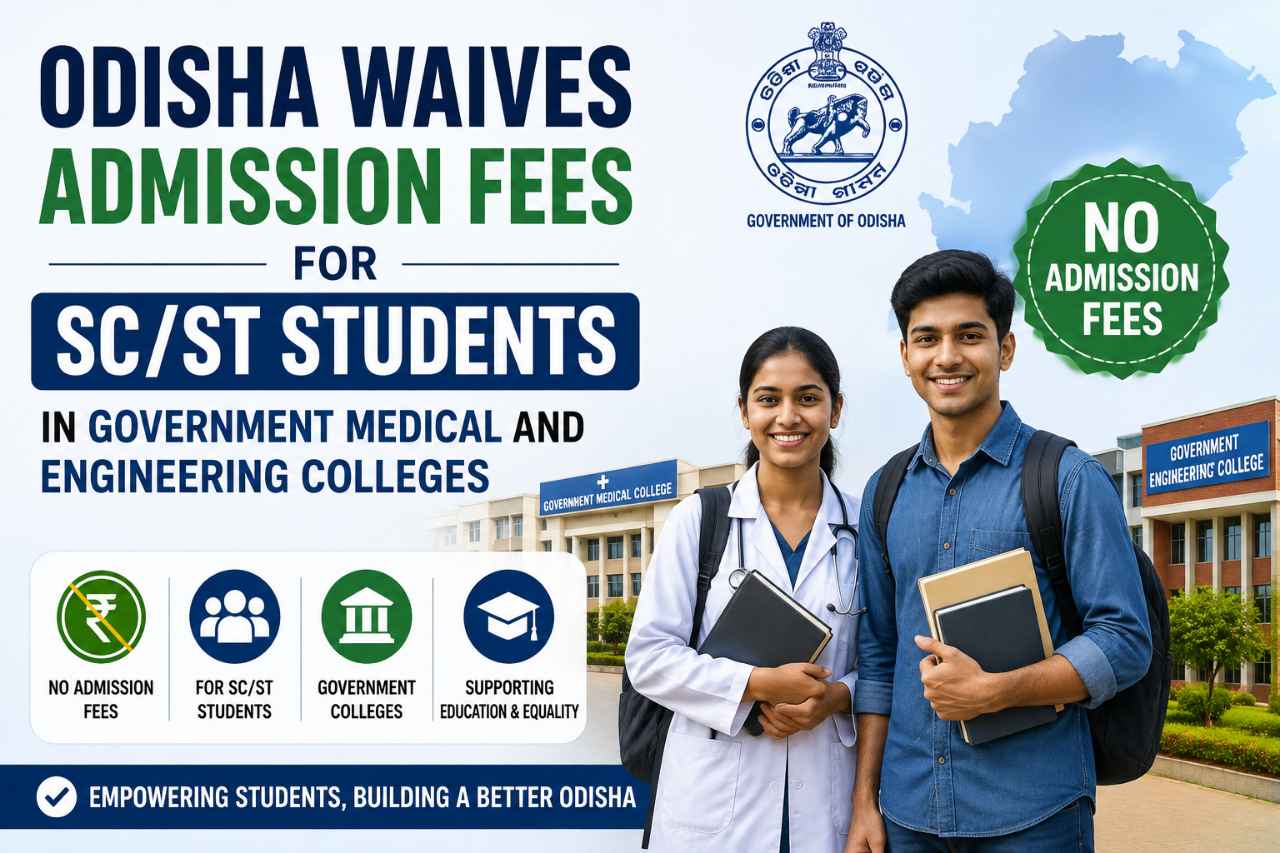

Admission season in India often brings celebration for students who clear competitive exams and immediate financial stress for families who must pay large upfront fees before classes begin. On September 1, 2026, Odisha Chief Minister Mohan Charan Majhi addressed this gap for two of the state's most vulnerable yet high-merit groups: Scheduled Tribe (ST) and Scheduled Caste (SC) students entering governemnt medical and engineering colleges.
The announcement is significant because it targets the exact moment when many qualified students lose seats not due to poor ranks, but because they cannot arrange admission deposits, hostel charges, or semester fees within tight counselling deadlines. For SC and ST learners who have already cleared NEET, OJEE, or related entrance pathways, the policy promises relief at admission and for six months thereafter. This guide explains what we know so far, who may benefit, how it compares with fee support in other states, and what students and parents should do while waiting for official guidelines from the Odisha government.
What Did Odisha Announce for SC and ST Students?
According to an official release cited by news agencies, CM Majhi directed that students belonging to ST and SC communities will not have to pay any fees at the time of admission in government medical and engineering institutions. The waiver extends beyond the admission desk: beneficiaries will not be required to deposit fees for six months after joining their allotted college.
The decision followed reports that many meritorious Scheduled Caste and Scheduled Tribe candidates despite securing strong ranks in demanding entrance tests struggle to complete formalities because families cannot mobilise lump-sum payments quickly. The state government has indicated that detailed guidelines will be issued soon, which should clarify document requirements, covered fee heads, and the process colleges must follow.
Key Highlights at a Glance
- Who: SC and ST students admitted to government medical and engineering colleges in Odisha
- What: No fee payment at admission and for six months post-admission
- Why: To prevent seat forfeiture due to short-term financial hardship after exam success
- When announced: September 1, 2026
- Next step: Formal government guidelines expected shortly
Why Admission-Time Fees Block Meritorious SC/ST Students
In Indian professional admissions, clearing an entrance exam is only the first hurdle. Counselling timelines are compressed. Medical allotments through NEET UG follow MCC and state quotas with document verification windows that may last only days. Engineering admissions through state-level exams such as OJEE similarly require immediate fee deposits to confirm seats.
For SC and ST categories, tuition may already be subsidised or waived under existing reservation and scholarship schemes. Yet practical costs at admission often include:
- One-time admission or registration charges
- First-semester or first-year tuition components not covered by ongoing scholarships
- Hostel security deposits and mess advance payments
- Library, laboratory, examination, and development fees
- Medical insurance, identity card, and uniform costs for MBBS programmes
When scholarships are disbursed later sometimes weeks or months after joining students who lack liquid savings may miss deadlines and lose seats to candidates lower on the merit list. Odisha's move directly targets this liquidity gap rather than questioning students' academic eligibility.
Real-World Scenario: When Merit Meets a Cash Crunch
Consider a tribal student from a remote district who ranks within the ST quota for a government engineering seat after years of preparation. The family sells livestock to fund coaching but cannot arrange ₹40,000 within 72 hours of spot-round allotment. Without deferral, the seat passes to the next candidate. Policies like Odisha's aim to prevent such outcomes while preserving merit-based order within reserved categories.
Which Colleges and Courses Are Likely Covered?
The announcement explicitly names government medical colleges and government engineering colleges in Odisha. While the pending guidelines will provide the authoritative list, students should expect coverage at state-run institutions offering MBBS, BDS (if included in medical ambit), B.Tech, and possibly B.Arch or integrated programmes where admission is through government quota seats.
Government Medical Colleges in Odisha
Odisha hosts multiple public medical colleges attached to district hospitals and medical university systems. MBBS aspirants typically enter through NEET UG counselling under state quota and All India Quota rules. If the waiver applies to all government medical institutions, beneficiaries could include students allotted seats at established public medical colleges in Bhubaneswar, Cuttack, Berhampur, and other centres subject to final notification language.
Government Engineering Colleges in Odisha
Engineering aspirants in the state generally pursue B.Tech through OJEE counselling or applicable central routes for centrally funded institutions within Odisha. Government engineering campuses offer affordable tuition compared with private colleges a model seen across India, from Government College of Engineering Chennai to northern institutions such as Government Engineering College Ajmer and Rajiv Gandhi Government Engineering College Alwar.
Students comparing government campuses nationwide often evaluate fee structure, placement records, and branch availability. Odisha's new directive adds a state-specific layer: even within low-fee government colleges, SC/ST students may now defer payments that previously blocked seat confirmation.
What May Not Be Covered Initially
Unless the upcoming guidelines state otherwise, students should assume private medical and engineering colleges are outside this order. Self-financing institutions whether Galgotias College of Engineering and Technology, NIET Engineering College, or Chennai-based options like SSN College of Engineering Chennai set their own fee schedules and rarely mirror state fee-deferral policies unless separately contracted.
How the Six-Month Fee Relief Period Works
The most distinctive element of CM Majhi's direction is the six-month post-admission window. This suggests the government recognises that scholarship credits, post-matric assistance, and family income may take time to align with academic calendars.
Probable Timeline for Students
Although exact dates will appear in official rules, a reasonable working model for the 2026–27 academic year might look like this:
- Month 0 (Admission): SC/ST student receives seat allotment; confirms without paying covered fees
- Months 1–6: Student attends classes; government or institutional mechanism tracks deferred fee liability
- After Month 6: Normal fee payment or settlement through scholarships/grants as per guidelines
This structure reduces the risk that a student drops out or vacates a seat because a single deadline fell before a caste certificate update, bank transfer, or scholarship sanction could be completed.
Existing Support Schemes SC/ST Students Should Know
Odisha's announcement builds on a wider architecture of affirmative action and financial aid in Indian higher education. Understanding these programmes helps families plan beyond the six-month deferral.
Central and State Scholarship Pathways
- Post-Matric Scholarship for SC/ST students: Covers tuition and maintenance subject to income ceilings and renewal rules
- Central Sector Scheme: Merit-cum-means support for college-level study
- State tribal welfare scholarships: Additional assistance for ST communities through Odisha's ST and SC Development Department
- Fee reimbursement under reservation policy: Some states already refund tuition for reserved-category students in government institutions
The new Odisha policy appears complementary: it addresses timing, not necessarily the ultimate responsibility for fees. Students should continue applying for scholarships in parallel so that when the six-month period ends, sanctioned funds can clear deferred balances.
Reservation in Medical and Engineering Admissions
SC and ST candidates compete under constitutionally mandated reservation in government seats. Medical counselling reserves vertical quotas; engineering admissions through OJEE apply category-wise merit lists. Securing a seat remains merit-linked within each category financial relief does not lower academic cut-offs.
Comparison: Government vs Private Engineering Colleges
To appreciate why a government-only waiver matters, consider how fee burdens differ across institution types. The table below offers a simplified comparison for planning purposes; actual figures vary by state, branch, and year.
| Factor | Government Engineering College | Private Engineering College |
|---|---|---|
| Annual tuition (approx.) | ₹20,000–₹1,00,000 | ₹1,00,000–₹3,00,000+ |
| Admission deposit | Often required upfront | Typically higher upfront capitation or seat blocking fees |
| Scholarship compatibility | Strong alignment with state/central aid | Varies; some aid covers partial tuition only |
| Odisha SC/ST deferral (2026) | Expected to apply per CM directive | Not announced |
Students exploring alternatives outside Odisha for example Chandigarh Engineering College, BPIT Engineering College, or Jaipur Engineering College JEC Jaipur should verify local SC/ST fee policies independently. National diversity in engineering options, from Dronacharya College of Engineering to Panimalar Engineering College Chennai, does not automatically replicate Odisha's administrative decision.
Impact on NEET UG and OJEE Counselling 2026
With NEET UG counselling ongoing across states in September 2026, Odisha's announcement arrives at a critical juncture for medical aspirants. SC/ST candidates allotted government MBBS seats in Odisha should monitor the state counselling authority website for circulars integrating the CM's directive into payment workflows on the portal.
Action Points for Medical Aspirants
- Complete document verification with valid SC/ST certificate issued by competent Odisha authority
- Take screenshot of seat allotment before fee step in case portal logic updates mid-session
- Contact helpdesk if payment gateway still demands fees after guideline publication
- Keep NEET UG allotment letter and category certificate copies ready for college reporting
Action Points for Engineering Aspirants
OJEE and related engineering counselling candidates should watch the Skill Development and Technical Education Department and OJEE cell announcements. Government B.Tech seats including core branches at public campuses may follow the same deferral protocol. Students aiming at institutions similar to Inderprastha Engineering College or RKGIT Engineering College in other states must not assume cross-state applicability.
State-Level Precedents and National Outlook
Odisha is not the first state to experiment with fee relief for disadvantaged groups, but the explicit six-month deferral at government professional colleges adds specificity worth noting. States such as Telangana and Andhra Pradesh have historically promoted fee reimbursement for SC/ST and BC students in certain professional courses. Tamil Nadu's extensive reservation architecture pairs with multiple welfare boards funding higher education. Rajasthan students often combine state scholarships with admissions to colleges like Sobhasaria College of Engineering Jaipur or Mahatma Gandhi Engineering College Jaipur, though fee rules differ from Odisha's government-college deferral.
At the national level, the National Education Policy 2020 emphasises equitable access and credit-based financing. Odisha's administrative order aligns with that spirit by removing a practical barrier at the admission gate. Whether other states adopt similar six-month windows may depend on Odisha's implementation data and student retention outcomes after the deferral period ends.
Broader Context: Equity in Professional Education
India's professional degree pipeline medicine, engineering, law, and beyond has repeatedly surfaced stories of students from marginalised communities surrendering seats after extraordinary exam performance. Root causes include last-mile financing, digital payment failures, lack of awareness about reimbursement cycles, and social pressure to accept lower-cost diploma routes instead of degree programmes.
Policy responses fall into three buckets: fee reduction (lower sticker price), fee reimbursement (pay first, refund later), and fee deferral (pay later or in instalments). Odisha's model blends deferral at admission with a defined six-month grace period a design that may inspire other states if implementation succeeds.
For tribal communities in particular, geographic distance from counselling centres and banks adds friction. Deferring government college fees removes one immediate barrier, though transport, lodging during reporting, and instrument costs for engineering labs may still require support. Holistic equity demands continued investment in hostels, digital counselling access, and transparent scholarship dashboards.
What Students and Parents Should Do Now
Until formal guidelines appear, proactive preparation reduces uncertainty. Treat the CM's statement as a strong policy signal while following only official documents for compliance.
Document Checklist
- Valid SC or ST certificate (Odisha domicile rules may apply confirm in notification)
- Category certificate format accepted by counselling authority (often latest government template)
- Income certificate if combined with scholarship applications
- Entrance exam scorecard and allotment letter
- Aadhaar-linked bank account details for future scholarship credit
- Passport-size photographs and medical fitness reports where required
Financial Planning Beyond the Waiver
Even with deferred institutional fees, budget for:
- Travel to reporting centres and college campus
- Hostel mess charges that may fall outside tuition waivers
- Books, laptops, and study materials
- Personal expenses during the six-month window
Families comparing engineering destinations nationally whether Maharishi Arvind College of Engineering Jaipur, Northern India Engineering College, or Hindustan College of Engineering Chennai should separate Odisha-specific benefits from general college selection criteria such as accreditation, faculty, and placements.
Expert Perspective: Why Timing Matters as Much as Tuition
From an admissions counselling standpoint, the difference between full tuition waiver and admission-time liquidity support is practical, not semantic. A student whose annual tuition is already low may still fail to join if ₹30,000–₹50,000 must be paid within 48 hours of allotment. Policies that align payment obligations with scholarship disbursement cycles convert merit into enrollment more effectively than post-hoc compensation alone.
Education administrators should ensure college ERP and treasury systems can flag deferred SC/ST accounts without generating automatic seat cancellation triggers. Transparent reporting how many students used the deferral, default rates after six months, and correlation with retention will determine whether the policy scales or adjusts.
Tips for First-Generation Learners
Students whose parents never attended college should lean on authorised counselling helpdesks rather than informal agents promising seat confirmation. Verify every instruction on government websites. Connect with senior SC/ST students already enrolled in target colleges through official orientation channels they often know practical reporting steps and hostel allotment norms.
Role of Colleges and Counselling Authorities
Successful rollout depends on coordination between three layers: the state government issuing rules, counselling bodies updating online payment modules, and individual colleges training admission staff. Government medical and engineering campuses must display notices in Odia and English at admission counters so rural families understand their rights. Counselling helplines should publish FAQ responses aligned with the official guideline once released. Colleges that also run parallel programmes similar in scale to large private campuses such as Velammal Engineering College Chennai or JIMS Engineering College still operate under distinct regulatory frameworks, underscoring why students must confirm institution type before expecting deferral benefits.
Looking Ahead: Guidelines and Accountability
The Odisha government has committed to issuing guidelines soon. Stakeholders should expect clarity on:
- Exact fee heads covered (tuition only vs all institutional charges)
- Whether hostel and mess deposits are included
- Interaction with existing post-matric scholarships
- Consequences if payment is not arranged after six months
- Appeal mechanism for students wrongly charged at admission counters
- Applicability to lateral entry or spot-round allotments
Students, college principals, and counselling officials share responsibility for fair implementation. A meritorious SC/ST student should not face harassment or informal facilitation demands when exercising a declared government benefit.
Conclusion
Odisha Chief Minister Mohan Charan Majhi's September 2026 directive marks a targeted intervention for SC and ST students entering government medical and engineering colleges: no fees at admission and no fee deposits for six months afterward. Born from recognition that financial bottlenecks not academic failure cost the state talented professionals, the policy could prevent seat wastage and strengthen inclusive growth in healthcare and technical sectors.
Final rules are still awaited, so students should track official Odisha counselling portals, maintain category documentation, and pursue scholarships concurrently. Whether you aspire to serve patients through a government medical college or build infrastructure as a graduate from a public engineering campus, this initiative removes an immediate hurdle on the path from entrance exam success to classroom enrollment. Stay informed, verify every step against published guidelines, and seek authorised helpdesk support if college counters are unaware of the updated instructions.