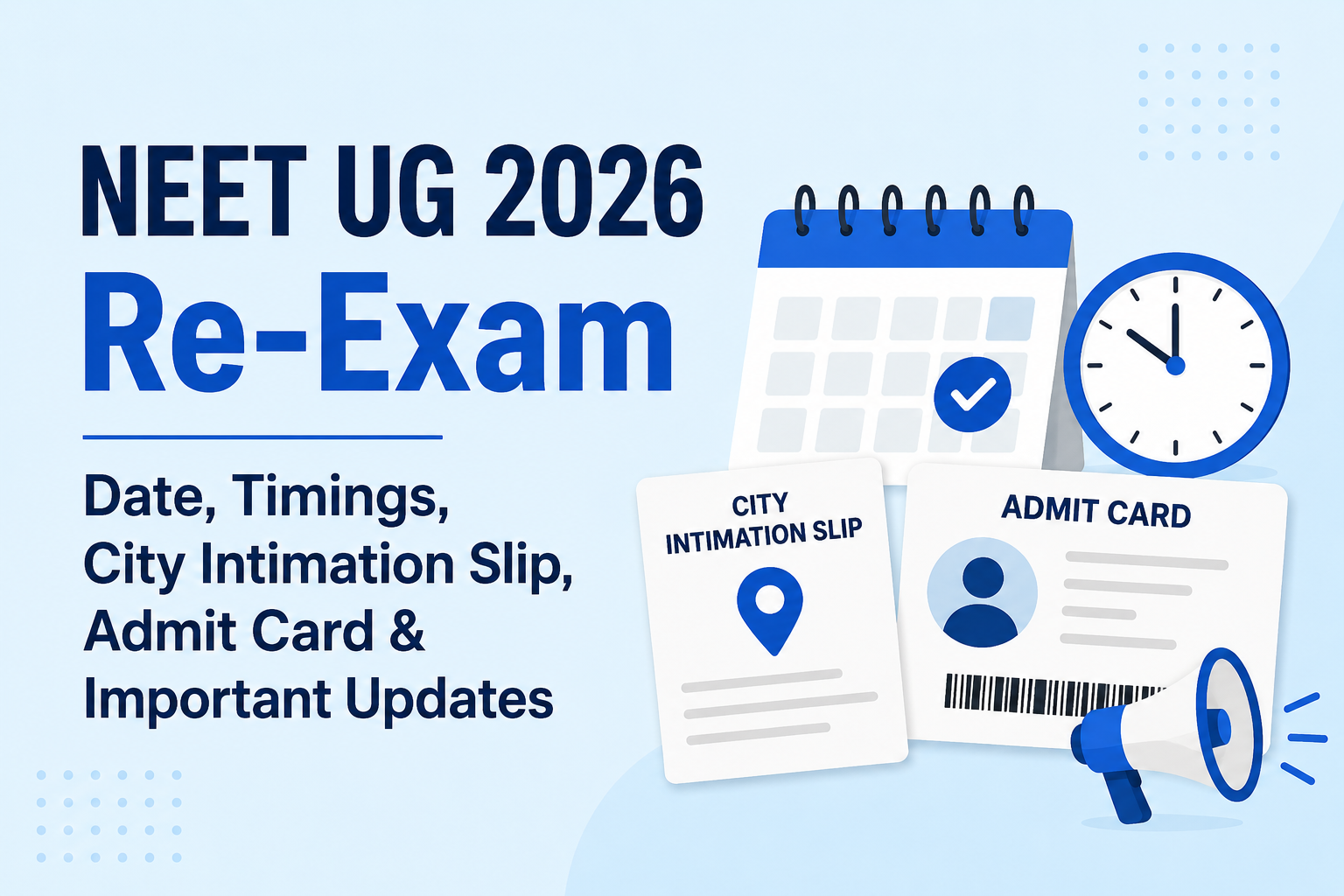
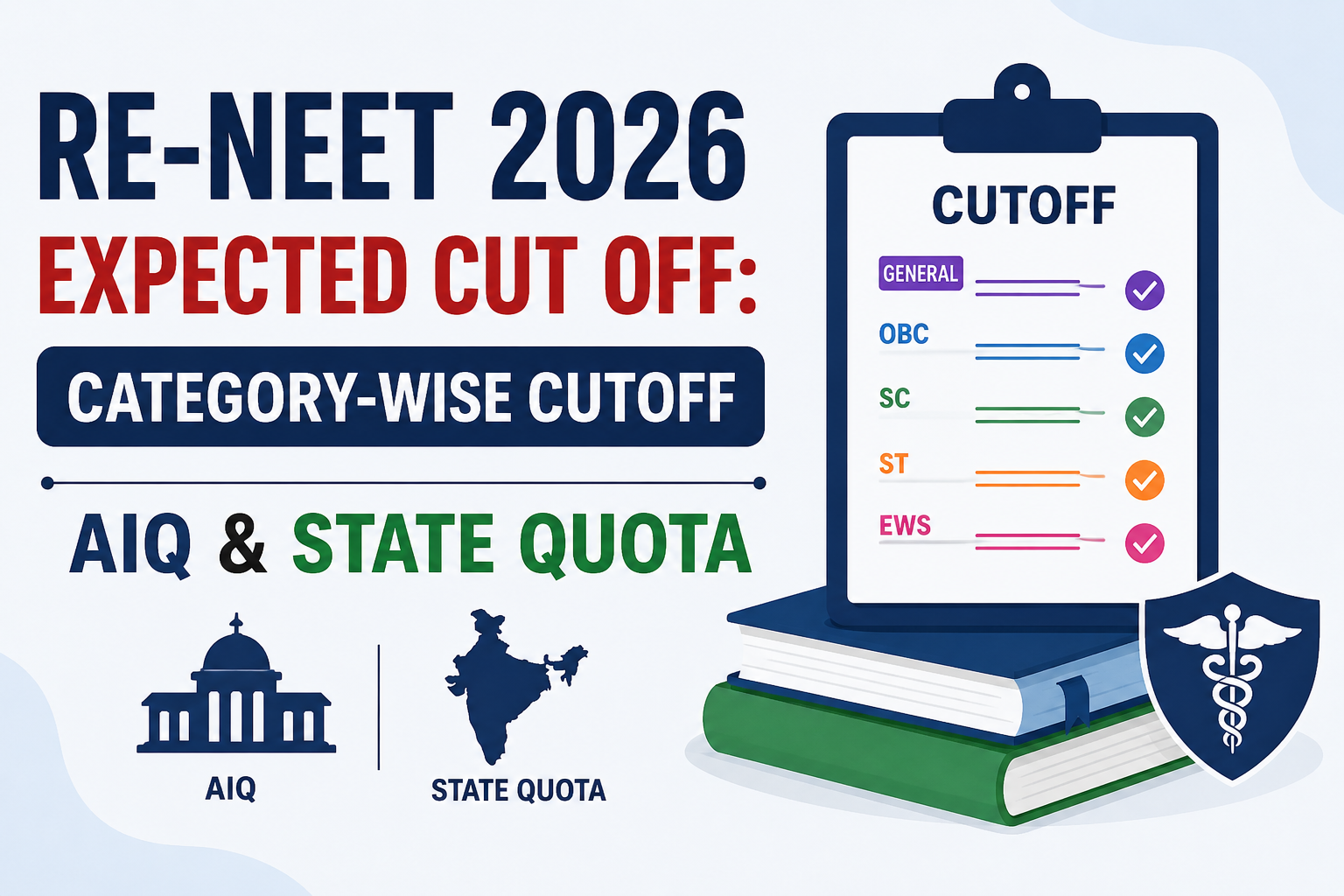

The original NEET UG 2026 examination was scheduled for May 3, 2026. However, following a paper leak controversy, the National Testing Agency (NTA) cancelled the examination and announced a fresh re-examination. The RE-NEET 2026 was conducted on June 21, 2026, across examination centres all over India, with approximately 23 lakh candidates appearing for the test.
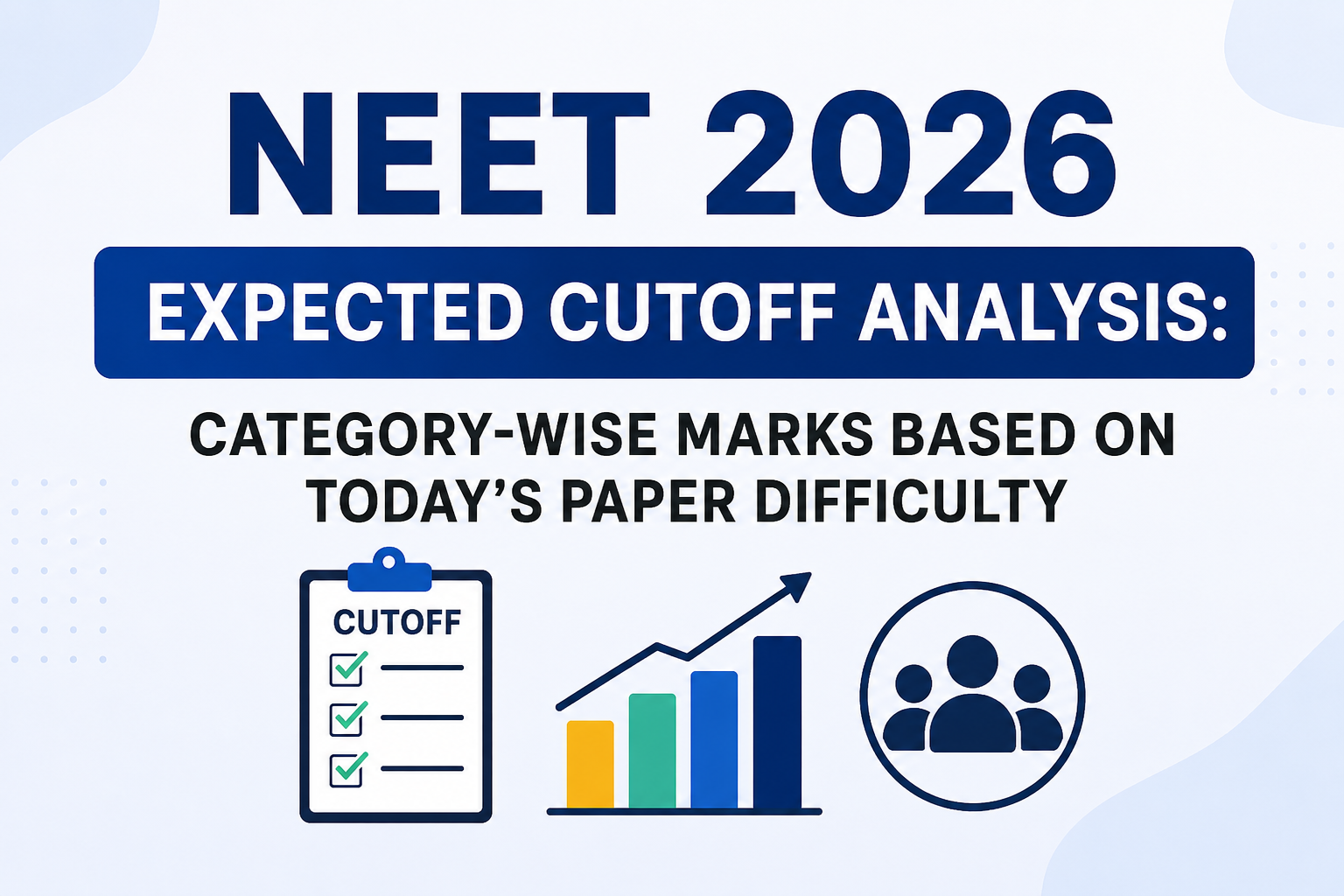
The RE-NEET 2026 is the only valid examination for MBBS, BDS, AYUSH, and other medical course admissions in India for the 2026-27 academic year. The cutoff declared for this re-examination will be used for all counselling purposes both All India Quota (AIQ) and State Quota admissions. According to initial expert feedback and student reactions, the RE-NEET 2026 question paper was rated as moderate in difficulty. Biology offered strong scoring opportunities, Chemistry remained balanced, while Physics emerged as the key differentiator with its focus on numericals and conceptual questions.
Key Facts About RE-NEET 2026
|
Detail |
Information |
|
Original Exam Date |
May 3, 2026 (Cancelled due to paper leak) |
|
Re-Exam Date |
June 21, 2026 |
|
Conducted By |
National Testing Agency (NTA) |
|
Total Candidates |
~23 Lakh (approximately) |
|
Paper Difficulty |
Moderate (as per expert analysis) |
|
Maximum Marks |
720 |
|
Total Questions |
200 (180 to be attempted) |
|
Subjects |
Physics, Chemistry, Biology (Botany + Zoology) |
|
Result Declaration |
To be announced by NTA |
|
Official Website |
neet.nta.nic.in |
Understanding the Two Types of NEET Cutoff
One of the most common confusions among NEET aspirants is mixing up the qualifying cutoff with the admission cutoff. These are two very different things, and understanding the difference is critical for your counselling strategy.
1. Qualifying Cutoff (Eligibility Cutoff)
The qualifying cutoff is the minimum percentile score set by NTA that makes a candidate eligible to participate in NEET counselling. Clearing this cutoff does NOT guarantee a medical seat it only means you are allowed to register for counselling.
• Set by NTA based on percentile, not absolute marks
• General/EWS category: 50th percentile
• OBC/SC/ST category: 40th percentile
• PwD candidates: 45th percentile (General-PwD), 40th percentile (SC/ST/OBC-PwD)
• Changes every year depending on exam difficulty and score distribution
2. Admission Cutoff (College Cutoff)
The admission cutoff is the actual score at which a specific medical college closes admissions during counselling. This is the score that actually matters for getting an MBBS or BDS seat. The admission cutoff is far higher than the qualifying cutoff and varies by college, category, state, and quota.
• Determined during MCC AIQ counselling and State counselling rounds
• Different for each college and each category
• Changes every year based on competition
• Published as closing ranks after each counselling round
• For General category in top government colleges: 620-700+ marks
Simple Comparison Table
|
Parameter |
Qualifying Cutoff |
Admission Cutoff |
|
Purpose |
Makes you eligible for counselling |
Determines actual seat allotment |
|
Set By |
NTA (National Testing Agency) |
MCC / State Counselling Authorities |
|
General Category (Expected) |
140-170 marks |
610-700+ marks |
|
OBC/SC/ST (Expected) |
110-130 marks |
500-620+ marks |
|
Changes Every Year? |
Yes (based on percentile) |
Yes (based on competition) |
|
Is It Enough for MBBS? |
No |
Yes (if above college closing rank) |
RE-NEET 2026 Expected Category-Wise Qualifying Cutoff
Historical NEET Qualifying Cutoff Trends
|
Category |
NEET 2023 |
NEET 2024 |
NEET 2025 |
RE-NEET 2026 (Expected) |
|
General/EWS |
137 |
164 |
144 |
140-170 |
|
OBC |
107 |
129 |
113 |
110-130 |
|
SC |
107 |
129 |
113 |
110-130 |
|
ST |
107 |
129 |
113 |
110-130 |
|
General-PwD |
121 |
146 |
128 |
125-145 |
|
OBC/SC/ST-PwD |
107 |
129 |
113 |
110-125 |
Category-Wise Expected Cutoff Marks
General / EWS Category
General category candidates must clear the 50th percentile. Based on the moderate difficulty of the RE-NEET 2026 paper and previous year trends, the expected qualifying marks for the General category are between 140 and 170 marks out of 720.
|
Category |
Percentile Required |
Expected Qualifying Marks |
Score Range |
|
General (UR) |
50th Percentile |
~145-170 marks |
145 – 720 |
|
EWS (Economically Weaker Section) |
50th Percentile |
~145-170 marks |
145 – 720 |
OBC (Other Backward Classes) Category
OBC candidates need to qualify at the 40th percentile. This is lower than the General category, making it comparatively easier to qualify. However, actual MBBS admission in government colleges still requires a significantly higher score.
|
Category |
Percentile Required |
Expected Qualifying Marks |
Score Range |
|
OBC |
40th Percentile |
~113-130 marks |
113 – 720 |
SC (Scheduled Caste) and ST (Scheduled Tribe) Categories
Both SC and ST candidates need to clear the 40th percentile, same as OBC. The expected qualifying marks for these categories are similar to OBC, in the range of 110-130 marks. However, ST candidates particularly benefit from lower competition within the reserved pool during actual seat allotment.
|
Category |
Percentile Required |
Expected Qualifying Marks |
Score Range |
|
SC |
40th Percentile |
~110-128 marks |
110 – 720 |
|
ST |
40th Percentile |
~110-128 marks |
110 – 720 |
PwD (Persons with Disability) Categories
PwD candidates have a separate cutoff structure. General-PwD candidates need to reach the 45th percentile, while OBC/SC/ST-PwD candidates need the 40th percentile.
|
Category |
Percentile Required |
Expected Qualifying Marks |
|
General-PwD |
45th Percentile |
~125-145 marks |
|
EWS-PwD |
45th Percentile |
~125-145 marks |
|
OBC-PwD |
40th Percentile |
~110-125 marks |
|
SC-PwD |
40th Percentile |
~110-125 marks |
|
ST-PwD |
40th Percentile |
~110-125 marks |
RE-NEET 2026 Expected AIQ (All India Quota) Cutoff
The All India Quota (AIQ) comprises 15% of the total MBBS and BDS seats in all government medical colleges across India, along with 100% seats in central institutions such as AIIMS, JIPMER, and others. The AIQ cutoff is highly competitive because students from all states compete for these seats.
AIQ Cutoff: Category-Wise Expected Marks
|
Category |
Expected AIQ Cutoff (Marks) |
Expected AIR Range |
Government MBBS Chances |
|
General/EWS |
610 – 650+ |
Within 15,000 |
Strong |
|
OBC |
560 – 610 |
Within 35,000 |
Good |
|
SC |
530 – 575 |
Within 70,000 |
Moderate to Good |
|
ST |
500 – 545 |
Within 90,000 |
Moderate |
|
General-PwD |
550 – 600 |
Varies |
Good |
|
OBC-PwD |
490 – 540 |
Varies |
Moderate |
|
SC-PwD |
460 – 510 |
Varies |
Moderate |
|
ST-PwD |
440 – 490 |
Varies |
Low to Moderate |
AIQ Cutoff for Top Government Medical Colleges
|
College |
State |
Expected AIQ Closing Marks (General) |
Expected AIR |
|
AIIMS New Delhi |
Delhi |
700 – 715 |
Top 50-100 |
|
AIIMS Mumbai |
Maharashtra |
690 – 710 |
Top 150-300 |
|
AIIMS Jodhpur |
Rajasthan |
685 – 705 |
Top 300-600 |
|
AIIMS Bhopal |
Madhya Pradesh |
680 – 700 |
Top 400-800 |
|
AIIMS Rishikesh |
Uttarakhand |
678 – 698 |
Top 500-1000 |
|
JIPMER Puducherry |
Puducherry |
680 – 700 |
Top 500-1200 |
|
Maulana Azad Medical College |
Delhi |
670 – 695 |
Top 1000-2500 |
|
UCMS Delhi |
Delhi |
665 – 690 |
Top 2000-4000 |
|
BHU (IMS) Varanasi |
Uttar Pradesh |
655 – 680 |
Top 3000-6000 |
|
KGMU Lucknow |
Uttar Pradesh |
620 – 650 |
Within 12,000 |
|
Grant Medical College Mumbai |
Maharashtra |
615 – 645 |
Within 15,000 |
|
Govt. Medical College Amritsar |
Punjab |
600 – 630 |
Within 20,000 |
AIQ Counselling Rounds
The MCC AIQ counselling typically happens in the following rounds. It is important to register for all rounds to maximise your chances:
• Round 1: Initial seat allotment based on choice filling and rank
• Round 2: For candidates who did not get their preferred seat in Round 1, and for vacant seats
• Mop-Up Round: Fills seats still vacant after Round 1 and Round 2
• Stray Vacancy Round: Final round for remaining unfilled seats across all categories
RE-NEET 2026 Expected State Quota Cutoff
The State Quota comprises 85% of MBBS and BDS seats in government medical colleges. These seats are reserved for domicile candidates of the respective state. State quota cutoffs are consistently lower than AIQ cutoffs, making them a more accessible and preferred route for MBBS admission.
Key Differences: AIQ vs State Quota
|
Parameter |
AIQ (15% Seats) |
State Quota (85% Seats) |
|
Managed By |
MCC (Central Government) |
State Counselling Authority |
|
Seat Share |
15% of government seats |
85% of government seats |
|
Who Can Apply |
All India candidates |
Domicile/State residents only |
|
Rank Used |
All India Rank (AIR) |
State Merit Rank |
|
Cutoff Level |
Higher competition |
Generally 20-50 marks lower |
|
Website |
mcc.nic.in |
State-specific portals |
|
Better For |
High scorers from any state |
State domicile candidates |
State-Wise Expected Cutoff for RE-NEET 2026 (General Category – State Quota MBBS)
|
State |
State Counselling Body |
Expected SQ Closing Marks (General) |
Key Government Colleges |
|
Maharashtra |
DMER Maharashtra |
590 – 640 |
Grant Medical, KEM Mumbai |
|
Delhi |
DGHS Delhi |
620 – 665 |
Maulana Azad, UCMS |
|
Tamil Nadu |
MRB Tamil Nadu |
560 – 620 |
Madras Medical College, Stanley |
|
Karnataka |
KEA Karnataka |
550 – 610 |
BMC Bangalore, Mysore Medical |
|
Uttar Pradesh |
UPNEET / DMER UP |
540 – 610 |
KGMU Lucknow, GSVM Kanpur |
|
West Bengal |
WBMCC |
570 – 625 |
Medical College Kolkata, IPGMER |
|
Rajasthan |
RUHS |
530 – 600 |
SMS Medical College Jaipur |
|
Gujarat |
ACPUG Gujarat |
560 – 615 |
BJ Medical College, NHL Municipal |
|
Madhya Pradesh |
DMAT MP |
530 – 595 |
GRMC Gwalior, MGM Indore |
|
Andhra Pradesh |
KNRUHS |
540 – 605 |
Guntur Medical, Kurnool Medical |
|
Telangana |
KNRUHS Telangana |
545 – 610 |
Osmania Medical, Gandhi Hospital |
|
Kerala |
CEE Kerala |
570 – 625 |
Government Medical College Trivandrum |
|
Bihar |
BCECEB |
520 – 585 |
PMCH Patna, DMCH Darbhanga |
|
Punjab |
BFUHS Punjab |
535 – 595 |
Govt Medical College Amritsar |
|
Haryana |
DMER Haryana |
530 – 590 |
PGIMS Rohtak, GMC Ambala |
|
Odisha |
OJEE Odisha |
510 – 575 |
SCB Medical Cuttack, MKCG Medical |
|
Himachal Pradesh |
HPPSC |
510 – 570 |
IGMC Shimla, Dr RPGMC Tanda |
|
Jharkhand |
JCECEB |
490 – 555 |
RIMS Ranchi, MGM Medical Jamshedpur |
|
Chhattisgarh |
CGDME |
490 – 550 |
RIMS Raipur, Late BRKM Medical |
Note: All state-wise cutoff figures are projected estimates based on 2025 closing data and expected competition in 2026. Official cutoffs will be released by respective state counselling authorities.
Category-Wise State Quota Expected Cutoff (General vs Reserved)
|
Category |
Expected State Quota Cutoff Range |
How Much Lower Than AIQ |
|
General/EWS |
560 – 640 marks |
20-50 marks lower than AIQ |
|
OBC |
510 – 580 marks |
30-60 marks lower than AIQ |
|
SC |
470 – 540 marks |
40-70 marks lower than AIQ |
|
ST |
440 – 510 marks |
50-80 marks lower than AIQ |
|
General-PwD |
490 – 560 marks |
40-60 marks lower than AIQ |
|
OBC-PwD |
440 – 510 marks |
40-70 marks lower |
|
SC-PwD |
410 – 480 marks |
45-70 marks lower |
|
ST-PwD |
390 – 460 marks |
50-80 marks lower |
Course-Wise RE-NEET 2026 Expected Cutoff
NEET UG is used for admissions to multiple courses beyond MBBS. The qualifying percentile remains the same for all courses, but the admission cutoff varies significantly by course, as MBBS attracts far higher competition than BDS or AYUSH.
|
Course |
Duration |
Expected Admission Cutoff (General) |
Competition Level |
|
MBBS |
5.5 Years |
610 – 700+ (AIQ Government) |
Very High |
|
BDS (Dental) |
5 Years |
500 – 580 (Government) |
High |
|
BAMS (Ayurveda) |
5.5 Years |
400 – 500 (Government) |
Moderate |
|
BHMS (Homeopathy) |
5.5 Years |
380 – 480 (Government) |
Moderate |
|
BUMS (Unani) |
5.5 Years |
360 – 460 (Government) |
Low to Moderate |
|
BSMS (Siddha) |
5.5 Years |
350 – 440 (Government) |
Low |
|
BNYS (Naturopathy & Yoga) |
5.5 Years |
340 – 420 (Government) |
Low |
|
B.V.Sc. & AH (Veterinary) |
5 Years |
370 – 460 (Government) |
Low to Moderate |
RE-NEET 2026 Expected Cutoff for Private Medical Colleges
Private medical colleges in India accept NEET scores for MBBS and BDS admissions. There are approximately 710 private MBBS colleges with around 52,000 private MBBS seats across India. The cutoff for private colleges is generally lower than government colleges, but fees are significantly higher.
Expected Private MBBS College Cutoff by Category
|
Category |
Expected Private MBBS Cutoff |
Expected Rank Range |
|
General/EWS |
450 – 580 marks |
50,000 – 2,00,000 |
|
OBC |
400 – 530 marks |
70,000 – 2,50,000 |
|
SC |
370 – 500 marks |
90,000 – 3,00,000 |
|
ST |
350 – 480 marks |
1,00,000 – 3,50,000 |
Tier-Wise Private MBBS College Cutoff
|
College Tier |
Examples |
Expected Cutoff (General) |
Annual Fees (Approx.) |
|
Top Private (Deemed Universities) |
CMC Vellore (Management), St. John's Bangalore |
580 – 640 marks |
₹5 – 15 Lakhs |
|
Mid-Tier Private |
Manipal, JSS, KLE, MGM |
510 – 580 marks |
₹10 – 20 Lakhs |
|
Standard Private |
State-specific private colleges |
450 – 520 marks |
₹8 – 25 Lakhs |
|
NRI Quota (Private) |
Any private college NRI quota |
~360 – 450 marks |
₹25 – 80 Lakhs |
State-Wise Competition Analysis for RE-NEET 2026
|
State |
Approx. State Quota MBBS Seats |
Competition Level |
State Quota Cutoff Difficulty |
|
Maharashtra |
3,500+ |
Very High |
High (590+) |
|
Tamil Nadu |
3,000+ |
Very High |
High (570+) |
|
Karnataka |
2,800+ |
High |
High (560+) |
|
Uttar Pradesh |
3,200+ |
Very High |
High (550+) |
|
West Bengal |
1,800+ |
High |
Moderate-High (570+) |
|
Rajasthan |
1,600+ |
Moderate-High |
Moderate (530+) |
|
Gujarat |
2,000+ |
High |
Moderate-High (560+) |
|
Delhi |
900+ |
Very High |
Very High (620+) |
|
Kerala |
1,200+ |
High |
High (570+) |
|
Bihar |
1,000+ |
Moderate-High |
Moderate (520+) |
|
Madhya Pradesh |
1,800+ |
Moderate |
Moderate (530+) |
|
Jharkhand |
600+ |
Moderate |
Low-Moderate (490+) |
|
Himachal Pradesh |
500+ |
Low-Moderate |
Low (510+) |
Expert Analysis of RE-NEET 2026 Paper & Cutoff Prediction
Paper Difficulty Summary
|
Subject |
Difficulty Level |
Key Observation |
|
Biology |
Easy to Moderate |
Strong scoring opportunities; largely NCERT-based |
|
Chemistry |
Moderate |
Balanced paper; Physical Chemistry had moderate numericals |
|
Physics |
Moderate to Tough |
Key differentiator; focused on numericals and conceptual questions |
|
Overall |
Moderate |
Aligned with NCERT; Physics was trickiest section |
Conclusion
The RE-NEET 2026 examination conducted on June 21, 2026 is the definitive exam for all medical admissions in India for the 2026-27 session. Understanding the difference between qualifying cutoff and admission cutoff, and knowing the AIQ vs State Quota dynamics, is critical for every aspirant.