
For thousands of government school teachers across India, 2026 has brought a new professional reality: clearing the Teacher Eligibility Test (TET) is no longer optional for most in-service educators. The Supreme Court upheld Section 23 of the Right to Education (RTE) Act, 2009, giving teachers a compliance window until 31 August 2028 but the preparation burden falls squarely on educators who are already managing classrooms, administrative duties, and often long commutes in rural areas.
Union Minister Rajmohan Unnithan recently stated that around 3,28,701 government school teachers may face job consequences if they fail to qualify. Many of these teachers have 15 to 20 years of classroom experience. They are not fresh graduates seeking their first posting; they are experienced professionals being asked to prove eligibility through a competitive exam while continuing to teach full time with limited official study support.
This article breaks down what the TET mandate means, why preparation feels overwhelming, and how working teachers can build a realistic study plan. Whether you completed B.Ed from a recognised institution like Delhi Teachers University or trained at a regional college such as Lal Bahadur Shastri Teachers Training College Kota, the strategies below apply to every in-service teacher navigating this transition.
What Is the TET Exam and Why Does It Matter in 2026?
The Teacher Eligibility Test (TET) is a national -level eligibility examination conducted by state governments and the Central Board of Secondary Education (CBSE) for the Central Teacher Eligibility Test (CTET). It assesses whether a candidate possesses the minimum qualifications prescribed under the national Council for Teacher Education (NCTE) to teach at primary (Classes I–V) and upper primary (Classes VI–VIII) levels.
TET was always part of the RTE framework, but its retrospective application to in-service teachers has changed the stakes dramatically. Clearing TET or CTET is now tied directly to continued employment in government and aided schools in many states. For new aspirants, TET opens doors to permanent teaching posts. For experienced teachers, it has become a compliance requirement that feels disconnected from years of proven classroom performance.
Key Facts About TET and CTET
- Conducting bodies: State education boards conduct State TET (STET); CBSE conducts CTET twice a year in most cycles.
- Validity: TET/CTET certificates are typically valid for lifetime from the 2023 notification onwards (earlier validity was seven years).
- Format: Multiple-choice questions (MCQs) covering Child Development and Pedagogy, Language I and II, Mathematics, Environmental Studies or Social Science, and subject-specific sections for upper primary.
- Minimum qualifying marks: General category candidates need 60% (55% for reserved categories in most states).
- Exemption: Teachers with five years or less remaining before retirement are exempt under the Supreme Court order.
The Supreme Court Ruling: Timeline and Implications
In early 2026, the Supreme Court upheld the constitutional validity of Section 23 of the RTE Act, which requires teachers in recognised schools to hold TET qualification. Using powers under Article 142, the court granted an extended compliance deadline of 31 August 2028 rather than ordering immediate dismissals.
This ruling affects teachers who were recruited before TET became a mandatory pre-appointment condition, or who entered service through routes that did not require TET at the time of hiring. State governments are now expected to facilitate exam opportunities, but the actual preparation remains largely self-directed.
Who Must Clear TET by 2028?
| Category | Requirement |
|---|---|
| In-service government school teachers without valid TET | Must qualify by August 2028 |
| Teachers with ≤5 years to retirement | Exempt from mandatory TET |
| New recruits after RTE enforcement | TET required at appointment stage |
| Private school teachers (state-dependent) | Varies by state RTE rules |
The extended deadline provides breathing room, but teachers who delay preparation risk last-minute cramming, multiple failed attempts, and unnecessary stress. Starting early even with 30 minutes daily significantly improves pass rates based on patterns seen in CTET preparation cohorts.
Why TET Preparation Feels Overwhelming for Working Teachers
Experienced educators across Tamil Nadu, Rajasthan, Delhi, and other states report a common set of obstacles. These are not excuses; they reflect structural gaps in how the mandate was rolled out.
1. No Dedicated Study Leave or Official Guidance
Unlike competitive exams where coaching ecosystems are mature, many government schools do not provide structured TET preparation support. Teachers in Cuddalore, Pollachi, Velachery, and rural blocks report relying on WhatsApp groups, colleague-shared PDFs, and unofficial YouTube channels to understand the syllabus. Official model question papers exist on state and CBSE portals, but navigating them without mentorship takes extra effort.
2. Severe Time Constraints
A typical government school teacher handles 25 to 40 students per class, prepares lesson plans, conducts assessments, attends meetings, and often manages mid-day meal or administrative duties. Finding two uninterrupted hours for study after school is difficult. Teachers with families and long commutes may have less than 45 minutes of usable preparation time on weekdays.
3. Digital Access Gaps in Rural Areas
Urban teachers can access online mock tests, Telegram study groups, and e-content from institutions like Tamil Nadu Teachers Education University Chennai. Rural teachers often face unreliable internet, limited smartphones, and no nearby coaching centres. A teacher in an interior village may depend on a sibling or colleague in a town to download and print materials a logistical burden that urban candidates rarely face.
4. Emotional and Professional Disconnect
Teachers with 10 to 20 years of experience find it demoralising to sit for an MCQ exam designed for fresh B.Ed graduates. As one Chennai-based educator noted, being tested after a decade in the classroom feels like the system ignores demonstrated competence. This emotional friction can reduce motivation unless teachers reframe TET as a one-time administrative hurdle rather than a judgment on their entire career.
5. Centre-Based Examination Logistics
TET and CTET require physical attendance at designated centres, often in district headquarters. Teachers in remote postings must arrange travel, leave, and sometimes overnight stays. MCQ-based exams could theoretically be proctored online, and educators have suggested remote options especially after recent concerns about paper leaks and centre overcrowding but current policy mandates in-person testing.
Understanding the TET Syllabus: What Working Teachers Must Revise
Many experienced teachers know pedagogy intuitively but struggle with exam-specific terminology and NCERT-aligned facts. A structured syllabus review prevents wasted effort.
Paper I (Primary Level – Classes I to V)
- Child Development and Pedagogy (30 MCQs): Piaget, Vygotsky, Kohlberg, inclusive education, learning difficulties, assessment strategies.
- Language I (30 MCQs): Usually the medium of instruction comprehension, grammar, pedagogy of language.
- Language II (30 MCQs): Second language (often English) same structure as Language I.
- Mathematics (30 MCQs): Number system, geometry, data handling, pedagogy of mathematics.
- Environmental Studies (30 MCQs): Family, food, water, travel, pedagogy of EVS.
Paper II (Upper Primary – Classes VI to VIII)
Paper II replaces EVS/Mathematics with subject-specific sections. Candidates choose Mathematics and Science or Social Science/Social Studies depending on their teaching subject. Child Development and Pedagogy and both language sections remain compulsory.
Actionable Tip: Map Your Weak Zones First
Download the official syllabus PDF from your state TET portal or ctet.nic.in. Attempt one previous-year paper under timed conditions. Score each section separately. Most working teachers score well in pedagogy but lose marks in Language II grammar and subject-specific factual recall. Prioritise weak sections in your weekly plan.
A Realistic 6-Month Study Plan for Full-Time Teachers
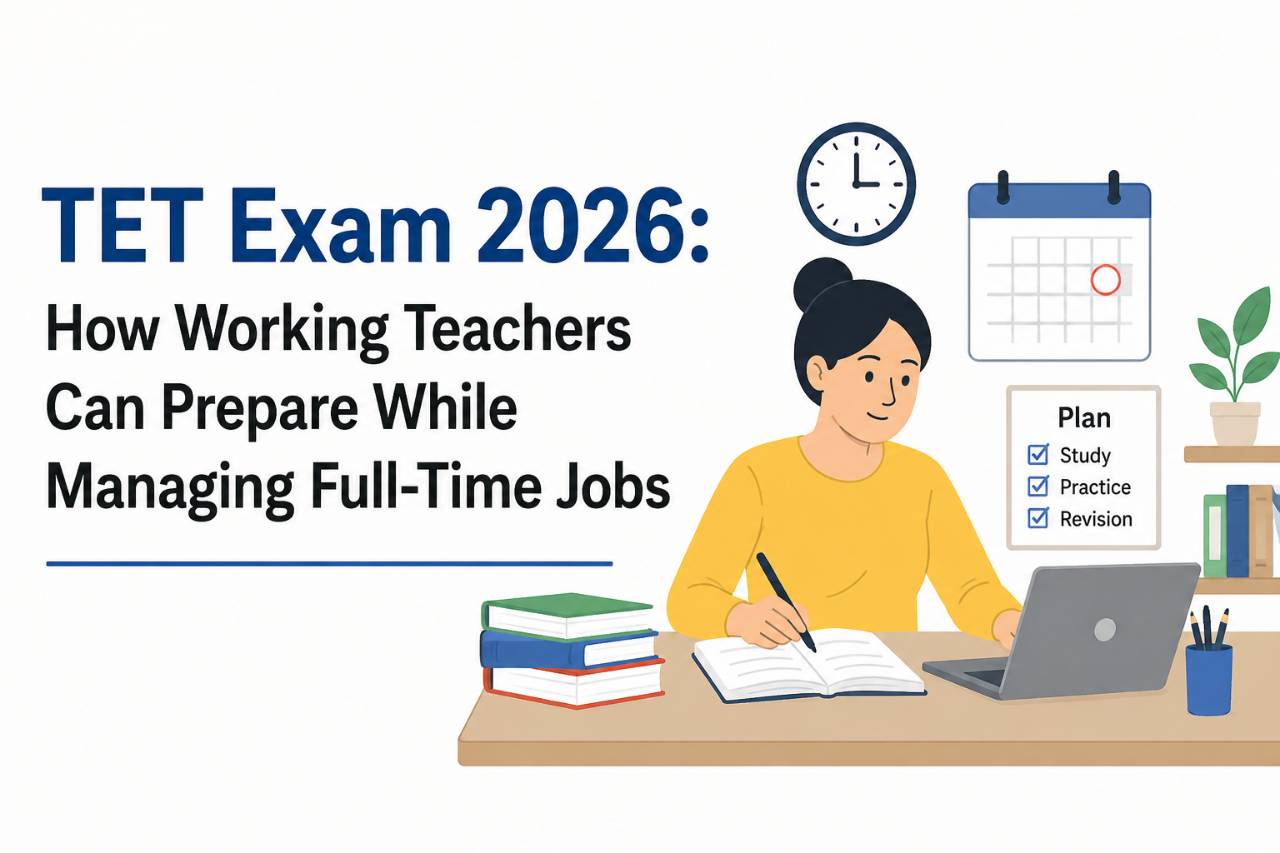
You do not need eight hours daily to pass TET. Consistency beats intensity. Below is a plan designed for teachers with 60 to 90 minutes of daily study time.
Months 1–2: Foundation and Diagnostic Phase
- Collect official syllabus, previous papers, and answer keys.
- Join one reliable WhatsApp or Telegram group avoid joining ten groups that flood your phone.
- Study Child Development and Pedagogy using NCERT textbooks for Classes VI–VIII and standard B.Ed notes.
- Revise Language I daily for 15 minutes read one editorial or passage and answer inference questions.
Months 3–4: Subject Depth and Mock Tests
- Allocate alternate days to Mathematics/EVS or your Paper II subject.
- Take one sectional mock test every weekend.
- Maintain an error notebook write every wrong answer with the correct concept.
- Pair with a colleague for accountability; many schools have informal study circles now.
Months 5–6: Revision and Exam Simulation
- Complete at least five full-length mock tests under 150-minute exam conditions.
- Revise the error notebook twice.
- Focus on speed: TET has 150 questions in 150 minutes one minute per question on average.
- Apply for the nearest examination centre early to avoid travel stress.
Study Resources That Actually Work for Busy Educators
Quality matters more than quantity. Working teachers should choose resources that match their access level.
Free and Official Resources
- Previous year question papers and official answer keys from state TET and CTET websites.
- NCERT textbooks from Classes I to VIII especially for EVS, Mathematics, and Science factual questions.
- NCF 2005 and NCFTE 2009 summaries for pedagogy questions.
- YouTube channels run by qualified teacher educators (verify credentials before trusting content).
Low-Cost Printed Materials
Teachers without reliable internet can use guidebooks from recognised publishers covering CTET Paper I and Paper II. Purchase one comprehensive book rather than five thin pamphlets. Libraries at teacher training institutions sometimes allow alumni access check with your alma mater, whether that is Vidya Bhavan Teachers Training College Jaipur, St Wilfreds Teachers Training College Jaipur, or Institute Of Advanced Studies In Education Churu.
Peer Networks
WhatsApp study groups run by district education officers, teachers' associations, or senior colleagues remain the most accessible support system. Share mock test links, clarify doubts, and coordinate leave for exam day. If you are helping a colleague in a remote area, download PDFs onto a pen drive or print key chapters small acts of support make a measurable difference.
The Rural–Urban Divide in TET Readiness
India's teacher TET challenge is also a geography story. Urban teachers in Chennai, Jaipur, Delhi, and Bengaluru can access coaching institutes, high-speed internet, and peer communities within minutes. Rural teachers in blocks across Cuddalore, Sikar, Neemkathana, and interior Rajasthan face fundamentally different conditions.
Low salaries in some states compound the stress. When a teacher earns modestly and must spend on travel, books, and leave without pay, TET preparation becomes a financial strain not just an academic one. State governments that provide free bridge courses, printed material distribution through block offices, and mobile-friendly offline content will see higher compliance rates before the 2028 deadline.
Aspirants entering the profession today can avoid future retrospective mandates by choosing NCTE-recognised B.Ed or D.El.Ed programmes from the start. Rajasthan alone hosts numerous recognised options including Shri Kalyan Teachers Training College Jaipur, Sanjay Teachers Training College Jaipur, Aravali Teachers Training College Neemkathana Sikar, and Womens Teachers Training College Sikar institutions that integrate TET-oriented pedagogy into their curriculum.
What Experts and Teachers Are Saying: A Balanced View
Stakeholders agree on the goal quality education requires qualified teachers but disagree sharply on retrospective enforcement.
Arguments Supporting the Mandate
- TET sets a minimum competency benchmark aligned with NCTE norms.
- Retrospective compliance closes a legal loophole where unqualified teachers remained in service for decades.
- The 2028 deadline is generous compared to immediate termination.
- Students deserve teachers who meet statutory eligibility regardless of years served.
Concerns Raised by Teachers and Parent Associations
- Recruitment systems should have verified qualifications at the point of hiring not years later.
- Experienced teachers may leave the profession rather than endure exam stress, worsening existing shortages.
- Rural schools lose the most when senior teachers fail or take extended leave to prepare.
- MCQ exams measure test-taking skill, not classroom effectiveness built over 15 years.
- Online or workplace-based assessment would reduce logistical hardship without lowering standards.
Both perspectives contain valid points. For individual teachers, the practical response is to focus on what you can control: preparation, attempt scheduling, and peer support while advocacy groups continue pushing for better implementation policies.
How Teacher Training Institutions Can Support In-Service Educators
B.Ed and D.El.Ed colleges are natural partners for bridge programmes. Institutions with continuing education cells can offer weekend TET workshops, mock test series, and refresher modules in pedagogy. Several national and state-level bodies already specialise in teacher development:
- Indian Institute Of Teacher Education Gandhinagar – model teacher education initiatives.
- National Institute Of Technical Teachers Training And Research Chennai – advanced pedagogy research.
- Jawaharlal Nehru Teacher Training College Kota – regional B.Ed training hub.
- Arya Mahila Teachers Training College Jaipur – women-focused teacher preparation.
- Sant Kabir Teacher Training College Jaipur – recognised D.El.Ed and B.Ed programmes.
State education departments should tie up with such institutions to run district-level orientation camps especially in underserved blocks where private coaching does not reach.
CTET 2026: Important Dates and Application Tips
Teachers who need a central eligibility certificate often appear for CTET in addition to or instead of state TET, depending on recruitment rules. Stay updated through the official CBSE CTET portal.
Before You Apply
- Verify your educational qualification matches Paper I or Paper II requirements.
- Keep scanned copies of B.Ed/D.El.Ed marksheets, Class X and XII certificates, and category certificate if applicable.
- Choose examination centre closest to your workplace or residence to minimise travel fatigue on exam day.
- Apply in the first week of the application window to avoid server crashes during the last days.
On Exam Day
- Reach the centre 90 minutes early with admit card and valid photo ID.
- Attempt easy questions first; mark uncertain ones for review.
- Do not leave any question blank there is no negative marking in CTET.
- Stay calm: experienced teachers often outperform fresh graduates in pedagogy sections.
Protecting Your Mental Health During TET Preparation
Exam stress on top of full-time teaching can affect health and classroom performance. Set boundaries: designate one study hour after dinner rather than sacrificing sleep. Talk to family members about why this exam matters so they can share household responsibilities temporarily. If anxiety feels overwhelming, connect with colleagues who are in the same situation shared experience normalises the struggle.
Remember that one exam does not erase your contribution to Indian education. Teachers who cleared TET after 15 years of service consistently report that structured preparation not innate brilliance made the difference. You already know how to teach; TET asks you to demonstrate that knowledge in a specific format.
Conclusion: Turning a Mandate Into a Manageable Milestone
The Supreme Court's TET compliance order has created genuine hardship for lakhs of working teachers, especially those in rural schools with limited resources and no official preparation support. The frustration is understandable. Yet the August 2028 deadline also offers a clear timeline to act methodically rather than panic at the last moment.
Start with a diagnostic mock test, build a 60-minute daily routine, use official materials, lean on peer networks, and attempt the exam early enough to allow a second try if needed. Advocate for better state-level support printed materials, bridge courses, and fair examination logistics while taking personal responsibility for preparation.
For future generations of educators, the lesson is equally clear: pursue NCTE-recognised teacher education from reputable institutions, clear TET before or immediately after B.Ed, and keep your eligibility certificate updated. Whether you train at Mahaveer Teachers Training College Jaipur, Geeta Bajaj Women Teacher Training Institute Jaipur, or any recognised college listed on CollegeDwar, early TET qualification prevents the retrospective scramble that today's in-service teachers face.
India needs experienced, qualified teachers in every classroom. Clearing TET is one step not the whole definition of your worth as an educator.