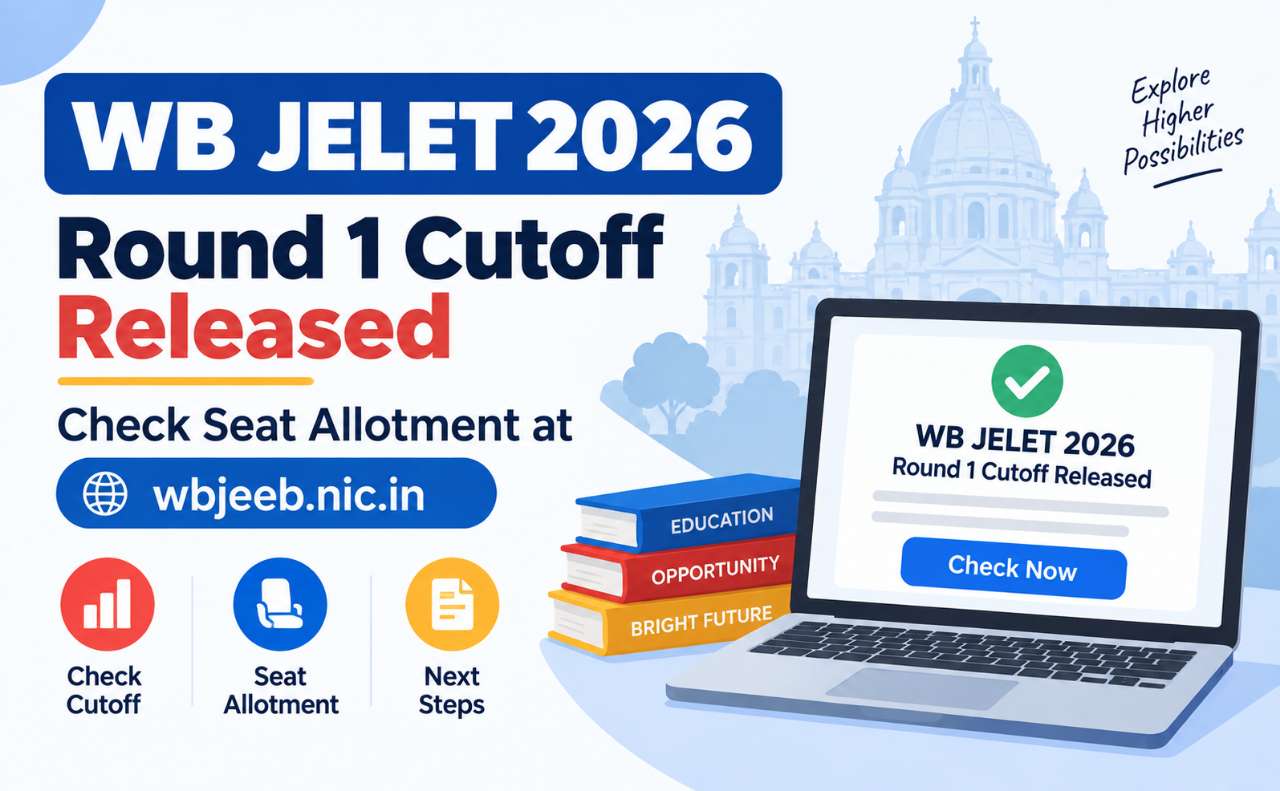
The West Bengal Joint Entrance Examinations Board (WBJEEB) has released the WB JELET 2026 Round 1 cutoff along with seat allotment results on the official portal at wbjeeb.nic.in. If you appeared for the Joint Entrance Examination for Lateral Entry (JELET) and participated in Round 1 counselling, this is the moment when your rank, college choices, and seat matrix finally translate into a real admission outcome. The Round 1 cutoff reflects the opening and closing ranks at which seats were allotted institute-wise, branch-wise, and category-wise across participating engineering colleges in West Bengal.
For diploma holders and B.Sc. graduates aiming at second-year B.Tech or B.E. admission, understanding the Round 1 cutoff is not optional it directly shapes your next steps. Whether you secured a seat at a top government college, received a lower-preference allotment, or missed out entirely, the published cutoff data helps you evaluate options before Round 2 and Round 3 counselling begin. This guide explains what the WB JELET 2026 Round 1 cutoff means, how to check it online, what the counselling timeline looks like, and how to plan your admission strategy with clarity.
What Is WB JELET and Why Does Round 1 Cutoff Matter?
WB JELET is West Bengal's state-level entrance examination for lateral entry into engineering degree programmes. Unlike first-year admissions through WBJEE, JELET is designed for candidates who have already completed a recognised diploma in engineering/technology or an equivalent qualification and wish to join the second year (third semester) of B.Tech/B.E. courses at participating institutes.
The exam is conducted annually by WBJEEB. In 2026, the written test was held on June 13, 2026. After results were declared, qualified candidates entered a structured online counselling process involving registration, document verification, choice filling, seat allotment, fee payment, and reporting to allotted institutes.
Round 1 is typically the most competitive phase because it includes the maximum number of fresh aspirants filling choices for the first time. The Round 1 cutoff represents the rank range within which seats were filled at each college and branch. In counselling terminology, this is often published as:
- Opening Rank (OR): The best (lowest numerical) rank at which a seat was allotted in a particular category, institute, and branch.
- Closing Rank (CR): The last (highest numerical) rank at which a seat was allotted before the category-seat block was exhausted for that round.
If your JELET rank is better (numerically lower) than the closing rank for a college-branch combination in your category, you had a realistic chance of allotment provided you listed that option during choice filling and seats were available when your turn came in the seat allocation algorithm.
Who Should Check the Round 1 Cutoff?
Every JELET 2026 participant should review the cutoff data, not only those who received allotments. Here is who benefits most:
- Allotted candidates confirming whether they got a high, medium, or safety choice and deciding whether to freeze, float, or withdraw for subsequent rounds.
- Non-allotted candidates comparing their rank against closing ranks to understand how far they were from preferred options and how to reorder choices in Round 2.
- Parents and counsellors helping students interpret category-wise OR-CR trends across government and private colleges.
- 2027 aspirants using current-year trends as a reference point alongside previous-year data.
WB JELET 2026 Round 1 Cutoff: Key Highlights
WBJEEB released the Round 1 seat allotment result on September 8, 2026. Alongside individual allotment letters available through candidate login, the board publishes institute-wise and category-wise opening and closing ranks through its e-counselling portal. These ranks collectively form the official Round 1 cutoff picture.
Important highlights candidates should note:
- Round 1 choice filling was open from September 2 to September 6, 2026.
- Round 1 seat allotment and cutoff publication: September 8, 2026.
- Seat acceptance fee payment and document verification window: September 8 to September 10, 2026.
- Provisional seat acceptance fee: ₹5,000 (paid online by allotted candidates within the deadline).
- Round 2 choice filling: September 11 to September 13, 2026; allotment on September 15, 2026.
- Round 3 choice filling: September 18 to September 20, 2026; allotment on September 22, 2026.
The cutoff varies significantly by branch. Based on historical trends and early Round 1 patterns, highly sought-after branches such as Computer Science and Engineering (CSE), Information Technology (IT), and Electronics and Communication Engineering (ECE) generally close at much better ranks than branches like Civil Engineering, Mechanical Engineering, or specialised programmes in printing, food technology, or architecture at the same institute.
Expected Competition Level by Branch (Round 1 Indicators)
While official Round 1 closing ranks should always be verified on the portal, past JELET cycles offer useful context. Top institutes such as Jadavpur University typically see extremely tight cutoffs for CSE and IT, often closing within the top few hundred ranks for general category home-state seats. Government engineering colleges like Jalpaiguri Government Engineering College (JGEC), Kalyani Government Engineering College (KGEC), and Cooch Behar Government Engineering College show moderately competitive cutoffs for core branches.
Private and self-financing institutes generally have higher (numerically larger) closing ranks, making them important safety options during choice filling. Candidates who listed only premium colleges without adequate backup choices often remain unallotted in Round 1 even with decent ranks.
How to Check WB JELET 2026 Round 1 Cutoff Online
WBJEEB publishes cutoff ranks through the official website. There are two related but distinct checks every candidate should perform after Round 1 allotment.
Method 1: Check Your Personal Seat Allotment Result
This tells you whether you received a seat and which institute-branch combination was allotted to you.
- Visit the official WBJEEB website at wbjeeb.nic.in.
- Navigate to the JELET section under the examinations tab.
- Open the Candidate Activity Board or e-counselling login portal.
- Click the link for JELET 2026 Round 1 Seat Allotment Result.
- Log in using your application number or roll number, password, and security PIN.
- View your allotted institute, course, category, and allotment status.
- Download and save the allotment letter PDF for admission reporting and future rounds.
Method 2: Check Institute-Wise Opening and Closing Ranks (OR-CR)
This public cutoff view helps you analyse competition across colleges and categories, even if you want to compare multiple options for the next round.
- Go to wbjeeb.nic.in.
- Select the eServices / OR-CR tab on the homepage.
- Choose the examination name WB JELET.
- Open the WB JELET 2026 Counselling link.
- Select Round 1 from the counselling round filter.
- Filter by institute, branch, seat type (home state / other state, if applicable), and reservation category.
- Note the opening rank and closing rank for each combination relevant to your rank and category.
Always rely on the official portal for final decisions. Third-party websites may summarise cutoff trends, but admission authority rests solely with WBJEEB and the reporting institute.
Understanding Category-Wise and Institute-Wise Cutoff
WB JELET cutoffs are not published as a single universal score. Instead, WBJEEB releases rank-based cutoffs segmented across multiple dimensions. Understanding this structure prevents common mistakes during choice filling.
Reservation Categories
Cutoffs are released separately for categories such as:
- General (Open)
- OBC-A and OBC-B
- SC, ST, and PwD
- EWS (Economically Weaker Section), where applicable
A candidate must compare their rank only against the closing rank of their own category. For example, if the CSE closing rank for General category at a college is 120 but your category's closing rank is 350, using the General cutoff as reference will mislead your counselling strategy.
Seat Type and Quota
Some institutes differentiate between home-state and other-state seats, management quota seats (where applicable in private institutions), and institute-specific seat matrices approved for JELET lateral entry. The seat matrix published before counselling remains the authoritative source for how many JELET seats exist per branch.
Branch-Wise Variation at the Same College
Do not assume one closing rank applies to an entire college. Within the same institute, CSE may close at rank 80 while Mechanical Engineering closes above rank 800 in the same round. This is normal and reflects branch-level demand, not an error in allotment.
WB JELET 2026 Round 1 Cutoff Trends: What Top Colleges Indicate
Premium engineering destinations in West Bengal continue to dominate JELET preferences. Although exact Round 1 numbers must be verified on the official OR-CR portal after release, historical and expected patterns help candidates interpret the 2026 outcome.
Computer Science and Information Technology
CSE and IT remain the most competitive JELET branches. At leading universities, opening ranks often start in single or double digits for general category seats, with closing ranks staying comparatively low due to limited lateral-entry seat intake. Private colleges absorb mid-rank candidates but still show sharp rank drops for CSE compared to conventional core branches.
Electrical, Electronics, and Mechanical Engineering
Core branches at government colleges typically close at moderate ranks. Jalpaiguri, Kalyani, and Berhampore institutions often serve as strong targets for diploma holders with ranks outside the top tier. Mechanical and Civil branches at the same top university may close several hundred ranks later than CSE, creating opportunities for candidates prioritising institute reputation over branch popularity.
Civil, Chemical, and Specialized Programmes
Branches such as Civil Engineering, Chemical Engineering, Food Technology, Printing Technology, and Architecture generally have relatively relaxed cutoffs. Candidates aiming for a government or university-affiliated tag with rank limitations often benefit from strategic branch flexibility in Round 1 and subsequent upgradation rounds.
WB JELET 2026 Counselling Schedule After Round 1 Cutoff
Once Round 1 cutoff and allotment are published, the counselling calendar moves quickly. Missing a deadline can cost a seat even after allotment.
| Counselling Event | Date |
|---|---|
| Round 1 Registration and Choice Filling | September 2–6, 2026 |
| Round 1 Seat Allotment and Cutoff Release | September 8, 2026 |
| Round 1 Seat Acceptance Fee and Document Verification | September 8–10, 2026 |
| Round 2 Registration and Choice Filling | September 11–13, 2026 |
| Round 2 Seat Allotment | September 15, 2026 |
| Round 2 Seat Acceptance and Reporting | September 15–17, 2026 |
| Round 3 Registration and Choice Filling | September 18–20, 2026 |
| Round 3 Seat Allotment | September 22, 2026 |
| Round 3 Seat Acceptance and Reporting | September 22–25, 2026 |
Candidates allotted in Round 1 must pay the seat acceptance fee and complete document verification within the specified window. Those who wish to participate in seat upgradation in later rounds must follow WBJEEB's instructions regarding seat status (such as freeze/float rules as applicable in the current year's information brochure).
What to Do After Checking Your Round 1 Cutoff and Allotment
If You Received a Seat in Round 1
- Download and print your allotment letter from the candidate portal.
- Pay the ₹5,000 provisional seat acceptance fee online before the deadline.
- Report to the allotted institute for document verification with original certificates, mark sheets, category certificates (if applicable), and photo ID.
- Confirm hostel, fee structure, and academic calendar directly with the institute.
- Decide whether to freeze the seat or remain eligible for upgradation in Round 2/Round 3 as per current counselling rules.
If You Did Not Receive a Seat in Round 1
- Compare your rank with Round 1 closing ranks for your preferred colleges and branches.
- Identify where your rank missed the cutoff marginally versus significantly.
- Revise your choice list for Round 2 with a balanced mix of realistic and safety options.
- Consider branch flexibility core branches at good government colleges may offer better odds than CSE at top institutes.
- Register and fill fresh choices during the Round 2 window without waiting for the last hour.
Documents Typically Required for Verification
While institutes may specify additional requirements, candidates should keep these ready:
- JELET 2026 admit card and rank card
- Diploma mark sheets and pass certificate (or qualifying examination proof)
- Class 10 and Class 12 mark sheets and certificates
- Category certificate (SC/ST/OBC-A/OBC-B/PwD/EWS) issued by competent authority
- Domicile or residence proof, if required
- Passport-size photographs and identity proof
- Allotment letter and seat acceptance fee payment receipt
Factors That Influence WB JELET Cutoff Each Year
Round 1 cutoffs are not arbitrary. WBJEEB's seat allotment algorithm processes candidate ranks, choice order, category, and seat availability simultaneously. Several external factors explain why cutoffs shift year to year.
- Number of applicants: More candidates competing for the same seat pool generally push closing ranks higher (numerically worse) for popular branches.
- Exam difficulty: A tougher paper can spread ranks differently, affecting cutoff boundaries even if seat numbers remain constant.
- Seat matrix changes: Addition or reduction of JELET seats in specific branches directly alters closing ranks.
- Choice-filling behaviour: If most top-rank holders cluster on a few colleges, lower-ranked institutes may close later than expected.
- Category-wise seat distribution: Reservation rules and seat allocation sequence affect category-specific OR-CR values.
- Institute reputation and placement trends: Perceived ROI and campus outcomes influence branch popularity in lateral entry as much as in regular entry.
Understanding these factors helps candidates avoid panic when a single branch closes earlier than the previous year. Cross-check multiple rounds before concluding that a college is permanently out of reach.
Comparing JELET with Other Engineering Entrance Pathways
Diploma holders in India often evaluate multiple routes to a B.Tech degree. WB JELET is the primary state-level lateral entry gateway for West Bengal engineering colleges. Candidates may also explore:
- Regular first-year entry exams: Some students pursue full four-year programmes through exams like JEE Main or state-level tests, though this typically requires starting from the first year rather than lateral entry.
- Institute-level lateral entry: Certain private universities conduct their own admission processes outside JELET for limited seats.
- Skill-focused higher education: Institutions such as Team Lease Skills University represent alternative pathways emphasising industry-aligned degrees and employability, which some diploma holders consider alongside traditional engineering admissions.
JELET remains the most structured and transparent option for government and participating private engineering colleges within West Bengal's centralized counselling framework. For candidates targeting national institutes or medical pathways, entirely different exams apply such as JEE Advanced for IITs or NEET for medical programmes at institutes like All india Institute of Medical Science Kalyani in West Bengal. JELET candidates should stay focused on engineering lateral entry timelines to avoid missing critical counselling deadlines.
Previous Year Cutoff Context for Smarter Decisions
Round 1 cutoffs for the current year are authoritative, but previous-year OR-CR data helps validate whether your rank aligns with historical patterns. For example, past JELET cycles have shown Jadavpur University CSE home-state general category seats closing within very top ranks, while the same institute's Civil or Production Engineering seats close significantly later. Government colleges outside Kolkata metro often provide strong value for mid-rank diploma holders.
When reviewing historical data:
- Compare the same round (Round 1 vs Round 1), not Round 1 with Round 3.
- Match category and seat type exactly.
- Account for seat matrix changes announced in the current year's brochure.
- Use past data for strategy, not as a guarantee cutoffs can move sharply when paper difficulty or applicant volume changes.
Common Mistakes to Avoid During JELET Counselling
- Listing too few choices: Always include safety options across multiple institutes and branches.
- Ignoring category-specific cutoffs: Never compare your SC/OBC rank with General category closing ranks.
- Missing fee payment deadlines: Allotment can lapse if seat acceptance fee is not paid on time.
- Skipping document verification: Online allotment alone does not complete admission.
- Not participating in later rounds: Many seats open up after Round 1 due to withdrawal, upgradation, and vacant seat movement.
- Relying on unofficial cutoff screenshots: Verify OR-CR on wbjeeb.nic.in before making final decisions.
Conclusion
The release of the WB JELET 2026 Round 1 cutoff at wbjeeb.nic.in marks a decisive stage in the lateral entry admission cycle for West Bengal engineering aspirants. Whether you have secured a seat at your dream institute or are preparing for Round 2 upgradation, the official opening and closing rank data gives you an evidence-based foundation for planning your next move. Pay the seat acceptance fee on time if allotted, verify documents at your institute, and use the OR-CR portal to refine your strategy for subsequent rounds.
JELET counselling rewards preparation, realistic choice ordering, and deadline discipline. Keep your login credentials secure, monitor official WBJEEB notifications daily, and treat the Round 1 cutoff as a strategic map not just a result. With Round 2 and Round 3 still ahead, many candidates still have meaningful opportunities to secure a quality B.Tech seat across government and participating private colleges in West Bengal.