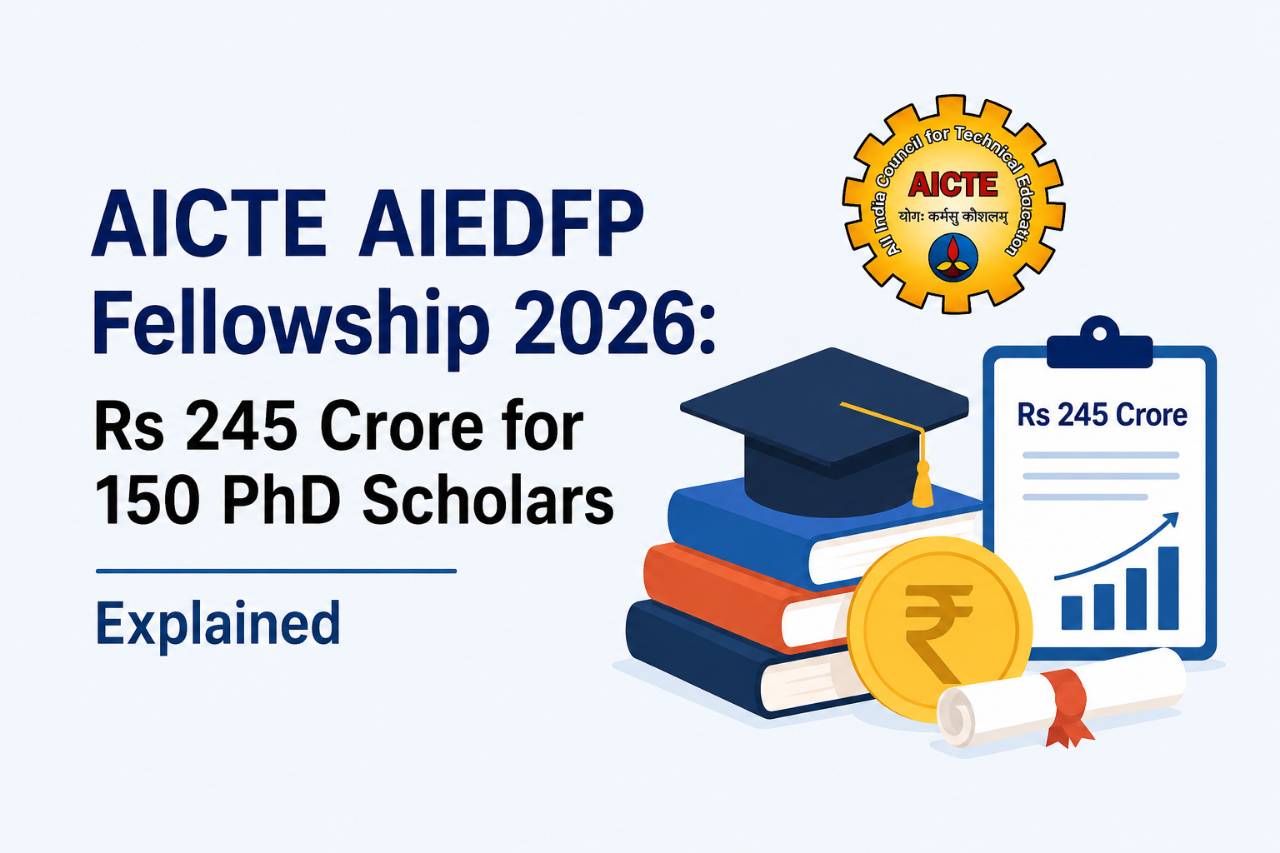

The All India Council for Technical Education (AICTE) has rolled out a major new doctoral funding initiative that could reshape how India trains its next generation of innovators. Called the AICTE Innovation and Entrepreneurship Doctoral Fellowship Programme (AIEDFP), the scheme sets aside Rs 245 crore over five years to support 150 PhD scholars whose research is problem-driven, application-oriented, and aligned with real-world impact. For students planning a research career after engineering, management, design, or applied sciences, this fellowship represents one of the most generous centrally backed doctoral grants announced in recent years.
Unlike traditional PhD funding that prioritises academic publications alone, AIEDFP explicitly rewards research that can move from the laboratory to the marketplace or to communities that need practical solutions. If you are exploring PhD admissions at AICTE-approved institutions, understanding this programme could help you plan your research proposal, choose a supervisor, and estimate your financial support during the doctoral journey.
What Is the AICTE AIEDFP Fellowship?
The AICTE Innovation and Entrepreneurship Doctoral Fellowship Programme (AIEDFP) is a centrally funded doctoral fellowship launched by AICTE to strengthen India's innovation-driven research ecosystem. According to the official notification cited in education news reports, the council approved Rs 245 crore to fund up to 150 fellowships, each supported for a maximum of five years subject to eligibility conditions and satisfactory academic and research progress.
The programme's core philosophy is straightforward: doctoral research in India should not remain confined to journal articles and conference papers. Instead, scholars should pursue problem-driven, application-oriented research that leads to deployable outcomes whether those are new products, improved processes, policy recommendations, or social innovations with measurable societal benefit.
Why AICTE Launched AIEDFP Now
India's higher education sector has expanded rapidly over the past two decades, with thousands of engineering colleges, management institutes, and multidisciplinary universities offering postgraduate and doctoral programmes. Yet industry leaders and policymakers have repeatedly flagged a gap between academic research output and on-ground innovation. Many PhD theses remain unread outside university libraries, while startups and manufacturing units struggle to access cutting-edge research from campuses.
AIEDFP addresses this gap by embedding innovation, entrepreneurship, technology transfer, and commercialisation into the doctoral experience itself. The fellowship signals that India wants PhD graduates who can contribute to national priorities from clean energy and healthcare to digital infrastructure and inclusive development while also building careers as researchers, founders, or technology leaders.
AIEDFP Fellowship Benefits: Stipend, HRA, and Innovation Grant
Financial support under AIEDFP is significantly higher than many existing doctoral fellowships in the technical education space. The structure is designed to let scholars focus on research without worrying about basic living expenses, while also funding the practical work needed to translate ideas into prototypes or pilot projects.
Monthly Fellowship and HRA
Selected PhD students receive the following monthly emoluments under the AICTE fellowship programme:
- Years 1 to 3: Rs 60,000 per month plus applicable House Rent Allowance (HRA)
- Years 4 and 5: Rs 70,000 per month plus applicable HRA
HRA is typically calculated as per central government norms applicable to the city or location where the scholar pursues research. Students availing institute hostel accommodation may not receive HRA, depending on final scheme guidelines always verify the latest notification on the official AICTE portal before budgeting your expenses.
Innovation Grant of Up to Rs 10 Lakh
Beyond the monthly stipend, each AIEDFP scholar may receive an Innovation Grant of up to Rs 10 lakh. This grant is meant for hands-on research activities that bridge theory and deployment, including:
- Prototype development and process innovation
- Policy or service innovation pilots
- Testing, validation, and field trials
- Data collection and consumables
- Contingency expenses, travel, and other research-related costs necessary to translate outcomes into deployable solutions
For comparison, the long-running AICTE Doctoral Fellowship (ADF) scheme offers Rs 37,000 per month for Junior Research Fellows and Rs 42,000 per month for Senior Research Fellows, along with an annual contingency grant of Rs 15,000. AIEDFP's higher stipend and dedicated innovation grant reflect its sharper focus on entrepreneurship and translational research. Students weighing both schemes should read official guidelines carefully, as eligibility, intake, and research expectations may differ.
Financial Benefits at a Glance
| Component | Years 1–3 | Years 4–5 |
|---|---|---|
| Monthly Fellowship | Rs 60,000 | Rs 70,000 |
| House Rent Allowance (HRA) | As per applicable norms | As per applicable norms |
| Innovation Grant | Up to Rs 10 lakh (per scholar, as approved) | |
| Maximum Duration | 5 years (subject to progress review) | |
| Total Scheme Budget | Rs 245 crore (150 fellowships over 5 years) | |
Research Focus: Application-Oriented and Impact-Driven Doctoral Work
AIEDFP is not a generic PhD scholarship. The initiative prioritises doctoral research that demonstrates tangible outcomes in areas such as innovation, entrepreneurship, technology transfer, commercialisation, and societal impact. Scholars are expected to think beyond incremental academic contributions and design research that can eventually reach users, industries, or public systems.
Technological and Non-Technological Pathways
The fellowship programme supports both technological and non-technological pathways of innovation. That means a computer science scholar developing an AI tool for rural healthcare and a management researcher designing a scalable social enterprise model could both align with the programme's vision provided their work is rigorous, problem-focused, and oriented toward real deployment.
AICTE also emphasises multidisciplinary and transdisciplinary research addressing identified national and global priorities. If your undergraduate background is in a technical field but your PhD explores the intersection of technology and public policy, or if you combine design thinking with engineering, your proposal may fit well subject to institutional approval and scheme guidelines.
Intellectual Property, Technology Transfer, and Commercialisation
The programme explicitly supports activities related to intellectual property (IP), technology transfer, innovation translation, and commercialisation. Relevant AICTE mechanisms including KAPILA (Knowledge Acquisition and Upgradation of Indigenous Learning in Academia) and YUKTI (Young India combating COVID with Knowledge, Technology and Innovation) may be utilised for support relating to patent filing and innovation translation.
For PhD aspirants, this is a practical tip: when drafting your research proposal, include a brief section on potential IP, licensing pathways, or startup spin-off possibilities. Even if your idea is early-stage, showing awareness of how research moves toward deployment strengthens your application narrative.
Industrial Exposure: 6 to 12 Months with Partner Organisations
One of the most distinctive features of AIEDFP is its provision for optional industrial exposure of 6 to 12 months. During this period, scholars can participate in research and development activities, prototype development, testing, validation, field trials, and data collection at partner organisations.
This industry immersion component mirrors global best practices in applied doctoral training. Institutes such as the Jawaharlal Nehru Centre For Advanced Scientific Research Bangalore and the Academy Of Scientific And Innovative Research have long emphasised close ties between fundamental research and application. AIEDFP brings a similar philosophy into AICTE's doctoral funding framework, making industry collaboration a funded, structured part of the fellowship rather than an informal add-on.
Students based at engineering colleges in Rajasthan, Tamil Nadu, or other states can leverage this exposure to connect with manufacturing clusters, MSME networks, or innovation hubs near their campus. For example, researchers at institutions like the Imperial College Of Engineering And Research Jaipur, the Icg Institute Educational Research Jaipur, or the Rajasthan College Engineering Research Technology Jaipur may find regional industry partnerships especially valuable for field validation work funded through the innovation grant.
Who Should Consider Applying for AIEDFP?
While the full eligibility circular should be downloaded from the official AICTE website, the fellowship is clearly aimed at PhD scholars pursuing full-time doctoral research at AICTE-approved institutions or universities. The scheme supports financial assistance for up to five years, contingent on satisfactory academic and research progress as assessed by the university and AICTE.
Ideal Candidate Profile
AIEDFP is best suited for candidates who:
- Are admitted or planning admission to a full-time PhD programme in engineering, technology, management, design, planning, applied sciences, or related professional disciplines approved by AICTE
- Have a research idea tied to a real problem industrial, social, environmental, or policy-related
- Are willing to engage with entrepreneurship, IP, or technology transfer during their doctoral journey
- Can demonstrate academic consistency and research readiness through prior degrees, qualifying examinations, or preliminary project work
Candidates coming from a Bachelor Of Computer Application (BCA) background who later pursue postgraduate studies and enter PhD programmes in computer applications or allied fields may also explore doctoral funding routes through AICTE, depending on institutional recognition and scheme-specific discipline lists. Always confirm discipline eligibility with your admitting university before applying.
AIEDFP vs AICTE Doctoral Fellowship (ADF)
Many students confuse AIEDFP with the existing AICTE Doctoral Fellowship (ADF). Both are AICTE-administered doctoral schemes, but they serve slightly different purposes:
- ADF supports first-year PhD students in AICTE-approved institutes across standard technical disciplines, with established application windows (typically January to April for July-admission cohorts). Stipends are Rs 37,000–42,000 per month with a Rs 15,000 annual contingency grant.
- AIEDFP is a newer, larger-budget initiative focused specifically on innovation and entrepreneurship outcomes, with higher stipends (Rs 60,000–70,000 per month), an innovation grant up to Rs 10 lakh, and structured industrial exposure.
If your research is primarily academic with limited commercialisation scope, ADF may still be appropriate. If your thesis is designed around deployable innovation, AIEDFP is the better-aligned option once applications open and eligibility is confirmed.
Top Research Destinations for PhD Aspirants in India
Choosing the right host institution is as important as securing fellowship funding. India offers a wide spectrum of research-focused universities from IISERs and central institutes to deemed universities and state engineering colleges with active doctoral centres.
IISERs and Central Research Institutes
The Indian Institute of Science Education and Research (IISER) network provides integrated science education and doctoral research opportunities. Campuses such as IISER Pune, IISER Kolkata, IISER Mohali, IISER Bhopal, IISER Thiruvananthapuram, IISER Berhampur, and IISER Tirupati are known for strong faculty mentorship and interdisciplinary research culture attributes that align well with AIEDFP's transdisciplinary emphasis.
Specialised institutes such as the National Brain Research Centre Gurgaon, the Indian Agricultural Research Institute Krishi Pusha New Delhi, the Forest Research Institute Dehradun, and the Indian Veterinary Research Institute Izatnagar offer domain-specific doctoral pathways for students whose innovation proposals address healthcare, agriculture, or environmental challenges.
Pharmaceutical and Medical Research Universities
Scholars interested in drug discovery, biomedical devices, or health-policy innovation may consider institutions like the National Institute Of Pharmaceutical Education And Research (NIPER) Hyderabad, NIPER Mohali, NIPER Guwahati, NIPER Hajipur, or the Delhi Pharmaceutical Sciences And Research University. Application-oriented PhD work in these institutes such as developing affordable formulations or diagnostic tools maps naturally onto AIEDFP's translational research goals.
Regional Research Hubs in South and West India
Tamil Nadu hosts several research-intensive deemed universities, including the Bharath Institute Of Higher Education Research, Meenakshi Academy Of Higher Education And Research Chennai, Chettinad Academy Of Research Education Kancheepuram, and Kalasalingam Academy Of Research And Education. In Chennai, the Mgr Educational And Research Institute Chennai also offers postgraduate and research programmes for students building toward doctoral study.
In Pune, the Deccan College Postgraduate Research Institute Pune represents another established research destination for humanities and social-science-oriented innovation, particularly where policy or community-focused solutions are involved. Institutes such as Jss Academy Of Higher Education Research and Kle Academy Of Higher Education And Research Belgaum further expand options for multidisciplinary doctoral training in southern and western India.
How to Prepare a Strong AIEDFP Application
Although the dedicated AIEDFP application portal and exact deadlines will be announced through official AICTE channels, doctoral fellowship applications in India generally follow a predictable preparation pathway. Starting early gives you a significant advantage especially when 150 seats are available nationwide and competition is expected to be intense.
Step 1: Secure PhD Admission at an AICTE-Approved Institution
Fellowship support is tied to enrolment in a recognised full-time PhD programme. Complete your institute's admission process including entrance tests, interviews, and research proposal presentation before applying for central funding. Coordinate with your prospective supervisor to ensure your topic fits both university requirements and AIEDFP's innovation focus.
Step 2: Draft a Problem-Driven Research Proposal
Your proposal should clearly state:
- The specific problem or market gap your research addresses
- Expected innovation outcome (product, process, service, or policy tool)
- Methodology for validation, including pilot or field trial plans
- Preliminary budget outline showing how an innovation grant up to Rs 10 lakh would be used
- Potential pathway for IP, licensing, or startup creation
Step 3: Gather Academic and Identity Documents
Based on patterns from AICTE's existing doctoral schemes, keep the following ready: degree mark sheets and certificates, qualifying examination scorecards (such as GATE, NET, or institute-specific tests where applicable), Aadhaar card, category certificate if claiming reservation, admission letter, and supervisor endorsement or No Objection Certificate (NOC) as required by the final AIEDFP notification.
Step 4: Register Through the Official AICTE Portal
Monitor aicte-india.org and fellowship.aicte.gov.in for the AIEDFP-specific portal link. Institutes typically create student IDs on the portal before scholars submit individual applications similar to the ADF workflow. Never apply through unofficial third-party websites charging facilitation fees.
Step 5: Track Evaluation and Fellowship Start Date
AICTE evaluates applications through a central committee that assesses research quality, innovation potential, and institutional support. Selected candidates receive fellowship payments from the notified start date, subject to periodic progress reviews throughout the five-year period.
Actionable Tips for PhD Students and Supervisors
Whether you are a first-year doctoral student or a faculty member guiding researchers, these practical steps improve your readiness for AIEDFP and similar translational funding schemes:
- Align thesis chapters with deployment milestones. Structure your PhD timeline so that prototype or pilot work happens before the final thesis submission year not after.
- Engage your institute's innovation cell early. Most AICTE-approved colleges have Innovation Councils, IIC chapters, or incubation centres that can connect you with KAPILA/YUKTI resources.
- Build an industry mentor network. Identify one or two partner organisations willing to host you during the optional 6–12 month industrial exposure window.
- Document expenses meticulously. Innovation grant utilisation typically requires proper bills, progress reports, and supervisor certification.
- Publish strategically. Peer-reviewed papers still matter for progress reviews, but pair publications with demonstrable prototypes or field outcomes to satisfy AIEDFP's impact criteria.
- Explore complementary funding. Institutes in Kota and other education hubs such as the Modern Institute Of Technology And Research Centre Kota, Om Kothari Institute Of Management And Research Kota, and Institute Of Advanced Research Gandhinagar may offer internal seed grants that complement central fellowships during early-stage proof-of-concept work.
What Happens After the Fellowship Ends?
A five-year funded PhD fellowship is a launchpad, not a career endpoint. AIEDFP scholars who successfully translate research into deployable solutions may pursue several pathways:
- Academic careers as faculty or postdoctoral researchers at institutes like Indira Gandhi Institute Of Development Research Mumbai, Dhanalakshmi Srinivasan Institute Of Research And Technology, or Manav Rachna International Institute Of Research Studies
- Industry R&D roles leveraging industrial exposure and prototype experience at organisations connected through the fellowship's partner network
- Entrepreneurship through DPIIT-recognised startups, supported by IP created during the fellowship
- Policy and social innovation roles in government agencies, NGOs, or think tanks such as those aligned with the National Academy Of Legal Studies Research (NALSAR) University Hyderabad
The Rs 245 crore investment reflects a broader national push to make doctoral education more responsive to India's development priorities. For the 150 scholars selected, the combination of generous stipends, innovation grants, and industry exposure could define not just their thesis but their professional identity as innovators.
Conclusion
The AICTE Innovation and Entrepreneurship Doctoral Fellowship Programme (AIEDFP) marks a significant shift in how India funds doctoral research in technical and professional disciplines. With Rs 245 crore allocated over five years, monthly stipends of Rs 60,000 to Rs 70,000 plus HRA, innovation grants up to Rs 10 lakh, and optional industrial exposure of 6 to 12 months, the scheme offers one of the most comprehensive support packages available to PhD scholars today.
For students navigating admissions, the key takeaway is to treat your PhD as more than a degree it is an opportunity to solve a real problem and build something deployable. Choose your institution and supervisor carefully, craft a research proposal with clear innovation outcomes, and stay updated on official AICTE announcements for application dates and eligibility details.
Whether you aim for a career in academia at a premier research centre, an R&D role in industry, or a startup of your own, AIEDFP provides the financial backbone and structural support to turn ambitious research ideas into outcomes that matter for your career and for the country.