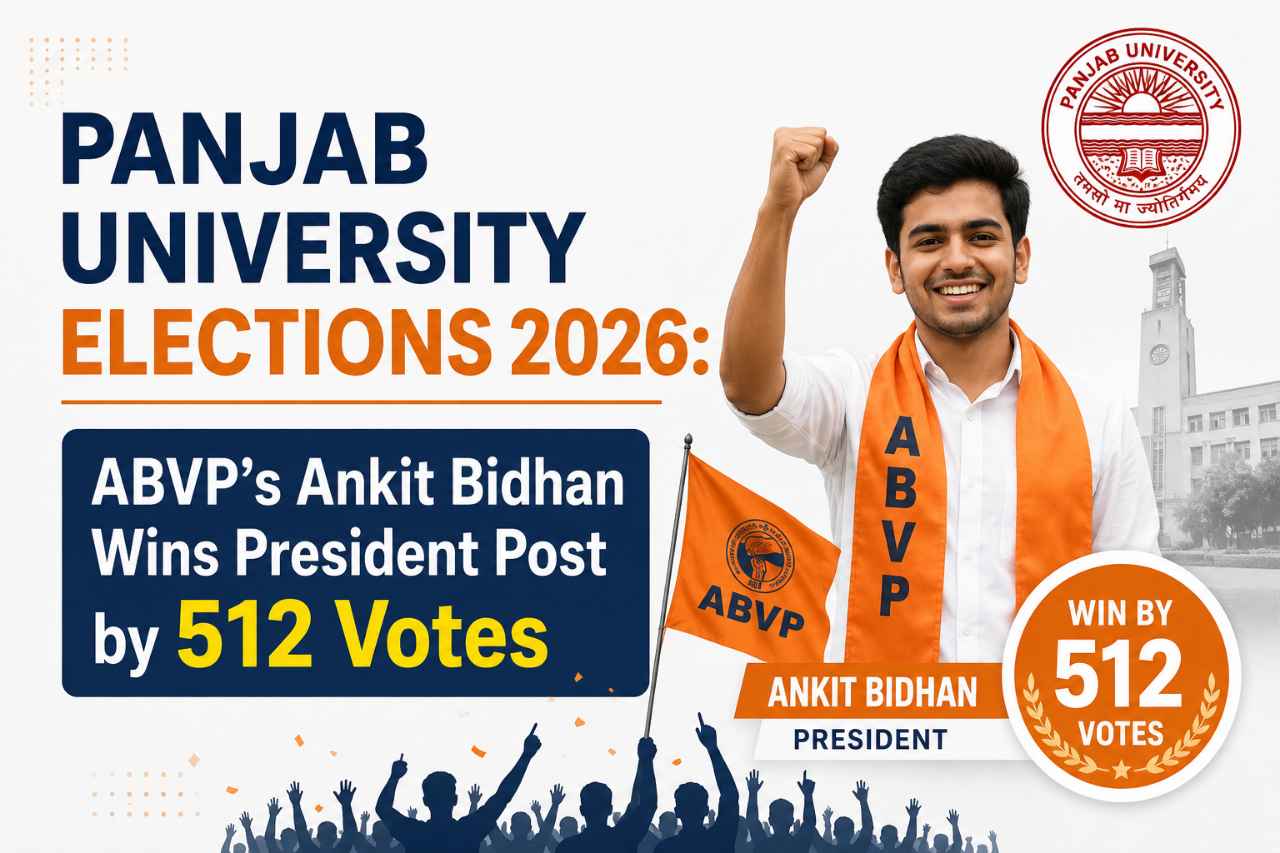

Student elections at Panjab University (PU), Chandigarh remain one of the most closely watched campus polls in North India. On Monday evening, September 1, 2026, officials declared results for the Panjab University Campus Students Council (PUCSC) elections held earlier that day. RSS-affiliated Akhil bharatiya Vidyarthi Parishad (ABVP) retained the president's post for the second year running, with its candidate Ankit Bidhan securing 3,149 votes and defeating his nearest rival by a margin of 512 votes.
For students planning higher education in Punjab, Haryana, and the wider North India region, PU's election outcome offers useful context about campus culture, student activism, and the political environment at a central university. Whether you are comparing PU with institutions like Chitkara University Engineering or exploring options at Lovely Professional University Engineering, understanding how student governance works can help you make informed college choices.
Key Highlights: Panjab University Polls 2026 at a Glance
The 2026 PUCSC elections drew attention beyond the campus because of tight presidential competition, cross-party alliances, and the symbolic weight of a second consecutive ABVP victory at a university that has historically seen diverse student fronts.
- President: Ankit Bidhan (ABVP) — 3,149 votes
- Runner-up: Aadil Brar (ASAP, AAP student wing) — 2,637 votes
- Margin: 512 votes
- Eligible voters: Around 16,500 students
- Polling booths: Approximately 190
- Polling time: 9:30 am to 11:00 am on September 1, 2026
- Total candidates: 16 across all posts
Bidhan's victory was not an isolated win. ABVP-aligned or supported candidates also captured the vice president, secretary, and joint secretary positions, giving the organisation a strong hold over the council for the coming academic year.
What Is the Panjab University Campus Students Council (PUCSC)?
The PUCSC is the elected student representative body at Panjab University, Chandigarh. It serves as a bridge between the student community and university administration on matters such as hostel facilities, examination grievances, library access, fee-related concerns, and campus infrastructure.
Posts Elected in PUCSC Elections
Each election cycle fills multiple offices. In 2026, students voted for:
- President — 4 candidates contested
- Vice President — 5 candidates contested
- Secretary — 3 candidates contested
- Joint Secretary — 4 candidates contested
Unlike purely ceremonial student bodies at some private universities, PUCSC office-bearers often engage directly with the vice chancellor's office, deans, and department heads. For prospective students researching campuses — whether at PU or alternatives such as Guru Gobind Singh Indraprastha University GGSIPU in Delhi or Amity University Noida — it is worth checking whether a campus has an active elected council and how much influence it carries.
Presidential Election Results: A Four-Way Contest
The race for president was the headline contest. Four major student fronts put forward candidates, reflecting the political diversity that has long defined PU's campus politics.
Candidate-Wise Vote Share (President)
| Candidate | Student Organisation | Votes Polled |
|---|---|---|
| Ankit Bidhan | ABVP | 3,149 |
| Aadil Brar | ASAP (AAP student wing) | 2,637 |
| Gurnam Singh Sidhu | NSUI (Congress student wing) | 2,263 |
| Darshpreet Singh | Sath | 1,387 |
Bidhan's win margin of 512 votes over Aadil Brar suggests a competitive but decisive outcome. While ABVP finished first, ASAP and NSUI together polled a substantial combined vote share, indicating that a significant section of the student electorate backed non-ABVP platforms. Darshpreet Singh of Sath secured the fourth position with 1,387 votes.
Why the Presidential Result Matters
PU's president post carries visibility far beyond hostel and canteen issues. The office-holder often represents student sentiment on national policy debates, university governance reforms, and Punjab-specific political developments. A second consecutive ABVP victory signals organisational continuity and sustained ground-level mobilisation — factors that political observers watch ahead of broader state-level elections.
Other PUCSC Election Results 2026
While the presidential contest dominated headlines, results for other posts completed ABVP's strong showing across the council.
Vice President
Armaan Singh Bhinder won the vice president's post with 3,322 votes, defeating Aakanksha Thakur, who received 2,818 votes. The vice president typically supports the president in coordinating council activities and deputises during official meetings with university authorities.
Secretary
Dhyan Singh secured the secretary's post with 4,045 votes, the highest vote count among individual winners in this cycle. He defeated Aryan Saharan, who polled 3,678 votes. The secretary manages documentation, meeting records, and communication between council members and student constituencies.
Joint Secretary
Vishal Bamal won the joint secretary position with 3,506 votes, ahead of Devraj Singh Nain, who received 2,338 votes. The joint secretary assists the secretary and often coordinates department-level student representatives.
Together, these results give ABVP and its aligned candidates control over all four principal offices of the PUCSC — a rare clean sweep in a university known for fragmented student politics.
SOI Support and the Political Context Behind the Win
One of the most discussed aspects of the 2026 PU elections was the support extended to ABVP by the Students' Organisation of India (SOI), the student wing of the Shiromani Akali Dal (SAD) led by Sukhbir Singh Badal.
What Happened With SOI's Candidature?
After SOI's own candidature was rejected, the organisation declared support for ABVP. Ankit Bidhan, speaking after his victory, described relations with SOI as positive and acknowledged the role the alliance played in consolidating votes. Political analysts noted that this move came amid speculation about a possible SAD–BJP realignment ahead of the Punjab Assembly elections expected early next year.
Reactions From Political Leaders
Senior BJP leader Sanjay Tandon congratulated Bidhan, attributing the win to student confidence and ABVP's campus work over the past year. Punjab BJP chief Kewal Singh Dhillon and former state BJP president Sunil Jakhar also issued statements. Jakhar framed the result as a sign of changing student attitudes and credited SOI's role in the victory.
For students who prefer campuses with less visible political activity, private universities such as BML Munjal University or Poornima University Jaipur may offer a different environment. However, at legacy public universities like PU, Delhi University, and JNU, student elections remain an integral part of campus life.
How Panjab University Conducts Student Elections
Understanding the election process helps both current PU students and applicants who want to know how representative governance functions on campus.
Eligibility and Voter Base
Officials stated that around 16,500 Panjab University students were eligible to vote in the 2026 PUCSC elections. Eligibility typically covers regularly enrolled students across affiliated colleges, university departments, and recognised programmes, subject to the Lyngdoh Committee guidelines and PU-specific rules notified before elections.
Polling Infrastructure
Approximately 190 polling booths were set up across the campus and affiliated institutions. Polling commenced at 9:30 am and concluded at 11:00 am — a compact two-and-a-half-hour window that encourages high same-day turnout and reduces prolonged campaign-related disruptions to academic schedules.
Vote Counting and Result Declaration
After polling closed, officials counted ballots and declared results on the evening of September 1, 2026. The relatively quick turnaround is standard for PU, where manual or hybrid counting procedures have been refined over decades of campus elections.
Student Politics at Panjab University: History and Significance
Panjab University, established in 1882 in Lahore and relocated after Partition, has been a crucible of student political engagement for generations. PUCSC elections have produced leaders who later entered state and national politics, and the campus has witnessed movements on issues ranging from fee hikes to faculty appointments and research scholar welfare.
ABVP's Back-to-Back Victory
ABVP's 2025 win broke a long period during which other student organisations frequently held the president's post. Retaining the presidency in 2026 with Bidhan's candidacy confirms that ABVP has built organisational depth — not merely benefiting from a one-time swing. Bidhan credited the win to work undertaken by ABVP during the previous year, suggesting that visible campus initiatives, grievance redressal, and consistent presence in student spaces translated into votes.
Comparison With Other North Indian Campuses
Student elections vary widely across institutions. At Delhi Technological University DTU and Netaji Subhas University of Technology NSUT Delhi, student bodies exist but operate under different frameworks than full-scale partisan polls. At Jamia Hamdard University, governance structures differ again. PU sits among a handful of universities — alongside Delhi University and several state universities — where elections mirror mainstream party-aligned student wings.
What Ankit Bidhan's Victory Means for PU Students
In his post-victory remarks, Bidhan said that "Gen Z proved that Prime Minister Narendra Modi ji and ABVP are in their hearts," framing the result as generational endorsement of ABVP's agenda. Regardless of political interpretation, the statement reflects how student leaders often connect campus outcomes to broader national narratives.
Practical Implications for the Campus
With ABVP holding all major PUCSC posts, students can expect policy priorities shaped by the organisation's manifesto commitments. Based on typical ABVP campaign themes at central universities, students may see emphasis on:
- Improved hostel and infrastructure facilities
- Scholarship and fee-relief advocacy
- Examination and result-related grievance handling
- Campus security and anti-ragging measures
- Placement and internship coordination with departments
Students from affiliated colleges under PU should monitor how the new council addresses issues at decentralised campuses, not only at the main Sector 14 campus in Chandigarh.
Panjab University: Quick Profile for Aspiring Students
For readers evaluating PU alongside other options, here is a concise overview of why the university attracts applicants from Punjab, Haryana, Himachal Pradesh, and beyond.
Academic Strengths
Panjab University offers undergraduate, postgraduate, and doctoral programmes across arts, sciences, commerce, law, engineering, and medical sciences. It consistently ranks among India's top public universities and benefits from Chandigarh's status as a planned city with strong connectivity.
Affiliated Colleges and Regional Alternatives
PU's network includes numerous affiliated colleges across Punjab and neighbouring states. Students who do not secure a seat at PU often explore regional alternatives such as Uniraj University of Rajasthan Jaipur, Jecrc University Jaipur, or Career Point University Kota for engineering and professional courses. Medical aspirants may compare PU-linked pathways with institutes like University College of Medical Sciences UCMS Delhi or Rajasthan University of Health Sciences RUHS Jaipur.
Campus Life and Student Engagement
PU's active student political culture means campus life extends beyond classrooms. Debates, dharnas, cultural festivals, and election campaigns create a vibrant — sometimes contentious — environment. Students who thrive in politically engaged spaces often find PU stimulating; those seeking quieter campuses may prefer institutions such as Galgotias University Greater Noida or Suresh Gyan Vihar University Jaipur SGVU.
Lyngdoh Committee Guidelines and Fair Elections
Indian university student elections operate under the Lyngdoh Committee recommendations, which aim to prevent excessive spending, criminalisation of campus politics, and disruption of academic calendars. Key principles include:
- Expenditure caps on campaigning to reduce money power
- Eligibility criteria requiring minimum attendance and academic standing
- Prohibition of physical force, weapons, and violent campaigning
- Fixed campaign periods to limit academic disruption
- Non-partisan administration of the election process by university authorities
PU officials adhered to these norms in conducting the 2026 polls, setting up 190 booths and completing polling within the designated morning window. Students contesting or voting in future cycles should familiarise themselves with the latest PU notification on election rules, which may update Lyngdoh-compliant provisions annually.
Actionable Tips for Students Following PU Campus Politics
Whether you are a current PU enrollee or a prospective applicant, these practical steps help you stay informed and engaged responsibly:
- Verify results officially: Cross-check election outcomes on the Panjab University website and official notices rather than relying solely on social media posts.
- Understand council functions: Know which issues PUCSC can actually resolve versus those requiring formal complaints to deans or the registrar.
- Compare campuses holistically: Use resources like CollegeDwar to compare PU with Jaipur National University JNU Jaipur and Guru Gobind Singh Indraprastha University Engineering on fees, placements, and campus culture.
- Participate constructively: Attend open house meetings organised by the new council to raise academic and welfare concerns.
- Stay neutral during exams: Avoid letting campaign tensions distract from internal assessments and end-semester examinations.
Performance of Opposition Student Wings in 2026
While ABVP swept the office-bearer posts, the vote totals reveal that opposition fronts remain electorally relevant at Panjab University. Aadil Brar of ASAP (Association of Students for Alternative Politics), backed by the Aam Aadmi Party's student ecosystem, finished second in the presidential race with 2,637 votes — a strong showing for a relatively newer platform on the PU campus. Gurnam Singh Sidhu of NSUI, the Congress-affiliated student wing, secured 2,263 votes, demonstrating continued support for the organisation that has historically been active in Punjab's student politics.
Darshpreet Singh of Sath polled 1,387 votes, reflecting the presence of independent and non-aligned student voices. Together, the three non-ABVP presidential candidates received 6,287 votes compared to Bidhan's 3,149 — a reminder that while ABVP won the plurality decisively, a large segment of the electorate backed alternative platforms. For students evaluating campus diversity of opinion, this split is as important as the final winner.
What ASAP and NSUI May Do Next
Opposition student organisations typically regroup after elections by strengthening department-level units, building alliances for the next cycle, and holding the elected council accountable through formal questions, protests, and media engagement. ASAP's second-place finish may energise its Punjab campus expansion, while NSUI will likely focus on reclaiming ground ahead of 2027. Students interested in campus activism — but not necessarily partisan politics — can engage through cultural societies, departmental associations, and academic forums that operate independently of PUCSC.
Recent Campus Issues Contextualising the 2026 Polls
The 2026 elections took place against a backdrop of ongoing debates at Panjab University, including student protests over governance appointments, research scholar welfare, and faculty promotion policies. These issues often surface in election manifestos and campaign speeches, giving voters a clear basis to evaluate candidates beyond party labels.
Students considering PU should read beyond election headlines and examine how previous councils handled specific grievances — hostel seat allocation, library hours, Wi-Fi infrastructure, and placement cell coordination. Comparing this with student feedback from institutions such as Parul University Engineering or Graphic Era University Engineering can provide a balanced perspective on whether a politically active public university or a privately governed campus better suits your priorities.
Looking Ahead: PUCSC Under ABVP Leadership
With Ankit Bidhan as president and allied office-bearers in place, the 2026–27 PUCSC term begins amid high expectations and scrutiny. ABVP will likely focus on consolidating its two-year hold by delivering visible improvements while navigating a campus where opposition student groups remain electorally significant.
The SOI alliance adds a Punjab-specific dimension that observers will watch as state assembly elections approach. For PU students, the immediate priority is ensuring that electoral outcomes translate into tangible action on hostel conditions, research scholar welfare, examination schedules, and placement support — issues that cut across party lines.
Conclusion
The Panjab University Campus Students Council elections 2026 delivered a clear verdict: ABVP's Ankit Bidhan won the presidency with 3,149 votes, beating AAP-backed Aadil Brar by 512 votes, while ABVP-aligned candidates swept the vice president, secretary, and joint secretary posts. With roughly 16,500 eligible voters, 190 polling booths, and 16 candidates across all positions, the election demonstrated robust student participation in democratic campus governance.
For higher education aspirants, PU's election results underscore the university's politically active identity — a factor worth weighing alongside academic rankings, course offerings, and placement records. Whether you choose Panjab University, a neighbouring Punjab campus like Lovely Professional University Engineering, or a Delhi NCR institution such as Guru Gobind Singh Indraprastha University Management, understanding student governance helps you prepare for the culture awaiting you on campus.
Last updated: September 1, 2026. Election results and figures are based on officially declared outcomes reported on the date of polling.