
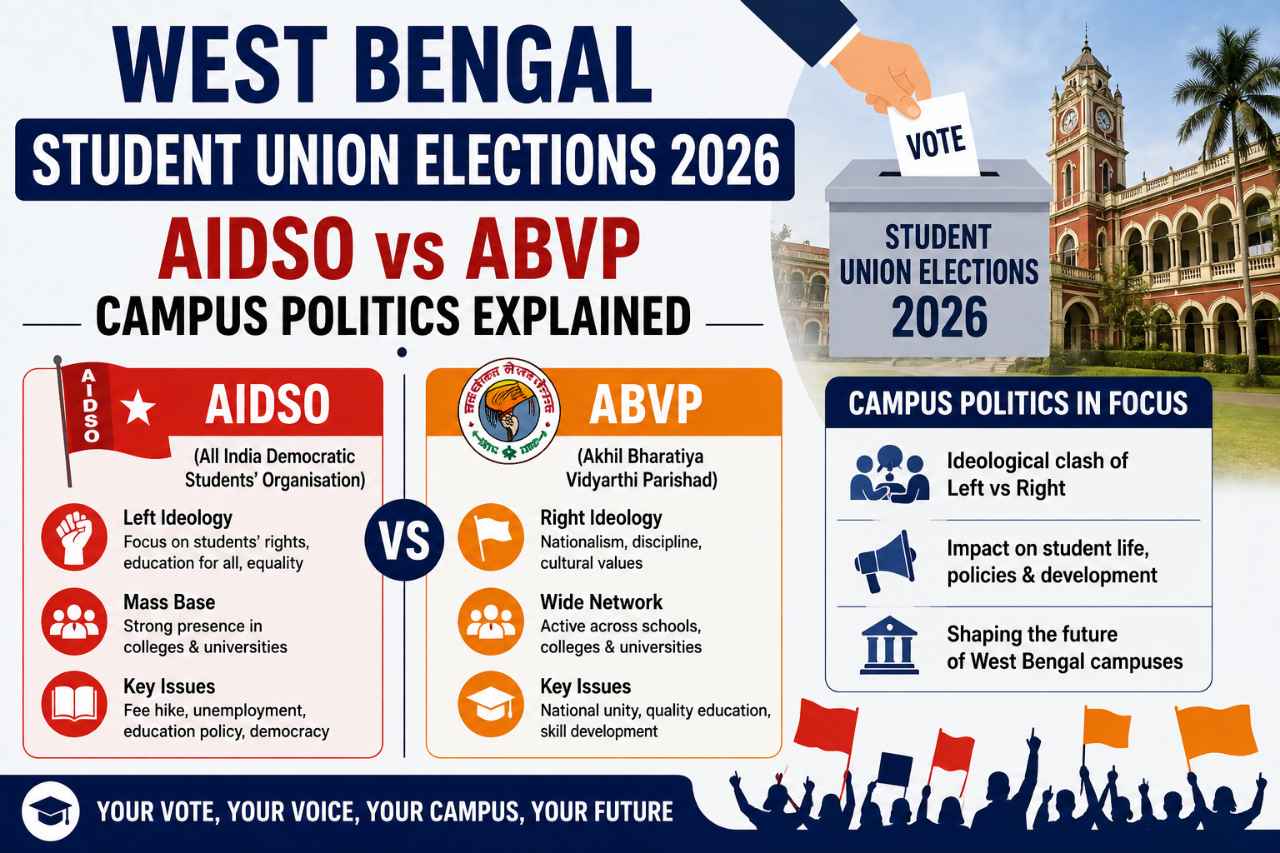

Student union elections are among the most visible expressions of campus democracy in Indian higher education. When a chief minister publicly links the outcome of those polls to a specific student organisation's flags, the debate quickly moves beyond campus gates and into questions of constitutional responsibility, institutional autonomy, and the rights of students preparing for careers in arts, science, commerce, and professional programmes across West Bengal.
In early September 2026, the All India Democratic Students Organisation (AIDSO) strongly criticised West Bengal Chief Minister Suvendu Adhikari after he stated that student elections would be held and that "saffron flags of ABVP would fly everywhere." AIDSO called the comment undemocratic and provocative, arguing that an elected constitutional office should not appear to favour one student wing. Teachers' bodies such as the All Bengal University Teachers' Association (ABUTA) have also raised concerns about political pressure on campuses, especially at Jadavpur University, where graffiti removals, administrative action, and recent unrest have drawn national attention.
For students exploring MA programmes, professional degrees, or undergraduate admissions in Kolkata and other Bengal cities, these events matter. Campus climate influences academic freedom, safety, hostel life, research opportunities, and the quality of everyday learning. This guide explains what happened, why student elections matter in India, how campus politics affects admissions and student life, and what students can do to stay informed and protected.
What Triggered the AIDSO Condemnation?
The immediate controversy began with Chief Minister Suvendu Adhikari's public remark linking the restoration of student union elections in West Bengal to the electoral success of the Akhil Bharatiya Vidyarthi Parishad (ABVP), the student wing associated with the Bharatiya Janata Party (BJP). AIDSO West Bengal state committee secretary Biswajit Roy said the statement reflected a "narrow partisan position" delivered from a constitutional office.
AIDSO has long demanded the restoration of student union elections in the state. Roy alleged that the previous government stalled democratic campus processes and that, even after a change in government three months earlier, ABVP was attempting to expand influence on campuses with administrative support. He also questioned the silence of the state over alleged campus takeovers, despite BJP state president Samik Bhattacharya stating that ABVP has no organisational connection with the BJP.
Key actors in the dispute
| Organisation / Body | Position in the debate |
|---|---|
| AIDSO | Left-leaning students' body; demands free and fair union elections without government bias |
| ABVP | Right-leaning students' organisation; linked by critics to the ruling party's campus ambitions |
| ABUTA | Teachers' association; warns that university autonomy and academic environment are under threat |
| Jadavpur University administration | Accused of selective action on graffiti while failing to address broader administrative lapses |
| West Bengal government | Faces questions over neutrality, campus security, and accountability of university leadership |
Understanding these roles helps students separate election rhetoric from governance facts. Union elections are meant to represent student interests on fees, hostels, libraries, harassment committees, and academic calendars—not to become proxies for state-level party battles.
Why Student Union Elections Matter in Indian Universities
In many states, student union elections were suspended for years due to violence, administrative orders, or court interventions. West Bengal is now discussing their return at a time when campuses nationwide are under scrutiny for political clashes, funding debates, and questions about who controls university decision-making.
Functions of a democratic students' union
- Academic representation: Unions raise issues related to timetables, exam delays, evaluation grievances, and curriculum updates.
- Welfare and safety: Hostel facilities, anti-ragging measures, mental health support, and gender sensitisation often depend on active student bodies.
- Financial transparency: Unions can demand clarity on development funds, laboratory upgrades, and library subscriptions.
- Career and research support: From seminar funding to placement cell accountability, elected leaders influence day-to-day student experience.
- Campus culture: Debates, cultural festivals, and interdisciplinary forums thrive when students have legitimate forums to organise.
When elections are delayed or politicised, students lose a structured channel for redress. That is why organisations like AIDSO frame the issue as one of "students' democratic rights" rather than merely an inter-party rivalry.
Historical context in West Bengal
West Bengal has a long tradition of politically active campuses, especially in Kolkata's central universities and colleges. Jadavpur University, Presidency University, Calcutta University, and numerous affiliated colleges have historically produced student leaders who later entered public life. However, the same political energy has sometimes led to clashes, boycotts, and administrative crackdowns.
For admission seekers, this history is a reminder that campus politics is not abstract. The environment you enter as a first-year undergraduate or as a postgraduate scholar—including those enrolling in humanities and social sciences pathways such as an Master of Arts (MA)—can shape research guidance, peer networks, and even internship access in politically sensitive departments.
Jadavpur University at the Centre of the Storm
Although the chief minister's remark was statewide in tone, much of the immediate tension has concentrated on Jadavpur University (JU), one of India's best-known public universities for engineering, arts, and interdisciplinary study.
Graffiti, slogans, and administrative response
ABUTA alleged that Jadavpur authorities acted with "extraordinary promptness" to remove graffiti from campus walls after the chief minister issued a deadline and threat, while broader administrative failures remained unaddressed. The teachers' body argued that targeting wall writings without fixing structural governance problems undermines academic autonomy.
The dispute intersects with earlier incidents in August 2026, when ABUTA claimed outsiders attacked the campus on August 19 and 20, and that the vice-chancellor acknowledged administrative failure in stakeholder meetings. ABUTA also raised irregularities in Executive Council elections—a matter reportedly taken to the Calcutta High Court—and said it had written to the Chancellor, chief minister, and education minister in June without visible action.
What this means for current and future JU students
- Check official notices: Rely on the university website and registered student portals for exam schedules, class suspensions, and security advisories.
- Document grievances formally: Use defined committees rather than informal social media escalation when possible.
- Know your rights: Students have protections against arbitrary disciplinary action; collect evidence and seek legal aid cells where available.
- Evaluate hostel and commute plans: During unrest, transport and hostel rules may change quickly.
- Stay academically focused: Political episodes pass, but degree timelines, credit requirements, and entrance-linked postgraduate options do not.
Students considering JU—whether for engineering, international relations, film studies, or postgraduate arts programmes—should weigh academic strengths alongside present campus conditions. Rankings and faculty reputation remain important, but so do safety, administrative stability, and the university's capacity to protect learning during political stress.
The ABVP, AIDSO, and Campus Political Ecology
India's campus politics is often organised through affiliated student wings of national parties and ideological groups. ABVP and AIDSO represent opposing poles in many states, though local independents and issue-based collectives also contest union posts.
ABVP's role and public statements
ABVP has sought police investigation into alleged conspiracies behind Jadavpur campus clashes and has positioned itself as a major claimant in restored union elections. Critics argue that the chief minister's "saffron flags" remark legitimises ABVP's expansion; supporters may read it as confidence in democratic competition. Either interpretation places student voters at the centre of a high-stakes narrative.
AIDSO's democratic-rights framing
AIDSO rejects the idea that a government should predict or promote a particular flag on campuses. Its emphasis on restoring elections "without administrative capture" resonates with students who fear that union polls could become managed contests rather than genuine representation. The organisation's condemnation is therefore not only about ABVP but about the neutrality expected from constitutional offices.
Neutrality expectations for universities and governments
University Grants Commission (UGC) frameworks and court judgments over the years have stressed that educational institutions should maintain order while respecting lawful expression. Governments may lawfully intervene when violence occurs or when statutory bodies fail, but routine academic governance—including student elections—should follow transparent rules known in advance.
Students should ask practical questions: Who announces the election schedule? Which forum resolves disputes? Are outsiders barred from campaigning inside campuses? Are faculty observers appointed? Clear answers signal whether polls will be credible.
Impact on Admissions, Exams, and Student Life in Bengal
Campus political conflict rarely cancels admissions outright, but it can disrupt the experiences that admissions brochures promise.
Short-term effects students may notice
- Temporary class suspensions or shifted exam centres during protests or security operations
- Delayed internal assessments if departments pause activities pending administrative orders
- Increased police presence near campus gates, affecting hostel curfews and visitor rules
- Heightened debate in orientation programmes, which can help new students learn campus history quickly
- Greater scrutiny of student societies and wall magazines, affecting cultural events
Long-term considerations for college choosers
If you are comparing institutions across Kolkata, Siliguri, Durgapur, or Kalyani, look beyond cut-offs and fee tables:
- Union election track record: When were polls last held? Were results accepted peacefully?
- Grievance redressal: Does the college publish anti-ragging and harassment committee contacts prominently?
- Autonomy indicators: Are academic councils functioning? Are faculty associations raising governance concerns publicly?
- Media and court records: Repeated litigation over council elections or fund misuse is a governance signal.
- Programme-specific stability: Professional courses with rigid exam timelines may suffer more from prolonged unrest than flexible arts programmes.
Postgraduate applicants—especially in social sciences, languages, and education—often choose universities where seminar culture and fieldwork opportunities remain uninterrupted. An MA degree depends heavily on mentorship, library access, and departmental continuity; political volatility can affect all three even when classes formally continue.
E-E-A-T Perspective: Expert View on Campus Democracy
From an educational governance standpoint, three principles emerge from the West Bengal controversy:
First, constitutional offices should model neutrality. When a chief minister appears to endorse a particular student organisation's symbols, it risks chilling dissent and discouraging independent candidates. Students may avoid contesting elections if they believe outcomes are pre-decided.
Second, university administrations must be accountable symmetrically. ABUTA's critique—that graffiti is removed swiftly while alleged failures during outside attacks go unpunished—points to a governance imbalance. Selective enforcement damages trust faster than any single slogan on a wall.
Third, elections require process, not slogans. Restoring union polls is not only about announcing dates. Credible elections need voter lists, campaign rules, security plans, counting protocols, and appeal mechanisms. Without these, "democratic restoration" remains symbolic.
Students are not passive observers in this framework. Informed voting, participation in court-mandated committees, and engagement with student charters can strengthen institutions that otherwise drift into partisan management.
Actionable Tips for Students and Parents
Before admission
- Read recent official notifications from the university—not only influencer reviews.
- Join verified student alumni groups and ask about election seasons and exam disruptions.
- Compare multiple campuses if your priority is uninterrupted professional licensure exams.
- Check whether the department offers structured mentorship for research degrees.
After enrollment
- Save contacts for proctor, warden, internal complaints committee, and local legal aid.
- Avoid sharing unverified protest videos that may misidentify individuals.
- Participate in lawful forums—department seminars, town halls, and union debates—to understand issues fully.
- If campaigning, follow campus code of conduct; violations can lead to disciplinary action regardless of political sympathy.
- Keep academic backups: cloud notes, duplicate assignment submissions, and exam form receipts.
For parents
Parents often worry when campus news trends nationally. Focus on verified communication from the institution, travel safety on protest days, and your ward's mental health. Political awareness is healthy; daily panic based on unverified clips is not.
What Happens Next? Likely Developments to Watch
Several threads will shape the coming months in West Bengal higher education:
- Election notification: Will the state publish a uniform framework for union polls across universities and colleges?
- Judicial proceedings: Calcutta High Court matters related to JU's Executive Council may influence broader governance reforms.
- Probe committees: Investigative panels into campus violence and graffiti incidents could recommend administrative penalties or security changes.
- Faculty mobilisation: ABUTA's continued advocacy may push for vice-chancellor accountability and clearer autonomy safeguards.
- Student registration drives: Organisations may intensify membership campaigns ahead of polls, increasing on-campus visibility.
Admission cycles for 2026–27 and entrance exams for postgraduate programmes will proceed on their own timelines, but campus conditions may influence counseling choices—especially for students who can select among multiple good universities.
Legal and Policy Framework for Campus Elections in India
Student union elections in India operate at the intersection of university acts, state higher education policies, Lyngdoh Committee guidelines, and local institutional ordinances. The Supreme Court's acceptance of the Lyngdoh Committee recommendations in 2006 set baseline expectations: fixed campaign periods, spending caps, eligibility criteria tied to academic performance and attendance, and bans on external interference in campus canvassing.
What Lyngdoh norms mean for West Bengal now
When West Bengal moves to restore union polls, institutions will likely need to publish rules aligned with these national expectations. That includes limiting loudspeaker use, prohibiting defacement of campus property during campaigns, and ensuring that counting is supervised transparently. Students who understand these norms can distinguish lawful political activity from violations that trigger disciplinary or criminal proceedings.
Courts have repeatedly held that universities enjoy autonomy in academic matters, but that autonomy is not unlimited when statutory bodies malfunction or when public order collapses. ABUTA's approach to the Calcutta High Court over Executive Council irregularities at Jadavpur University illustrates how faculty and students use judicial review when internal remedies stall. For admission seekers, pending litigation is not automatically a reason to avoid an institution, but it signals where governance reform may lag behind academic reputation.
Featured snippet answer: Are student union elections mandatory in India?
No. There is no single national law making student union elections compulsory in every college. States and individual universities decide whether and how to conduct polls. Many institutions run unions through indirect elections, nominated bodies, or suspended polls citing violence. West Bengal's current discussion is significant because it could reverse a long pause—but only if implemented through published rules rather than political announcements alone.
How This Controversy Compares With Campus Politics Elsewhere
West Bengal is not the only state where campus politics has collided with executive statements. Delhi University's student elections, Kerala's historically competitive union culture, and Bihar's debates over bringing colleges under tighter government control all show that students nationwide navigate similar tensions between representation and disruption.
What makes the Bengal episode distinctive in September 2026 is the explicit linkage drawn by a chief minister between election outcomes and a particular organisation's flags—a framing that student groups like AIDSO argue pre-empts voter choice. Elsewhere, disputes more often centre on fee hikes, hostel shortages, or appointment of vice-chancellors. Bengal's combination of graffiti enforcement, alleged outsider violence, and union restoration rhetoric creates a layered crisis touching symbolism, security, and administration simultaneously.
Students applying across states should compare how quickly each institution returns to normal academic routines after political flashpoints. A campus that resolves conflict through published committees and transparent minutes may remain a strong choice even if headlines are temporarily alarming.
Conclusion
The AIDSO condemnation of Chief Minister Suvendu Adhikari's "saffron flags" remark is more than a headline about student elections in West Bengal. It captures a wider national tension: how to restore vibrant campus democracy without turning universities into arenas for party propaganda or administrative favouritism. Jadavpur University's recent troubles—graffiti removals, alleged outside attacks, Executive Council disputes, and teachers' warnings about autonomy—show why governance quality matters as much as political symbolism.
For students mapping their higher education journey, the lesson is practical. Choose colleges and courses with open eyes, understand the role of student unions, protect your academic record during turbulent periods, and engage with campus life through lawful, informed channels. Whether you pursue engineering, law, sciences, or an MA course in Kolkata or elsewhere, your degree is built in classrooms, libraries, and laboratories that function best when institutions—not flags alone—earn student trust.
Democratic student elections can strengthen Indian higher education when conducted fairly. The current debate in West Bengal is a reminder that announcing polls is only the first step; credible process, neutral oversight, and accountable administrations are what ultimately serve students best.