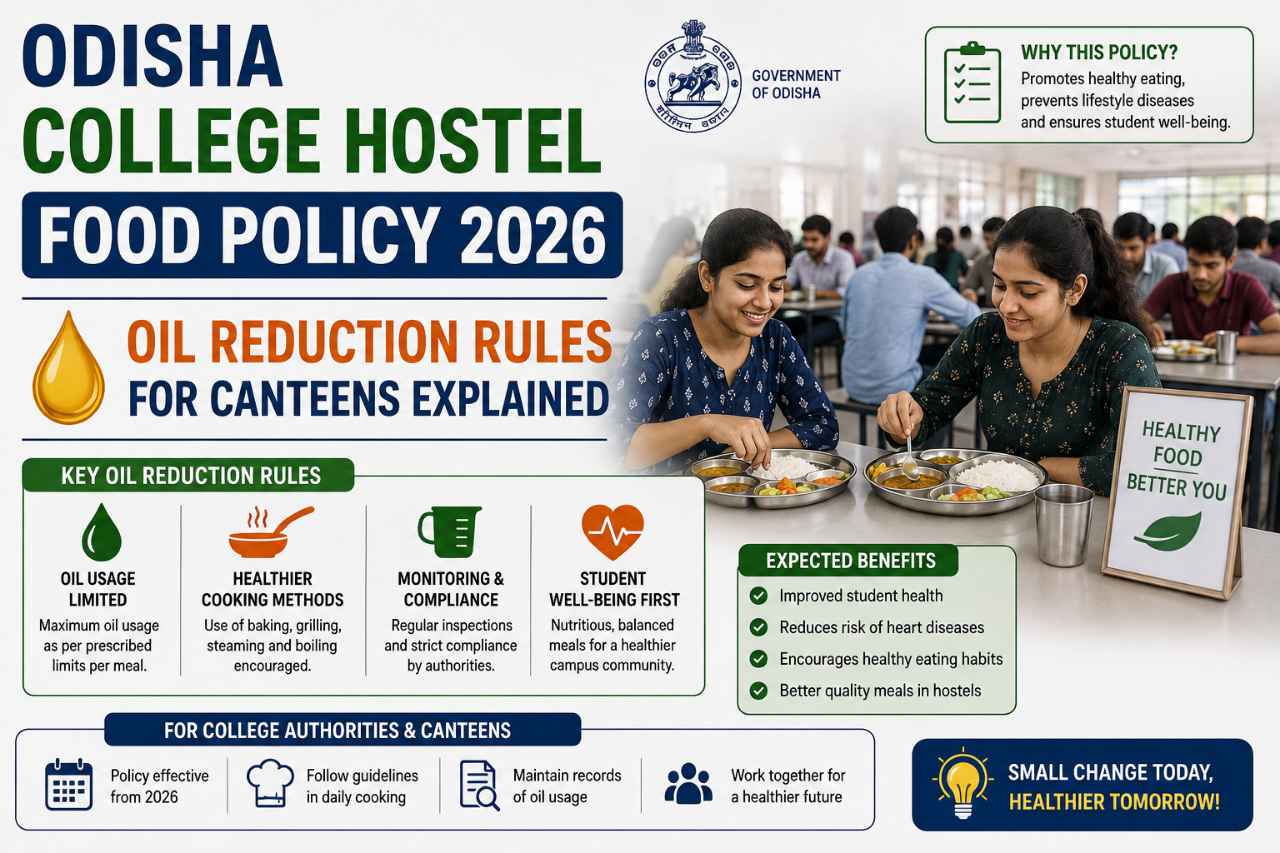

The Odisha government has issued fresh instructions to principals of all government-run and government-aided colleges across the state, asking them to reduce cooking oil use in hostel messes and campus canteens. In a letter dated August 28, 2026, HIgher Education Department Deputy Secretary Ramesh Chandra Behera directed institutions to avoid high-oil breakfast items such as puris, vadas, and bondas, while promoting healthier cooking practices without compromising student nutrition.
For students preparing for admissions, living in hostels, or comparing colleges across India, this directive reflects a growing focus on campus wellness, food security, and sustainable consumption. Whether you are exploring institutions like Odisha University of Technology and Research or evaluating hostel facilities at colleges nationwide, understanding what this policy means can help you make informed choices about where and how you study.
This guide explains the Odisha order in simple language, its background, practical impact on college life, healthier food alternatives, and what students, parents, and College administrators should do next.
What Did the Odisha Government Direct Colleges to Do?
According to the official communication from the Odisha Higher Education Department, principals of government and aided colleges must take immediate steps to reform food preparation in hostels and canteens. The key instructions include:
- Avoid high-oil breakfast items such as puris, vadas, and bondas on regular menus.
- Reduce deep-fried food across meals without lowering nutritional value for students.
- Cut overall cooking oil consumption in institutional kitchens.
- Promote traditional oils including ghee, mustard oil, and groundnut oil instead of imported palm oil, sunflower oil, and soyabean oil.
- Engage student volunteers from the National Service Scheme (NSS) and Youth Red Cross (YRC) to run community awareness programmes on reducing household oil use.
The letter was addressed to principals, who are expected to pass these instructions down to hostel wardens, canteen contractors, and mess committees. Colleges such as Gandhi Institute of Engineering and Technology University Odisha, Gunupur (GIET University), along with dozens of aided arts, science, and commerce colleges, fall under this directive.
Who Does This Order Apply To?
The instruction specifically covers government-run colleges and government-aided colleges in Odisha. Private universities and self-financing institutions may not be legally bound by the same letter, but the broader message on oil conservation and student health applies across the higher education ecosystem.
Students currently in hostel accommodation at aided degree colleges, autonomous colleges under state support, and government institutions should expect visible menu changes in the coming weeks. If you are shortlisting Odisha colleges for UG or PG admission, it is worth asking about mess policies during campus visits or counselling.
Why Has Odisha Asked Colleges to Reduce Cooking Oil?
The government's reasoning goes beyond campus dining alone. Deputy Secretary Behera linked the directive to wider global and national challenges that have affected food, fuel, and fertiliser supply chains since the COVID-19 pandemic.
Global Supply Chain Pressures
The letter noted that repeated supply chain disruptions and crises have affected countries worldwide. Conflicts in regions such as Ukraine and Iran have created supply-side problems for essential commodities, including edible oils, food grains, and energy resources. No country, the communication stressed, remains fully immune to these economic pressures.
India's Oil Import Dependence
India imports a significant share of its edible oil requirements. Palm oil, sunflower oil, and soyabean oil—often used in bulk cooking at hostels and canteens—depend heavily on international markets. When global prices rise or shipments face delays, institutional kitchens that rely on deep frying feel the impact quickly through higher mess bills and budget strain.
By shifting toward domestically available options like mustard oil, groundnut oil, and ghee, colleges can support local agriculture while reducing exposure to volatile import prices. This approach also aligns with India's broader push to strengthen domestic oilseed production and reduce edible oil import bills over the long term.
Prime Minister's Appeal for Collective Action
The letter also referenced a public appeal by Prime Minister Narendra Modi urging citizens to contribute in small, everyday ways to address national challenges. Reducing unnecessary oil use in community settings—including College hostels with hundreds of daily meals—is one such practical step that scales quickly when implemented across every aided campus in a state.
Which High-Oil Foods Are Targeted in College Canteens?
Understanding which items are flagged helps students anticipate menu changes and plan their diets accordingly.
Breakfast Items Named in the Directive
The Odisha government specifically mentioned three popular South Asian breakfast foods:
- Puris — deep-fried wheat bread, often served with potato curry or chana.
- Vadas — lentil or potato fritters fried in oil, common in South Indian and Eastern Indian menus.
- Bondas — spiced potato or vegetable balls coated in batter and deep-fried.
These items are affordable, filling, and easy to prepare in bulk, which is why they appear frequently on hostel breakfast menus. However, they absorb substantial oil during frying, making them a logical target for reduction campaigns.
Other Deep-Fried Foods Colleges May Limit
Although the letter highlights breakfast, the broader instruction covers all deep-fried preparations. Colleges may also reduce or rotate items such as:
- Samosas and kachoris
- Pakoras and bhajis
- Fried noodles and parathas cooked with excess oil
- Repeated serving of oily gravies and tempering-heavy dishes
The goal is not to eliminate taste or cultural food preferences, but to balance tradition with nutrition and resource efficiency.
Health Impact: Why Less Oil Matters for College Students
College years are a critical period for building lifelong health habits. Poor hostel diets high in trans fats and refined oils have been linked to weight gain, fatigue, digestive issues, and reduced concentration—all of which can affect academic performance.
Physical Health Concerns
Regular consumption of deep-fried foods may contribute to:
- Weight gain and metabolic stress, especially when combined with sedentary study routines.
- Digestive discomfort, including acidity and bloating after oily meals.
- Elevated cholesterol levels over time when fried foods dominate daily intake.
- Skin and energy issues that students often attribute to exam stress but may partly reflect diet.
Medical institutions emphasise preventive nutrition early in life. Students aspiring to careers in healthcare—whether at Sudha Medical College and Hospital Kota, Vardhman Mahavir Medical College (VMMC) Delhi, or Maulana Azad Medical College (MAMC) Delhi—already study how lifestyle factors influence long-term wellness. Campus food policy is an extension of that same principle.
Mental Focus and Exam Performance
Heavy, oily breakfasts can cause post-meal sluggishness, making it harder to stay alert during morning lectures or competitive exam preparation sessions. Lighter, balanced meals with adequate protein, fibre, and complex carbohydrates support sustained energy.
Students preparing for exams like UGC NET, GATE, or state-level entrance tests often overlook diet as a performance factor. Institutional menu reforms can create a healthier default environment, especially for first-year students living away from home for the first time.
Traditional Oils vs Imported Oils: What Colleges Are Encouraged to Use
A distinctive part of the Odisha directive is its preference for indigenous cooking mediums over imported alternatives.
Oils Colleges Should Promote
- Ghee — used in moderation, offers flavour and fat-soluble vitamins; suitable for tempering and select preparations.
- Mustard oil — widely produced in Eastern India, with a strong regional culinary identity in Odisha and neighbouring states.
- Groundnut oil — domestically available, with a relatively high smoke point for Indian cooking styles.
Oils Colleges Are Asked to Reduce
- Palm oil — heavily imported and commonly used in commercial bulk frying due to lower cost.
- Sunflower oil — import-dependent, with prices sensitive to global events.
- Soyabean oil — another major import item used in institutional catering.
Switching oils requires staff training, recipe adjustment, and sometimes short-term cost planning. However, colleges that source locally may gain more stable pricing and fresher supplies over time.
What This Means for Odisha College Students in Hostels
If you live in a government or aided college hostel in Odisha, here is what you can realistically expect:
Short-Term Menu Changes
Breakfast rotations may include idli, upma, poha, steamed rice dishes, boiled eggs, sprout salads, and chapati-based meals instead of daily puri or vada service. Canteens may offer grilled or baked alternatives where kitchen equipment allows.
Mess Fee and Quality Discussions
Some students worry that healthier menus could reduce portion satisfaction or increase mess fees. Colleges should communicate transparently about any cost adjustments linked to oil substitution or ingredient quality upgrades. Student mess committees play an important role in giving feedback.
Comparison with Other States
Odisha is not the first state to link public institutions with resource conservation messaging, but issuing a specific hostel menu directive tied to global supply concerns is notable. Students comparing hostel life across regions—whether at Hindu College Delhi, St Stephen's College Delhi, or RMK College of Engineering and Technology Chennai—should remember that mess standards vary widely by institution, contractor, and state policy.
Role of NSS and Youth Red Cross Volunteers
The directive assigns an active role to NSS and YRC units on campuses. These student bodies are asked to organise awareness programmes beyond college gates, encouraging families and neighbourhoods to reduce oil consumption in everyday cooking.
This community outreach component serves multiple purposes:
- Reinforces the policy message through peer-led education.
- Connects campus action with household behaviour change.
- Builds leadership and civic responsibility among volunteers.
- Creates a visible link between higher education institutions and public welfare.
Students interested in social impact activities—common at institutions like Lady Shri Ram College for Women (LSR) Delhi and Jesus and Mary College Delhi—will recognise this as part of a broader national emphasis on youth participation in community challenges.
Actionable Tips for College Administrators
Principals and hostel authorities can implement the directive effectively by following structured steps rather than abrupt menu cuts that frustrate students.
Audit Current Oil Usage
Track how much cooking oil each hostel kitchen consumes weekly, which dishes use the most oil, and which suppliers provide imported versus local oils. Data makes policy conversations with contractors more objective.
Redesign Menus With Nutrition Input
Consult a dietician or home science faculty member to ensure reduced-oil menus still meet calorie and protein needs for young adults. Simply removing fried items without adding balanced alternatives can backfire.
Train Kitchen Staff
Cooks need practical guidance on shallow frying, steaming, grilling, and using mustard or groundnut oil in familiar recipes without compromising taste.
Run a Student Feedback Loop
Pilot new menus for two to three weeks, collect feedback through mess committees, and adjust gradually. Sudden elimination of beloved breakfast items often creates unnecessary resistance.
Actionable Tips for Students and Parents
For Students
- Give new menu items a fair trial before comparing them to previous oily favourites.
- Supplement hostel food with fruits, nuts, and curd from canteens when available.
- Stay hydrated and maintain basic physical activity to support metabolism.
- Participate in NSS or YRC awareness drives if you want to contribute to campus wellness initiatives.
- If you have specific dietary needs, inform the hostel warden early in the semester.
For Parents
Parents of hostel residents should ask colleges about current mess menus, oil types used, and hygiene standards during admission visits. Institutions with transparent food policies—whether in Odisha, Rajasthan at Imperial College of Engineering and Research Jaipur, or Uttar Pradesh at Galgotias College of Engineering and Technology—demonstrate stronger student-care infrastructure.
Alternative Breakfast Options Colleges Can Serve
To comply with the directive while keeping students satisfied, canteens can rotate affordable, low-oil options:
| Food Item | Why It Works | Preparation Tip |
|---|---|---|
| Idli and sambar | Steamed, low fat, protein from lentils | Batch steam to serve hot during peak hours |
| Poha with peanuts | Light, quick, uses minimal oil | Add vegetables for fibre |
| Upma with vegetables | Filling and easy to scale | Use mustard oil sparingly for tempering |
| Boiled eggs and bread | High protein breakfast | Offer vegetarian protein alternatives alongside |
| Chapati and seasonal sabzi | Familiar, balanced, low deep-fry | Limit excessive ghee brushing |
| Sprout chaat | Fresh, nutritious, no frying | Serve with lemon and mild spices |
| Moong dal chilla | Uses very little oil on a flat pan | Pair with mint chutney |
Colleges offering professional courses in nutrition, hospitality, or wellness—such as Government Yoga and Naturopathy Medical College Sikar or Vivekanand Yoga and Naturopathy College Sikar—can also advise peer institutions on sustainable meal planning.
How to Check Whether Your College Hostel Follows the New Guidelines
Students who want to verify compliance can take a few practical steps during the first month of implementation. Visit the canteen during breakfast service and note whether puris, vadas, or bondas appear on the daily board. Ask the mess secretary whether the kitchen has switched from imported palm or sunflower oil to mustard, groundnut, or ghee. Check notice boards for circulars issued by the principal referencing the Higher Education Department letter. If your college has an active NSS unit, attend an awareness session to understand how the policy connects to wider oil conservation efforts. Document your observations and share constructive feedback through official mess committee meetings rather than informal complaints alone.
Broader Implications for Indian Higher Education
The Odisha order signals a shift in how state governments view campus infrastructure. Hostel food is no longer treated only as a logistics issue—it is increasingly connected to national resource strategy, student health, and institutional accountability.
Policy Trend to Watch
Other states may introduce similar guidelines linking campus dining with edible oil conservation, local sourcing, or non-communicable disease prevention. Students evaluating colleges should look beyond rankings and placement data to daily living conditions, including mess quality, hygiene audits, and wellness programmes.
Admissions and Campus Life Checklist
When researching colleges on platforms like CollegeDwar, add these questions to your checklist:
- Is the hostel mess run in-house or contracted out?
- Does the menu rotate weekly with balanced meals?
- Are there vegetarian and special dietary options?
- Has the institution adopted any state nutrition or oil-reduction guidelines?
- Are NSS, YRC, or health clubs active on campus?
Whether you are considering Rajasthan College of Arts and Science Sikar, Kirori Mal College Delhi, or an Odisha aided degree college, hostel food quality can shape your daily productivity as much as faculty or library resources.
Conclusion
Odisha's directive to college hostels and canteens—to avoid high-oil breakfast items like puris, vadas, and bondas, reduce deep-fried food, and promote traditional oils over imported alternatives—reflects both immediate economic pressures and long-term student welfare goals. Issued on August 28, 2026, by Higher Education Department Deputy Secretary Ramesh Chandra Behera, the order applies to government and aided colleges statewide and encourages NSS and YRC volunteers to spread awareness beyond campus boundaries.
For students, the practical takeaway is clear: expect healthier, lower-oil menus in Odisha's public higher education hostels, and use this moment to build better eating habits during your college years. For administrators, success depends on gradual menu reform, staff training, and open communication with student mess committees. For parents and admission seekers comparing institutions across India, hostel nutrition policy is now a legitimate factor in college selection—one that deserves as much attention as fees, courses, and cut-offs.
Staying informed about state-level education policies helps you navigate admissions, campus life, and career preparation with confidence. Keep tracking official updates from the Odisha Higher Education Department and your chosen institution's hostel office for the latest menu and compliance details.