
Disclaimer: This article reports on a sensitive incident involving student death at NIMS University Jaipur. If you or someone you know is in distress, please scroll to the helpline section or call AASRA at 9820466726 or iCALL at 9152987821 immediately.
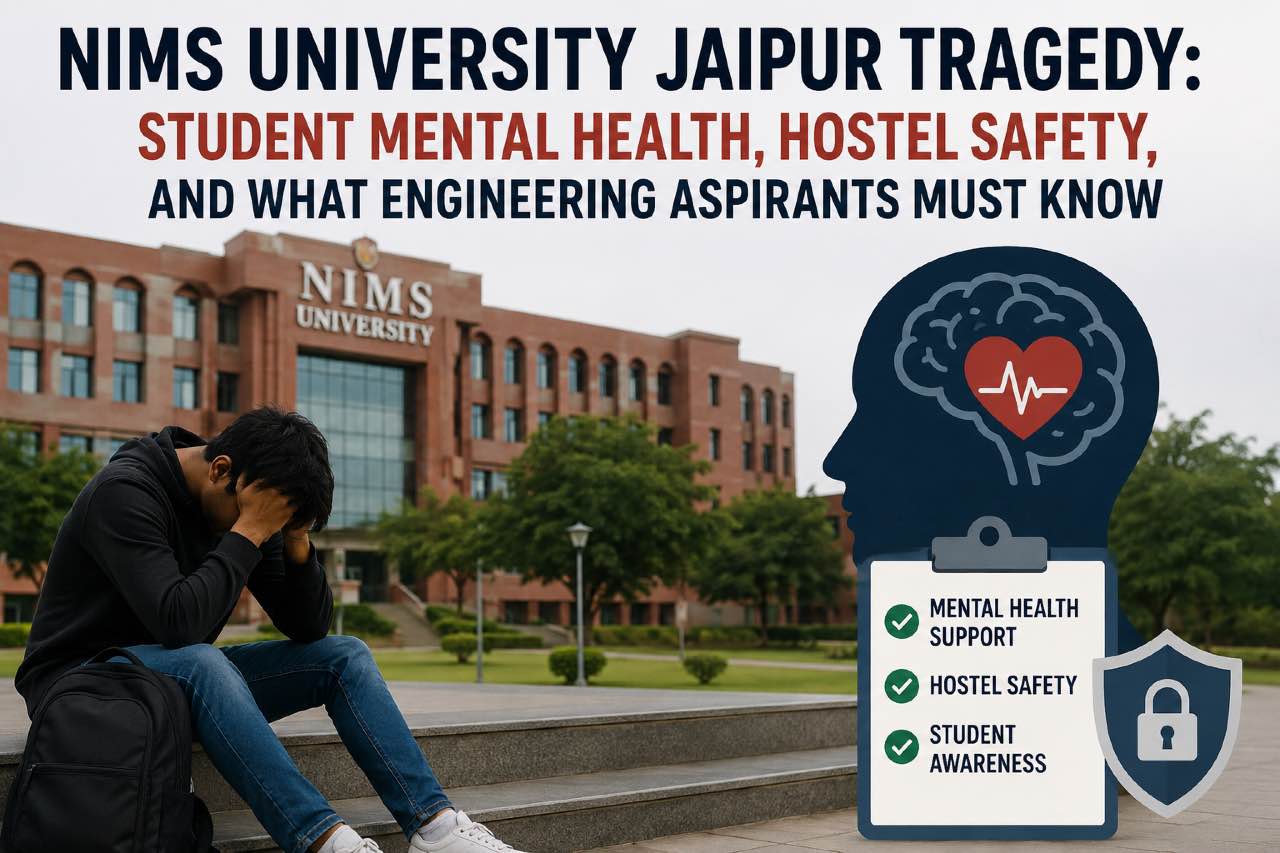
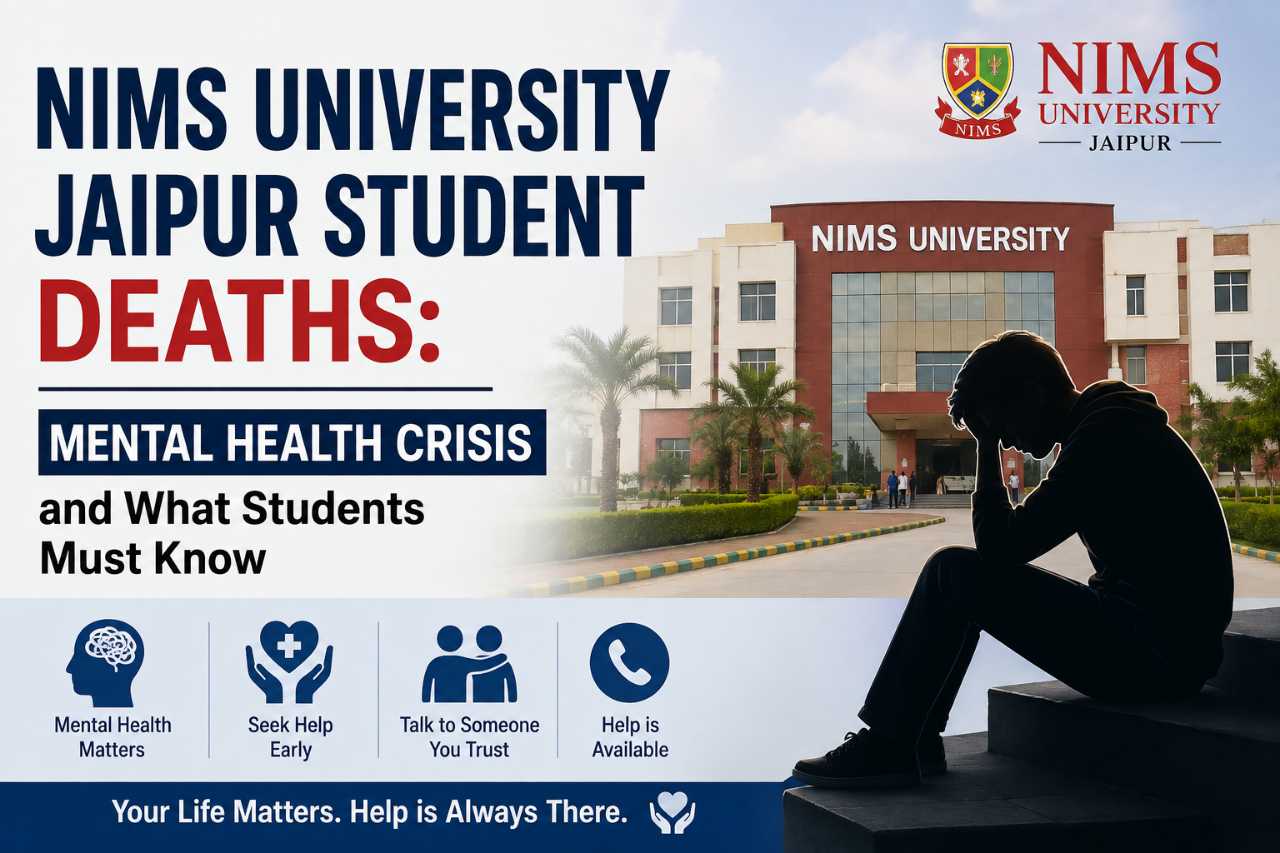
In a deeply troubling development for Rajasthan's higher education landscape, a second student at NIMS University Rajasthan Jaipur has died by suicide within the same week, according to police reports cited by national media on August 28, 2026. The latest case involves Mohit Saini, a second-year Certified Personal Trainer (CPT) course student from Mathura, Uttar Pradesh, who was found dead in his room at a private hostel opposite the university campus.
These back-to-back tragedies have renewed urgent conversations about student mental health, hostel safety, counselling infrastructure, and institutional accountability across private universities in Jaipur and beyond. For students preparing for admissions through exams like NEET, JEE, or state-level entrance tests, and for parents evaluating colleges in Rajasthan's capital, this incident is a sobering reminder that rankings and brochures alone cannot measure whether a campus is truly safe and supportive.
What Happened at NIMS University Jaipur: Key Facts
According to reports from Chandwaji police, Mohit Saini was staying at Sunrise Hostel, located opposite NIMS University. On Wednesday night, around 11 pm, fellow hostel residents noticed a foul smell emanating from his room and alerted the authorities. When police opened the door, they found Saini's body hanging inside. Investigators suspect he may have died one or two days before the discovery.
Saini was enrolled in the second year of the Certified Personal Trainer (CPT) programme a vocational fitness course that attracts students from across North India seeking careers in wellness and sports training. His body was sent to NIMS Hospital for post-mortem examination, and police are continuing their investigation.
This incident came just one day after another tragedy at the same institution: on Tuesday, a BTech student allegedly died by suicide after jumping from the 15th floor of a university hostel, police said. Two student deaths within 48 hours at one campus is exceptionally rare even in a country where student suicide rates have drawn increasing public concern.
Timeline of Events (August 2026)
- Tuesday, August 26: A BTech student at NIMS University allegedly died by suicide after jumping from the 15th floor of a hostel building.
- Wednesday, August 27 (approx. 11 pm): Hostel residents at Sunrise Hostel report a foul smell from Mohit Saini's room; police discover his body.
- Thursday, August 28: Media reports confirm Saini's identity, course details, and the post-mortem process at NIMS Hospital.
Why Two Student Deaths in One Week Raise Systemic Alarms
Individual tragedies are always devastating, but when two occur at the same institution within days, questions naturally shift from personal circumstances to systemic gaps. Indian higher education has expanded rapidly over the past two decades Jaipur alone hosts dozens of private universities including Manipal University Jaipur, Amity University Jaipur, and Jaipur National University Jaipur yet mental health infrastructure has not kept pace with enrolment growth.
Several recurring factors appear across student suicide cases at Indian colleges:
- Academic pressure: Backlogs, attendance rules, and high-stakes exams create chronic stress, especially for first-generation learners.
- Hostel isolation: Students from distant states often live in private hostels with limited supervision, weak peer networks, and minimal counselling access.
- Financial strain: Course fees, hostel rents, and family expectations can overwhelm students who cannot easily return home.
- Stigma around mental health: Many students avoid counselling due to fear of being labelled "weak" by peers or faculty.
- Delayed discovery: Saini's case highlights how students can remain undetected in locked hostel rooms for days a structural safety concern, not merely a personal one.
The Hostel Factor: Private Accommodation vs. Campus Residence
Saini stayed at Sunrise Hostel, a private facility opposite the university not necessarily in an on-campus dormitory managed directly by NIMS. This distinction matters because responsibility for student welfare often falls into a grey zone between university administration and private hostel operators.
Across Jaipur, thousands of outstation students live in similar arrangements near campuses like Poornima University Jaipur, JECRC University Jaipur, and Suresh Gyan Vihar University Jaipur (SGVU). Parents frequently choose colleges based on course quality and fee structure without verifying hostel safety protocols, warden availability, or emergency response systems.
Understanding CPT and Vocational Courses: Unique Pressures Students Face
Mohit Saini was enrolled in the Certified Personal Trainer (CPT) programme a vocational course within the broader fitness and wellness sector. Unlike traditional BTech or MBBS pathways, CPT and similar skill-based programmes often attract students who may have shifted career direction after school, sometimes without the same peer support networks that mainstream degree students enjoy.
Vocational students at institutions like Vishwakarma Skill University Jaipur and Bhartiya Skill Development University Jaipur frequently balance practical training, certification exams, and part-time work expectations. The pressure to become financially independent quickly especially for students from middle-income families in towns like Mathura can intensify stress when job placements do not materialise as promised during admission counselling.
Parents evaluating vocational or allied health programmes should ask colleges specifically about mentorship structures, internship support, and whether CPT or diploma students receive the same counselling access as degree-programme students. At many private universities, welfare resources are concentrated in flagship departments while vocational batches receive minimal attention a disparity that regulators should address.
Comparison Table: On-Campus vs. Private Hostel Student Welfare
| Factor | University-Managed Hostel | Private Hostel (Off-Campus) |
|---|---|---|
| Warden accountability | Directly employed by university | Often contracted; limited university oversight |
| Counselling access | Usually linked to campus welfare cell | Students must travel to campus independently |
| Absence monitoring | Integrated with class attendance systems | May rely only on manual roll calls |
| Emergency response | Campus security and medical units nearby | Depends on local police jurisdiction |
| Parent communication | Formal channels through university admin | Often informal; no standard protocol |
Student Mental Health in Indian Higher Education: The Bigger Picture
India's National Crime Records Bureau (NCRB) data consistently shows that young adults aged 18–30 represent a significant share of suicide victims. While NCRB figures do not isolate "college students" as a separate category, education-sector experts and mental health advocates have long flagged campuses as high-risk environments particularly engineering, medical, and coaching-heavy institutions.
The University Grants Commission (UGC) has issued advisories encouraging universities to establish counselling cells, appoint trained psychologists, and create anti-ragging committees. The National Education Policy (NEP) 2020 also emphasises holistic education and student well-being. However, compliance remains uneven, especially among private universities operating under state private university acts.
What UGC and NEP Expect from Universities
- Functional counselling centres with qualified mental health professionals
- 24x7 helplines or tie-ups with external crisis services
- Orientation programmes addressing stress management and homesickness
- Faculty sensitisation on identifying distressed students
- Anti-ragging committees with student representation
- Regular hostel inspections and attendance monitoring systems
Students comparing institutions in Jaipur should ask whether these mechanisms exist in practice not just on paper. Reputed campuses such as Central University of Rajasthan Jaipur and Vivekananda Global University (VGU) Jaipur often publish student welfare policies; prospective applicants should request the same transparency from every college on their shortlist.
Choosing a College in Jaipur: Safety Beyond Rankings and Cutoffs
Jaipur has emerged as a major education hub in North India, attracting students for programmes in medicine, engineering, law, physiotherapy, and vocational training. Institutions affiliated with or regulated by bodies like Rajasthan University of Health Sciences (RUHS) Jaipur follow specific health-sciences norms, but private multi-disciplinary universities operate under their own internal policies.
When evaluating any Jaipur college including IIS Deemed to be University Jaipur, Apex University Jaipur, or Maharishi Arvind University Jaipur parents and students should assess safety alongside academics:
Checklist for Parents Before Confirming Admission
- Visit the hostel in person or arrange a verified video tour; check locks, ventilation, warden rooms, and CCTV coverage in common areas.
- Ask about counselling staff: How many full-time counsellors serve how many students? Is there a psychiatrist on call?
- Understand leave and communication policies: Can parents contact wardens directly? Are unexplained absences flagged within 24 hours?
- Review anti-ragging records: Request data on complaints and resolutions from the past three years.
- Speak to current students informally about workload, faculty behaviour, and peer support not just placement statistics.
- Verify emergency protocols: What happens if a student misses classes for two consecutive days?
- Check medical tie-ups: Is there a hospital on campus or nearby with a memorandum of understanding?
Medical and health-sciences aspirants often weigh options between Mahatma Gandhi University Medical Sciences Jaipur and other RUHS-affiliated colleges; engineering candidates may compare JK Lakshmipat University Jaipur with RNB Global University Jaipur. In every case, student welfare infrastructure deserves equal weightage as NAAC grade or placement percentage.
Warning Signs Every Student, Roommate, and Parent Should Know
Suicide is rarely sudden without preceding signals. Mental health professionals identify common warning signs that peers and family members can learn to recognise:
- Withdrawal from friends, classes, or activities previously enjoyed
- Sudden drops in academic performance or attendance
- Expressing hopelessness, being a burden, or having no future
- Increased substance use or reckless behaviour
- Giving away possessions or saying goodbye-like statements
- Sleep disturbances insomnia or excessive sleeping
- Visible anxiety before exams, results, or fee payment deadlines
In hostel settings, roommates are often the first observers. The delay in discovering Saini's body underscores why hostel communities must normalise checking on neighbours who have not been seen for extended periods a simple habit that can save lives.
Immediate Helplines and Crisis Resources in India
If you or someone you know is experiencing suicidal thoughts, please reach out immediately. These services are free and confidential:
- AASRA: 9820466726 (24x7) www.aasra.info
- iCALL (Tata Institute of Social Sciences): 9152987821 email: icall@tiss.edu
- Vandrevala Foundation: 1860-2662-345 / 1800-2333-330
- Tele-MANAS (Government of India): 14416 or 1-800-891-4416
- KIRAN (Ministry of Social Justice): 1800-599-0019
- NIMHANS Helpline: 080-46110007
Students at any institution including Jagannath University Jaipur, Sanskriti University Jaipur, or Amity University Rajasthan Jaipur can use these national helplines regardless of whether their college has an on-campus counsellor.
Legal and Regulatory Framework: Who Is Responsible?
When a student dies in a private hostel near a university campus, determining accountability becomes complex. The university may argue the student was not in official accommodation; the hostel owner may claim no duty beyond providing rooms; and state regulators may lack clear jurisdiction over private paying-guest facilities.
Rajasthan's higher education department, the UGC, and local police each play partial roles. After twin tragedies at NIMS, stakeholders will likely examine whether the university maintained a registry of off-campus students, whether anti-ragging and welfare committees extended oversight to affiliated hostels, and whether mandatory orientation included mental health resources for outstation entrants.
Students comparing Dr Bhimrao Ambedkar Law University Jaipur, Jyoti Vidyapeeth Women's University Jaipur, or Homoeopathy University Jaipur should note that legal compliance on paper does not guarantee daily welfare practices. Direct questions to current students remain the most reliable due-diligence tool.
What Universities Must Do After Tragedies Like This
When two student deaths occur within a week, institutions owe their community more than brief statements. Best practices observed at campuses that have faced similar crises include:
- Independent inquiry: External panel review, similar to probes at IIT Delhi and other national institutions after student deaths.
- Immediate counselling deployment: On-site grief counsellors for affected students, faculty, and hostel staff.
- Hostel safety audit: Review of room-check protocols, warden staffing, and private hostel partnerships.
- Transparent communication: Regular updates to students and parents without compromising investigation integrity.
- Policy revision: Mandatory wellness modules, peer-support programmes, and faculty training.
- Long-term investment: Permanent counselling centre staffing rather than temporary crisis responses.
Regulatory bodies and state higher education departments may also intervene to assess compliance with UGC welfare guidelines. Students considering alternatives in Rajasthan might explore established institutions such as UniRaj (University of Rajasthan) Jaipur or Jaipur National University (JNU) Jaipur, but the lesson from NIMS applies universally: due diligence on student support systems is non-negotiable.
Expert Recommendations: Building a Safer Campus Culture
Education psychologists and student welfare officers across India recommend several evidence-based interventions that any Jaipur university including NIMS and its peers can implement without massive budget increases:
- Peer counsellor programmes: Train senior students to recognise distress and refer cases to professionals.
- Faculty office hours with wellness focus: Encourage professors to discuss stress openly during the first week of each semester.
- Digital check-in systems: Apps that prompt students to confirm well-being if they miss two consecutive meals or classes.
- Parent orientation at admission: Educate families on realistic expectations and signs of distress before the student leaves home.
- Post-crisis community support: Group counselling after tragedies to prevent contagion effects and survivor guilt among peers.
Institutions such as Jayoti Vidyapeeth Women's University Jaipur and Sangam University Jaipur that invest in these practices often report higher student retention and fewer disciplinary crises even when academic rigour remains high.
Role of Parents, Faculty, and Peers in Prevention
For Parents of Outstation Students
Maintain regular but not intrusive contact. Weekly video calls, awareness of exam schedules, and open conversations about mental health reduce the isolation that many hostel residents feel. If your child mentions excessive stress, take it seriously rather than responding with "everyone faces pressure." Ask specifically about roommates, wardens, and whether they know how to reach the college counselling cell.
For Faculty and Wardens
Faculty who notice three consecutive absences should flag the student to the department head and counselling cell not wait until end-semester exams. Wardens must maintain daily attendance logs and investigate unverified absence within 24 hours. In Saini's case, a gap of one or two days before discovery suggests that routine welfare checks were either absent or ineffective at Sunrise Hostel.
For Fellow Students
Peer support is among the most effective early interventions. If a roommate has not left the room for meals in two days, knock. If a classmate talks about "ending it all," do not keep it secret inform a counsellor, warden, or helpline immediately. You will not be betraying them; you may be saving their life.
Broader Context: Jaipur as an Education Hub Under Scrutiny
Jaipur hosts over 30 private universities and numerous affiliated colleges, making it one of India's fastest-growing education destinations. While this expansion has created opportunities for students from Uttar Pradesh, Bihar, Madhya Pradesh, and northeastern states, it has also strained municipal infrastructure, hostel regulation, and student services.
Comparing institutions purely on fee or course availability whether at ICFAI University Jaipur, Mewar University Jaipur Campus, or Maharaj Vinayak Global University Jaipur without evaluating welfare infrastructure repeats a pattern that ends in preventable tragedies.
State governments and university regulators must also strengthen oversight of private hostels operating near campuses. Registration, fire safety, warden qualification norms, and mandatory reporting of student absences beyond 48 hours should be enforceable standards not optional guidelines.
Moving Forward: Turning Grief Into Systemic Change
The deaths at NIMS University Jaipur are not isolated statistical anomalies they reflect a national crisis demanding coordinated response from universities, regulators, parents, and students themselves. Mohit Saini and the BTech student who died a day earlier were real people with families, ambitions, and futures cut short.
For every student currently navigating admission counselling, hostel allocation, or the stress of a new semester, the most important education may not come from a textbook. It comes from knowing that asking for help is strength, that helplines exist, and that the college you choose should protect your well-being as fiercely as it promotes your degree.
Collegedwar encourages every prospective student and parent to use our college profiles to compare not just courses and fees, but to directly ask institutions about counselling cells, hostel safety, and crisis protocols before making life-defining admission decisions.
Conclusion
Two student suicides at NIMS University Jaipur within one week have shaken Rajasthan's academic community and highlighted critical gaps in hostel oversight, mental health support, and institutional accountability. Mohit Saini, a CPT student from Mathura found in a private hostel, and the BTech student who died a day earlier represent losses that no placement report or accreditation badge can offset.
Indian higher education must treat student mental health as a core academic responsibility not an optional add-on. Whether you are enrolling at NIMS or comparing alternatives among Jaipur's many universities, prioritise safety, counselling access, and transparent welfare policies. And if you are struggling right now, please call AASRA at 9820466726 or iCALL at 9152987821. You are not alone, and help is available.