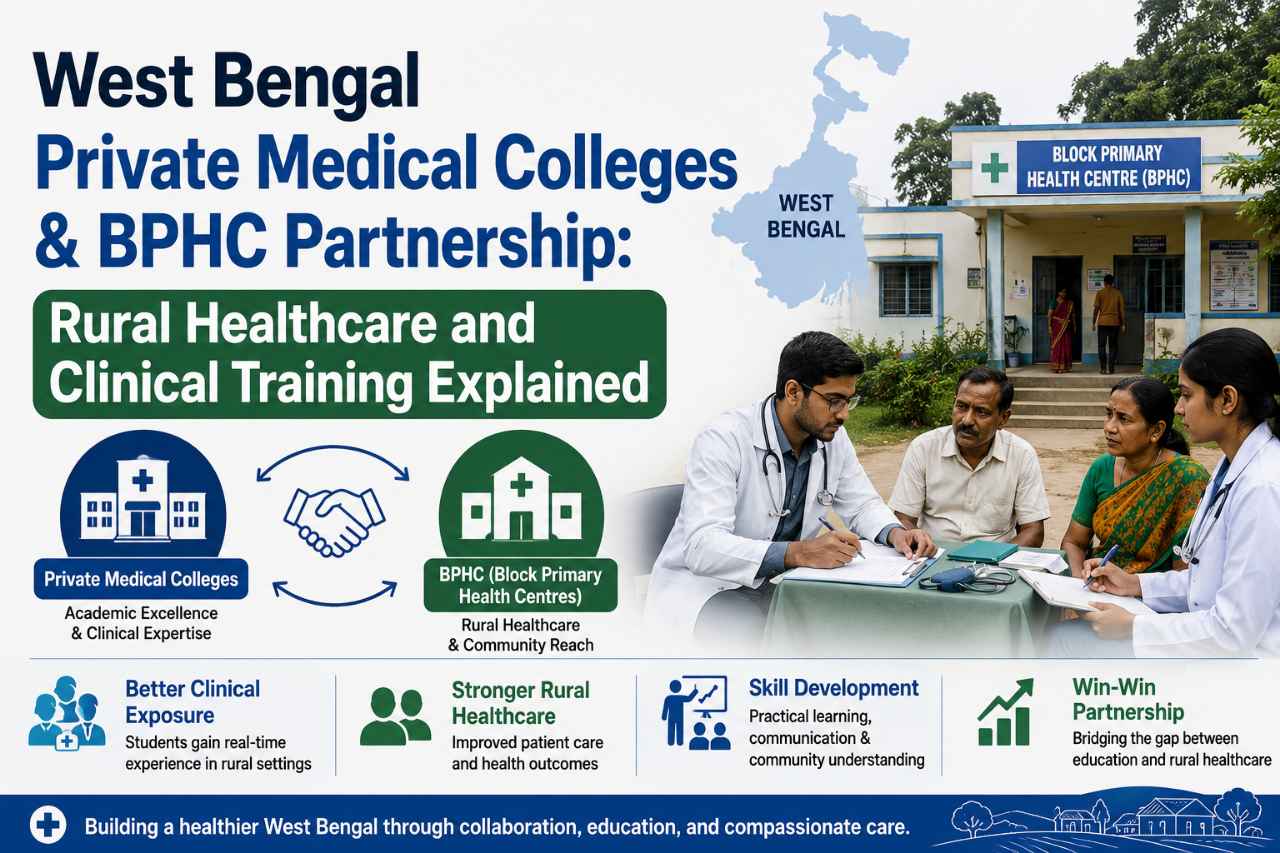
West Bengal is exploring a new partnership model that could reshape both rural healthcare and medical education in the state. Health Minister Sharadwat Mukherjee recently outlined a preliminary plan under which private medical colleges would collaborate with government-run Block Primary Health Centres (BPHCs) to upgrade grassroots facilities while giving MBBS students more real-world clinical exposure. With 17 operational private medical colleges already in the state and six new government medical colleges in the pipeline, the proposal sits at the intersection of public health policy, NEET-based admissions, and the long-standing challenge of training doctors where patients actually live not only in metro hospitals.
For students, parents, and educators tracking medical admissions in West Bengal, this development matters because clinical training quality directly affects internship readiness, postgraduate competitiveness, and ultimately patient care in underserved districts. This guide explains what the BPHC tie-up could mean, how it compares with existing models elsewhere in India, and what aspiring doctors should watch as discussions move from concept to implementation.
What Is the Proposed Private Medical College–BPHC Partnership?
At its core, the West Bengal model is a shared-responsibility arrangement between the state health department and private medical institutions. Minister Mukherjee described the logic in simple terms: the government would channel patients to selected BPHCs, while private colleges would invest in infrastructure, equipment, and trained nursing support at those centres.
Speaking at an interaction with the Forum for Business, Social and Cultural Initiatives (FBSC) on Saturday evening, the minister said the idea was still at a preliminary stage. However, the broad framework is already visible each private medical college could potentially mentor around 10 BPHCs, creating a distributed network of upgraded rural health nodes linked to academic supervision.
The "Patients for Infrastructure" Exchange
Mukherjee summarised the concept as: "We will provide them with patients, and they provide us with infrastructure." In practical terms, this means:
- State contribution: Patient referrals, deployment of doctors and allied staff, operational linkage with the existing public health grid, and policy facilitation.
- Private college contribution: Diagnostic equipment (such as ultrasonography machines and semi-auto analysers), nursing manpower, maintenance support, and academic oversight for student postings.
- Mutual benefit: Rural populations gain better-equipped primary care access; colleges gain consistent patient flow for teaching.
This is not a privatisation of BPHCs in the conventional sense. Ownership and core staffing accountability would remain with the government, while colleges act as technical and academic partners similar in spirit to corporate social responsibility tie-ups and rural health missions seen in other states, though the West Bengal version is explicitly framed around medical education needs.
Why BPHCs Matter for Rural Healthcare in West Bengal
Block Primary Health Centres form the backbone of India's three-tier rural health system above sub-centres and below district hospitals. In West Bengal, where a significant share of the population lives outside Kolkata and its immediate suburbs, BPHCs are often the first point of contact for maternal care, infectious disease management, minor surgeries, and emergency stabilisation before referral.
Current Capacity at the Block Level
According to the minister's remarks, a typical BPHC in the state generally operates with around 20 beds and can serve 30 patients or more depending on seasonal demand and staffing. That scale is adequate for primary and some secondary care, but infrastructure gaps outdated labs, missing imaging, inconsistent nursing coverage limit what clinicians can deliver on site.
Rural patients therefore travel to district towns or Kolkata for investigations that could theoretically be done locally. That increases out-of-pocket costs, delays treatment, and overloads tertiary hospitals a pattern familiar to students who train at premier institutions such as All India Institute Of Medical Sciences Delhi (AIIMS Delhi), where referral pressure from peripheral centres is a daily reality.
The Twin Problem the Policy Aims to Solve
Mukherjee identified two linked challenges:
- Inadequate infrastructure at rural health facilities, limiting service quality at the block level.
- Insufficient patient exposure for medical students in private colleges, especially where attached teaching hospitals see uneven caseloads.
Medical education, he stressed, depends entirely on patients: "Healthcare teaching depends solely on patients. Without patients, you cannot make a doctor." The BPHC partnership is designed to address both sides of that equation simultaneously.
Private Medical Colleges in West Bengal: Context and Numbers
West Bengal has emerged as one of eastern India's major hubs for medical education. The state currently has 17 operational private medical colleges, alongside government institutions and colleges under universities such as The West Bengal University Of Health Sciences Kolkata, which affiliates and regulates many health-sciences programmes.
How Private Colleges Fit the State's Health-Education Map
Private medical colleges admit students primarily through NEET-UG counselling conducted by the West Bengal Medical Counselling Committee (WBMCC). They expand seat capacity beyond what government colleges alone can offer, but they also face scrutiny over fees, faculty strength, hospital bed occupancy, and whether clinical material matches advertised intake.
Institutions like United Medical College represent the growing private sector footprint that could participate in the proposed BPHC mentoring model. If each of the 17 colleges supports roughly 10 centres, the state could theoretically cover 170 block-level facilities a substantial fraction of its rural network, though final numbers would depend on geography, feasibility studies, and formal agreements.
Regulatory Oversight and Academic Standards
Any partnership would need alignment with National Medical Commission (NMC) norms on clinical training hours, faculty ratios, and affiliated hospital requirements. The West Bengal University of Health Sciences would likely play a coordinating role for affiliated colleges, ensuring logbooks, rotations, and assessment standards remain uniform whether students clerk in a college hospital or a BPHC posting.
Students comparing West Bengal with other states should note that clinical exposure quality varies widely. Government colleges with established district hospital links often have predictable caseloads; newer private campuses may rely heavily on a single attached hospital. The BPHC model, if implemented well, could diversify training sites and embed community medicine into everyday learning rather than treating rural postings as a box-ticking exercise.
How the Partnership Could Strengthen Clinical Training
For MBBS students, the difference between reading about primary care and managing a febrile child at 2 a.m. in a resource-limited setting is enormous. The minister explicitly positioned BPHCs as a clinical training base for private college students not merely as charity outreach.
Skills Students Could Gain at BPHC Postings
- Primary care competencies: History-taking, examination, and management of common conditions without immediate specialist backup.
- Public health integration: Immunisation drives, antenatal tracking, tuberculosis and malaria programmes tied to National Health Mission workflows.
- Procedural confidence: Basic wound care, IV access, emergency stabilisation, and use of point-of-care diagnostics once equipment arrives.
- Communication and ethics: Counselling families with limited health literacy in Bengali and other regional languages, often under time pressure.
- Referral judgement: Deciding when a patient needs transfer to a district hospital a skill underscored in community medicine but best learned through repetition.
These competencies mirror what interns learn at busy government setups, and they complement the tertiary exposure available at larger teaching hospitals. Colleges affiliated with broader university ecosystems whether health-focused or multi-disciplinary campuses such as Techno India University West Bengal may find it easier to integrate BPHC data into research on rural disease patterns and health economics.
Comparison: Urban Teaching Hospital vs BPHC Exposure
| Training Setting | Typical Case Mix | Learning Advantage | Common Limitation |
|---|---|---|---|
| Attached private hospital | Elective surgeries, specialised OPD | Procedural volume in chosen specialties | May under-represent primary care |
| District hospital | Mixed medical-surgical emergencies | Broad clerkship experience | Overcrowding can reduce teaching time |
| BPHC (proposed model) | Primary care, preventive services | Community medicine in practice | Historically limited equipment |
| Tertiary centre (e.g. AIIMS-type) | Complex referrals, sub-specialty | Advanced diagnostics and rounds culture | Less representative of rural India |
A balanced MBBS curriculum needs more than one row in that table. The West Bengal proposal, by pairing equipment upgrades with guaranteed patient flow, attempts to make the BPHC row clinically rich rather than administratively thin.
Broader Health Infrastructure Plans in West Bengal
The BPHC partnership does not exist in isolation. Mukherjee indicated parallel investments that together sketch a multi-year health and medical education roadmap for the state.
Six New Medical Colleges
The government is working on starting six new medical colleges, which would expand government MBBS seats and reduce dependence on private fee structures for many aspirants. New colleges typically take several years from land allocation to NMC recognition, but they signal long-term capacity building especially if located in underserved regions where graduates might later serve.
AIIMS-Like Institution in North Bengal
Plans for an AIIMS-like institution in north Bengal address a chronic geographic imbalance: students and patients in districts such as Darjeeling, Jalpaiguri, and Cooch Behar often travel long distances for advanced care. A super-specialty anchor in the north could retain talent, support referral networks, and offer postgraduate pathways without forcing migration to Kolkata.
Trauma Centre in South Bengal
A proposed trauma centre in south Bengal would strengthen emergency and accident care along dense transport corridors. Trauma infrastructure pairs naturally with upgraded BPHCs primary centres stabilise; trauma hubs operate definitive care.
Together, these projects suggest a layered strategy: block-level primary care partnerships, district and regional hospitals, and apex institutes. Students researching where to study should map how each layer connects to their preferred college's training sites.
Stakeholders, Consultations, and Implementation Path
The minister stated that the model is being discussed with the association of private medical colleges. That consultation phase is critical because successful partnerships require legal clarity, financial sustainability, and buy-in from college management, faculty, and student representatives.
Key Implementation Questions
- Memorandum of understanding (MoU) terms: Duration, equipment ownership, maintenance liability, and exit clauses if either party underperforms.
- Staffing models: Which cadres remain state employees versus college-deputed nurses or technicians.
- Patient referral protocols: How ASHA workers, sub-centres, and ambulances route cases to partnered BPHCs without disrupting existing chains.
- Student safety and supervision: Faculty presence requirements, night-duty policies, and malpractice insurance during rural postings.
- Monitoring and audit: Outcome metrics institutional delivery rates, lab turnaround times, student competency scores not just inauguration photos.
States that have experimented with public–private partnerships in health have learned that governance design matters as much as equipment lists. West Bengal's preliminary framing avoids promising overnight transformation; instead, it tests a scalable unit one college, ten blocks that can be piloted, evaluated, and adjusted.
What This Means for NEET Aspirants and MBBS Students
If you are preparing for NEET-UG or already enrolled in a West Bengal medical college, the proposed tie-up offers both opportunity and homework.
For NEET-UG Aspirants Choosing West Bengal
When filling choices during WBMCC counselling, look beyond annual fee and cutoff rank. Investigate:
- Bed occupancy and OPD numbers at the attached teaching hospital.
- Whether the college publishes rural health outreach or has existing PHC linkages.
- Faculty strength in community medicine and preventive social medicine departments.
- Alumni placement patterns in West Bengal government service versus other states.
Private colleges with credible BPHC partnerships could eventually advertise stronger community clerkships a differentiator in a market where clinical exposure claims are hard for applicants to verify.
For Current MBBS Students
Students should treat upcoming BPHC postings as career-shaping, not punitive. Document cases diligently, seek feedback from block medical officers, and understand NHM reporting systems you may later apply for rural service bonds, postgraduate seats with service quotas, or public health fellowships.
Those interested in allied health pathways can also explore complementary programmes at institutions such as Sarvodaya College Of Paramedical And Nursing Education Kota or West Bengal-based nursing colleges, recognising that strengthened BPHCs will increase demand for skilled nurses and lab technicians the very cadres private colleges may deploy under the partnership.
Challenges and Criticisms to Watch
Any policy blending public patients with private capital invites scrutiny. A balanced assessment should acknowledge plausible risks.
Equity and Access Concerns
Channeling patients to BPHCs upgraded by specific colleges must not create two-tier block care partnered centres thriving while neighbouring blocks remain neglected. The state would need allocation rules tied to health indices, not political convenience.
Commercialisation Worries
Parents already face high fees in private medical colleges; some may ask whether infrastructure spending at BPHCs indirectly subsidises college branding without fee relief. Transparent reporting on CSR versus operational budgets would help.
Quality Assurance
Equipment without sustained training yields dusty machines. Nursing support without career progression leads to attrition. The NMC and university inspectors must treat partnered BPHCs as accredited training sites subject to the same surprise visits as main hospitals.
Workforce Motivation
Government doctors posted in rural blocks often cite isolation and housing as pain points. Partnerships that improve facilities but ignore accommodation and career advancement may still struggle to retain staff a lesson documented across rural health schemes nationwide.
How West Bengal Compares With Other States
Several states link medical colleges government and private to district hospitals and taluk hospitals for integrated care and teaching. Karnataka, Tamil Nadu, and Maharashtra have long histories of medical college–district hospital pairs. What is relatively novel in West Bengal's discourse is the explicit block-level scale (10 BPHCs per private college) and the quid-pro-quo framing around patient flow.
Students familiar with institutions like Government Medical College Kota or Maulana Azad Medical College (MAMC Delhi) know that deep district-hospital integration produces graduates comfortable with high patient volumes. West Bengal aims to replicate that confidence at a more grassroots tier, which could be transformative if governance keeps pace.
Timeline Expectations: Preliminary Stage to Policy
Mukherjee was clear that the idea remains at a preliminary stage. Realistic milestones might include:
- 2026 (current): Stakeholder consultations with private college associations and departmental feasibility studies.
- Short term: Pilot MoUs with a subset of colleges and BPHCs in one or two districts.
- Medium term: Standardised equipment packages, nursing recruitment pipelines, and integration with MBBS rotation schedules.
- Long term: Statewide rollout linked to new medical colleges and the north Bengal AIIMS-like project.
Aspirants should follow official notifications from the West Bengal Department of Health & Family Welfare and WBMCC rather than relying on unofficial social media summaries.
Actionable Tips for Students and Parents
- Verify claims during admission season: Ask colleges directly about BPHC partnerships and request written rotation schedules once pilots begin.
- Build primary care skills early: Volunteer at health camps and learn basic Bengali medical terminology if you are from out of state.
- Track state health budgets: Capital outlays for BPHCs often appear in budget speeches before they reach your campus.
- Consider rural service pathways: West Bengal periodically advertises medical officer posts; BPHC experience could become a hiring advantage.
- Use university resources: Affiliated universities, including West Bengal State University Barasat for broader higher-education context and health-sciences regulators for programme accreditation updates.
Conclusion
West Bengal's exploration of a private medical college–BPHC partnership reflects a pragmatic recognition that good doctors need patients, and rural India needs functional primary care. By proposing that each of the state's 17 private medical colleges mentor around 10 block centres supplying equipment and nursing support in exchange for structured patient flow the government is testing a scalable model that could upgrade grassroots healthcare while deepening MBBS training.
The idea remains at an early stage, with active discussion among health officials and private college associations. Success will depend on transparent agreements, equitable distribution of upgrades, NMC-aligned supervision, and sustained investment beyond initial equipment photo-ops. For NEET aspirants, current students, and rural communities alike, this is a development worth monitoring closely not as a guaranteed reform, but as a potentially significant shift in how medical education and public health meet at the block level in eastern India.
Disclaimer: Policy details are evolving. Always refer to official government notifications and the National Medical Commission for binding regulations on medical education and clinical training.