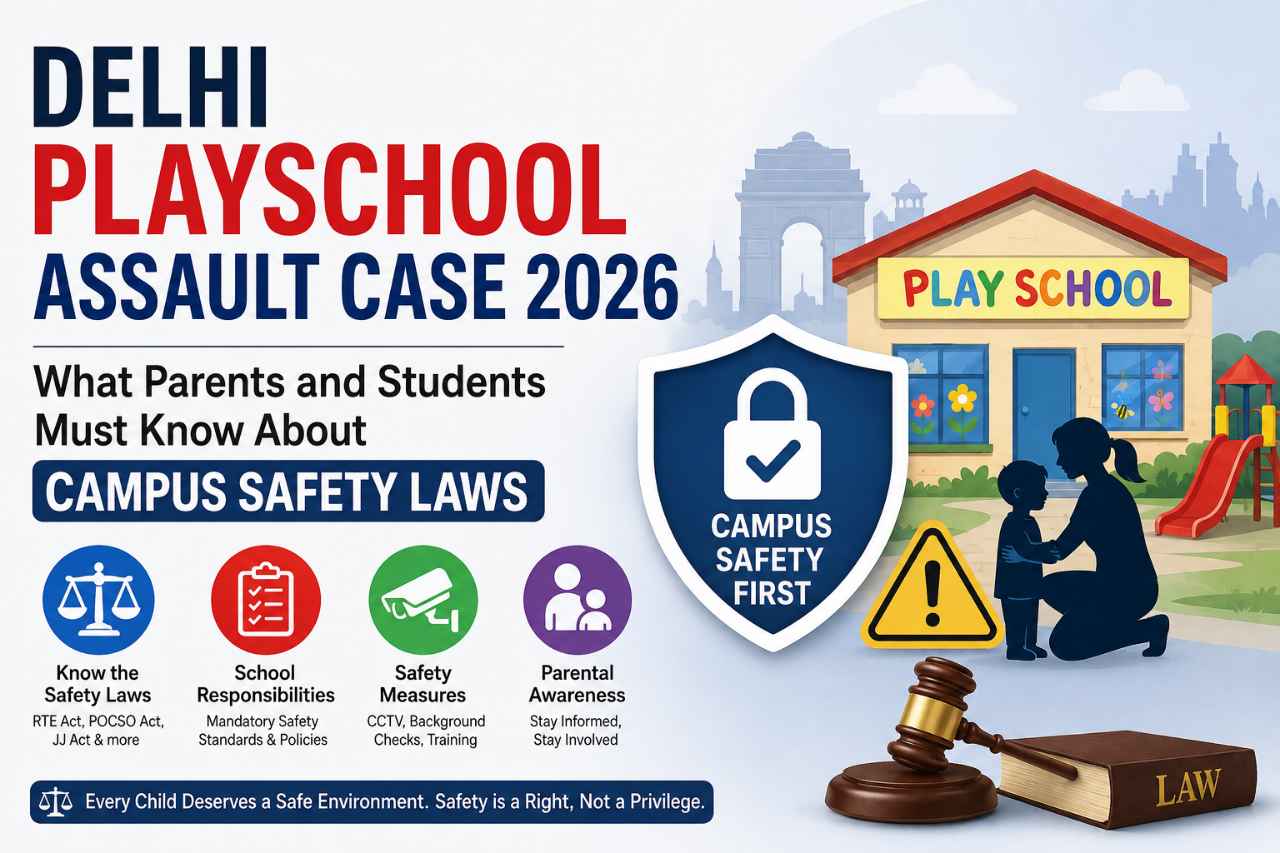

On August 30, 2026, news from northeast Delhi shook families across the National Capital Region. Police registered a case after a three-and-a-half-year-old boy was allegedly assaulted at a playschool in the Jafrabad area. Four people the School director, principal, a teacher, and a caretaker were booked under the Protection of Children from Sexual Offences (POCSO) Act, the Juvenile Justice (Care and Protection of Children) Act, and the Bharatiya Nyaya Sanhita (BNS). The child was medically examined at GTB Hospital, CCTV footage was seized, and investigators were reviewing medical reports and other evidence. No arrests had been made at the time of reporting.
For parents planning admissions from playschools to Delhi's top universities this incident is a stark reminder that safety is not a secondary checkbox. It is as important as rankings, cut-offs, and placement records. Families in Delhi often compare institutions like Indian institute of Technology Delhi (IIT Delhi), Lady Shri Ram College for Women (LSR Delhi), and Jamia Millia Islamia New Delhi on academic merit. Yet the same diligence must apply when evaluating any campus where a child spends hours away from home.
This article explains what happened in the Jafrabad case, how Indian law protects minors, what behavioural red flags parents should watch for, and how Delhi students and families can assess institutional safety before admission. The goal is practical, trustworthy guidance aligned with Google's E-E-A-T standards grounded in verified facts, clear legal context, and actionable steps you can use today.
What Happened in the Jafrabad Playschool Case?
According to police sources cited in media reports, the child's family noticed disturbing changes in his behaviour before approaching the police. They reported that he had difficulty sleeping and showed fear around using the toilet signs that, in young children, can sometimes indicate trauma rather than ordinary toddler anxiety.
The family alleged that the boy was beaten at the school and subjected to inappropriate conduct. Delhi Police registered an FIR and began verifying the claims through multiple channels:
- Medical examination at Guru Teg Bahadur (GTB) Hospital, including a joint examination as part of standard protocol in sensitive cases involving minors.
- CCTV footage seized from the playschool premises for forensic review.
- Statements from staff, caregivers, and witnesses as the investigation continued.
Four individuals connected to the institution were named in the FIR: the director, principal, a teacher, and a caretaker. Charges invoked include provisions under POCSO which carries stringent bail conditions and special trial procedures for offences against children the Juvenile Justice Act, and the BNS, India's updated penal code that replaced much of the Indian Penal Code (IPC) from July 2024 onward.
It is important to note that at the time of initial reporting, the case remained under investigation. Allegations are not convictions. However, the swift registration of an FIR and medical examination reflect how seriously Delhi Police treats complaints involving young children a standard that families should expect from any responsible institution as well.
Why This Case Matters Beyond Early Childhood Education
Playschools sit at the earliest stage of formal education, but the safety principles apply across the pipeline. A student entering St Stephen's College Delhi or Hindu College Delhi through CUET still deserves a campus culture that prioritises dignity, consent education, and zero tolerance for abuse. Medical aspirants comparing AIIMS Delhi, Maulana Azad Medical College (MAMC Delhi), and VMMC Delhi should also review hostel safety policies and anti-ragging frameworks not just NEET cut-offs.
Delhi hosts thousands of registered and unregistered early-learning centres alongside hundreds of colleges and professional institutes. The regulatory gap between a playschool in Jafrabad and a deemed university in South Campus may be wide, but a parent's fundamental question stays the same: Will my child be safe here?
Understanding the Laws Involved: POCSO, JJ Act, and BNS
Indian law treats offences against children with exceptional seriousness. Three frameworks featured prominently in the Jafrabad FIR.
POCSO Act, 2012
The Protection of Children from Sexual Offences Act defines a child as anyone below 18 years. It covers sexual assault, harassment, pornography involving minors, and failure to report known abuse. Key features relevant to parents include:
- Mandatory reporting: Anyone with knowledge of abuse including teachers, doctors, and school staff must report it. Failure can itself attract legal consequences.
- Child-friendly procedures: Statements should be recorded sensitively, often at home or a neutral place, and repeated questioning is discouraged.
- Stringent bail norms: Accused persons face tougher bail thresholds compared with many other offences.
- Presumption of guilt in certain cases: Where sexual intent is established, the burden may shift to the accused to disprove culpability.
POCSO applies equally to private playschools, government schools, coaching centres, and college hostels. Age does not reduce protection a three-year-old and a seventeen-year-old undergraduate are both covered, though procedures differ by developmental stage.
Juvenile Justice (Care and Protection of Children) Act
The JJ Act governs how the state protects children in need of care. In institutional contexts, it addresses neglect, cruelty, and failure of duty by caregivers responsible for minors. When school authorities allegedly ignore or conceal harm, JJ Act provisions can complement POCSO charges.
Bharatiya Nyaya Sanhita (BNS)
Replacing much of the IPC, the BNS modernised general criminal offences including hurt, wrongful confinement, and criminal intimidation. In cases where physical beating is alleged alongside sexual misconduct, investigators often file overlapping sections under BNS and POCSO to capture the full scope of harm.
Practical takeaway: If your child discloses harm at any age you do not need to determine which law applies before seeking help. Approach the police, dial 1098 (Childline), or visit the nearest hospital with a paediatric unit. Trained officials will classify offences correctly.
Behavioural Red Flags Parents Should Not Ignore
The Jafrabad family reportedly acted after noticing sleep disturbances and toilet-related fear. Young children rarely invent elaborate abuse narratives, but they may express distress indirectly. Watch for these signs:
- Sudden regression: bed-wetting, clinginess, or loss of language skills in toddlers.
- Unexplained fear of a specific place, person, or activity (such as going to school or using the bathroom).
- Physical marks, difficulty sitting, or genital discomfort seek immediate medical evaluation.
- Aggression, withdrawal, or repeated nightmares without an obvious trigger.
- Reluctance to change clothes or be examined during bath time.
For older students including those preparing for JEE, NEET, or CUET at Delhi coaching hubs red flags may look different: falling grades, social isolation, substance use, or unexplained absences. Colleges such as Miranda House Delhi and Gargi College Delhi operate internal committees under the University Grants Commission (UGC) anti-sexual harassment guidelines (often called Internal Complaints Committees). Students should know these bodies exist before a crisis occurs.
How to Talk to Your Child Without Leading Questions
If you suspect something is wrong, create a calm environment. Use open prompts: "Tell me about your day. What made you happy? What made you scared?" Avoid naming suspects prematurely. Document what your child says in their own words with dates and times. Do not force repeated retelling; one gentle conversation followed by professional support is often better than intensive grilling, which can confuse young witnesses.
Campus Safety in Delhi: From Playschools to Universities
Delhi's education map spans informal neighbourhood playschools, CBSE-affiliated K–12 schools, and globally recognised institutions. Safety standards vary sharply across this spectrum.
Early Childhood and School-Level Checks
Before enrolling a toddler or primary student, verify:
- Registration status with the Delhi government's Directorate of Education or municipal corporation, where applicable.
- Staff verification: police clearance, identity proofs, and reference checks for every caregiver.
- CCTV coverage of common areas not private changing zones, which must still be supervised by vetted staff.
- Parent access policies: Can you observe classes occasionally? Are pick-up and drop-off IDs strictly enforced?
- Complaint mechanisms: Is there a written child protection policy displayed on campus?
Higher Education and Professional Institutes
When shortlisting colleges, combine academic research on CollegeDwar with safety due diligence:
- Read the institution's anti-ragging affidavit and ICC (Internal Complaints Committee) contact details published on its website.
- For hostels, ask about warden ratios, visitor logs, and emergency helplines.
- Check National Institutional Ranking Framework (NIRF) parameters indirectly tied to student welfare, such as outreach and inclusivity, while remembering rankings alone do not measure safety.
- Speak with current students during open days ask direct questions about reporting culture, not just placements.
Management aspirants evaluating Fore School of Management Delhi, International Management Institute (IMI Delhi), or New Delhi Institute of Management should weigh culture and governance alongside ROI. Similarly, tech applicants comparing Delhi Technological University (DTU), NSUT Delhi, and IIIT Delhi can review campus security apps, shuttle services, and night-transport rules.
Delhi NCR Context: Jafrabad and Northeast District
Jafrabad falls in northeast Delhi a densely populated area with mixed private and government schools. Families here often commute across districts for better-known brands. Distance alone does not guarantee safety; a well-marketed chain school without verified staff training may pose greater risk than a modest neighbourhood playschool with transparent parent communication. Local proximity can help you can respond quickly to emergencies and build relationships with administrators but only if the institution earns trust through documented policies, not marketing alone.
Legal Remedies and Where to Report in Delhi
Knowing reporting channels empowers families and prevents delays that weaken evidence collection.
Immediate Steps After a Disclosure or Discovery
- Ensure the child's immediate safety remove them from the suspected environment if risk continues.
- Seek medical care at a government or trusted private hospital; request documentation and preserve clothing if relevant.
- File an FIR at the local police station or through Delhi Police's online portals; POCSO cases can be registered at any police station regardless of where the offence occurred.
- Call Childline 1098 for counselling and referral support.
- Notify the education regulator Directorate of Education for schools, UGC or AICTE for colleges, depending on affiliation.
Role of CCTV and Digital Evidence
In the Jafrabad investigation, police seized school CCTV footage a common step in Delhi cases. Institutions are increasingly required to maintain recordings, but retention periods vary. If you suspect harm, request preservation of footage immediately; many systems overwrite data within seven to thirty days. WhatsApp messages, attendance logs, and medical reports also form part of the evidentiary chain.
Support Services in the Capital
Delhi offers specialised resources beyond general policing:
- GTB Hospital and AIIMS provide medico-legal examination facilities; AIIMS Delhi also trains paediatric specialists who understand forensic protocols.
- Delhi Commission for Protection of Child Rights (DCPCR) accepts complaints about schools and childcare institutions.
- University grievance cells at campuses like Kirori Mal College Delhi and Ramjas College Delhi handle student welfare issues under University of Delhi guidelines.
Choosing Safe Institutions: A Framework for Admission Season
Admission season in Delhi peaks between January and August across age groups nursery lotteries, CUET counselling, NEET seat allotment, and MBA entrance cycles. Use this framework to balance ambition with safety.
Layer 1: Regulatory Legitimacy
Confirm affiliation, recognition, and accreditation. Unrecognised playschools may lack fire NOCs and background-checked staff. For higher education, verify listings on the UGC, AICTE, NMC, or BCI portals as applicable. Delhi Metropolitan Education and other private institutes should display clear approval numbers on official sites.
Layer 2: Physical Infrastructure
During campus visits, inspect boundary walls, security desks, ID checks, and emergency exits. Hostel rooms should have functional locks and documented visitor policies. Architecture and planning students familiar with institutions like School of Planning and Architecture New Delhi know that good design includes sightlines and safe circulation paths features parents can observe even without technical training.
Layer 3: Culture and Accountability
Ask administrators: What happened the last time a parent complained? Institutions with mature governance answer honestly and cite policy. Avoid places that dismiss concerns as "overprotective parenting." Cross-check with alumni networks and local parent WhatsApp groups while treating anonymous rumours cautiously, repeated patterns deserve scrutiny.
Layer 4: Education Continuity Planning
Safety incidents can disrupt academic trajectories. Families relocating within Delhi for example, from northeast districts toward South Campus colleges like Jesus and Mary College Delhi or Kamala Nehru College Delhi should maintain counselling support if a child transfers after trauma. Delhi's cluster of women's colleges often provides robust pastoral care; ask about on-campus counsellor availability during admission tours.
Table: Quick Comparison of Safety Checks by Education Stage
Use this reference during school and college shortlisting:
| Education Stage | Key Safety Documents | Questions to Ask | Red Flags |
|---|---|---|---|
| Playschool / Pre-primary | Registration, staff ID proofs, fire NOC | Who supervises bathroom breaks? Is CCTV active? | No pick-up ID policy; refusal of parent observation |
| CBSE / ICSE School | Affiliation certificate, POCSO compliance training records | Is there a child protection committee? | High teacher turnover; unexplained injuries |
| Coaching Centre | Local municipal registration where required | Are minors supervised during late batches? | Isolated one-on-one sessions without oversight |
| Undergraduate College | UGC affiliation, ICC constitution, anti-ragging affidavit | How are hostel complaints escalated? | No published ICC contact; ragging history ignored |
| Professional / PG Institute | AICTE/NMC approval, NAAC grade | What mental health support exists? | NDA-style gag clauses in fee agreements |
Broader Trends: Why Campus Safety Is a 2026 Priority
The Jafrabad case emerged alongside other education headlines teacher misconduct cases in Uttar Pradesh, student welfare protests at IIT Delhi, and renewed debates on coaching centre regulation in Maharashtra. Together, these stories signal a national shift: families and students expect transparency, not silence.
Regulatory proposals increasingly mirror Kota-style coaching oversight, while universities expand into new campuses the University of Southampton Delhi, for instance, plans dozens of new courses over the next decade. As institutional footprints grow, child and student protection policies must scale too. Prospective applicants should treat safety infrastructure as a ranking criterion equal to faculty credentials.
For social-work and psychology aspirants, incidents like the Jafrabad case underscore demand for trained counsellors and child protection officers. Programmes at institutes such as Madras School of Social Work Chennai while outside Delhi reflect a growing professional field that Delhi schools and colleges urgently need onsite.
What Institutions Must Do: Responsibilities of Schools and Colleges
Accountability cannot rest on parents alone. Delhi institutions should implement baseline measures:
- Annual POCSO and child rights training for all staff, including support workers and security guards.
- Visible complaint boxes and online forms monitored by senior leadership, not only front-desk staff.
- Partnerships with hospitals for emergency medico-legal referrals.
- Clear protocols when a child discloses abuse never interrogate the child internally before reporting to authorities.
- For colleges, functional Internal Complaints Committees with student representation and published annual reports.
Management education itself can reinforce ethical leadership. Programmes at Delhi School of Management and IIFT Delhi increasingly include governance and CSR modules; playschool directors would benefit from similar mandatory certification in child protection.
Conclusion: Safety First, Always Before Cut-Offs and Rankings
The alleged assault of a three-and-a-half-year-old boy at a Jafrabad playschool is a painful reminder that every educational institution whether a neighbourhood crèche or a flagship university holds a position of trust. Delhi Police acted on a family complaint by registering an FIR under POCSO, the Juvenile Justice Act, and the Bharatiya Nyaya Sanhita, conducting medical examinations, and reviewing CCTV evidence. The legal process continues, and the child deserves support, privacy, and justice.
For parents navigating Delhi's crowded admission landscape, the lesson is clear: verify before you enrol. Ask hard questions during campus visits to Hansraj College Delhi, NIT Delhi, or your local playschool. Teach children age-appropriate body safety rules. Know that 1098 and your nearest police station exist to help not to judge.
Academic excellence at institutions like Deen Dayal Upadhyaya College Delhi or TERI School of Advanced Studies New Delhi matters deeply but it builds on a foundation of safety. Choose institutions that earn trust through transparency, trained staff, and accountable leadership. That is the standard every child in Delhi and every student pursuing higher education deserves.