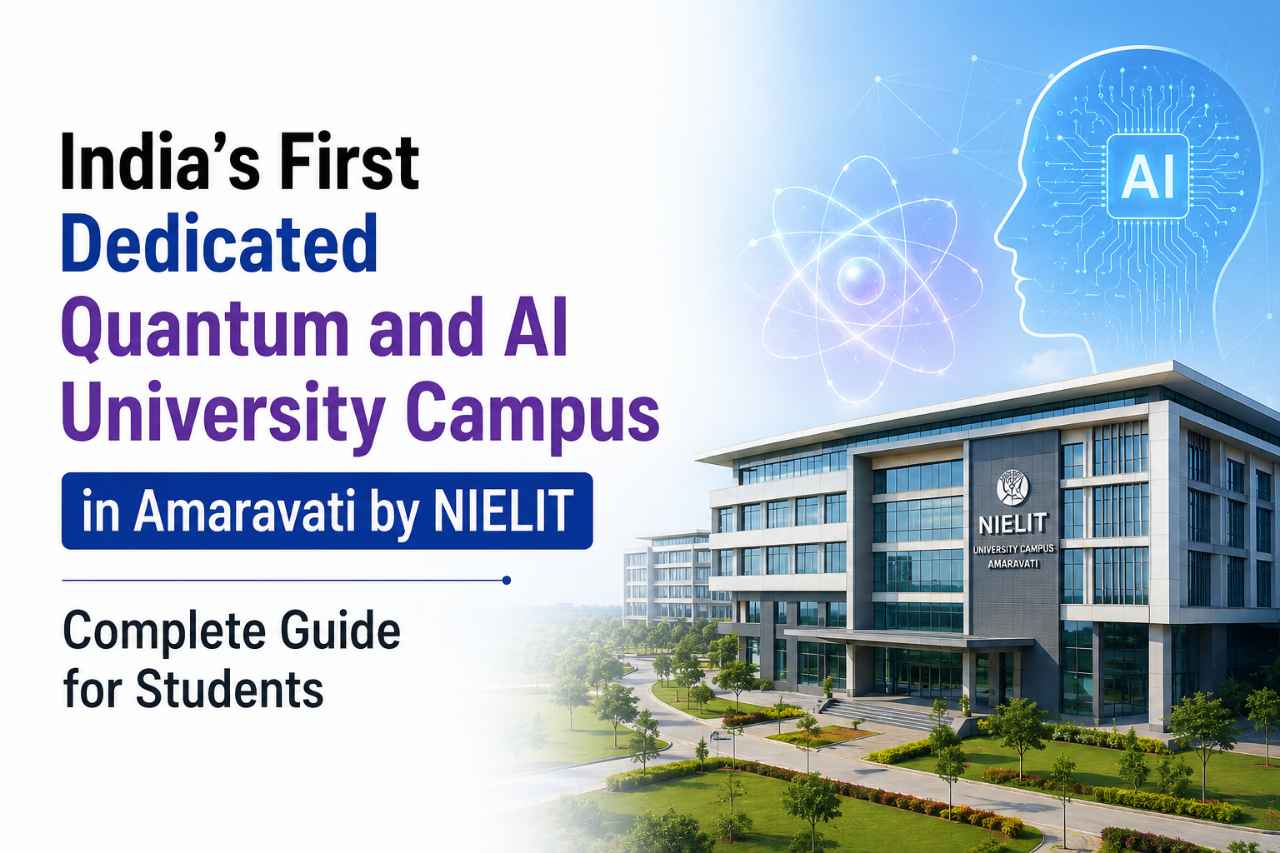
Andhra Pradesh is set to become a national hub for deep technology education. On August 28, 2026, Chief Minister N Chandrababu Naidu approved India's first dedicated Quantum and Artificial Intelligence (AI) University campus in Amaravati, to be developed by the National Institute of Electronics and Information Technology (NIELIT) under the Ministry of Electronics and Information Technology (MeitY), Government of India. The decision was taken at a Capital Region Development Authority (CRDA) meeting and marks a major shift in how India plans to train talent for quantum computing, machine learning, chip design, and semiconductor manufacturing.
For students, parents, and career planners across India, this is not just another campus announcement. It signals that future-ready skills in quantum technologies and AI will soon be available through formal degrees, diplomas, doctorates, and executive programmes within Andhra Pradesh's capital region. If you are exploring engineering, data science, or emerging technology courses after Class 12 or graduation, understanding this project early can help you align your preparation, entrance exams, and college shortlists with a fast-growing opportunity.
What Is the NIELIT Quantum and AI University Campus in Amaravati?
NIELIT is an autonomous body under MeitY that has long delivered electronics, IT, and digital skilling programmes across India. The Amaravati campus will be India's first university-scale institution dedicated specifically to Quantum Technologies and Artificial Intelligence, rather than offering these subjects as optional electives within a general engineering degree.
According to official reports cited by Careers360, CM Naidu stated: "We have approved the establishment of India's first dedicated Quantum and AI University campus in Amaravati by the NIELIT, under the MeitY, Government of India." The campus will combine education, research, skilling, innovation, and entrepreneurship under one roof, making it closer to an integrated deep-tech ecosystem than a traditional standalone college.
Students already studying in Andhra Pradesh may find the location strategically important. Amaravati sits within a region that is building multiple higher education and research institutions. For context, private universities such as SRM University AP Amaravati have helped establish the capital area as an education destination. The NIELIT project adds a government-backed, nationally aligned layer focused on frontier technologies.
Why a Dedicated Quantum and AI Campus Matters
Quantum computing, AI, and semiconductors are no longer niche research topics. They sit at the centre of India's national missions in technology self-reliance, cybersecurity, healthcare innovation, financial modelling, and advanced manufacturing. A dedicated campus allows:
- Curriculum depth: Programmes can move beyond introductory coding into quantum algorithms, photonics, cryogenics, VLSI, and high-performance computing.
- Industry-linked labs: Cleanrooms, chip-design studios, and incubation spaces support practical learning rather than theory-only degrees.
- Skilling at scale: Alongside formal degrees, short-term certifications can upskill working professionals and diploma holders.
- Regional talent retention: Andhra Pradesh students may no longer need to relocate to Delhi, Bengaluru, or Hyderabad for specialised deep-tech training.
Institutions such as Delhi Technological University (DTU) and Netaji Subhas University of Technology (NSUT) have strong computer science and electronics traditions in North India. The Amaravati campus aims to create a comparable deep-tech anchor in South India, with a sharper focus on quantum and AI from day one.
Key Project Details: Investment, Land, and Timeline
Understanding the scale of the project helps students set realistic expectations about when admissions, infrastructure, and full-degree pathways will mature.
Financial Outlay and Land Area
Reports indicate the permanent campus will be developed across 8.5 acres in Amaravati with an estimated investment of Rs 730.7 crore over five years. The project is proposed to be fully funded through grant-in-aid from MeitY, which suggests stable central backing rather than dependence on private tuition revenue alone.
When Will Classes Begin?
Academic and advanced technology skill-development programmes are scheduled to begin from September 2026 at a temporary facility at Acharya Nagarjuna University in Guntur. The permanent Amaravati campus will be developed in parallel. Students applying in the first intake cycle should expect initial operations in Guntur, with migration to Amaravati once construction is complete.
This phased model is common for large government-backed institutions. Similar transitions occur when new IITs or IIITs begin in interim buildings before shifting to permanent townships. Applicants should confirm campus location, hostel availability, and transport for each admission cycle directly from official NIELIT and state notifications.
Learner Targets Over Five Years
The project aims to train around 8,250 learners over five years. Of these:
- 1,650 learners through formal degree programmes
- 6,600 learners through skilling and certification programmes
By the fifth year, annual intake is expected to reach approximately 3,913 learners. This mix of degrees and certifications makes the campus relevant both for fresh school graduates and for professionals seeking upskilling in AI or semiconductor technologies.
Programmes Offered: Degrees, Diplomas, and Executive Courses
The university is expected to offer undergraduate, postgraduate, diploma, doctoral, and executive programmes. Based on official reports, key academic areas include:
- Quantum computing
- Quantum communication and security
- Artificial Intelligence and Machine Learning
- Data Science
- Semiconductor fabrication
- Chip design and Very Large Scale Integration (VLSI)
- Assembly, Testing, Marking and Packaging (ATMP)
- Embedded systems
- High-performance computing
Who Should Consider These Programmes?
After Class 12 (Science stream): Students with strong Physics, Mathematics, and Computer Science foundations are best placed for quantum and AI pathways. Consistent performance in board exams and entrance tests will matter, especially if seats are limited in early years.
After B.Tech or B.Sc: Postgraduate programmes in AI, data science, VLSI, or quantum technologies may accept candidates from electronics, computer science, physics, and related branches. GATE scores, university-specific tests, or portfolio-based selection may apply depending on final rules.
Working professionals: Executive and certification tracks could suit software engineers, network specialists, and IT professionals pivoting into AI or chip-design roles. Institutions like Amity University Noida and Galgotias University Greater Noida already offer AI and data science programmes in the private sector; NIELIT's model adds a central-government deep-tech option in Andhra Pradesh.
Students comparing options nationwide may also review Quantum University, which uses quantum themes in branding and programme design, though it is a separate private institution and not the same as the NIELIT Amaravati campus.
Campus Infrastructure and Research Facilities
Infrastructure quality often determines whether a technology degree leads to research careers, start-ups, or routine IT jobs. The Amaravati project plans substantial research infrastructure.
Quantum Research, Innovation and Incubation Block
The quantum research block will cover approximately 1.2 lakh square feet and is expected to include:
- Quantum computing and communication labs
- Quantum photonics facilities
- Quantum security infrastructure
- Cryogenic systems for low-temperature experiments
- High-performance computing clusters
- Cleanrooms and nano-fabrication units
- Semiconductor technology laboratories
- Chip design centres
- Data centres
- Start-up incubation spaces
For students aspiring to R&D rather than only corporate coding roles, these facilities matter. Comparable engineering ecosystems exist at institutions such as Shiv Nadar University Engineering, Chitkara University Engineering, and Lovely Professional University Engineering, but the Amaravati campus is distinctive because quantum labs and semiconductor cleanrooms are planned as core infrastructure from the start.
Residential and Green Campus Features
The permanent campus is expected to include:
- Smart classrooms and advanced laboratories
- Hostels and a 500-bed residential facility
- Solar power generation and solar water heating
- Energy-efficient utilities
- EV charging infrastructure
- Scientific waste-management systems
Residential capacity is important for students from North India, Northeast states, and other regions who may relocate for specialised programmes. Early applicants should verify hostel policy, fees, and seat allocation for the Guntur temporary phase as well as the Amaravati permanent phase.
Academic Collaborations and Ecosystem Partners
NIELIT has proposed collaborations with leading Andhra Pradesh institutions for academic programmes, research, and technology development. Reported partners include:
- IIT Tirupati
- IIIT Sri City
- Andhra University
- JNTU institutions
Such partnerships can improve faculty exchange, joint research, credit transfers, and internship pipelines. Students benefit when a new university leverages existing IIT and IIIT networks instead of building every resource independently.
If you are currently exploring engineering admissions in Andhra Pradesh, comparing SRM University Engineering programmes alongside future NIELIT announcements can help you build a balanced shortlist of established private options and emerging public deep-tech pathways.
Alignment with National Technology Missions
The Amaravati campus is designed to support three major national initiatives:
- National Quantum Mission: Builds India's capacity in quantum communication, computing, sensors, and materials.
- IndiaAI Mission: Expands AI innovation, datasets, start-ups, and skilled manpower.
- India Semiconductor Mission: Strengthens chip design, fabrication, and packaging ecosystems.
Students who graduate from programmes aligned with these missions may find opportunities in public research labs, defence technology, telecom security, health-tech AI, and semiconductor firms. Policy-backed sectors often create fellowships, sponsored projects, and internship pipelines that are less visible in generic IT training institutes.
Innovation-focused universities such as Laxminarayan Innovation Technological University emphasise entrepreneurship and applied research in their regions. The NIELIT Amaravati model extends that philosophy with direct central ministry alignment and national mission funding.
Impact on Andhra Pradesh and Indian Higher Education
Andhra Pradesh has actively pursued technology investments, including electronics manufacturing and data-centre corridors. A dedicated Quantum and AI university strengthens the state's case as a deep-tech destination alongside Hyderabad and Bengaluru in neighbouring regions.
The capital region already hosts multiple universities and professional colleges, creating a cluster effect where shared housing, transport, internships, and industry events benefit students across institutions. Over time, collaboration between NIELIT and nearby campuses could produce joint hackathons, faculty workshops, and cross-registration for elective courses in AI, electronics, and materials science—similar to how university clusters operate in Pune, Jaipur, and the NCR.
Benefits for Local and National Students
- Reduced migration: Talented students from Andhra Pradesh, Telangana, Odisha, and Tamil Nadu may access world-class labs closer to home.
- Skilling at scale: Certification programmes can reach diploma holders, polytechnic graduates, and ITI alumni—not only full-time degree students.
- Start-up culture: On-campus incubation can convert final-year projects into commercial ventures in AI and hardware.
- Faculty and research careers: Doctoral programmes may attract scholars in physics, electronics, and computer science.
How This Compares with Other Universities
Many universities teach AI as one subject within computer science. Few Indian campuses combine quantum communication labs, semiconductor fabrication exposure, and AI research incubation in a single dedicated institution. Private engineering universities— including Guru Gobind Singh Indraprastha University (GGSIPU), Techno India University West Bengal, and Pandit Deendayal Petroleum University—offer strong technology and energy-focused programmes, but the NIELIT campus is unique in its public, mission-driven mandate for quantum and AI.
Admissions, Eligibility, and What to Watch in 2026
As of the August 2026 announcement, detailed admission brochures, fee structures, and seat matrix may still be rolling out. Based on standard practice for central institutions and new campuses, students should monitor the following:
Expected Admission Channels
- Official NIELIT and MeitY websites for notifications
- Andhra Pradesh higher education and CRDA announcements
- Possible entrance tests or merit based on Class 12 / graduation scores
- Separate application windows for degree programmes vs certification courses
Documents Students Should Keep Ready
- Class 10 and 12 mark sheets and certificates
- Graduation transcripts (for PG and executive programmes)
- Entrance exam scorecards such as JEE Main, AP EAPCET, GATE, or institute-specific tests if required
- Category, domicile, and income certificates if applicable
- Valid ID and passport-size photographs
Until official eligibility is published, use this time to strengthen fundamentals. Physics and linear algebra support quantum computing. Python, statistics, and matrix operations support AI and data science. Logic design and electronics fundamentals support VLSI and semiconductor pathways.
Important Considerations Before You Apply
New campuses offer first-mover advantage but also carry uncertainty. Faculty recruitment, permanent lab readiness, industry tie-ups, and placement track records take time to mature. Students should ask clear questions during open houses or counselling sessions: Which programmes run at Guntur vs Amaravati? Are degrees awarded by NIELIT or in partnership with a university? What internship MOUs exist with semiconductor and IT firms? Transparent answers to these questions help you compare the project fairly against established options such as SRM University AP Amaravati or national institutes elsewhere in India.
A practical approach is to treat the 2026–2027 intake as an early cohort opportunity while maintaining backup admissions through state engineering counselling, JEE-based programmes, or private university routes. Early cohorts sometimes benefit from smaller batch sizes and closer faculty access, but they should also plan for evolving infrastructure during campus construction.
Career Outcomes After Quantum, AI, and Semiconductor Programmes
Graduates from this ecosystem may pursue roles such as:
- Quantum software developer or research assistant
- AI / machine learning engineer
- Data scientist or MLOps specialist
- VLSI design engineer
- Semiconductor process technician or engineer
- Embedded systems developer
- Cybersecurity analyst with quantum-safe cryptography knowledge
- Deep-tech start-up founder
Employers may include public-sector research organisations, semiconductor fabs, telecom companies, IT services firms building AI practices, and global capability centres in Hyderabad, Bengaluru, Chennai, Pune, and NCR. Students should still build portfolios—GitHub projects, Kaggle competitions, research papers, and internships—to compete with graduates from established institutions.
Salary and Growth Outlook in India
While starting packages vary by role and city, AI engineers, data scientists, and VLSI designers continue to see strong demand in India's technology labour market. Quantum-specialised roles are still emerging but are expected to grow as the National Quantum Mission expands public and private investment. Graduates who combine domain skills with communication, project management, and interdisciplinary knowledge— for example, AI applied to healthcare or quantum-safe security for banking—may differentiate themselves in both research and industry tracks.
Certification pathways at the NIELIT campus may also help working professionals already employed in IT services move into higher-paying product, chip-design, or AI engineering roles without leaving the workforce. This dual track of degrees plus certifications is especially relevant in a country where millions of diploma and ITI graduates seek upskilling options alongside traditional B.Tech students.
Actionable Tips for Aspirants and Parents
- Track only official sources: Avoid unverified social media admission links. Confirm details on NIELIT and MeitY portals.
- Plan for the Guntur temporary campus: If you apply for 2026 intake, check accommodation and commute plans in Guntur until Amaravati facilities open.
- Build a parallel college list: Keep confirmed admission options at established universities while waiting for final NIELIT seat matrices.
- Invest in maths and programming early: Free resources in Python, linear algebra, and basic quantum computing concepts are widely available online.
- Consider certification pathways: If degree seats are limited initially, short-term NIELIT skilling programmes may still offer useful credentials.
- Evaluate ROI carefully: Compare fees, hostel costs, faculty profiles, lab access, and placement support once officially disclosed.
Conclusion
The approval of India's first dedicated Quantum and AI university campus in Amaravati by NIELIT represents a landmark moment for Indian higher education. With Rs 730.7 crore investment, 8.5 acres of permanent infrastructure, programmes beginning in September 2026 at Acharya Nagarjuna University in Guntur, and a five-year target to train 8,250 learners, the project combines academic degrees with large-scale skilling in quantum computing, AI, semiconductors, and deep tech.
For students, the opportunity is promising but still evolving. Official admission rules, fee structures, and placement outcomes will define its true value alongside established institutions across India. Start preparing now, follow verified announcements, and build strong STEM foundations so you are ready when applications open. Amaravati may soon stand alongside India's best-known technology hubs—not only as a capital city project, but as a national destination for quantum and AI education.