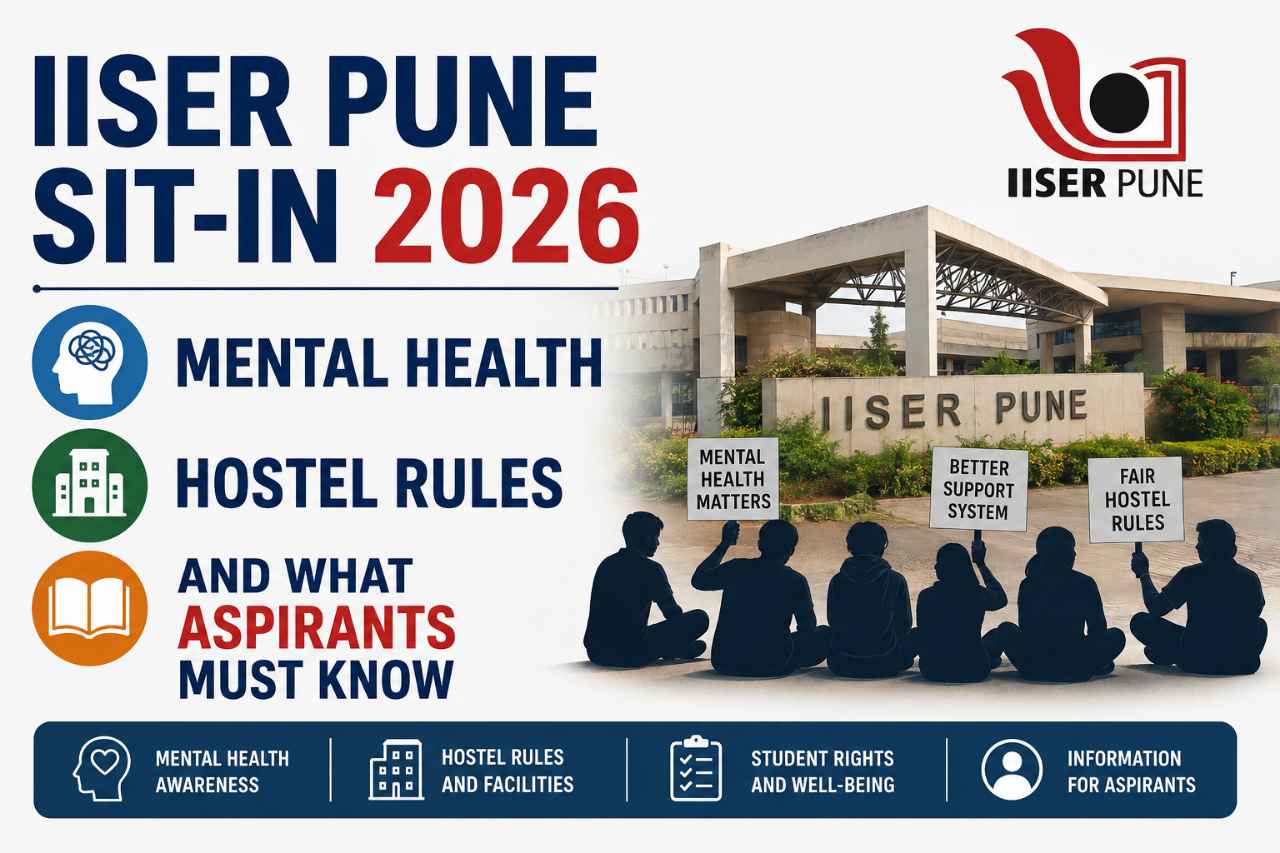

Campus wellbeing has become a central concern for students, parents, and policymakers across India's top research institutes. In August 2026, students at the Indian institute of Science Education and Research (IISER) Pune launched an indefinite sit-in protest, calling for stronger mental health support, changes to hostel rules, and protection for students who participate in peaceful demonstrations. The protest also centres on the suspension of Student Council General Secretary Raj Bagwe, whose case has become a flashpoint in broader debates about safety, accountability, and student voice on campus.
For aspirants preparing for IISER admissions through the IAT (IISER Aptitude Test), the unfolding events at Pune offer more than news headlines. They highlight what every future undergraduate or postgraduate student should evaluate before accepting a seat: counselling infrastructure, hostel policies, grievance redressal systems, and how an institute responds during a crisis. This guide explains what triggered the protest, what students are demanding, how the institute has responded, and what lessons apply to higher education across India.
What Triggered the IISER Pune Sit-In Protest?
According to reports from August 31, 2026, IISER Pune students began an indefinite sit-in on campus after a series of interconnected issues escalated over several weeks. The immediate trigger included the suspension and removal of Raj Bagwe from his post as Student Council General Secretary. Students allege that Bagwe had raised concerns with the institute through email regarding an alleged sexual harassment incident on campus, after which disciplinary proceedings were initiated against him rather than addressing his concerns in the manner students expected.
The institute has stated that Bagwe's suspension followed a thorough investigation by a committee based on complaints received, and that he had filed an appeal against the decision. Students claim the initial suspension was for one year and was later reduced to six months. This disagreement over process and proportionality has fuelled wider unrest.
The protest did not emerge in isolation. It follows the death of a woman student on campus on August 16, 2026, an event that shook the entire IISER community and raised urgent questions about campus safety, mental health, and institutional response. Together, these incidents have pushed student wellbeing from a background concern to the front of campus discourse.
Timeline of Key Events
- August 16, 2026: A woman student was found seriously injured outside a hostel building at around 9:45 pm. She was taken to hospital but could not be saved. The institute informed her parents and police and pledged support for the ongoing investigation.
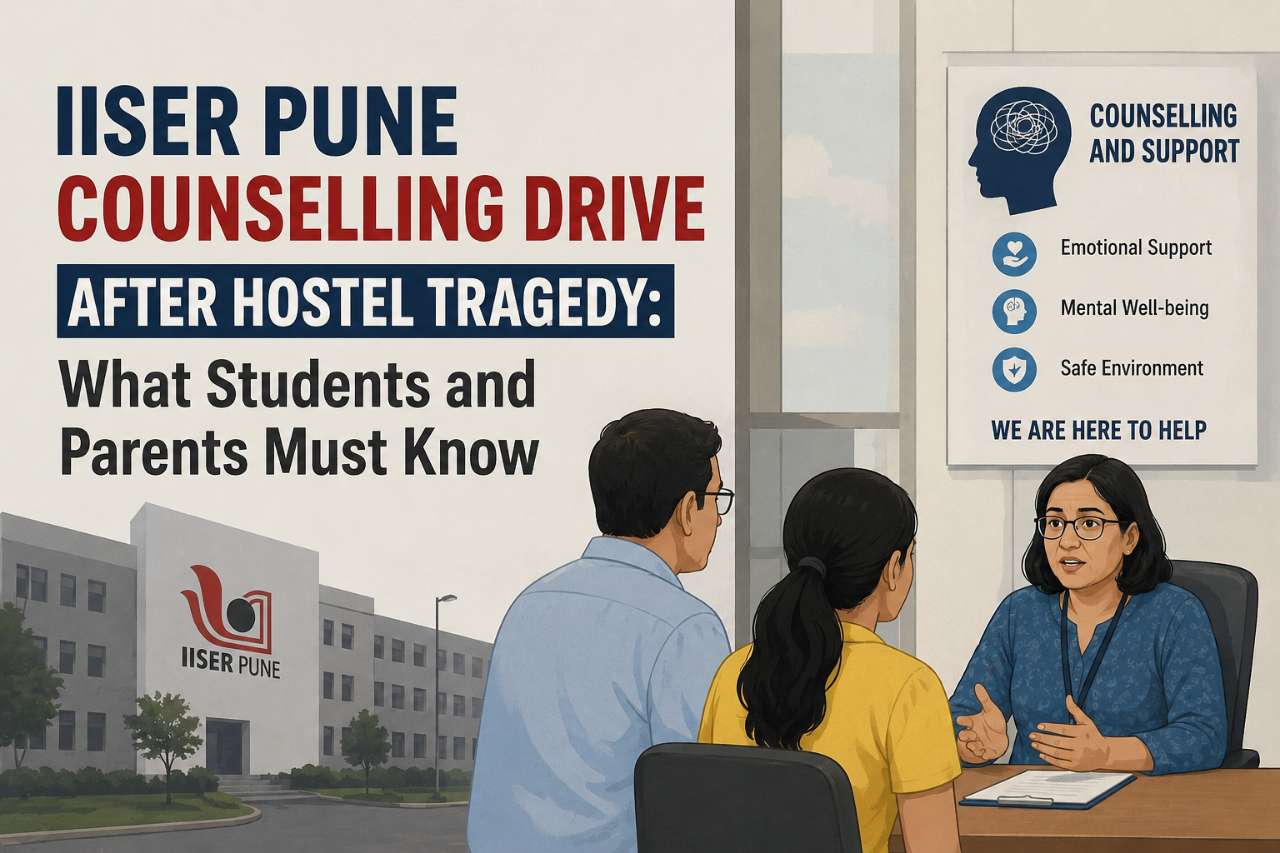
- Post-August 16: IISER Pune cancelled classes for the following day and arranged campus-wide individual and group counselling sessions. The institute also said it was considering academic accommodations and flexible attendance policies for affected students.
- Following weeks: Tensions grew over hostel restrictions, mental health infrastructure, and the suspension of the Student Council General Secretary.
- August 31, 2026: Students launched an indefinite sit-in with a consolidated list of demands related to mental health, hostel access, and protection from disciplinary action during peaceful protests.
What Are IISER Pune Students Demanding?
Student protesters have put forward a clear set of demands that go beyond any single disciplinary case. Understanding these demands helps aspirants and parents assess whether campus policies align with student expectations at premier science institutes.
1. Stronger Mental Health Support
Students want meaningful improvements to IISER Pune's mental health support system—not symbolic gestures after a tragedy, but sustained, accessible, and confidential counselling services. Research-intensive institutes like IISER often place heavy academic pressure on students pursuing BS-MS dual degrees, PhD programmes, and rigorous laboratory work. Without adequate psychological support, stress, isolation, and burnout can accumulate quietly until a crisis erupts.
Following the August 16 incident, IISER Pune stated that it currently has two full-time counsellors and had brought in two additional counsellors through the Campus Mental Wellbeing Centre. The institute also said it was in the process of hiring one or two more full-time counsellors. Students argue that staffing levels, appointment wait times, and the quality of follow-up care still fall short of what a residential campus of this calibre requires.
Institutions such as the National Institute of Mental Health and Neuro Sciences (NIMHANS), Bangalore represent India's gold standard for mental health services. While IISERs are not clinical hospitals, students increasingly expect research campuses to maintain professional counselling ratios, 24/7 crisis helplines, and trained peer-support networks—not just reactive counselling drives launched after a tragedy.
2. Changes to Gender-Based Hostel Restrictions
A second major demand concerns what students describe as oppressive gender-based hostel restrictions. IISER Pune has said that stricter implementation of hostel rules was introduced after some women residents of Hostel 3 raised concerns about their safety. The institute maintains that measures were intended to prevent unauthorised entry into hostel buildings, while common areas on the ground floor remained accessible to all students.
This framing captures a difficult balance that many residential campuses face: protecting residents' safety without creating rules that feel discriminatory or excessively restrictive to other students. Protesters want revisions that address safety concerns while restoring reasonable access to campus spaces and facilities. They also seek extended access to campus spaces beyond current limits—a demand that reflects how hostel curfews and visitor policies shape daily student life.
3. Protection from Disciplinary Action Over Peaceful Protests
Students are demanding assurance that participating in peaceful protests will not lead to disciplinary action. This demand reflects a broader national pattern: when students raise legitimate grievances, fear of suspension or academic penalties can silence dissent. For democratic campus culture to function, institutes need transparent protest guidelines that distinguish peaceful assembly from disruptive or violent behaviour.
4. Revocation of Raj Bagwe's Suspension
Protesters specifically want the institute to revoke the suspension of Student Council General Secretary Raj Bagwe and reinstate him to his elected post. Students view his case as emblematic of how whistleblowing and grievance-raising can backfire when institutional processes lack transparency. The institute, meanwhile, insists its action followed due process based on committee findings.
How Has IISER Pune Responded?
IISER Pune's public statements reveal an institute attempting to manage multiple crises simultaneously: a police investigation into a student's death, student grief and trauma, and an escalating protest movement. The institute's responses can be grouped into three areas.
Counselling and Academic Accommodations
After the August 16 tragedy, IISER Pune cancelled classes for one day and rolled out individual and group counselling across campus. It confirmed existing counselling staff and temporary reinforcements through the Campus Mental Wellbeing Centre, with plans to hire additional full-time counsellors. Academic accommodations and flexible attendance policies were also under consideration for students affected by the incident.
These steps address immediate trauma but may not fully satisfy students who want structural, long-term reform rather than crisis-response measures. Aspirants comparing IISER campuses should ask: How many counsellors serve how many residential students? Is counselling available on weekends and during exam periods? Are services confidential and independent of academic administration?
Hostel Safety Measures
On hostel restrictions, the institute has framed its actions as safety-driven responses to concerns raised by women residents. It has emphasised that ground-floor common areas remain open to all students while restricting unauthorised entry into hostel buildings. Students counter that the implementation feels punitive and unevenly applied.
Disciplinary Proceedings
Regarding Raj Bagwe, IISER Pune has maintained that the suspension followed a committee-based investigation triggered by complaints received. The institute noted that Bagwe had appealed the decision—a standard grievance mechanism. Students who lack confidence in internal committees often push for external oversight, ombudsperson offices, or student representation on disciplinary panels.
The IISER Network: Context Beyond Pune
IISER Pune is one of seven IISERs established by the Government of India to integrate science education with research. Aspirants often compare multiple campuses before filling their IAT counselling preferences. While each IISER operates with local autonomy, campus culture, hostel rules, and student support systems vary.
Other IISER campuses include:
- IISER Kolkata — established in West Bengal, known for strong chemistry and biological sciences research
- IISER Mohali — located near Chandigarh, popular among North Indian science aspirants
- IISER Bhopal — central India's IISER with growing research output
- IISER Thiruvananthapuram — Kerala's IISER with a strong regional student base
- IISER Tirupati — newer campus serving South Indian aspirants
- IISER Berhampur — Odisha's IISER, expanding intake and infrastructure
The Pune protest does not automatically reflect conditions at other IISERs, but it signals issues that can surface at any residential research institute: inadequate counselling ratios, rigid hostel policies, and contested disciplinary processes. Before locking your IAT preference list, review each campus's student handbook, speak with current students where possible, and check whether the institute publishes wellness and safety policies transparently.
Mental Health Crisis on Indian Campuses: A National Pattern
The IISER Pune sit-in is part of a wider pattern of student protests and wellbeing concerns across India's premier institutions. In 2026 alone, reports have covered mental health protests at IIT Delhi following student deaths, wellbeing concerns at multiple central universities, and renewed debates about coaching pressure in cities like Kota. Science and technology campuses are not immune—if anything, the intensity of academic competition and research pressure can amplify stress.
India's higher education ecosystem includes dedicated health sciences universities that train counsellors, psychiatrists, and public health professionals who could support campus wellness programmes. Examples include the Maharashtra University of Health Sciences (MUHS), Nashik, which oversees medical and allied health education in the state where IISER Pune is located, and the Indian Institute of Public Health, Gandhinagar, which focuses on population health and policy. Partnerships between research institutes and such institutions could strengthen campus mental health infrastructure beyond in-house hiring alone.
Research organisations like the Tata Institute of Fundamental Research (TIFR), Mumbai face similar pressures—long hours, competitive funding, and isolated laboratory work. Any student considering a career in fundamental science should evaluate whether an institute treats mental health as a core infrastructure priority, not an optional welfare add-on.
Signs of a Strong Campus Mental Health System
- At least one counsellor per 500–800 students, with crisis coverage after hours
- Clear, publicised helpline numbers and walk-in hours
- Confidentiality policies posted and communicated at orientation
- Peer support programmes trained by qualified professionals
- Academic flexibility policies for students facing mental health challenges
- Regular wellness workshops—not only post-crisis counselling drives
- Anti-harassment committees (Internal Complaints Committee) that students trust
Hostel Policies: Safety, Access, and Student Autonomy
Hostel life defines the residential campus experience. For IISER Pune students, restrictions on hostel entry, visiting hours, and access to common spaces have become a focal point of protest. The institute says tighter rules followed safety concerns raised by women residents of Hostel 3. Students describe the same rules as oppressive and gender-discriminatory.
This tension is not unique to IISER Pune. Across India—from Savitribai Phule Pune University affiliated colleges to private campuses like Symbiosis International Deemed University, Pune—hostel curfews, gender-segregated visitor policies, and biometric entry systems remain standard. Safety and autonomy are often framed as opposing values when they should be designed together.
What Aspirants Should Ask About Hostel Policies
- What are the curfew timings for men and women? Are they identical?
- How does the institute handle safety complaints without blanket restrictions?
- Are common rooms, libraries, and laboratories accessible outside hostel hours?
- Is there a functioning Internal Complaints Committee (ICC) for harassment cases?
- How quickly does the institute respond to safety incidents?
Parents and students reviewing Pune as an education hub should compare IISER policies with those at nearby institutions such as Bharati Vidyapeeth, Pune or Gokhale Institute of Politics and Economics, Pune to understand how different campuses balance security and freedom.
Student Rights, Protests, and Disciplinary Action
Indian universities and institutes operate under frameworks that include UGC regulations, institute statutes, and internal disciplinary codes. Students have the right to peaceful assembly and to raise grievances through elected representatives, formal complaints, and—when other channels fail—protests. Institutes have the right to maintain academic order and investigate misconduct complaints through due process.
Conflicts arise when these rights collide: a student leader raises a harassment concern and faces disciplinary action; protesters demand policy changes and fear retaliation. Transparent process is the bridge. Institutes that publish disciplinary procedures, allow student representation in inquiries, and protect good-faith whistleblowers tend to resolve conflicts faster than those that rely on opaque committee decisions.
The Raj Bagwe case illustrates why aspirants should read an institute's student constitution and disciplinary rules before admission. Elected student council leaders should not face disproportionate punishment for raising safety concerns, yet institutes must also investigate complaints against any student impartially. The credibility of the process matters as much as the outcome.
What IISER Aspirants Should Know in 2026
If you are preparing for IISER UG admissions through IAT 2026, the Pune protest should inform—not panic—your college choice. IISER Pune remains one of India's most prestigious science education institutes, with strong faculty, research facilities, and placement pathways into academia and industry. At the same time, campus culture and support systems deserve the same scrutiny you apply to cut-offs and rankings.
Actionable Tips for IAT Counselling
- Read official statements: Check iiserpune.ac.in and iiseradmission.in for institute communications on counselling, safety, and student support.
- Compare all seven IISERs: Do not assume one campus's protest reflects conditions everywhere. Review each IISER's hostel and wellness policies individually.
- Connect with senior students: Alumni networks, Reddit communities, and open-day sessions offer ground-level perspectives.
- Evaluate wellness infrastructure: Ask about counsellor count, ICC composition, and crisis protocols during admission interactions.
- Keep perspective on protests: Student protests at premier institutes often lead to policy improvements. They signal an engaged student body, not necessarily a broken campus.
Pune's education ecosystem extends far beyond IISER. Students interested in health sciences may also explore programmes at IIHMR Institute of Health Management, Jaipur or PHFI Institute of Public Health Sciences for careers in health policy and management—fields directly relevant to campus wellbeing reform.
Broader Reforms Students and Institutes Should Consider
Sustainable resolution of campus wellbeing crises requires structural reforms, not temporary concessions. Based on the IISER Pune demands and national best practices, several reforms deserve consideration at research institutes across India.
Institutional Reforms
- Establish an independent campus ombudsperson office for grievances
- Publish annual wellness reports with counsellor ratios and appointment wait times
- Form joint student-administration committees to review hostel rules
- Mandate ICC training and public reporting of harassment case timelines (without identifying victims)
- Create academic flexibility policies for mental health—modeled on disability accommodations
- Partner with institutions like NIMHANS for staff training and referral pathways
Student-Led Initiatives
- Peer listening circles with professional supervision
- Wellness ambassadors in each hostel block
- Regular feedback surveys on hostel and counselling services
- Orientation modules on consent, harassment reporting, and stress management
Health sciences universities across states—from Kerala University of Health Sciences to Rajasthan University of Health Sciences, Jaipur—train professionals who could serve campus counselling roles if institutes expand hiring and internships. The talent pipeline exists; funding and institutional priority must match.
How This Compares to Other Campus Protests in 2026
The IISER Pune sit-in joins a growing list of student movements in 2026 demanding institutional accountability. IIT Delhi students protested over mental health following multiple student deaths. Jadavpur University saw political tensions around campus visits. Bihar teachers protested government plans to bring colleges under direct state control. These movements differ in cause but share a common thread: students and educators want greater transparency, safety, and respect for democratic campus life.
For research institutes specifically, the lesson is clear. Academic excellence without student wellbeing is an unstable foundation. India's ambition to become a global research hub depends on retaining talented young scientists—not losing them to burnout, harassment, or preventable tragedies.
Conclusion: Choosing Science Education with Eyes Open
The indefinite sit-in at IISER Pune is a reminder that India's best science campuses are living communities, not just ranking tables and cut-off scores. Students are demanding stronger mental health support, fairer hostel policies, extended campus access, and protection for peaceful protest—demands that reflect genuine gaps in how residential research institutes support young adults under intense academic pressure.
For IAT aspirants, parents, and counsellors, the practical takeaway is straightforward: evaluate campus wellbeing with the same rigour you apply to faculty profiles and laboratory facilities. Ask about counsellor staffing, read hostel handbooks, understand grievance mechanisms, and speak with current students. The IISER network—including campuses in Mohali, Kolkata, Bhopal, and beyond—offers world-class science education; choosing the right campus means finding one where academic excellence and student dignity reinforce each other.
As IISER Pune navigates investigation, grief, and reform, the outcome of this protest may shape policies that benefit future batches across the entire IISER system. Staying informed through official channels and trusted education news sources will help aspirants make confident, well-rounded decisions during IAT counselling and beyond.