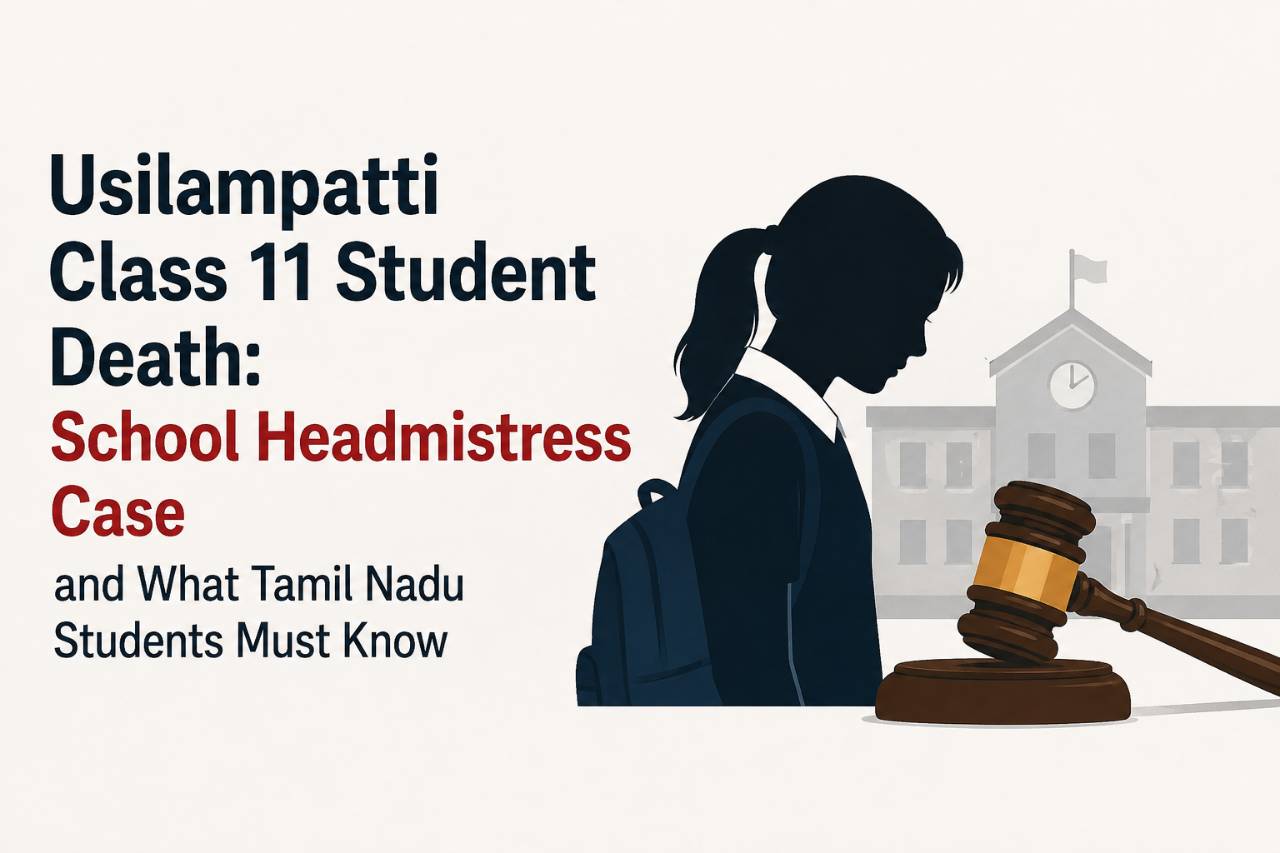

A tragic incident near Usilampatti in Tamil Nadu's Madurai district has once again placed school admission practices, teacher conduct, and student mental health at the centre of India's education debate. On August 25, 2026, a Class 11 student from Thottappanaickanur was found dead at her home. Police initially registered a case of suspicious death. After her mother filed a formal complaint, charges were altered to include abetment of suicide and provisions of the Scheduled Castes and Scheduled Tribes (Prevention of Atrocities) Act against the headmistress of a government school in Usilampatti, identified as Vimaladevi.
For students preparing for higher education across Tamil Nadu whether targeting engineering at institutions like Tamil Nadu College Of Engineering Chennai, law programmes at Tamil Nadu National Law University, or social-work and counselling pathways at the Madras School Of Social Work Chennai this case is a sobering reminder that the journey to college begins long before entrance exams. How schools treat adolescents during transfers, certificate issuance, and re-admission can shape confidence, wellbeing, and academic continuity.
This article explains the Usilampatti case in clear terms, outlines the legal and policy context, and offers practical guidance for students, parents, and educators. It is written for Indian families navigating school-to-college transitions, with a focus on rights, accountability, and mental-health support.
What Happened in Usilampatti: Timeline and Key Facts
Understanding the sequence of events helps families recognise warning signs and systemic gaps. Based on police statements reported in August 2026, the following timeline emerges.
Background: Transfer Between Government Schools
The student, a resident of Thottappanaickanur, had recently joined a government school in Poochipatti. She subsequently stopped attending classes. School authorities asked her parents to collect her Transfer Certificate (TC) and seek admission elsewhere a routine administrative step in Tamil Nadu's government school system, but one that can feel abrupt and stigmatising for teenagers already struggling to adjust.
Seeking a fresh start, the girl and her mother visited the government school in Usilampatti for new admission. During the interaction, the mother reportedly stood before the headmistress with folded arms a gesture some interpret as respectful submission in rural Tamil Nadu. The student intervened and pulled her mother's hands apart, objecting to what she perceived as humiliation.
The Altercation and Its Aftermath
According to the complaint, the headmistress allegedly reprimanded the student and refused immediate admission. She stated she would first contact the Poochipatti school to understand why the TC was issued. The next day, the student visited Poochipatti, collected her TC, and returned home. That evening, she was found deceased at her residence.
The mother alleged in her police complaint that derogatory language used during the altercation pushed her daughter to take the extreme step. Usilampatti Taluk Police, which had initially registered a suspicious-death case, altered charges after receiving the formal complaint. A case was registered against headmistress Vimaladevi under abetment of suicide and the SC/ST Act. Investigation remains ongoing as of late August 2026.
Important note: Charges at the registration stage are based on the complainant's account and preliminary inquiry. Final legal outcomes depend on investigation and judicial process. This article does not pre-judge guilt or innocence.
Why This Case Matters for Higher Education Aspirants in Tamil Nadu
Class 11 and Class 12 are critical years for students eyeing NEET, JEE, TNEA counselling, law entrances, and university admissions. A disrupted school record missing months, repeated transfers, or hostile interactions with staff can affect attendance certificates, internal marks, and emotional readiness for competitive exams.
Tamil Nadu hosts a wide range of post-school pathways: central institutions such as Central University Of Tamil Nadu Tiruvarur, professional colleges including Dmi College Of Engineering Chennai, and flexible options through Tamil Nadu Open University Chennai. Yet none of these opportunities matter if a student cannot complete Plus One and Plus Two in a safe, supportive environment.
The Transfer Certificate (TC) System Explained
In Tamil Nadu government and aided schools, the TC is an official document confirming that a student has left one institution and may join another. Common reasons for TC issuance include:
- Relocation to a new town or district
- Switch from government to private school or vice versa
- Long absence without approved leave
- Disciplinary withdrawal (in some cases)
- Parental request for a change of environment
When a school asks parents to collect a TC after irregular attendance, the message a vulnerable adolescent may hear is: you are unwanted here. Without counselling, bridge classes, or a structured return plan, such decisions can accelerate dropout risk a concern flagged repeatedly in UDISE+ and state education reviews.
Admission Discretion at the Receiving School
Headmasters and headmistresses often verify records with the previous school before confirming admission. This is legitimate administrative practice. Problems arise when verification is communicated harshly, when caste-linked slurs are alleged, or when students are made to feel punished for their family's demeanour or socioeconomic status.
Future teachers trained at institutions like Tamil Nadu Teachers Education University Chennai are taught child psychology and inclusive pedagogy. Incidents like Usilampatti underscore why that training must translate into everyday school culture not remain confined to textbooks.
Legal Framework: Abetment of Suicide and the SC/ST Act
Indian law treats suicide as a tragic outcome; when another person's conduct is alleged to have instigated it, criminal liability may follow. Families and students should understand the broad legal landscape, even while specific cases are adjudicated in court.
Section 108 of the Bharatiya Nyaya Sanhita (BNS), 2023
Abetment of suicide replaces the earlier IPC Section 306 framework. A person may face charges if investigation establishes that their actions or words intentionally aided, instigated, or left the victim with no reasonable alternative. Courts examine context: Was the conduct sustained harassment? Was there a power imbalance? Were threats or humiliation involved?
Education stakeholders comparing legal studies programmes might explore courses at Tamil Nadu Dr Ambedkar Law University Chennai or national benchmarks like National Law School Of India University Bangalore to understand how criminal and constitutional law intersect with school governance.
Scheduled Castes and Scheduled Tribes (Prevention of Atrocities) Act
When a victim belongs to a Scheduled Caste or Scheduled Tribe community and the alleged offence carries a caste-based dimension such as casteist insults or humiliation in a public or institutional setting the POA Act may apply alongside other charges. The Act provides for stringent investigation timelines and special courts in many jurisdictions.
Students interested in social justice and policy can deepen their understanding through programmes at the Madras School Of Economics Chennai or research-oriented institutes such as the Institute Of Advanced Studies In Education Churu, which examine education equity at scale.
Student Mental Health and School-Related Stress in India
The Usilampatti tragedy did not occur in isolation. Across India, adolescents face academic pressure, bullying, caste discrimination, gender bias, and fear of disappointing parents. National Crime Records Bureau data and NGO surveys consistently show that family and education-related stressors rank among leading contexts in youth suicide cases though each death has unique circumstances.
Warning Signs Parents and Teachers Should Watch For
- Sudden withdrawal from friends, hobbies, or school activities
- Expressing hopelessness, shame, or being a burden
- Sharp decline in attendance or academic performance after a school conflict
- Disturbed sleep, appetite changes, or unexplained physical complaints
- Talking about wanting to escape, disappear, or die even indirectly
- Giving away possessions or saying goodbye in subtle ways
Medical and counselling professionals affiliated with universities such as Tamil Nadu Dr Mgr Medical University Chennai emphasise that mentioning suicide does not plant the idea; it opens a door for intervention. Listening without judgment is the first step.
Institutional Responsibility
Schools are not passive certificate factories. Under Right to Education principles and state school education rules, institutions must provide a safe environment. Recommended practices include:
- Designated counsellors or tie-ups with district mental-health programmes
- Anti-bullying and anti-discrimination committees with student representation
- Clear TC and re-admission SOPs that prioritise counselling over exclusion
- Teacher sensitisation on adolescent behaviour, caste dignity, and de-escalation
- Parent engagement without blaming students for family conduct
Management graduates from institutes like Thiagarajar School Of Management Chennai who enter education administration can play a role in designing humane policies measuring success not only by pass percentages but by retention and wellbeing indicators.
Tamil Nadu School Admission Rules: What Students and Parents Should Know
Transparency reduces conflict. While exact procedures vary slightly by district and school type, the following principles generally apply in Tamil Nadu government schools.
Documents Required for Class 11 Admission
- Transfer Certificate from the previous school
- Class 10 mark sheet or equivalent
- Community certificate (where applicable)
- Aadhaar and address proof
- Passport-size photographs
- Previous attendance and conduct records (sometimes requested from sending school)
Rights During the Admission Process
Students have the right to:
- Receive information about admission criteria in writing or through official notice boards
- Be treated with dignity regardless of caste, gender, religion, or disability
- Not face public humiliation in front of staff, parents, or peers
- File a grievance with the head of school, Block Education Officer (BEO), or District Education Officer (DEO)
- Continue education through alternative routes such as Tamil Nadu Open University Chennai if regular schooling breaks down
When a School Refuses Admission
Receiving schools may delay admission pending verification but indefinite refusal without reason can be challenged. Parents should:
- Request the refusal in writing with stated reasons
- Approach the BEO with TC and prior mark sheets
- Contact the Tamil Nadu School Education Department helpline or online grievance portal
- Document dates, names, and statements for any formal complaint
Students aiming for specialised fields fisheries science at Tamil Nadu Fisheries University, architecture through pathways linked to School Of Architecture Anna University Chennai, or humanities at Tamil Univesity Thanjavur should protect their academic continuity early. Missing even one term of Class 11 can delay entrance-exam preparation significantly.
Quick Reference: Who to Contact in Tamil Nadu
The table below summarises escalation options for families dealing with admission disputes or alleged mistreatment. Keep phone numbers and office addresses saved before a crisis occurs.
- School Head / Headmistress: First point of contact for admission status and TC queries
- Block Education Officer (BEO): Oversees all schools in a block; handles unresolved admission and conduct complaints
- District Education Officer (DEO): Escalation when BEO response is inadequate; can coordinate inter-school admissions
- Tamil Nadu School Education Department: State-level grievance redressal and policy clarification
- Local Police Station: Criminal complaints including abetment, SC/ST Act, or intimidation allegations
- Childline 1098: Free emergency support for anyone under 18 facing abuse or distress
Students comparing national legal-aid models from National University Of Advanced Legal Studies Kochi to National Academy Of Legal Studies Research Nalsr University Hyderabad will recognise that accessible complaint mechanisms are the foundation of justice. Rural families in Madurai district deserve the same procedural clarity available to urban applicants.
From School Crisis to College Planning: Building Resilience
A hostile school experience does not define a student's future. Many successful graduates have changed schools, taken a year to stabilise mental health, or moved to open and distance learning before cracking NEET, TANCET, CLAT, or state board exams.
Alternative Pathways Worth Exploring
- Other government or aided schools in the same or neighbouring district
- NIOS (National Institute of Open Schooling) for flexible Class 11–12 completion
- Tamil Nadu Open University for degree programmes after completing equivalency requirements
- Vocational ITI courses for students needing immediate skill-based direction
- Counselling-supported re-entry after a planned break preferable to silent dropout
National conversations on education reform from Delhi policy schools such as Fore School Of Management Delhi to comparative studies at Teri School Of Advanced Studies New Delhi increasingly link student wellbeing with long-term workforce outcomes. Colleges want academically prepared entrants; they also benefit when incoming students are emotionally grounded.
Role of Policymakers, Media, and Civil Society
The Usilampatti case has drawn local and state-level attention. Constructive responses include:
- Fast and impartial police investigation with sensitivity toward the bereaved family
- Departmental inquiry parallel to criminal proceedings, including suspension where rules permit
- District-wide refresher training for head teachers on SC/ST Act compliance and adolescent counselling
- Public data on school transfers how many students receive TC requests after short absences, and with what follow-up support
Civil society campaigns on school reform including community initiatives that encourage respectful admission practices align with broader goals: every child completes higher secondary education without fear.
Lessons from Other Campus Wellbeing Movements
In 2026, student protests over mental-health failures at premier institutions including IIT Delhi have shown that pressure does not vanish after school. Higher-education entrants carry accumulated stress from Plus One and Plus Two. Colleges and universities that invest in counselling centres, peer-support networks, and anti-discrimination cells report better retention. For Tamil Nadu, embedding similar safeguards at the school level costs less than losing a generation of first-generation learners to dropout and despair.
Education researchers at institutes such as Manav Rachna International Institute Of Research Studies and Sanchi University Of Buddhist Indic Studies note that dignity-based pedagogy treating every learner as capable of growth reduces conflict at admission counters. Head teachers who pause, listen, and offer a clear next step rather than public rebuke often defuse situations that might otherwise spiral.
Actionable Tips for Students Facing Similar Situations
If you are a Class 11 or Class 12 student in Tamil Nadu (or anywhere in India) dealing with harsh treatment during admission or transfer, consider these steps:
- Tell a trusted adult immediately a relative, family friend, or teacher outside the conflict
- Write down what was said dates, words used, witnesses present
- Do not stay alone after a distressing school visit reach out to a friend or helpline the same day
- Know that one school's refusal is not the end other schools and open boards exist
- Call a helpline iCall (+91-9152987821), Kiran (1800-599-0019), or state health department numbers
- Ask parents to escalate formally rather than accepting verbal dismissals
For parents, balancing respect for school authority with advocacy for your child's dignity is difficult especially in rural settings. Folding arms or deferential language should never become grounds for a teenager to feel ashamed. Support your child's instinct to protect family dignity while channelling conflict through official grievance channels.
Conclusion
The death of a Class 11 student near Usilampatti is a human tragedy first and a legal case second. Police action against the headmistress under abetment of suicide and the SC/ST Act signals that alleged humiliation in a government school will be taken seriously. For thousands of Tamil Nadu students mapping routes to engineering, medicine, law, fisheries, social work, and the arts, the lesson is equally urgent: academic ambition must be built on safe, dignified schooling.
Institutions from Tamil Nadu College Of Engineering Chennai to Central University Of Tamil Nadu Tiruvarur await students who complete Plus Two with confidence. Reaching them requires schools that counsel before they exclude, teachers trained in empathy as well as syllabus, and families equipped with knowledge of rights and helplines.
As investigation continues in Usilampatti, students and parents elsewhere should use this moment not for fear, but for preparedness: document interactions, demand written procedures, seek mental-health support early, and remember that no admission desk holds a monopoly on your future.
If you or someone you know is in distress, contact Kiran Mental Health Helpline at 1800-599-0019 (24x7) or reach emergency services at 112.