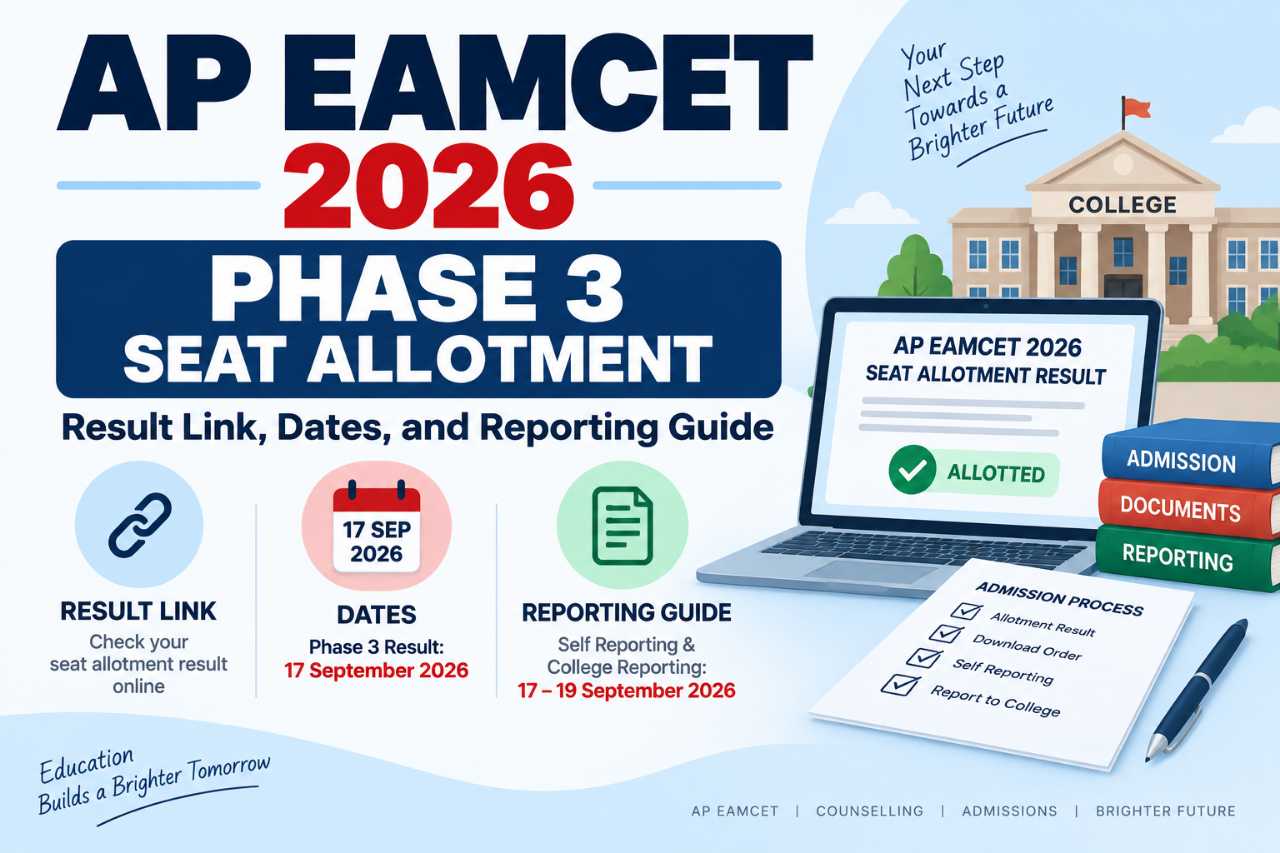
The Andhra Pradesh Engineering, Agriculture and Pharmacy Common Entrance Test now officially known as AP EAPCET concludes its admission cycle with Phase 3 seat allotment, the last and most decisive round for thousands of engineering, agriculture, and pharmacy aspirants across the state. If you participated in earlier counselling rounds but did not secure a seat, or if you are upgrading from a lower-preference college, Phase 3 represents your final opportunity to join an Andhra Pradesh college through the centralised admission process managed by APSCHE.
This guide explains everything you need to know about the AP EAMCET seat allotment 2026 Phase 3 link, important dates, how to check your result, mandatory self-reporting steps, document verification, and practical tips to avoid last-minute mistakes. Whether you are a local candidate from Vijayawada, Visakhapatnam, or Tirupati, or a non-local student seeking admission in Andhra Pradesh, the process remains the same only your category certificates and eligibility documents differ.
What Is AP EAMCET Phase 3 Seat Allotment?
AP EAMCET counselling follows a multi-phase seat allocation model. After the entrance exam and rank declaration, eligible candidates register for counselling, fill college and course preferences, and participate in successive allotment rounds. Phase 1 and Phase 2 allocate seats based on rank, reservation category, and the choices submitted by candidates. Seats that remain vacant or are surrendered when students upgrade to better options become available for the next round.
Phase 3 is the final allotment round for AP EAPCET 2026. No further web counselling rounds are typically held after this phase. Colleges that still have open seats in branches such as CSE, ECE, Mechanical Engineering, B.Pharm, or B.Sc Agriculture will fill them during this round. Candidates who did not register earlier may still be eligible if the counselling schedule permits late participation; however, most Phase 3 allotments go to candidates already in the counselling pool who modified their options or held back for better branches.
For a complete overview of the exam pattern, eligibility, and syllabus, refer to our detailed AP EAMCET guide. Students comparing state-level engineering entrances may also review the parallel process for Telangana through TS EAMCET, which follows a similar counselling framework under TSCHE.
AP EAMCET 2026 Phase 3 Seat Allotment Date and Schedule
Staying aligned with the official timeline is critical. Missing a reporting deadline even by one day can lead to automatic cancellation of your allotted seat. Below is the consolidated counselling schedule for AP EAPCET 2026 based on the revised APSCHE notification.
Round-wise Counselling Timeline
| Event | Round 1 | Round 2 | Round 3 (Final) |
|---|---|---|---|
| Seat allotment result date | August 9, 2026 | August 26, 2026 | September 16–17, 2026 |
| Self-reporting and physical reporting | August 10 to 15, 2026 | August 27 to 31, 2026 | September 17 to 19, 2026 |
| Classes commencement | August 10, 2026 |
The AP EAMCET third seat allotment 2026 result is published on the official CAP portal. APSCHE generally activates the allotment link on the scheduled date; minor delays of a few hours are common during high-traffic periods. Candidates should keep their login credentials ready and avoid relying on third-party websites for result access.
Key Deadlines for Phase 3 Candidates
- Allotment result: Expected on September 16 or 17, 2026
- Online self-reporting window: Opens immediately after allotment; must be completed within the prescribed period
- Physical reporting at allotted college: September 17 to 19, 2026 (last date)
- Fee payment: Must be completed during self-reporting for seat confirmation
Set phone reminders for each deadline. APSCHE may send SMS alerts to registered mobile numbers, but the allotment letter itself must be downloaded from the portal it is not sent by post or email.
Official AP EAMCET Seat Allotment 2026 Link and Portal
APSCHE has migrated counselling operations to a dedicated Centralised Admission Processing portal. The official website for checking seat allotment is:
- Official portal: cap.apcfss.in
- Conducting authority: Andhra Pradesh State Council of Higher Education (APSCHE)
- Exam name: AP EAPCET 2026 (formerly AP EAMCET)
Only candidates who completed AP EAPCET counselling registration including payment of counselling fee and option entry can log in to view allotment results. If you see a blank dashboard or an error message, verify that your counselling registration was successful and that you participated in the relevant option-exercise window for Phase 3.
How Allotment Results Are Communicated
APSCHE publishes allotment results exclusively through the online portal. The system displays your allotted college, course, category of seat (such as convener quota), and reporting instructions. You must download and print the provisional allotment order for submission during physical reporting. Treat this document as your primary proof of seat allocation until final admission is confirmed at the college.
How to Check AP EAMCET Seat Allotment 2026 Phase 3 Result
Checking your allotment is straightforward if you follow the official login process. Avoid clicking unverified links shared on social media, as phishing pages mimicking the CAP portal have been reported during previous counselling seasons.
Step-by-Step Login Process
- Visit the official portal at cap.apcfss.in using a laptop or smartphone with a stable internet connection.
- Click on the Candidate Login tab on the homepage.
- Enter your User ID or application number and the password created during counselling registration.
- Complete the CAPTCHA verification as displayed on screen.
- Submit your credentials and navigate to the seat allotment section within your dashboard.
- Download and save the allotment letter in PDF format; take multiple printouts for college reporting.
If you forget your password, use the portal's password recovery option linked to your registered mobile number and email. Keep OTP access ready, as recovery often requires two-factor verification.
What to Do After AP EAMCET Phase 3 Seat Allotment
Receiving an allotment is only the first step. Seat confirmation depends on completing both online and offline processes within the deadline. Here is a structured action plan for candidates allotted a seat in Phase 3.
1. Download the Allotment Order
Immediately after the result is declared, log in and download your allotment order. Verify that your name, rank, category, allotted college, and branch are correct. Report discrepancies to the helpline listed on the official portal before proceeding to self-reporting.
2. Complete Online Self-Reporting
Self-reporting is mandatory for candidates who wish to accept the allotted seat. Through the candidate login portal, you must:
- Confirm acceptance of the allotted seat
- Pay the prescribed tuition or admission fee online
- Lock your acceptance status before the deadline
Candidates who do not self-report within the given window forfeit their seat, which may then be reallocated or remain vacant. If you intend to reject the seat and wait for no further round (since Phase 3 is final), understand that you may exit the counselling process entirely.
3. Report Physically to the Allotted College
After successful self-reporting, visit the allotted institution during the reporting window (September 17 to 19, 2026 for Phase 3). Carry original documents along with photocopies for verification. The college admission cell will validate your certificates, collect remaining fees if applicable, and issue an admission confirmation.
4. Collect Admission Confirmation and Join Classes
Once document verification is complete, obtain your admission receipt, student ID process instructions, and hostel allotment details if applicable. Phase 1 candidates began classes on August 10, 2026; Phase 3 joiners should report immediately to avoid academic backlog.
Documents Required for AP EAMCET 2026 Verification
Incomplete documentation is one of the most common reasons for admission delays. Prepare the following documents in both original and attested copy format before reporting to your college.
Mandatory Documents for All Candidates
- Proof of date of birth (SSC or equivalent memo)
- AP EAPCET 2026 rank card
- AP EAPCET 2026 hall ticket
- Intermediate or equivalent marks memo
- Transfer certificate (TC) from the last institution attended
- Study certificates from Class VI through Intermediate
Category and Reservation Documents
- Integrated community certificate for BC, SC, or ST candidates (issued by competent authority)
- Income certificate of parents from all sources issued on or after January 1, 2020, or valid White Ration Card
- EWS certificate valid for 2026–27 from MeeSeva for OC candidates claiming EWS reservation
- Local or non-local status certificates as applicable
- Andhra Pradesh residence certificate of father or mother for 10 years (for non-local category claims)
- Residence certificate for the preceding seven years for private candidates
- Local status certificate for candidates who migrated from Telangana between June 2, 2015 and June 1, 2026
Organise documents in a folder in the same order as the official checklist. Colleges may also request passport-size photographs and undertaking forms at the time of reporting.
Factors That Determine AP EAMCET Seat Allotment
Understanding how seats are allocated helps candidates set realistic expectations especially in the final phase when only limited branches remain available.
Primary Allotment Parameters
- AP EAPCET rank: Higher rank improves the chance of receiving a preferred college and branch.
- Choices filled during counselling: Allotment is strictly based on the order of preferences you submitted. No seat is offered outside your option list.
- Seat availability: Vacant seats after Phase 2 determine what remains for Phase 3. Popular branches like CSE in top colleges may already be full.
- Reservation category: Seats are distributed across OC, BC, SC, ST, EWS, and other applicable categories per government rules.
Phase 3 Specific Considerations
In the final round, you may receive a branch or college lower on your preference list or one you added specifically as a safe option. Review the seat matrix published by APSCHE before option entry to understand which colleges still have openings. Candidates comparing state counselling systems for example, Maharashtra's engineering admissions through MHT CET or Delhi's IPU CET process will notice that rank, category, and preference order remain universal deciding factors across Indian state entrance systems.
Accepting vs. Rejecting a Phase 3 Allotment
Because Phase 3 is the last round, your decision carries finality. Consider these scenarios before confirming self-reporting.
When to Accept
- The allotted college meets your minimum acceptable standard for placements, faculty, and location.
- The branch aligns with your career goals, even if it is not your first preference.
- You prefer a confirmed seat this academic year over risking a drop year.
When to Reject or Not Report
- The allotment is significantly below your rank-based expectations and you plan to reattempt AP EAPCET next year.
- You have secured admission through another channel such as JEE Main, management quota, or a deemed uuniversity.
- Financial or location constraints make the allotted college impractical.
Rejecting a seat in Phase 3 typically ends your participation in AP EAPCET 2026 counselling. There is no Phase 4 under the standard schedule.
Common Mistakes to Avoid During Phase 3 Reporting
Even well-prepared candidates lose seats due to avoidable errors. Keep these pitfalls in mind during the final allotment window.
- Missing the self-reporting deadline: Online acceptance and fee payment are non-negotiable prerequisites for physical reporting.
- Incorrect document versions: Income and EWS certificates must meet the specified validity dates; expired certificates are rejected.
- Relying on unofficial websites: Always use cap.apcfss.in for results and fee payment.
- Not verifying allotment details: Errors in name or category should be flagged immediately.
- Delaying college visit until the last day: Long queues are common on September 19; report early if possible.
- Ignoring SMS alerts: While not a substitute for portal login, official messages may contain deadline reminders.
AP EAMCET vs. AP EAPCET: Name Change Clarification
Andhra Pradesh renamed AP EAMCET to AP EAPCET (Engineering, Agriculture and Pharmacy Common Entrance Test) to reflect the full scope of programmes covered. The counselling portal, rank card, and allotment process remain functionally the same. When searching for updates, use both terms many students and parents still refer to the exam as AP EAMCET, while official APSCHE communications use AP EAPCET.
Who Should Pay Attention to Phase 3 Allotment?
Phase 3 is especially relevant for:
- Candidates who skipped earlier rounds waiting for better seat availability
- Students upgrading or downgrading based on revised preference lists
- Rank holders who registered late but within the counselling schedule
- Aspirants targeting agriculture, pharmacy, or engineering branches with remaining vacancies in district colleges
If you hold a valid AP EAPCET rank and active counselling registration, monitor the portal on allotment day from morning hours onward. Server load peaks in the first two hours after result activation.
Option Entry Strategy Before Phase 3 Allotment
Your allotment outcome in Phase 3 is largely decided before the result is published by the preferences you submit during the option-exercise window. Smart option filling can make the difference between securing a seat and going empty-handed in the final round.
Practical Tips for Filling Preferences
- Research the seat matrix: APSCHE publishes vacancy data after each round. Use this to identify colleges that still have seats in your preferred branch.
- Balance ambition with safety: List dream colleges at the top, but include realistic backup options at the bottom of your preference list.
- Do not leave options blank: An unfilled slot means you cannot be allotted a seat at that position even if vacancies exist.
- Reorder carefully before locking: Once options are frozen for a phase, changes may not be permitted until the next option-exercise window opens.
- Consider district colleges: In Phase 3, seats in government and private colleges outside major cities often remain available at moderate rank ranges.
Candidates who also appeared for TS EAMCET should note that Andhra Pradesh and Telangana counselling are separate processes. A seat allotted in one state does not affect the other unless you fail to report and wish to explore cross-border options in a future year.
Fee Payment and Financial Planning During Self-Reporting
Online fee payment during self-reporting is a binding step toward seat confirmation. The exact fee amount depends on the college type (government or private), the programme allotted, and any reservation-based fee concessions applicable to your category.
What to Expect During Payment
- Payment modes: The CAP portal typically supports net banking, debit card, credit card, and UPI. Keep transaction limits in mind if using a student bank account.
- Save payment receipt: Download and print the fee payment confirmation immediately. Colleges may ask for this receipt during physical reporting.
- Partial vs. full payment: Some institutions collect a counselling fee online and remaining tuition at the college. Read the allotment order instructions carefully.
- Fee reimbursement: SC, ST, and eligible BC candidates may qualify for government fee reimbursement subject to income limits. Submit required income documents during verification.
Discuss the financial commitment with your family before accepting the seat. Private engineering colleges in Andhra Pradesh may charge significantly higher fees than government institutions, and Phase 3 allotments often land in colleges with remaining management or convener quota seats.
Troubleshooting Common Portal and Login Issues
Technical difficulties on allotment day are frequent due to heavy traffic. Knowing how to resolve common problems saves valuable time during the short reporting window.
- Page not loading: Clear browser cache, switch to a different browser, or try during off-peak hours such as early morning or late evening.
- Invalid credentials error: Confirm you are using counselling login details, not AP EAPCET exam application credentials these may differ.
- Allotment not visible: You may not have been allotted a seat in this phase. Check the official notice on vacant seats and whether further option entry is allowed.
- Payment failure: If money is debited but confirmation is not received, wait 24 hours and check with your bank before retrying. Duplicate payments may require a refund request through the helpline.
- Discrepancy in allotted branch: Contact the APSCHE helpline number listed on cap.apcfss.in before self-reporting to avoid enrolling in an unintended course.
Local and Non-Local Candidature Rules for Andhra Pradesh
Seat allocation in AP EAPCET counselling also depends on your local-area status. Andhra Pradesh divides candidates into local and non-local categories based on residence and study history. Local candidates receive priority for seats reserved under the local quota in their home region (Coastal Andhra or Rayalaseema).
Non-local candidates compete for the remaining unreserved and non-local quota seats. If you migrated from Telangana after June 2, 2015, you may qualify for local status in Andhra Pradesh upon producing the required local status certificate from the designated authority. Ensure these certificates are obtained before reporting, as colleges will not provisionally admit candidates with pending documentation.
Conclusion
The AP EAMCET seat allotment 2026 Phase 3 marks the final chapter of Andhra Pradesh's centralised engineering, agriculture, and pharmacy admissions for this academic year. With results expected on September 16 or 17, 2026, on the official portal cap.apcfss.in, candidates must act swiftly download the allotment order, complete mandatory self-reporting, pay fees online, and report to the allotted college between September 17 and 19, 2026.
Success in this round depends as much on timely action as on your entrance rank. Prepare documents in advance, verify every detail on your allotment letter, and treat the reporting deadline as non-extendable. For ongoing exam updates and counselling guidance, bookmark our AP EAMCET resource page and stay informed through official APSCHE announcements only.