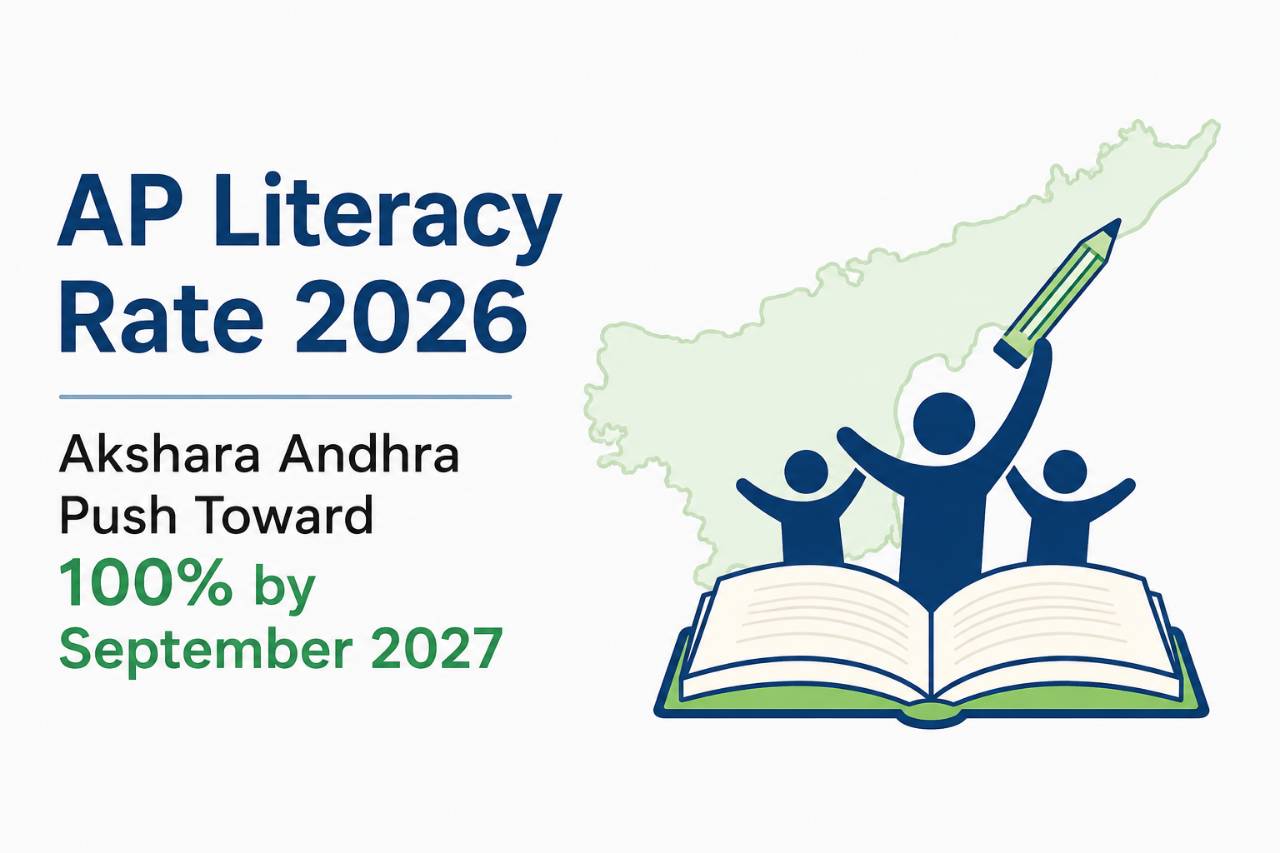
Andhra Pradesh has recorded one of the fastest literacy gains among Indian states in recent years. According to Education Minister Nara Lokesh, the state's literacy rate rose from 72.6% in 2024 to 82.1% in 2026 a jump of nearly 10 percentage points in just two years. Around 25 lakh people became literate through the government's Akshara Andhra programme, and the state has now set an ambitious deadline of September 2027 to reach 100% literacy.
For students, parents, and educators tracking higher education in India, this shift matters beyond statistics. Literacy is the gateway to school enrolment, board exams, college admissions, and skilled employment. When a state moves quickly on foundational education, it creates ripple effects across degree programmes, vocational training, and workforce readiness. This guide explains what changed in Andhra Pradesh, how the Akshara Andhra campaign works, what the 2027 target means, and how literacy connects to college pathways including affordable options at institutions like ICFAI Foundation For Higher Education Hyderabad in neighbouring Telangana and leading government colleges across India.
Andhra Pradesh Literacy Rate 2026: Key Numbers at a Glance
Understanding the scale of Andhra Pradesh's literacy push helps students and families place the news in context. The figures below are based on official statements from the state education department as reported in September 2026.
| Indicator | 2024 | 2026 | Target |
|---|---|---|---|
| Overall literacy rate | 72.6% | 82.1% | 100% by Sep 2027 |
| People made literate (Akshara Andhra) | ~25 lakh | ~52 lakh more needed | |
| Out-of-school children (identified) | 1,64,821 | Enrolment ongoing | |
| Children enrolled back in 2026 | ~33,000 | Continued outreach |
The jump from 72.6% to 82.1% is especially significant because Andhra Pradesh was among the states with the lowest literacy levels when Nara Lokesh took charge of the education department in 2024. A double-digit improvement in two years signals that field-level campaigns, when backed by political will and inter-department coordination, can produce measurable results.
What Is the Akshara Andhra Programme?
Akshara Andhra is the flagship literacy initiative launched by the Andhra Pradesh government to bring reading and writing skills to adults and out-of-school populations who never completed formal schooling. Unlike conventional school-centric programmes that focus only on children aged 6–14, Akshara Andhra deliberately reaches people who have aged out of the formal system but still lack basic literacy.
Core Objectives of Akshara Andhra
- Identify illiterate adults and youth across villages, towns, and urban pockets through door-to-door surveys and community mapping.
- Deliver short-duration, practical literacy modules that teach reading, writing, and basic numeracy in Telugu and, where needed, bilingual formats.
- Coordinate with 11 government departments so literacy is not treated as an education-department-only responsibility.
- Run parallel efforts to enrol out-of-school children into formal schools while adult literacy continues at the community level.
- Achieve 100% literacy across Andhra Pradesh by September 2027 through phased targets.
The programme reflects a broader policy insight: literacy cannot be achieved inside classrooms alone. Community centres, anganwadi networks, self-help groups, and local elected representatives all play a role in identifying learners and sustaining motivation.
How Akshara Andhra Differs from Regular Schooling
Regular schooling follows a structured curriculum tied to age and grade progression. Akshara Andhra uses flexible timings, shorter learning cycles, and learner-centred methods suited to working adults, homemakers, agricultural labourers, and elderly citizens. The goal is functional literacy being able to read signboards, fill forms, use mobile phones for basic tasks, and eventually pursue skill certificates or open school pathways.
For families comparing higher education options, this distinction is important. A parent who becomes literate through Akshara Andhra may later support a child's application to a degree college, polytechnic, or nursing programme. Institutions such as Government Polytechnic College Kota and Government Polytechnic College Sikar illustrate how literacy at home often precedes enrolment in affordable technical education elsewhere in India.
Why Andhra Pradesh's Literacy Rate Jumped by Nearly 10%
Several factors combined to produce Andhra Pradesh's sharp literacy gain between 2024 and 2026. Understanding these drivers helps other states and individual learners draw actionable lessons.
1. Intensive Field-Level Campaigns
Officials were directed to intensify ground operations to locate people who could not read or write. MLAs and local representatives were asked to participate actively, which helped penetrate remote mandals where literacy drives historically stalled. Field teams used household surveys rather than relying solely on outdated census estimates.
2. Inter-Department Coordination
Eleven government departments now coordinate under Akshara Andhra. When revenue, rural development, women and child welfare, and panchayat raj departments share data and outreach duties, duplicate efforts reduce and coverage widens. This model mirrors how successful education ecosystems combine schooling with health, livelihood, and local governance.
3. Teacher and Volunteer Engagement
Education Minister Nara Lokesh publicly credited teachers for their role in the literacy campaign. School teachers often serve as trainers, assessors, or motivators during evening and weekend sessions. Their involvement lends credibility and ensures quality control in teaching methods.
4. Dual Track: Adults and Out-of-School Children
The government pursued adult literacy and child enrolment simultaneously. With 1,64,821 school-age children identified as out of school, officials enrolled roughly 33,000 in the current academic cycle and continued identification drives. Preventing new illiteracy while clearing historical backlogs is essential for sustaining gains.
5. Clear Phased Targets
Rather than announcing a distant goal without milestones, the government set interim targets: approximately 25 lakh more people to be made literate by March 2027, followed by the remaining 27 lakh by September 2027. Phased planning makes monitoring easier and keeps district officials accountable.
September 2027 Deadline: Roadmap to 100% Literacy
Andhra Pradesh aims to become a fully literate state by September 2027. Achieving this requires covering roughly 52 lakh additional people who remain illiterate after the first phase of Akshara Andhra.
Phase-wise Implementation Plan
- Phase 1 (completed by 2026): Approximately 25 lakh learners covered; literacy rate reached 82.1%.
- Phase 2 (by March 2027): Target to make another 25 lakh people literate.
- Phase 3 (by September 2027): Cover the remaining 27 lakh learners to hit 100% literacy.
Review meetings with school and intermediate education officials are held regularly to track district-wise progress. Lokesh has instructed officials to strengthen coordination, involve elected representatives, and maintain aggressive field outreach until the final learner is reached.
Challenges on the Path to 100%
Reaching the last mile is always harder than achieving early gains. Marginalised communities, migrant workers, elderly populations, and persons with disabilities may require customised approaches. Seasonal agricultural work can disrupt attendance at literacy centres. Digital divide issues may limit outreach unless offline methods remain central.
States and students watching this experiment should note that literacy targets succeed when they are treated as social missions, not one-year projects. Sustained funding, volunteer retention, and integration with skill development programmes will determine whether Andhra Pradesh meets its September 2027 deadline.
Out-of-School Children in Andhra Pradesh: What Parents Should Know
Literacy campaigns mean little if school-age children remain outside the formal system. Andhra Pradesh identified 1,64,821 out-of-school children, a figure that underscores the link between foundational access and future college eligibility.
Who Counts as Out-of-School?
Children typically counted in this category include those who never enrolled, dropped out before completing elementary or secondary school, or migrated and lost continuity. Without intervention, these children miss board exams, counselling rounds, and eligibility for higher education programmes ranging from BA and BCom streams to professional courses.
Government Response and Enrolment Drives
Officials reported enrolling around 33,000 previously out-of-school children during the current year. Lokesh directed teams to continue identification and facilitate admissions alongside Akshara Andhra. Parents who suspect their neighbours' children are out of school can contact local school headmasters, mandal education officers, or helplines publicised during enrolment drives.
Once children re-enter school, pathways open toward intermediate education, polytechnics, and universities. Families exploring affordable higher education models elsewhere in India often look at government institutions for example, Government College Jaipur, Government Arts College Kota, and Jawahar Lal Nehru Government College Sikar where low fees and established curricula support first-generation learners.
How Literacy Connects to Higher Education and College Admissions
Literacy is not the finish line it is the on-ramp. Students who read and write confidently perform better in entrance exams, understand application forms, and navigate online counselling portals used for admissions across India.
From Basic Literacy to Degree Programmes
The typical progression runs from foundational literacy to Class 10 (SSC), Class 12 (intermediate), and then undergraduate study. Andhra Pradesh's intermediate system feeds into engineering, medicine, commerce, and arts degrees both within the state and nationally. As literacy expands, demand for seats at universities, polytechnics, and professional colleges is likely to grow.
Role of Government and Women's Colleges
Government colleges remain critical for students from newly literate households because they combine affordability with recognised degrees. Women's colleges, in particular, support female learners in communities where girls historically had limited schooling. Institutions such as Bharathidasan Government College For Women Chennai, Government Girls College Sikar, Sk Government Girls College Sikar, and Srd Modi College For Women Kota demonstrate how targeted institutions widen access for women pursuing undergraduate and postgraduate degrees.
At the national level, colleges like Lady Shri Ram College For Women Lsr Delhi, Indraprastha College For Women Delhi, and Indira Gandhi Delhi Technical University For Women show the long-term payoff when girls' education is prioritised early a policy lesson relevant to Andhra Pradesh's literacy push.
Engineering, Medical, and Professional Pathways
Students from literate families are better positioned to prepare for competitive exams such as EAPCET (for Andhra Pradesh engineering and pharmacy admissions), NEET for medical courses, and national-level tests for central universities. Government engineering and medical colleges offer subsidised routes for meritorious candidates.
Examples from other states highlight the diversity of options: Government College Of Engineering Chennai, Government Engineering College Ajmer, Rajiv Gandhi Government Engineering College Alwar, and Government Medical College Kota serve students who often come from public-school backgrounds similar to those Akshara Andhra is now strengthening.
Comparing Andhra Pradesh with Other States: Context for Students
India's literacy rates vary widely by state, gender, and urban-rural divide. Andhra Pradesh's rapid improvement positions it as a case study, but students planning admissions should compare regional ecosystems holistically not by literacy alone.
What a Rising Literacy Rate Signals
- Greater competition for college seats: More qualified applicants may raise cut-offs for popular courses.
- Expansion of skill and vocational demand: Literate workers seek diplomas and certificates, boosting polytechnic enrolment.
- Improved female participation: Women's literacy often correlates with higher enrolment in degree programmes.
- Stronger foundation for digital education: Basic literacy enables use of online learning platforms and government e-services.
States with mature government college networks Rajasthan's clusters in Jaipur, Sikar, and Kota, for instance offer templates for scaling access. Explore options like Govind Guru Government College Jaipur, Sawai Man Singh Government College Jaipur, Government Commerce College Sikar, and Government Science College Sikar when researching affordable UG programmes in commerce, science, and arts streams.
Teacher Education and Literacy Sustainability
Long-term literacy depends on trained educators. Colleges focused on B.Ed and education degrees such as Shekhawati College For Education Losal Sikar play a role in supplying teachers who can eventually support programmes modelled on Akshara Andhra in other regions.
Actionable Tips for Students and Families in Andhra Pradesh
Whether you are a parent, a school-leaver, or an adult learner, Andhra Pradesh's literacy momentum creates practical opportunities. Use these tips to align personal education plans with the state's direction.
For Adult Learners
- Contact your local mandal education office or village secretariat to enrol in Akshara Andhra centres.
- Attend sessions consistently; short modules work best with regular practice at home.
- After gaining basic literacy, explore open school programmes (NIOS or state equivalents) for formal certificates.
- Consider vocational courses at polytechnics once reading and numeracy skills stabilise.
For Parents of School-Age Children
- Verify that every child in the household is enrolled and attending regularly.
- Report out-of-school children in your community to school authorities enrolment drives depend on accurate local data.
- Start planning for intermediate stream selection early; science, commerce, and arts choices affect college eligibility.
- Use government scholarships and fee reimbursement schemes available to SC, ST, BC, and economically weaker sections.
For College-Aspirant Students
- Track EAPCET, NEET, and university counselling calendars on official portals.
- Research both Andhra Pradesh institutions and national options; compare fees, placements, and accreditation.
- Visit resources like CollegeDwar to compare government colleges for example, Quaid E Millath Government College Chennai or Government College Bundi before finalising applications.
- Build English and digital skills alongside Telugu literacy to improve employability after graduation.
Policy Lessons: What Other States Can Learn
Andhra Pradesh's experience offers transferable insights for policymakers, NGOs, and education entrepreneurs across India.
Success Factors
- Political ownership: Visible leadership from the education minister sustained public attention.
- Measurable milestones: Two-year literacy gains were tracked and communicated transparently.
- Multi-stakeholder design: Eleven departments sharing responsibility prevented silos.
- Parallel child and adult focus: Addressing out-of-school children while teaching adults avoided generational relapse.
Risks to Monitor
- Quality versus speed: Rapid literacy certification must still meet functional standards.
- Data verification: Independent audits help confirm self-reported district numbers.
- Post-literacy pathways: Learners need clear bridges to skills, jobs, or further study.
- Funding continuity: Budget support must survive election cycles to reach 2027 targets.
Private universities also absorb growing demand from literate populations seeking specialised degrees. Institutions such as Graphic Era University Dehradun, Avinashilingam Institute For Home Science Higher Education For Women Coimbatore, and Laxminarayan Innovation Technological Lit University illustrate how diverse higher education ecosystems complement public literacy efforts.
Future Outlook: Beyond 100% Literacy
Hitting 100% literacy by September 2027 would place Andhra Pradesh among India's top-performing states on foundational education indicators. However, literacy alone does not guarantee quality employment or equitable college access.
The next frontier includes:
- Raising secondary and higher secondary completion rates.
- Reducing gender gaps in STEM and professional enrolment.
- Integrating digital literacy and financial literacy into community programmes.
- Aligning Akshara Andhra graduates with PMKVY-style skill certifications and local industry needs.
- Strengthening counselling infrastructure so first-generation college goers understand admission procedures.
Students nationwide can explore specialised pathways from Government Law College Kota and Government Law College Sikar for legal careers to Shri Kalyan Government Medical College Sikar and Government Nursing College Kota for healthcare once foundational schooling is secure.
Conclusion
Andhra Pradesh's literacy rate climb from 72.6% in 2024 to 82.1% in 2026 marks a turning point for one of India's most ambitious state-led education campaigns. Through Akshara Andhra, roughly 25 lakh people have already gained reading and writing skills, and the government has set a firm September 2027 deadline to achieve 100% literacy by covering an additional 52 lakh learners in phased targets through March and September 2027.
For students and families, this progress is more than a headline it reshapes access to schools, board exams, and college admissions over the coming decade. Adult learners gain dignity and opportunity; children re-entered into schools gain a fair chance at degrees and careers. Whether you pursue study within Andhra Pradesh or at established institutions like Sk Government Post Graduate College Sikar, Government Girls College Chomu Jaipur, or Centre For Design Excellence Jaipur, the foundation remains the same: literacy opens the door, and informed planning walks you through it.
Stay updated on official announcements from the Andhra Pradesh education department, participate in community enrolment drives if eligible, and use trusted college comparison platforms to map your next academic step as the state moves toward full literacy.