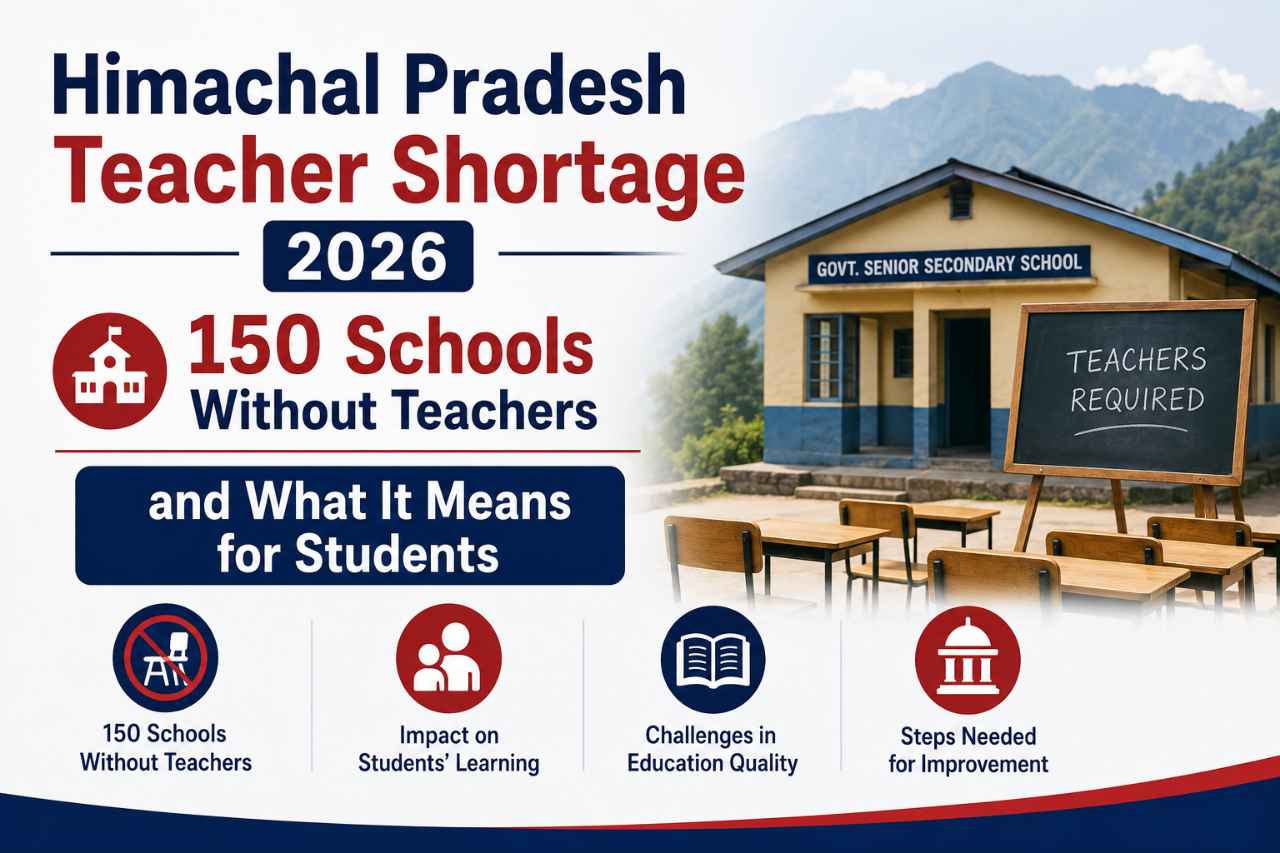

In August 2026, Himachal Pradesh's education minister Rohit Thakur told the state Assembly a number that shocked parents and policy watchers alike: 150 government schools were operating without a single teacher, while roughly 3,500 schools had only one teacher on roll. For a state that officially reports one of India's strongest pupil-teacher ratios about 1:10 the gap between spreadsheet statistics and classroom reality could not be wider.
The disclosure came during Zero Hour after BJP MLA Reena Kashyap raised concerns about teacher vacancies in her Pachhad constituency, where she said 12 schools had no teacher at all. Chief Minister Sukhvinder Singh Sukhu responded that the government is drafting a dedicated policy for single-teacher schools, while the education department continues large-scale recruitment. For students planning higher education in Himachal Pradesh and for graduates considering teaching as a career the crisis raises urgent questions about school quality, rural access, and where the state's education pipeline is heading.
What the Assembly Data Reveals About Himachal's School Staffing Crisis
When education ministers speak in the Assembly, the numbers are not abstract they map directly onto villages across Kangra, Sirmaur, Shimla, Kullu, and other districts. According to statements reported in the monsoon session, the staffing picture looks like this:
- 150 schools functioning with zero teachers
- About 3,500 schools with only one teacher handling all classes and subjects
- 2,500 schools with fewer than 15 enrolled students
- 5,209 vacant posts for Trained Graduate Teachers (TGT) and Junior Basic Training (JBT) categories, as cited in related Assembly replies
- 9,000 teaching posts filled during the current government's tenure, with plans to recruit 6,500 more before the term ends
In constituencies such as Pachhad, the human cost is visible. Kashyap reported that six schools in Narag and five in Sarahan had no teachers, that several schools had more than 40 students, and that parents in some areas were pooling money to hire private tutors because the government system had failed them. Principal and lecturer posts also remain unfilled in multiple blocks.
These figures matter for college-bound students because foundational learning gaps in Classes 1 through 10 directly affect performance in board exams, entrance tests, and confidence when applying to institutions such as Himachal Pradesh University Shimla, Himachal Pradesh Technical University Hamirpur, and Central University of Himachal Pradesh Dharmshala Kangra.
Single-Teacher Schools: A Hidden Majority
Breakdowns from Assembly discussions suggest that of schools with just one teacher, roughly 3,214 are primary schools and about 101 are secondary schools. A single educator in a multi-grade rural school may teach Classes 1 through 5 simultaneously, manage mid-day meals, maintain records, and handle administrative duties leaving little room for structured pedagogy or individual attention.
For parents comparing government schools with private institutions or weighing whether to send children to universities in Shimla, Hamirpur, or outside the state this staffing pattern is a practical concern, not merely a political talking point.
Why Himachal Pradesh Has India's Best PTR on Paper but Empty Classrooms on the Ground
Education Minister Thakur noted that Himachal Pradesh's official pupil-teacher ratio stands at approximately 1:10, meaning one teacher for every ten students statewide. By national standards, that is exceptionally strong. So why are hundreds of schools without staff?
The answer lies in a mismatch between aggregate statistics and geographic distribution. Teachers tend to cluster in urban centres, plain-area schools, and institutions with better facilities. Remote hamlets in Sirmaur, Kinnaur, Chamba, and Lahaul-Spiti face posting reluctance because of distance, connectivity, housing, and family considerations.
Key Structural Causes
- Large number of small schools: With 2,500 schools enrolling fewer than 15 students each, maintaining a full staff roster at every location is administratively and financially difficult.
- Rationalisation delays: The government has attempted to redeploy teachers through rationalisation merging under-enrolled schools or transferring surplus staff to deficit areas but posting orders are sometimes revised under local pressure.
- Deputation burden: Hundreds of primary and secondary schools are reportedly run by teachers on deputation, which temporarily fills gaps but destabilises permanent staffing plans.
- Pre-primary gap: Of 6,297 sanctioned Nursery Teacher Training (NTT) posts, only about 518 were filled at last count, largely because eligible candidates were unavailable.
- Enrolment decline: The education minister has stated that government school enrolment fell by roughly four lakh students over 15 years, prompting policy shifts including CBSE affiliation for selected institutions.
Understanding this paradox is essential for education policy students, social work aspirants, and anyone studying at institutions like Madras School of Social Work Chennai, where rural development and public administration intersect with ground-level schooling challenges.
Quick Comparison: Paper PTR vs Ground Reality
The table below summarises why Himachal's education debate can confuse parents who hear both "best ratio in India" and "no teacher in our village school" in the same news cycle:
- Statewide PTR (official): ~1:10 among the strongest in India
- Schools with zero teachers: ~150 concentrated in remote blocks
- Schools with one teacher: ~3,500 often multi-grade rural primaries
- Micro-schools (<15 students): ~2,500 hard to staff at full sanctioned strength
- Unfilled TGT/JBT posts: ~5,209 recruitment lag despite available candidates
This contrast explains why fixing Himachal's problem requires location-specific posting policy not merely hiring more teachers at the state total level.
Government Response: Recruitment, Rationalisation, and the CBSE Shift
The Sukhu-led government has positioned itself as pro-recruitment, citing 9,000 appointments already made and a target of 6,500 additional hires. Parallel initiatives address the CBSE-affiliated government school segment, which expanded in the 2025–26 academic session.
Major Policy Actions Announced in 2026
- Single-teacher school policy: CM Sukhu said a formal framework is being prepared to govern appointments in schools that currently depend on one educator.
- CBSE teacher recruitment deadline: The Chief Minister set 30 September 2026 as the target to fill vacancies across 147 government CBSE schools, with merit-based selection and salaries for a 10-month period.
- Special recruitment scheme: Around 3,468 teachers are being hired above sanctioned strength for CBSE schools, with a fixed monthly salary of approximately Rs 30,000 for ten months annually.
- Computer lab investment: Rs 80 crore was sanctioned to establish computer labs in all 147 CBSE schools opened so far, with plans for 100 additional CBSE schools.
- School rationalisation: The government continues to explore consolidation of low-enrolment schools to concentrate teachers where student numbers justify full staffing.
For job seekers, these announcements signal active hiring cycles but also highlight that many positions are contractual or fixed-term, not permanent gazetted posts. Aspiring teachers should read notification fine print carefully regarding tenure, pay scales, and promotion pathways.
Assembly Debate: Opposition Concerns
BJP legislators including Sudhir Sharma, Randhir Sharma, and Vipin Singh Parmar questioned whether CBSE affiliation was rolled out before adequate teacher availability. With thousands of posts still vacant in the CBSE segment alone, the debate underscores a broader lesson for Indian education governance: curriculum reform without staffing reform rarely delivers results.
Impact on Students, Parents, and the Higher Education Pipeline
Teacher shortages do not stay confined to school corridors. They ripple forward into college admissions, competitive exams, and workforce readiness across Himachal Pradesh.
Immediate Effects on Schoolchildren
- Multi-grade teaching fatigue: One teacher covering five classes reduces time for concept clarity, especially in mathematics and language foundations.
- Irregular instruction: Schools without teachers may rely on occasional visits from block-level staff or community volunteers not a substitute for daily structured learning.
- Parent-funded stopgaps: Where communities hire private tutors, inequality widens between families that can pay and those that cannot.
- Board exam vulnerability: Students entering Class 10 HP Board or CBSE exams without consistent subject teachers face higher failure and dropout risk.
Long-Term Effects on College Aspirants
Himachal Pradesh hosts a growing higher education ecosystem. Institutions such as Himachal Pradesh National Law University Shimla, Chaudhary Sarwan Kumar Himachal Pradesh Krishi Vishvavidyalaya Palampur, and HPTU-affiliated engineering colleges expect applicants to meet baseline proficiency in reasoning, languages, and domain fundamentals.
When rural schools lack subject specialists, students often depend on coaching centres in Shimla, Solan, or out-of-state hubs adding financial strain. This makes transparent information about colleges, cut-offs, and scholarships on platforms like CollegeDwar especially valuable for hill-state families navigating both school gaps and admission complexity.
Unemployed but Qualified: A Statewide Pool Waiting for Posts
Assembly data indicated that roughly 65,254 B.Ed-qualified and 16,028 JBT or D.El.Ed-qualified youth were registered as unemployed with the state employment department. Himachal produces teachers; the bottleneck is post creation, posting logistics, and willingness to serve in remote locations not a absence of trained human capital.
CM Sukhu noted that students from Sirmaur designated an Aspirational District by the central government have been successfully clearing written recruitment examinations, demonstrating that merit pathways exist even in disadvantaged geographies when access to preparation resources improves.
How to Pursue a Government Teaching Career in Himachal Pradesh
If you are a Class 12 graduate, degree holder, or B.Ed candidate considering teaching in Himachal Pradesh, the current hiring wave offers entry points provided you understand eligibility rules and recruitment channels.
Basic Eligibility Overview
Requirements vary by post category, but common pathways include:
- JBT / primary level: Senior secondary with JBT or Diploma in Elementary Education (D.El.Ed), often with HTET or state TET clearance where applicable.
- TGT / upper primary and secondary: Graduation with B.Ed and subject-specific qualifications; TET qualification typically mandatory.
- PGT / senior secondary: Postgraduation in the relevant subject plus B.Ed; competitive written examinations and merit lists.
- CBSE contractual posts: Merit-based selection with defined salary periods; check Himachal Pradesh Staff Selection Commission (HPSSC) and education department portals for active notices.
Formal teacher preparation from recognised institutions strengthens both eligibility and classroom readiness. Across India, established options include Delhi Teachers University, Indian Institute of Teacher Education Gandhinagar, and National Institute of Technical Teacher Training and Research Chandigarh for those aiming at technical education roles.
Where to Monitor Official Notifications
- HPSSC official website for combined recruitment examinations
- Himachal Pradesh Directorate of Higher Education and School Education portals
- Employment newspaper and state employment exchange registrations
- District-level announcements for rationalised posting and contractual CBSE hiring
Register early, keep domicile and caste/category certificates updated, and document teaching practicum hours from your B.Ed or D.El.Ed programme verification delays are a common reason otherwise eligible candidates miss selection.
Teacher Training Colleges: Building the Educator Pipeline Beyond Himachal
Because Himachal's own NTT and specialised training intake remains limited, many aspiring educators from hill districts study in neighbouring states and return home for recruitment exams. Rajasthan, Delhi, Gujarat, and Tamil Nadu host numerous recognised teacher training colleges.
Examples students frequently explore include:
- Vidya Bhavan Teachers Training College Jaipur and St Xaviers Teachers Training College Jaipur for B.Ed programmes in Rajasthan
- Mahala Teacher Training Institute Sikar and Womens Teachers Training College Sikar for elementary and secondary teacher preparation
- Jawaharlal Nehru Teacher Training College Kota and Lal Bahadur Shastri Teachers Training College Kota for Kota-based B.Ed pathways
- Geeta Bajaj Women Teacher Training Institute Jaipur for women-focused teacher education
- National Institute of Technical Teachers Training and Research Chennai for engineering and polytechnic faculty preparation
Before enrolling, verify NCTE recognition, affiliation status, and whether the programme satisfies Himachal Pradesh recruitment rules for your target post category. Institutes such as Sant Kabir Teacher Training College Jaipur, Shri Kalyan Teachers Training College Jaipur, and Aravali Teachers Training College Neemkathana Sikar are among the many Rajasthan-based options hill-state students consider when local intake is limited always cross-check recognition before paying fees.
Higher Education in Himachal Pradesh: Opportunities Amid Schooling Challenges
Teacher shortages at the school level coexist with expanding higher education options a reminder that "education crisis" narratives are sector-specific rather than uniform.
Key Institutions for Degree and Professional Programmes
Students who overcome early schooling disadvantages or who attend better-resourced urban schools can pursue diverse pathways within the state:
- General and professional degrees: Himachal Pradesh University Shimla remains the central affiliating body for many undergraduate and postgraduate programmes across districts.
- Engineering and technology: Himachal Pradesh Technical University Hamirpur oversees technical education and entrance-linked admissions in the state.
- Law: Himachal Pradesh National Law University Shimla attracts students interested in CLAT and legal careers fields that demand strong language and reasoning skills often weakened by understaffed rural schools.
- Agriculture and allied sciences: CSK Himachal Pradesh Krishi Vishvavidyalaya Palampur supports careers in agronomy, horticulture, and rural development directly relevant to Himachal's economy.
- Central university programmes: Central University of Himachal Pradesh at Dharamshala offers research-oriented postgraduate and doctoral options in humanities, sciences, and education-related disciplines.
For students unsure whether to pursue teaching, law, agriculture, management, or technical fields, comparing institutional outcomes on CollegeDwar helps align school-level realities with realistic college targets.
Actionable Tips for Students, Parents, and Policy Watchers
For Parents in Understaffed School Zones
- Request written staffing details from the school principal and block education officer RTI queries can clarify sanctioned versus deployed posts.
- Explore district rationalisation plans; sometimes nearby cluster schools offer better staffing than isolated single-teacher institutions.
- Supplement board preparation with free DIKSHA, SWAYAM, and NCERT resources if subject teachers are unavailable.
- Track HP Board and CBSE exam calendars early; weak foundations require longer preparation horizons for college entrance tests.
For Graduates Seeking Teaching Jobs
- Keep HPSSC and education department bookmarks active recruitment waves are time-sensitive.
- Consider remote-area postings as stepping stones; permanent absorption often favours candidates with difficult-station service.
- Prepare simultaneously for TET, state subject tests, and interview components.
- Join state employment exchange lists if not already registered among the tens of thousands of documented B.Ed and JBT job seekers.
For College Counsellors and Education Researchers
Document district-level PTR separately from state averages when advising rural students. Aggregate ratios hide local deficits that predict support needs during degree programmes particularly in English, mathematics, and science streams feeding into institutions like School of Planning and Architecture Bhopal or national universities that require competitive exam readiness.
Looking Ahead: Can Recruitment Close the Gap?
Himachal Pradesh's teacher crisis is solvable on paper the state has qualified unemployed educators, active hiring targets, and political acknowledgment at the highest level. The harder problems are geographic equity, rationalisation politics, pre-primary staffing, and ensuring that CBSE expansion does not outpace human resource planning.
For CM Sukhu's September 2026 CBSE deadline and the broader 6,500-teacher recruitment goal, success will be measured not in press releases but in whether Narag, Sarahan, Pachhad, and hundreds of similar locations still report empty classrooms when the next Assembly session convenes.
Students planning college in Himachal should stay informed, leverage every available learning resource during school gaps, and explore the state's universities and professional institutes with clear eyes about both opportunities and the foundational challenges many hill communities still face.
Conclusion
The headline 150 schools without teachers and 3,500 with only one captures a rural staffing emergency inside a state that otherwise boasts impressive pupil-teacher statistics. Assembly debates, opposition questions, and government recruitment pledges confirm that Himachal Pradesh is hiring at scale, yet distribution failures and small-school structures keep many classrooms effectively unattended.
For CollegeDwar readers, the lesson is twofold. School-level staffing shapes college readiness, so parents and students in affected districts must plan proactively. At the same time, Himachal's higher education sector continues to offer credible pathways through its universities, law school, technical institutions, and central university especially for motivated learners who supplement weak schooling with self-study, community support, and well-chosen teacher training or degree programmes when opportunities arise.
Monitor official recruitment notifications, verify institutional recognition before enrolling in B.Ed or D.El.Ed courses, and treat education news from the state Assembly as more than politics it is an early warning system for the conditions shaping the next generation of Himachali graduates.