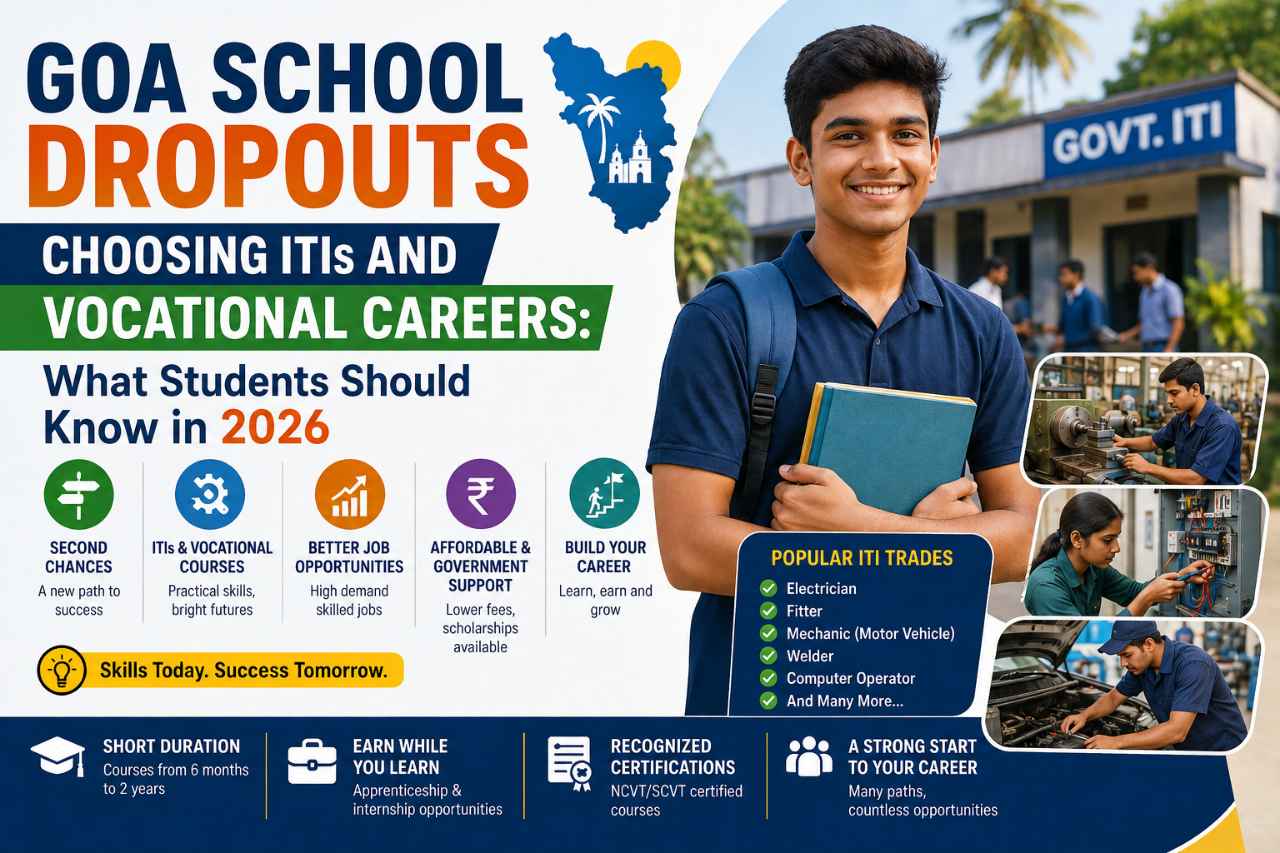
When students leave government schools before completing secondary or higher secondary education, the decision is rarely about giving up on learning altogether. In Goa, a coastal state where tourism, hospitality, and a growing technology ecosystem shape local employment, many young people are redirecting their ambitions toward practical, job-ready pathways. Responding to an unstarred question in the Goa Legislative Assembly on August 31, 2026, Chief Minister Pramod Sawant who also holds the Education portfolio said that data from UDISE+ (Unified District Information System for Education Plus) and allied sources shows students exiting government schools are pursuing ITIs, private vocational courses, board exams as private candidates, and direct employment in sectors such as information technology, hotels, and tourism.
For parents, counsellors, and students weighing their next move, this shift raises important questions: Is vocational education a setback or a strategic choice? What support does the Goa government offer to prevent dropouts? And how does a skills-first route connect to degrees, diplomas, and long-term careers? This CollegeDwar guide unpacks the policy context, explains available alternatives, and offers actionable advice grounded in India's broader higher-education and employability landscape.
Understanding School Dropouts in Goa: Data, Context, and Real Choices
School dropout rates are tracked nationally through UDISE+, which captures enrolment, transitions, and retention across government and aided institutions. When policymakers refer to students "leaving" government schools, the reasons vary: financial pressure, migration, disengagement with purely academic subjects, family responsibilities, or a deliberate preference for earning sooner through skilled work. Independent MLA Antonio Vas raised the dropout question in the assembly, seeking clarity on how many students were affected and what the state was doing in response.
CM Sawant's reply emphasised that exit from the formal school stream does not always mean exit from education. Many learners continue through Industrial Training Institutes (ITIs), appear as private candidates under the Goa Board of Secondary and Higher Secondary Education, or enrol in short-term industry-linked programmes. Others enter the workforce directly in Goa's dominant service sectors. Recognising this nuance matters for students who fear that leaving a government school closes every door often, it opens different ones.
From an admissions and career-planning perspective, the assembly exchange is significant because it officially documents what counsellors and NGOs have reported informally for years: dropout statistics alone do not describe student outcomes. A learner counted as "dropped out" in UDISE+ may simultaneously appear in ITI enrolment registers, private coaching batches for Goa Board exams, or employer payrolls in Panaji's service economy. Families researching options on platforms like CollegeDwar should therefore look beyond headline dropout percentages and examine pathway quality, recognition, and long-term mobility.
Why Vocational Routes Appeal in a State Like Goa
Goa's economy is tightly linked to hospitality, travel, retail, and increasingly to IT-enabled services in hubs around Panaji, Margao, and Mapusa. Employers in these sectors frequently value demonstrable skills kitchen operations, front-office management, digital literacy, basic coding, customer service over lengthy academic credentials alone, especially at entry level. For students who find abstract subjects such as advanced Mathematics or Science challenging, vocational tracks under the National Skill Qualification Framework (NSQF) can feel more relevant and achievable.
The Chief Minister noted that skill-based subjects give academically weaker students pathways to progress while offering alternatives to difficult core subjects. That policy framing aligns with a national conversation about making school education more inclusive without lowering standards for those who thrive in academic streams.
Where Goa Students Go After Leaving Government Schools
According to the Chief Minister's assembly statement, students who discontinue government schooling in Goa are pursuing several distinct routes. Understanding each helps families compare timelines, costs, and outcomes.
Industrial Training Institutes (ITIs)
ITIs offer NCVT- or SCVT-recognised trades such as electrician, fitter, computer operator and programming assistant (COPA), welder, and hospitality-related skills. Programmes typically run one to two years and include mandatory practical training. ITI certification can lead to apprenticeships, shop-floor jobs, or lateral entry into polytechnic diplomas. For Goa students near industrial and tourism corridors, trades connected to maintenance, electrical work, and food production often align with local hiring patterns.
Private Candidates Through the Goa Board
Some dropouts re-enter the formal qualification ladder by registering as private candidates with the Goa Board of Secondary and Higher Secondary Education. This route allows learners to sit for Class 10 (SSC) or Class 12 (HSSC) examinations without regular school attendance, provided they meet eligibility norms. Clearing these exams preserves options for Goa University degree programmes, professional diplomas, or national entrance tests later.
Job-Oriented Private Courses in IT, Hotels, and Tourism
Short certificate and diploma programmes often run by private training centres target employability in Goa's key industries. IT courses may cover web development fundamentals, networking, or office software; hospitality programmes may focus on front office, housekeeping, or food and beverage service. While quality varies, accredited or industry-partnered courses can shorten the school-to-work transition. Students should verify affiliation, placement records, and recognition before paying fees.
Direct Employment
A segment of learners enter employment immediately, particularly in family businesses, small hotels, retail, or gig-style service roles. Early earnings can support households, but lack of certification may limit promotion later. Combining work with part-time skill certification through ITIs, NSQF-aligned short courses, or evening board exam preparation is often the smarter long-term strategy.
How the Goa Government Is Working to Reduce Dropouts
While acknowledging alternative pathways, the state government has rolled out multiple interventions aimed at keeping students in school and improving learning outcomes. CM Sawant outlined these measures in his assembly reply.
Learning Enhancement and Digital Tracking
A learning enhancement programme has been introduced across government schools to support students who fall behind grade-level expectations. Complementing this, the Vidya Samiksha Kendra and the SamarthX e-Governance portal track attendance and academic performance, flagging learners at risk of dropout early enough for counsellors and headmasters to intervene.
PARAKH Assessments for Early Identification
Regular assessments under PARAKH (Performance Assessment, Review, and Analysis of Knowledge for Holistic Development) help monitor whether students are mastering foundational competencies. Schools can use PARAKH data to group students for remedial instruction rather than waiting for failure at board level when disengagement often becomes irreversible.
PM SHRI Exemplar Schools and Digital Classrooms
Under the PM SHRI (PM Schools for Rising India) scheme, 28 government schools in Goa are being developed as exemplar institutions with upgraded infrastructure, including smart boards and wired internet. The goal is a more student-centred teaching-learning environment that competes with the perceived quality of private coaching and vocational marketing.
NSQF Skill Subjects in School
Introducing NSQF-aligned skill subjects inside government schools gives students a taste of vocational education without leaving the system. Exposure to applied learning in areas such as retail, IT, or tourism can rekindle motivation and clarify career interests before Class 10 or 12 board decisions.
PM POSHAN and Mukhyamantri Dnyanparva Yojana
Nutrition and staffing also influence retention. The PM POSHAN scheme provides quality breakfast to students, addressing hunger-related concentration issues. The Mukhyamantri Dnyanparva Yojana deploys additional teachers for performing arts and for pre-primary and primary sections stages where strong foundations reduce later dropout risk.
Comparing Pathways: A Quick Reference for Students and Parents
The table below summarises common routes mentioned in policy discussions and on the ground in Goa. Timelines and costs are indicative; always confirm with the institution.
| Pathway | Typical Duration | Best For | Next-Level Options |
|---|---|---|---|
| Stay in govt school + NSQF skill subject | Ongoing till Class 10/12 | Students at risk but still enrolled | Board exams, ITI, diploma, degree |
| ITI trade course | 1–2 years | Hands-on learners seeking quick employability | Apprenticeship, polytechnic, entrepreneurship |
| Goa Board private candidate | 1+ years prep | Dropouts wanting formal certificates | Higher secondary, university, entrance exams |
| Private vocational certificate | 3 months–1 year | Sector-specific entry (IT, hotel, tourism) | Work experience, later diploma/Degree |
| Direct job + part-time upskilling | Immediate | Family income needs | NSQF courses, ITI, open schooling |
Vocational and Skills Education Beyond Goa: Models Worth Knowing
Goa's trend mirrors national movement toward employability-focused learning. Students researching alternatives can look at established vocational institutions elsewhere for comparison not necessarily to relocate immediately, but to understand programme structures and accreditation norms.
Institutions such as the Loyola Institute of Vocational Education in Chennai and ITM Vocational University in Vadodara illustrate how vocational education can be organised at institute and university level, with structured curricula and industry interfaces. In healthcare a sector employing thousands across India schools like Mahatma Gandhi General Nursing School in Sikar, Satya Sai School of Nursing in Sikar, and Government Girls School of Nursing in Sikar show how short professional programmes create regulated career ladders.
Creative and wellness vocations remain popular among young learners seeking entrepreneurship. Programmes at the International School of Design in Jaipur or Orane International School of Beauty and Wellness in Sikar represent segments where portfolio and client skills matter as much as certificates. For agriculture and allied sectors relevant to Konkan and coastal economies, institutions such as Dr Balasaheb Sawant Konkan Krishi Vidyapeeth in Ratnagiri offer degree pathways adjacent to Goa's geographic region.
Specialised course categories including BATS courses and other niche qualifications listed on CollegeDwar can supplement general schooling when students know their target industry.
Higher Education in Goa: Academic Routes Still Open
Vocational choices need not permanently exclude degree-level study. Goa hosts reputable higher-education institutions that admit students through board marks, entrance tests, or lateral entry after diplomas.
- Goa University offers undergraduate and postgraduate programmes across arts, science, commerce, law, and technology accessible after HSSC or equivalent.
- Indian Institute of Technology Goa and National Institute of Technology Goa serve high-performing students via national engineering entrance examinations; a strong Class 12 foundation remains essential.
- Students who later pivot to management can explore programmes at institutions such as FORE School of Management in Delhi, Delhi School of Management, Galgotias Business School, Thiagarajar School of Management in Chennai, or Al Falah School of Management often through exams like the CAT after graduation.
- Architecture and design aspirants may consider benchmarks such as the School of Architecture at Anna University Chennai, School of Planning and Architecture New Delhi, SPA Bhopal, SPA Vijayawada, or Sir J J School of Art, Architecture and Design.
- Social sciences and economics pathways include Madras School of Social Work in Chennai, Madras School of Economics in Chennai, and Bengaluru Dr B R Ambedkar School of Economics University.
The takeaway is straightforward: ITI or vocational certification can be a stepping stone, not a ceiling especially when combined with open schooling, board re-entry, or diploma-to-degree bridges.
Actionable Tips for Students, Parents, and Counsellors
Whether you are trying to prevent dropout or planning after one has occurred, these evidence-informed steps can reduce regret and improve outcomes.
- Request school-level data early. Ask headmasters about PARAKH results, attendance alerts on SamarthX, and remedial slots before board years.
- Match pathway to learning style. Students who struggle with theory-heavy subjects may thrive in COPA, hospitality, or retail NSQF modules test interest while still enrolled if possible.
- Verify recognition before enrolling privately. Check NCVT/SCVT affiliation for ITIs, board recognition for private courses, and employer testimonials for short programmes.
- Keep one formal qualification active. Even while working, register as a private candidate or pursue National Institute of Open Schooling (NIOS) credentials to preserve future degree options.
- Build a skills portfolio. Certificates, apprenticeship letters, and project work matter in IT and creative fields when applying beyond entry level.
- Use nutrition and counselling support. PM POSHAN and school counsellors address non-academic dropout drivers use them.
- Plan geography wisely. Tourism skills suit coastal Goa; tech roles may require mobility or remote-work readiness; agriculture-linked courses align with Konkan livelihoods.
- Budget total cost of ownership. Include exam fees, travel for practicals, and tool kits not just tuition.
Policy Gaps and What the Assembly Question Revealed
MLA Antonio Vas also sought constituency-wise data on government schools, student strength, and teaching staff in Cortalim. The government's reply noted that such granular, constituency-level school statistics are not maintained centrally an administrative gap that can hinder localised planning. For citizens, this underscores the value of community-level monitoring: parent-teacher associations, panchayat education committees, and civil society audits can complement state dashboards when official breakdowns are unavailable.
Nationally, debates on government school quality teacher vacancies, infrastructure, and pastoral care continue to influence dropout narratives. Goa's emphasis on both prevention (smart classrooms, assessments, nutrition) and post-exit pathways (ITI, vocational jobs) reflects a pragmatic dual strategy rather than treating dropout purely as failure.
For students in other states facing similar choices, Goa offers a useful case study. Coastal economies with strong tourism footprints Kerala, Karnataka's coastal districts, and parts of Maharashtra often see parallel movement toward hospitality certifications and service-sector jobs. Inland regions may show higher ITI uptake in manufacturing trades. Comparing local labour demand with qualification type remains the single most reliable filter when selecting among ITI, diploma, degree, or immediate employment.
Open Schooling and NIOS as Safety Nets
Beyond Goa Board private candidature, the National Institute of Open Schooling (NIOS) remains an underused bridge for students who paused regular schooling. NIOS allows flexible subject selection and multiple exam attempts, which suits learners balancing work with study. Combining NIOS secondary or senior secondary credentials with an ITI trade creates a profile that satisfies both formal education requirements and skilled workforce norms a combination many recruiters in organised hospitality and IT services increasingly accept at supervisor-track levels.
The Bigger Picture: Skills-First India and Student Agency
India's education policy increasingly treats vocational and academic streams as parallel highways with multiple interchange ramps. NSQF levels, credit banks, and industry partnerships aim to let learners stack qualifications over time. For Goa students, the CM's disclosure validates what many families already observe anecdotally: when school feels disconnected from livelihoods in tourism and services, young people vote with their feet toward ITIs, private courses, and jobs.
The challenge for policymakers is to ensure those feet land on safe, recognised rungs. For students, the challenge is to choose pathways deliberately combining employability now with optionality later. Institutions across the country, from IIT (ISM) Dhanbad to National Law School of India University Bangalore, show that elite academic peaks remain but they are not the only legitimate definition of success.
Conclusion
Goa Chief Minister Pramod Sawant's August 2026 assembly statement confirms a visible shift: government school dropouts in the state are increasingly entering ITIs, vocational programmes, private board examinations, and employment in IT, hospitality, and tourism. That reality should guide counselling conversations away from stigma and toward informed planning. The state's parallel investments learning enhancement, PARAKH monitoring, PM SHRI upgrades, NSQF subjects, PM POSHAN, and teacher supplementation through Mukhyamantri Dnyanparva Yojana signal serious intent to reduce preventable exits while improving classroom experience for those who stay.
For students at the crossroads, the wisest approach blends immediate employability with preserved academic optionality. Explore recognised ITI trades and NSQF courses, consider Goa Board private candidature or NIOS if formal certificates are missing, and research higher-education anchors such as Goa University, IIT Goa, and NIT Goa for long-term goals. Vocational education is not the opposite of ambition it is one proven route to economic participation in a state built on skilled service industries. Choose with eyes open, verify every credential, and keep building skills that the labour market and your future self will reward.