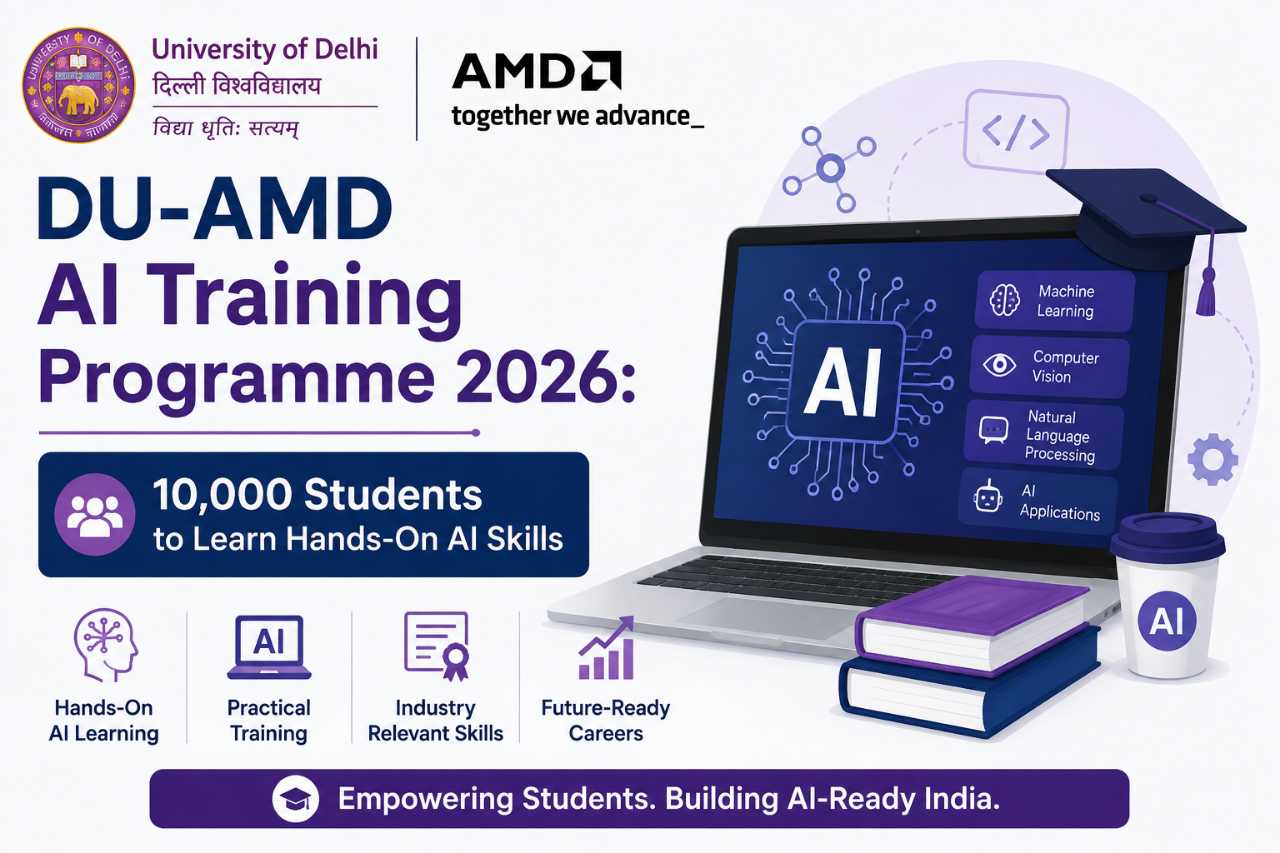
Artificial intelligence is reshaping careers across India, and Delhi's largest public university is responding with a major industry tie-up. On September 3, 2026, the University of Delhi (DU) signed an agreement with Advanced Micro Devices, Inc. (AMD) to provide hands-on AI training to up to 10,000 students and faculty members over the next year. The partnership connects classroom learning with the same open-source tools and GPU infrastructure used in real-world AI development.
For DU aspirants, current undergraduates, postgraduate researchers, and faculty, this initiative is more than a headline. It signals how India's central universities are aligning with semiconductor and AI leaders to build job-ready talent. This guide explains what the DU-AMD collaboration covers, who benefits, which skills students will gain, and how it compares with AI-focused pathways at other Delhi NCR institutions such as Netaji Subhas University of Technology (NSUT) and Delhi Technological University (DTU).
What Is the DU-AMD AI Training Partnership?
The University of Delhi and AMD have entered into a formal agreement under AMD's AI Engage Developer Program. The core objective is straightforward: move students from understanding AI concepts to building, testing, and deploying AI applications using industry-standard platforms. Registrar Vikas Gupta signed on behalf of DU, while Jaya Jagadish, AMD India Country Head and Senior Vice President of Engineering, represented the company at the signing ceremony held on September 3, 2026.
Vice-Chancellor Yogesh Singh described the collaboration as a bridge between academia and industry. He emphasised that such programmes are essential for developing skills that match employer expectations in artificial intelligence, high-performance computing, and related fields. AMD framed the initiative as part of its long-term commitment to strengthening India's AI ecosystem and nurturing future-ready developers.
Key Numbers at a Glance
- Beneficiaries: Up to 10,000 DU students and faculty members
- Duration: Training rollout planned over the next 12 months
- Platform: AMD ROCm open-source AI software stack
- Resources: Structured curriculum, technical workshops, and GPU cloud credits
- Signing date: September 3, 2026
What Will Students and Faculty Receive?
Unlike generic awareness sessions, this partnership offers tangible learning infrastructure. Participants will receive structured access to AMD's AI learning curriculum, live and recorded technical workshops, open software tools, and cloud-based GPU resources for experimentation. Faculty members can integrate these materials into existing courses or use them for research projects that require accelerated computing.
The programme is designed for practical outcomes. Students will work through modules that cover model development, optimisation, deployment workflows, and performance tuning on AMD hardware through the ROCm ecosystem. GPU cloud credits reduce a common barrier for learners who cannot afford local high-end machines, making advanced AI experimentation accessible from college labs or home setups.
Components of the Training Package
- ROCm platform access: Open-source software for AI and HPC workloads on AMD GPUs
- Curriculum modules: Step-by-step learning paths aligned with developer workflows
- Workshops: Faculty-led and industry-supported sessions on tools and best practices
- GPU cloud credits: Cloud compute for training models and running experiments
- Research support: Resources for faculty pursuing AI and high-performance computing projects
Understanding AMD ROCm and the AI Engage Developer Program
ROCm (Radeon Open Compute) is AMD's open software platform for GPU-accelerated computing. It supports popular AI frameworks and helps developers run machine learning workloads on AMD hardware. For students accustomed to learning theory from textbooks, ROCm exposure introduces the toolchain side of AI—environment setup, library compatibility, memory management, and deployment considerations that hiring managers increasingly expect.
The AI Engage Developer Program is AMD's umbrella initiative for academic partnerships across India. By joining through DU, participants gain institutional support, coordinated scheduling, and access pathways that individual learners might struggle to secure alone. Jaya Jagadish noted that India has both the talent and ambition to lead the next wave of AI innovation, but early access to production-grade platforms remains the missing link for many undergraduates.
Why Open-Source AI Platforms Matter for Indian Students
Proprietary tools can be expensive or restricted in academic settings. Open-source stacks like ROCm allow universities to teach scalable AI development without locking students into a single vendor. This aligns with India's broader push to expand skilled professionals in artificial intelligence, semiconductors, and high-performance computing—sectors highlighted in national skill and innovation policies.
Students who master open platforms often find it easier to adapt when organisations use mixed hardware environments. That flexibility is valuable whether you pursue roles in product companies, research labs, startups, or public-sector digital initiatives.
Who Attended the Signing and What It Signals
Several senior DU officials were present at the agreement ceremony, reflecting institutional buy-in beyond a single department. Attendees included Director, South Campus Rajni Abbi; Dean Academic K. Ratnabali; Chairperson of the DU Culture Council Anoop Lather; and Dean, Faculty of Technology Sanjeev Singh. Their participation suggests the programme may span multiple faculties—not only computer science or mathematics, but potentially interdisciplinary applications in commerce, social sciences, and applied sciences where AI tools are gaining ground.
For students evaluating DU against specialised technology universities, this industry linkage adds weight to DU's evolving technology footprint. Institutions such as Indira Gandhi Delhi Technical University for Women (IGDTUW) and Guru Gobind Singh Indraprastha University (GGSIPU) have long emphasised engineering and applied tech pathways; DU's AMD partnership shows a central university can combine liberal arts breadth with cutting-edge AI infrastructure.
How the DU-AMD Initiative Fits India's AI Education Landscape
India's higher education sector is witnessing a wave of AI-focused partnerships between universities and technology firms. From developer programmes to chip-design collaborations, the goal is consistent: reduce the gap between academic credentials and employable skills. DU's scale—thousands of colleges and lakhs of enrolled students—makes this agreement particularly significant because even a subset of 10,000 trained learners can influence project culture, hackathons, and startup activity across North Campus, South Campus, and affiliated colleges.
The timing aligns with rising student interest in AI electives, data science minors, and industry certifications. Programmes like this also support faculty upskilling, which is critical when syllabus revision cycles lag behind tool updates in fast-moving fields.
Comparison: DU vs Other Delhi NCR Tech-Focused Institutions
Students often compare DU with Delhi's established engineering and technology universities. The table below offers a simplified view for planning—not a ranking, but a decision aid.
| Institution | Primary Strength | AI-Relevant Note |
|---|---|---|
| University of Delhi | Wide arts, science, commerce portfolio | New AMD partnership; ROCm and GPU cloud access for 10,000 learners |
| DTU | Engineering and technology | Strong core CS and research labs; industry projects common |
| NSUT Delhi | Engineering intake via JEE | Deep technical curriculum; competitive coding culture |
| GGSIPU | Affiliated engineering and professional colleges | Multiple campuses; varied AI and IT programmes |
| Delhi Skill and Entrepreneurship University | Skill-based and vocational focus | Practical training aligned with job roles |
Private universities in the NCR corridor—such as Amity University Noida and Galgotias University Greater Noida—also market AI and data science programmes heavily. DU's AMD tie-up distinguishes the public university pathway with direct access to a global semiconductor firm's developer ecosystem, which may appeal to cost-conscious students seeking credible industry exposure without private tuition fees.
Skills Students Can Expect to Build
Participation in the AMD-backed programme can help students develop both foundational and applied competencies. While exact module titles may be announced through DU's academic channels, the partnership's stated goals point to several skill areas.
Technical Skills
- Setting up AI development environments on open-source GPU stacks
- Training and fine-tuning machine learning models with cloud GPU resources
- Optimising workloads for performance and cost efficiency
- Testing and deploying AI applications in sandbox and pilot settings
- Using version control and reproducible workflows for team projects
Professional and Research Skills
- Translating business or academic problems into AI use cases
- Collaborating across disciplines—finance, healthcare, linguistics, design
- Documenting experiments for publications, internships, or portfolio reviews
- Presenting project outcomes in hackathons, conferences, and placement interviews
Faculty members can leverage the same infrastructure for grant-supported research in natural language processing, computer vision, computational biology, and social analytics—fields where DU departments already maintain active interest.
Career Pathways After AI Training at DU
AI skills open doors across sectors India's graduates traditionally enter: IT services, product engineering, fintech, edtech, healthcare analytics, government digital missions, and academic research. Employers increasingly screen for hands-on project evidence, not just course titles on a transcript. A DU student who completes AMD-supported workshops and ships a deployed model demo gains a concrete talking point for campus placements and off-campus hiring.
Roles that benefit from this training include machine learning engineer, AI application developer, data engineer, research assistant, MLOps associate, and technical product analyst. Students combining AI skills with domain knowledge—economics, law, journalism, or pharmacy—can pursue hybrid roles that pure coding bootcamps rarely address. For medical-adjacent interests, DU affiliates and Delhi institutions such as University College of Medical Sciences (UCMS) illustrate how health sciences and computational methods increasingly overlap.
Actionable Tips for Maximising the Opportunity
- Monitor official DU notices: Registration details, eligibility, and batch schedules will appear on university portals and department boards—verify only through authenticated channels.
- Strengthen prerequisites early: Comfort with Python, linear algebra, and basic statistics will help you absorb ROCm workshops faster.
- Build a project portfolio: Document each lab exercise as a GitHub repository with README files explaining problem statements and results.
- Pair with internships: Use GPU cloud credits to prototype solutions that align with startup or corporate internship applications.
- Engage faculty mentors: Research supervisors can integrate AMD resources into dissertations and funded projects.
- Network across campuses: Collaborate with peers from South Campus, North Campus, and affiliated colleges to simulate cross-functional AI teams.
Broader Implications for Faculty, Research, and Innovation
Industry-academic partnerships work best when faculty are empowered to redesign assignments, capstone projects, and elective syllabi around accessible tooling. AMD's curriculum and workshop support lowers the overhead for professors who want to introduce GPU-accelerated labs without negotiating separate vendor contracts each semester.
The initiative also complements India's semiconductor and AI talent ambitions. As chipmakers and cloud providers invest in developer communities, universities that embed these tools early produce graduates who require less onboarding time in corporate environments. Dean, Faculty of Technology Sanjeev Singh's involvement hints that technology-oriented faculties may coordinate rollout, but interdisciplinary adoption could follow as AI literacy becomes a baseline expectation—similar to spreadsheet skills a decade ago.
Nearby institutions continue parallel efforts. Jamia Hamdard University Engineering and BML Munjal University emphasise industry-linked engineering education in the NCR. DU's AMD agreement raises the benchmark for what large public universities can offer at scale, potentially prompting similar collaborations elsewhere in India.
What Students Should Watch For Next
As of the September 3, 2026 announcement, operational details such as college-wise seat allocation within the 10,000 target, application windows, and certification format may still be finalised. Students should prepare academically while awaiting formal circulars. Faculty applicants interested in workshop facilitation or research credits should coordinate through their departments and the Dean Academic office.
Prospective DU entrants comparing programmes should weigh this AI initiative alongside traditional factors: course structure, faculty research output, placement trends, campus location, and affordability. Central university education remains attractive for many families; adding AMD-backed AI training strengthens the value proposition for tech-curious applicants who might otherwise consider only private engineering colleges such as Manav Rachna University Engineering or Sharda University Engineering in the broader NCR region.
Red Flags to Avoid
- Third-party websites claiming guaranteed seats or paid fast-track entry into the AMD programme
- Unofficial social media groups selling leaked GPU credits or login credentials
- Coaching centres misrepresenting the partnership as a replacement for DU degree admissions
- Ignoring baseline academic responsibilities while chasing AI badges without foundational understanding
Why Industry-Academic AI Partnerships Matter in 2026
India's National Education Policy 2020 encouraged higher education institutions to deepen ties with industry so graduates enter the workforce with demonstrable skills, not only theoretical knowledge. The DU-AMD agreement is a visible example of that policy direction in action. Semiconductor and AI companies are investing in developer communities because talent shortages slow product cycles; universities benefit from access to current tooling that would be costly to replicate independently.
For parents and students in Delhi and across India, partnerships like this reduce uncertainty about whether a traditional BA, BSc, BCom, or MA programme can still lead to technology careers. When a central university integrates AMD's developer stack, students in mathematics, statistics, economics, and computer applications—not just core engineering—can explore AI project work without transferring institutions mid-degree.
India's AI Talent Gap and How DU Responds
Reports from industry bodies consistently highlight demand for professionals who can implement AI solutions, not merely discuss trends. Colleges that offer GPU-backed labs and structured developer curricula help close that gap faster than lecture-only electives. AMD's statement that the initiative supports India's AI ecosystem reflects a shared recognition: the country produces large graduate volumes, but employers filter candidates using project portfolios and platform familiarity.
Delhi remains a magnet for higher education seekers nationwide. Alongside DU, the capital hosts specialised universities including National Law University Delhi, Dr B R Ambedkar University Delhi, and Delhi Pharmaceutical Sciences and Research University. Each serves distinct career paths, yet AI literacy is becoming cross-cutting. Law students explore AI governance; pharmacy students encounter computational drug discovery; design aspirants at institutions like World University of Design experiment with generative tools. DU's AMD programme gives its large student body a unified entry point into developer-grade AI infrastructure.
Planning Your Education Path Around the DU-AMD Announcement
If you are a Class 12 student considering DU admissions through CUET or legacy eligibility routes, treat the AMD partnership as a value-add rather than the sole reason to apply. Evaluate programmes on faculty quality, course flexibility, campus life, and long-term goals. If AI is a priority, also research whether your preferred DU college offers mathematics, computer science, or data-centric electives that complement AMD workshops.
Engineering-focused applicants comparing JEE routes to DU should note the difference in entry exams and programme structure. Chitkara University Engineering, Lovely Professional University Engineering, and other private institutions market AI labs aggressively. DU's advantage for many families is affordable public education combined—now—with semiconductor industry backing. That combination is relatively rare at this scale among central universities in 2026.
Checklist for Faculty Coordinators
- Map AMD curriculum modules to existing semester learning outcomes
- Schedule GPU lab slots so cloud credits are used efficiently across sections
- Identify interdisciplinary capstone themes—urban analytics, climate modelling, digital humanities
- Track student project outputs for institutional innovation showcases
- Share feedback with DU academic offices to improve future cohort planning
Conclusion
The Delhi University and AMD agreement to train up to 10,000 students and faculty members represents a practical step toward industry-aligned AI education at one of India's most recognised public universities. Through the AI Engage Developer Program, participants gain access to ROCm, structured curricula, workshops, and GPU cloud resources that translate AI theory into build-and-deploy experience. Vice-Chancellor Yogesh Singh and AMD's Jaya Jagadish both framed the partnership as essential for bridging academia and the technology industry—a priority echoed across Indian higher education today.
For DU students, the opportunity is clear: engage early, build projects, and document skills that employers can evaluate. For aspirants choosing between DU and specialised tech institutions like Delhi Technological University or NSUT Delhi, this initiative adds a compelling reason to consider DU's diverse academic environment paired with semiconductor-grade AI tooling. Stay tuned to official DU communications for enrollment procedures, and use the waiting period to strengthen programming and mathematics fundamentals so you can fully leverage one of the largest AI training partnerships announced for a central university in 2026.