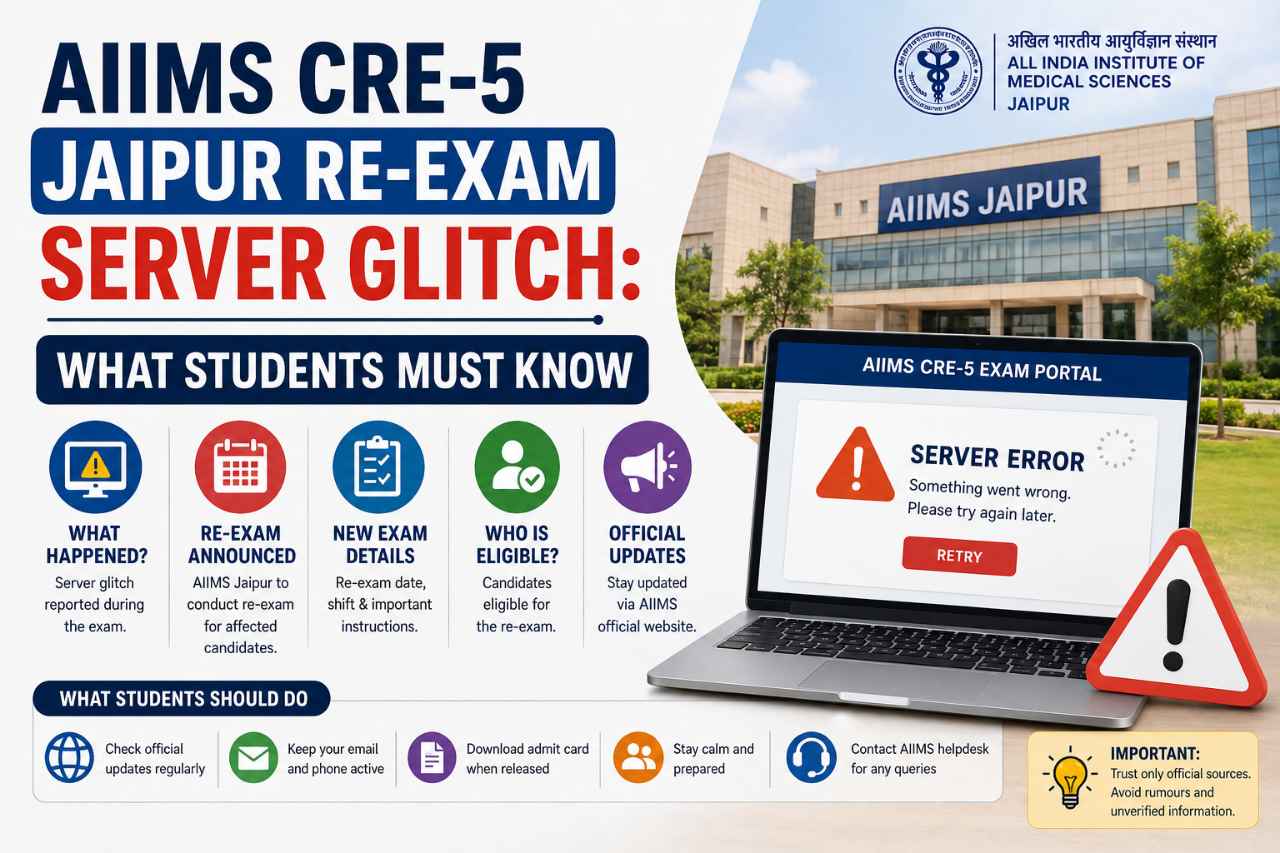
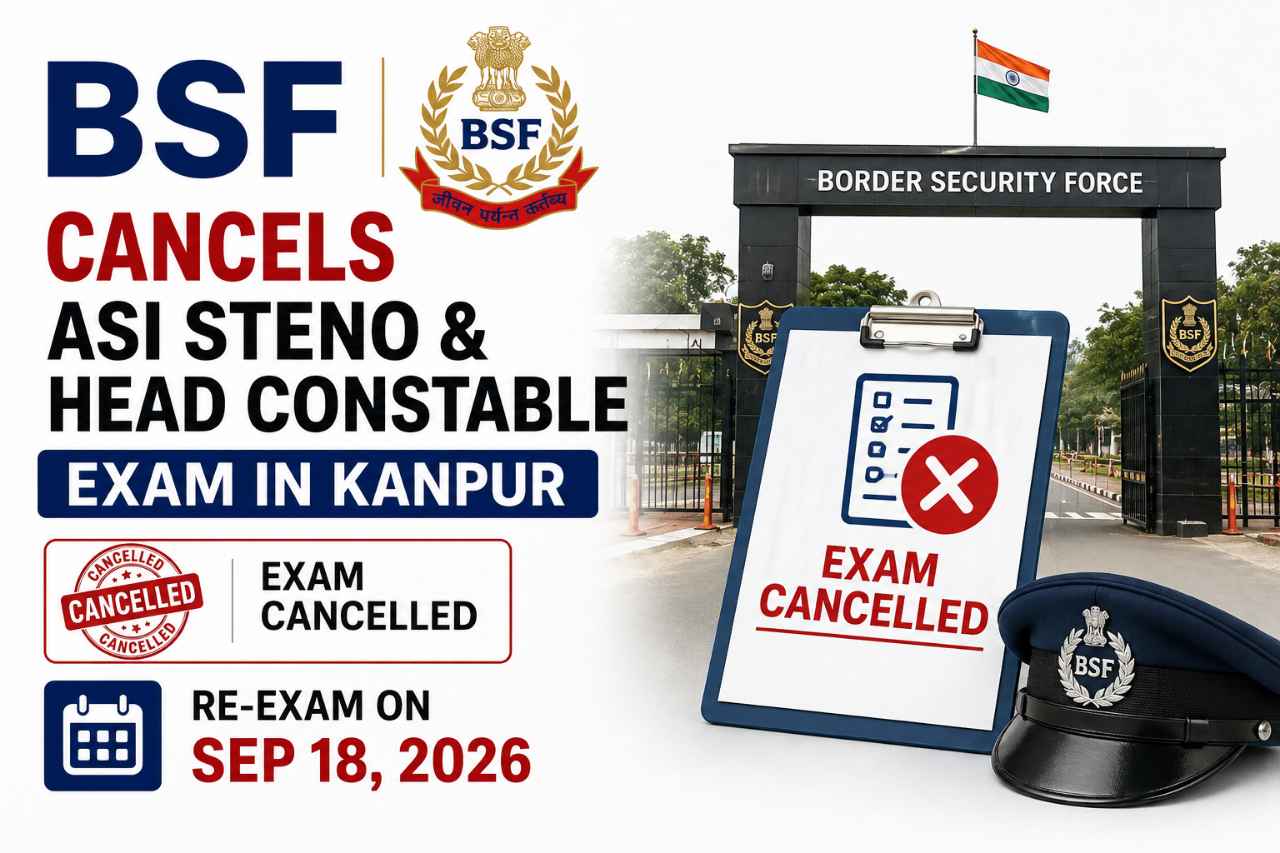

The Border Security Force (BSF) recruitment examination for Assistant Sub-Inspector (Stenographer) and Head Constable (Ministerial) posts was cancelled at an examination centre in Kanpur on September 2, 2026, after repeated technical failures disrupted the computer-based test. More than 500 candidates who had travelled from across Uttar Pradesh and neighbouring states were affected when systems at the MD Infotech Centre in Shyam Nagar, Chakeri, stopped working shortly after the exam began.
For thousands of government job aspirants, competitive examinations are not just tests of knowledge—they represent years of preparation, financial sacrifice, and family hope. When an exam is halted mid-shift due to infrastructure failure, the emotional and practical impact is immediate. This article explains what happened in Kanpur, what authorities have announced, how the re-examination on September 18, 2026 will work, and what candidates should do next. We also connect this incident to the broader landscape of government recruitment in India, including how students in exam hubs like Kanpur balance defence and paramilitary ambitions with higher education pathways at institutions such as National Institute Of Technology Kanpur and Chatrapati Sahuji Maharaj Kanpur University Kanpur.
What Happened at the Kanpur BSF Examination Centre?
On September 2, 2026, the BSF was conducting its recruitment examination for ASI (Stenographer) and Head Constable (Ministerial) posts at centre code 25916, located at MD Infotech Centre in Shyam Nagar, Chakeri area of Kanpur. The centre was scheduled to accommodate approximately 500 candidates across three shifts.
Timeline of the Disruption
According to reports from the examination day, the disruption followed a troubling sequence of delays and system failures:
- 7:30 AM — Entry for the morning shift was scheduled, but candidates reported delays in allowing candidates inside the centre.
- ~9:00 AM — The examination eventually started, roughly 90 minutes behind the planned schedule.
- ~15 minutes into the test — Computer systems at the centre stopped functioning. Staff attempted to restore operations.
- 15–20 minutes later — Systems shut down again after a brief restart attempt.
- After ~40 minutes — Authorities concluded the examination could not continue and asked candidates to leave the centre.
Candidates described screens freezing, login failures, and repeated crashes—conditions that make a fair, timed computer-based test impossible. When the exam could not resume, frustration spilled outside the centre. Reports indicate that more than 500 students gathered in protest, demanding a fresh examination and raising concerns about the integrity of the process. Social media posts from the day carried phrases such as "system was repeatedly crashing," reflecting the shared experience of multiple shifts affected by the same infrastructure problem.
Location Context: Kanpur as an Exam Hub
Kanpur has long been a major centre for competitive examinations in northern India. Alongside large-scale recruitment tests, the city is home to respected academic institutions including Chandra Shekhar Azad University Of Agriculture Technology Kanpur, CSJMU, and IIT Kanpur. Many aspirants who sit for BSF and other paramilitary exams also pursue diploma or degree programmes at technical universities in the region, such as Harcourt Butler Technical University and Drapj Abdul Kalam Technical University Lucknow, using formal qualifications to strengthen their career options beyond a single recruitment cycle.
Kanpur's connectivity by rail and road makes it a convenient examination city for candidates from eastern Uttar Pradesh, Bundelkhand, and parts of Madhya Pradesh. That geographic advantage, however, also means that a single centre failure can displace hundreds of aspirants who booked hotels, took unpaid leave, or travelled overnight—multiplying the human cost of technical unpreparedness.
Official Response: Technical Failure vs Candidate Allegations
Authorities and candidates offered different interpretations of the day's events. Understanding both perspectives helps aspirants navigate the situation without panic or misinformation.
What Authorities Said
According to official statements cited in media reports, ADCP East Shiva Singh confirmed that a notice was issued cancelling the examination across all three shifts at the affected Kanpur centre. At first glance, authorities attributed the cancellation to a technical or electrical fault and stated that the matter was being examined in detail. This framing suggests the BSF and examination conducting agency treated the incident as an infrastructure failure rather than a deliberate irregularity—at least pending investigation.
Police presence and administrative coordination at the centre were reportedly stepped up once protests formed outside the venue. Cancelling all shifts rather than only the disrupted batch indicates authorities accepted that fairness could not be guaranteed under the prevailing conditions—a standard response when computer-based tests lose candidate responses or examination time.
What Candidates Alleged
Many aspirants at the centre raised separate concerns. Beyond system crashes, some candidates alleged irregularities and voiced fears about a possible paper leak. These allegations have not been independently verified in public reports at the time of writing, and authorities have not confirmed any leak. However, the combination of delayed entry, mid-exam cancellation, and lack of immediate clarity often triggers suspicion among students who have seen similar controversies in other recruitment exams across India.
From an E-E-A-T perspective—Experience, Expertise, Authoritativeness, and Trustworthiness—it is important for candidates to:
- Rely on the official BSF recruitment portal for verified updates.
- Avoid sharing unverified screenshots or rumours on social media.
- Document their own experience (admit card, centre details, timestamps) in case grievance mechanisms open later.
- Understand that cancellation due to technical failure and cancellation due to malpractice are legally and procedurally different outcomes, even if both result in a re-exam.
Re-Examination Date: September 18, 2026
Authorities have announced a re-examination for affected candidates on September 18, 2026. Candidates have been advised to regularly check the official BSF portal for admit cards, centre allotments, and any revised instructions.
Key Details Candidates Should Note
| Aspect | Details for Kanpur Candidates |
|---|---|
| Original exam date | September 2, 2026 |
| Cancelled centre | MD Infotech Centre, Shyam Nagar, Chakeri (Code 25916) |
| Posts affected | ASI (Stenographer), Head Constable (Ministerial) |
| Approximate candidates affected | ~500 (three shifts combined) |
| Re-exam date | September 18, 2026 |
| Official updates | BSF recruitment website and candidate login portal |
| Admit card | Fresh admit card likely required; confirm on official portal |
Students should not assume the re-exam centre will be the same as September 2. Conducting bodies sometimes shift venues after infrastructure failures. Check your updated admit card carefully for centre name, address, reporting time, and shift. If the new centre is in a different part of Kanpur—such as moving from Chakeri to a campus near GT Road or Kakadeo—plan route and parking accordingly.
Similar Cancellation in Jaipur: A Pattern Worth Watching
The Kanpur incident was not isolated. Reports indicate that a similar technical issue occurred at an examination centre in Jaipur, where the BSF ASI Stenographer and Head Constable (Ministerial) computer-based examination was also cancelled. The retest for affected candidates in Jaipur has likewise been scheduled for September 18, 2026, and candidates will need fresh admit cards for the rescheduled examination.
For students in Rajasthan comparing government job preparation with degree options, institutions such as Rajasthan Technical University Kota, Government Engineering College Ajmer, and Sawai Man Singh Government College Jaipur remain popular pathways for building skills in administration, computer applications, and technical fields that align with ministerial and stenography roles.
When multiple centres fail on the same examination day, it raises legitimate questions about vendor readiness, power backup, server capacity, and quality assurance before high-stakes tests—not just local centre management. National-level recruitment agencies increasingly rely on third-party CBT vendors; a single software patch error or insufficient UPS units can therefore surface simultaneously in geographically distant cities.
Understanding the BSF ASI Steno and Head Constable (Ministerial) Exam
To make sense of the Kanpur cancellation, it helps to understand what examination was being conducted and why computer-based delivery matters for these posts.
Assistant Sub-Inspector (Stenographer)
The ASI (Stenographer) role in paramilitary forces requires shorthand proficiency, typing speed, accuracy under pressure, and general awareness. The selection process typically includes a written or computer-based test assessing reasoning, numerical ability, language skills, and stenography-related components, followed by skill tests and document verification. A stable computer environment is essential because even brief system outages can erase attempted answers or disturb timed stenography modules.
Stenography posts remain among the most competitive ministerial categories because they offer a clear promotion path within the force and transferable office skills. Candidates often train at private institutes for months to reach the required shorthand speed—making exam-day reliability a non-negotiable requirement.
Head Constable (Ministerial)
Head Constable (Ministerial) posts support administrative functions—record keeping, correspondence, data entry, and office management within BSF units. Candidates are evaluated on clerical aptitude, basic computer knowledge, Hindi and English language skills, and general knowledge. Ministerial roles reward consistency and accuracy, qualities that candidates expect the examination system itself to demonstrate.
Typical Eligibility and Selection Stages
While specific advertisement criteria vary by recruitment cycle, BSF ministerial posts generally require:
- Educational qualification of 10+2 or equivalent from a recognised board
- Age limits as prescribed in the official notification, with relaxation for reserved categories
- Computer-based written examination covering aptitude and language
- Skill test (typing/shorthand for stenographer posts)
- Document verification and medical standards
Candidates who also hold diplomas from polytechnics such as Government Polytechnic College Sikar or degrees from universities like Uttrakhand Technical University Dehradun may find the computer literacy and office practice modules familiar—though BSF exams follow their own pattern and scoring.
Why Computer-Based Tests Fail
Technical glitches in CBT exams usually stem from one or more of the following:
- Insufficient UPS or generator backup during power fluctuation
- Overloaded local servers or poor network configuration
- Outdated hardware at third-party examination centres
- Software bugs during login, question loading, or response saving
- Inadequate dry runs before live examination day
When systems crash within the first 15 minutes—as reported in Kanpur—the fairest administrative decision is often full cancellation and re-examination rather than partial continuation, which would disadvantage candidates who lost attempted answers.
Political and Public Reaction
The cancellation also drew political commentary. The Aam Aadmi Party (AAP) issued a statement on social media platform X, accusing the BJP-led government of failing to protect young job aspirants. The party referenced a broader pattern of paper leaks, cancelled exams, and broken promises affecting youth preparing for government jobs, stating that young Indians spend years preparing only to face disrupted examinations.
While political debate highlights systemic concerns, candidates should separate campaign messaging from actionable exam information. Regardless of party statements, your immediate priorities remain official notifications, re-exam preparation, and personal documentation. Parliamentary questions and state-level grievance cells occasionally take up mass exam disruptions, but re-examination notices from the recruiting agency remain the legally operative instruction for candidates.
What Should Affected Candidates Do Now?
If you were scheduled at Kanpur centre code 25916 on September 2, 2026, treat the next two weeks as a structured preparation and verification phase—not a waiting period based on rumours.
Immediate Action Checklist
- Check the official BSF recruitment portal daily for re-exam admit cards and centre details.
- Save all previous communications—application receipt, old admit card, and any SMS or email from the conducting body.
- Do not pay third parties claiming to secure re-exam slots or leaked papers; these are common scams after cancellations.
- Revise core topics—quantitative aptitude, reasoning, English/Hindi comprehension, and general awareness—for ASI and Head Constable patterns.
- Practise typing and stenography drills if you are an ASI (Stenographer) candidate, since skill tests may follow the written stage.
- Plan travel early for September 18; Kanpur centres draw candidates from rural districts across UP.
- Report grievances through official channels only if a formal window opens on the portal.
Sample Weekly Preparation Plan Before Re-Exam
| Day Focus | Activity | Duration |
|---|---|---|
| Reasoning & aptitude | Timed mock sets; analyse wrong answers | 2–3 hours |
| Language (Hindi/English) | Comprehension, grammar, vocabulary | 1–2 hours |
| General awareness | Current affairs notes; BSF and MHA basics | 1 hour |
| Skill practice (ASI Steno) | Shorthand dictation + typing speed test | 1–2 hours |
| Portal check | Admit card, instructions, centre map | 15 minutes daily |
Balancing Exam Preparation with Higher Education
Many aspirants preparing for BSF and other defence or paramilitary examinations simultaneously pursue diplomas or degrees to keep career options open. Technical and administrative skills developed in formal programmes can complement ministerial post requirements. Students interested in computer applications, office management, or language proficiency may explore programmes at institutions such as Indira Gandhi Delhi Technical University For Women, I K Gujral Punjab Technical University Jalandhar, or Government College Of Engineering Chennai depending on region and eligibility.
Similarly, candidates who also sit for other entrance tests—for example, design aspirants tracking the Nift Entrance Exam—should maintain separate calendars so one cancelled exam does not disrupt preparation for another opportunity. Dual-track planning—government job exams plus a technical or undergraduate programme—reduces the career risk of any single cancellation event.
Rights and Grievance Options for Exam Affected Candidates
Indian recruitment law and agency practice increasingly recognise candidate rights when examinations fail through no fault of the applicant. While individual remedies depend on the official notification and conduct rules, affected Kanpur candidates should be aware of general principles:
- Right to fair re-test: When an exam is cancelled due to centre failure, eligible candidates typically receive a fresh attempt without additional application fees.
- Right to transparent communication: Conducting bodies should publish revised dates and admit cards within a reasonable window; document the absence of communication if delays occur.
- Travel cost claims: Refunds for travel or lodging are rarely automatic unless explicitly promised; retain tickets if future compensation schemes are announced.
- RTI and public accountability: Serious or repeated failures sometimes lead to RTI queries about vendor contracts and centre audits—useful for journalists and candidate unions, though not a substitute for portal updates.
Student groups in Kanpur and other exam cities have occasionally coordinated peaceful representations to district administration. Such actions can draw media attention but should remain lawful; your re-exam eligibility is determined by BSF records, not by protest participation alone.
Lessons for Examination Conducting Bodies
High-stakes recruitment exams affect national security staffing and lakhs of aspirants annually. The Kanpur and Jaipur cancellations underscore systemic lessons:
- Redundant power and connectivity must be tested under full candidate load, not empty labs.
- Contingency protocols should define when to pause versus cancel, communicated clearly to centre staff.
- Real-time help desks reduce panic and prevent unverified leak rumours from spreading.
- Transparent post-incident reports build trust—even a brief technical summary helps candidates accept re-exam decisions.
- Vendor accountability ensures third-party centres meet minimum hardware and IT standards before allocation.
Students in tier-II cities deserve the same examination reliability as those in metro centres. Kanpur's academic ecosystem—from IIT Kanpur to CSJMU—demonstrates the city's capacity to host serious academic activity; recruitment infrastructure should match that standard. Training institutes such as National Institute Of Technical Teachers Training And Research Chennai emphasise quality assurance in technical education; similar rigour applied to CBT exam centres would reduce preventable cancellations.
How to Stay Updated and Avoid Misinformation
After exam cancellations, WhatsApp forwards and unofficial Telegram channels often circulate fake admit cards, false new dates, or paid "insider" claims. Protect yourself with source hierarchy:
- Primary source: Official BSF website and candidate login dashboard
- Secondary source: Reputed news outlets citing official statements
- Ignore: Anonymous leak channels, unverified PDFs, and paid "confirm slot" services
Enable email and SMS alerts on your registration profile if the portal offers them. Follow only verified social media accounts of the force or the Staff Selection Commission ecosystem where relevant cross-announcements appear. Cross-check any viral screenshot against the official portal before sharing—it protects fellow aspirants from panic.
Conclusion
The cancellation of the BSF ASI (Stenographer) and Head Constable (Ministerial) examination at MD Infotech Centre in Kanpur on September 2, 2026, disrupted the plans of hundreds of aspirants who had prepared for months. Repeated computer failures, delayed start times, and an inability to resume the test after roughly 40 minutes led authorities to call off all three shifts at centre code 25916. While candidates raised concerns about irregularities and possible paper leaks, officials initially cited technical or electrical faults and launched a detailed review.
The announced re-examination on September 18, 2026 gives affected candidates a second chance, but it also demands careful attention to official admit cards, centre assignments, and travel planning. With a parallel retest scheduled for Jaipur on the same date, the incident reflects broader challenges in delivering reliable computer-based recruitment examinations across India.
For aspirants, the path forward is clear: verify every update on the official BSF portal, continue focused preparation, document your examination history, and reject misinformation. Whether your long-term goal is a paramilitary ministerial career or a technical degree from institutions like IIT Kanpur or state universities, resilience and reliable information remain your strongest assets in India's competitive examination landscape.