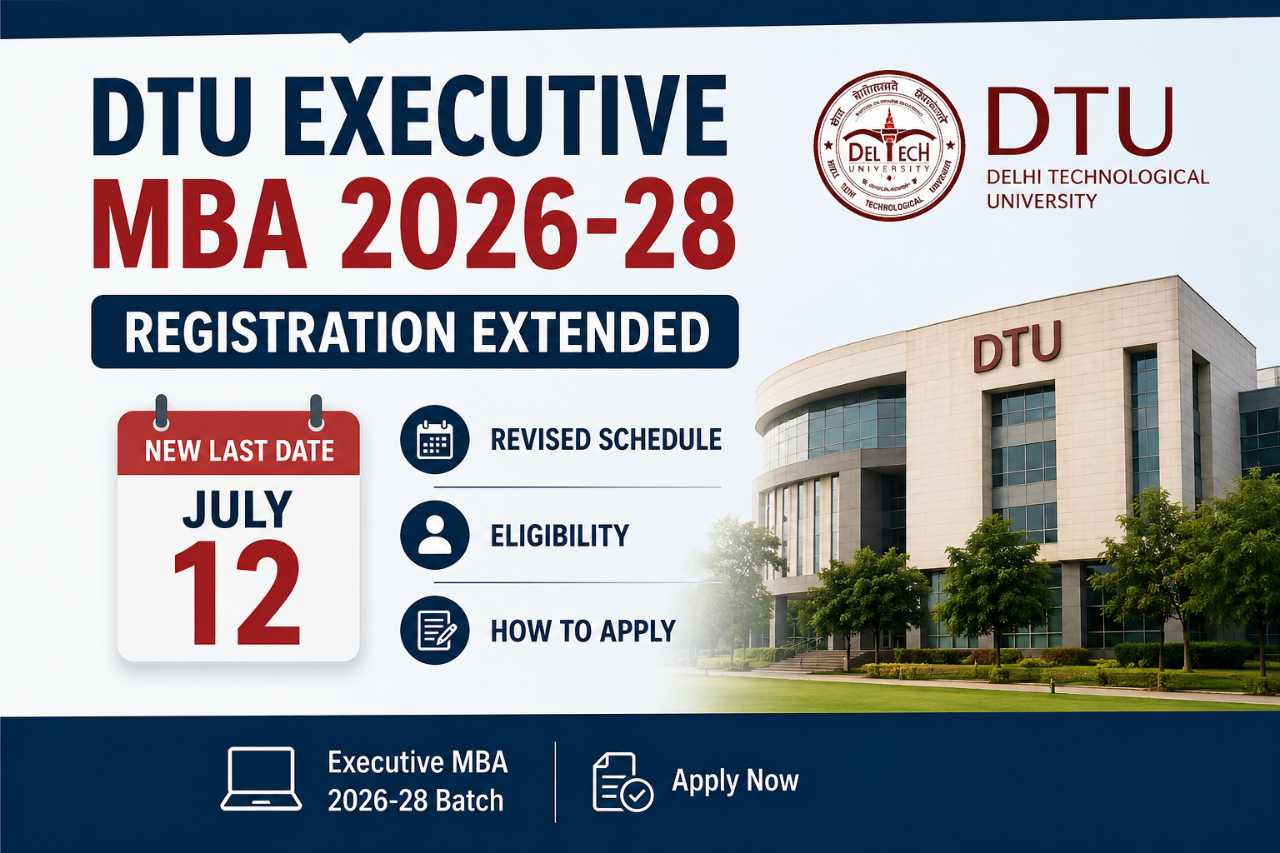
Delhi Technological University (DTU) has given working professionals additional time to apply for its Executive MBA 2026-28 batch. The University has officially extended the online registration deadline from July 10 to July 12, 2026, giving candidates two extra days to complete applications on the DTU admissions portal. For mid-career applicants balancing office deadlines with admission forms, this revision is a practical relief rather than a minor calendar change.
The Delhi Technological University DTU programme is offered through the Delhi School of Management (DSM) and is designed for experienced professionals who want a structured Master of Business Administration MBA qualification without leaving full-time employment. The current intake focuses on an Executive MBA in Data Science and Analytics, aligning management education with one of India's fastest-growing career domains. If you are exploring postgraduate management options in Delhi NCR, this revised timeline deserves immediate attention.
What Has Changed in the DTU Executive MBA 2026 Admission Timeline?
Admission timelines for executive programmes often shift when application volumes rise or when universities want to accommodate candidates facing document or payment delays. DTU's extension follows this pattern. The registration window remains open until July 12, 2026, after which no new applications will be accepted for the current cycle.
More importantly, the university has published a revised admission schedule that sets clear dates for the next stages. Candidates who register before the deadline should prepare for document verification and a personal interview within roughly two weeks of the closing date. Treat the extension as an opportunity to submit a complete, error-free application—not as extra time to begin the process from scratch.
Revised DTU Executive MBA 2026-28 Admission Schedule
The following table summarises the key dates announced for the current admission cycle. Always cross-check these dates on the official DTU website, as universities may issue further updates.
| Admission Event | Revised Date | Notes |
|---|---|---|
| Last date for online registration | July 12, 2026 | Applications must be submitted and fee paid online |
| Document verification | July 25, 2026 | Carry original certificates and identity proof |
| Personal interview | July 26, 2026 | Conducted for shortlisted candidates |
| Venue | Delhi School of Management, DTU | Report at the designated campus location |
The gap between July 12 and July 25 gives applicants a focused preparation window. Use this period to arrange employer documents, verify mark sheets, and plan travel to the DTU campus in Delhi.
Why Did DTU Extend the Registration Deadline?
Universities typically extend admission deadlines when a significant number of applicants face technical issues, payment failures, or document upload errors near the closing date. Extensions may also accommodate candidates awaiting final degree mark sheets or employer letters. For DTU, the shift from July 10 to July 12, 2026 suggests the administration wants to ensure genuinely interested and eligible professionals are not excluded due to last-minute portal congestion. However, candidates should not assume a second extension. Once July 12 passes, the registration link will close for the current batch.
Understanding the DTU Executive MBA Programme
Before rushing to fill the form, it helps to understand what this programme actually offers. Unlike a standard full-time MBA aimed at early-career graduates, an Executive MBA (EMBA) assumes that students already have substantial workplace exposure. Classes are typically scheduled to suit working professionals, and peer learning often comes from classmates who bring real industry problems into classroom discussions.
DTU's Executive MBA for the 2026-28 session is positioned around Data Science and Analytics. This specialisation reflects how Indian businesses—from e-commerce firms and banks to healthcare startups—are investing in data-driven decision-making. For professionals in IT, consulting, operations, or even traditional manufacturing roles, combining management fundamentals with analytics skills can significantly improve career mobility.
What You Learn in the Data Science and Analytics Track
While the detailed syllabus is published in the official brochure, executive programmes with an analytics focus generally cover business statistics, predictive modelling, data visualisation, machine learning applications for managers, and strategy frameworks for digital transformation. The goal is not to turn every manager into a data scientist, but to help leaders ask the right questions, interpret analytical outputs, and make evidence-based decisions. Professionals from marketing, supply chain, human resources, and finance increasingly need this hybrid skill set as organisations adopt business intelligence platforms and automated reporting systems across departments.
Who Should Consider This Programme?
The DTU Executive MBA is best suited for candidates who meet most of the following criteria:
- You have at least five years of full-time work experience and want formal management credentials.
- Your current role involves data, strategy, product, or team leadership—and you want deeper analytical tools.
- You can commit to weekend or executive-format classes while continuing employment.
- You are prepared to obtain employer sponsorship or a No Objection Certificate (NOC), where required.
- You value studying at a reputed Delhi-based institution with strong engineering and technology roots.
If your background includes a BA or any other bachelor's discipline, you remain eligible provided you meet the minimum marks and experience requirements. The programme is not limited to engineering graduates, though DTU's legacy attracts many professionals from technical sectors.
Eligibility Criteria for DTU Executive MBA 2026-28
Eligibility is assessed at the time of registration, and DTU may cancel admission later if any submitted information is found incorrect. Read the official brochure carefully before applying.
Academic Requirements
- A bachelor's degree in any discipline from a recognised university.
- Minimum 50% marks in the qualifying degree (or equivalent CGPA as per university conversion norms).
- Relaxation in marks may apply for reserved categories as per government and university rules—confirm the latest notification on the DTU portal.
Work Experience Requirements
- At least five years of full-time work experience as per the current admission cycle guidelines.
- Experience is typically calculated up to the application deadline, so roles joined very recently may not count fully.
- Freelance or part-time engagements may not meet the requirement unless clearly accepted in the official guidelines.
Employer Documentation
Working executives are generally required to produce a No Objection Certificate (NOC) or employer sponsorship letter at the time of joining. If your organisation supports higher education, initiate this process early. HR departments often need one to two weeks to approve formal letters.
Application Fee and Programme Cost
Financial planning is a key part of executive education. DTU charges a registration fee of Rs 1,500 for all categories, including General, OBC, EWS, SC, ST, PwD, Defence Personnel, and Kashmiri Migrants. This fee is paid online during application submission and is non-refundable.
Accepted payment modes usually include net banking, debit card, credit card, and UPI. A small convenience charge may apply depending on the payment gateway. Save your transaction receipt immediately after payment.
Indicative Programme Fee Structure
While the exact fee for the 2026-28 batch should be verified on the official fee notification, DTU Executive MBA fees in recent years have been in the range of Rs 6 lakh to Rs 6.5 lakh for the full two-year programme, excluding hostel charges. Executive students often continue living in their home cities and attend classes as per the programme schedule, so hostel costs may not apply to everyone.
For context, specialised management pathways such as MBA Finance at other institutions may follow different fee patterns. Compare total cost, schedule flexibility, alumni network, and specialisation depth not just the sticker fee—before deciding.
How to Apply for DTU Executive MBA Before July 12, 2026
The application process is fully online. Incomplete forms, blurry uploads, or pending payments are the most common reasons candidates lose eligibility despite intending to apply. Follow each step carefully.
Step-by-Step Registration Process
- Visit the official portal: Open the DTU admissions website or the Saarthi portal link published on dtu.ac.in for the 2026-27/2026-28 admission cycle.
- Create your login: Register using a valid email ID and mobile number. Use personal contact details you will retain throughout the admission process.
- Select MBA Executive: Choose the Executive MBA programme option and read the instructions PDF or brochure before filling details.
- Enter personal and academic details: Fill name, category, address, graduation information, and percentage/CGPA exactly as shown on mark sheets.
- Add employment history: List organisations, designations, and durations clearly. Inconsistent experience records can create problems during verification.
- Upload documents: Scan degree certificates, mark sheets, experience proofs, photograph, signature, and category certificate (if applicable) in the prescribed format and size.
- Pay Rs 1,500 registration fee: Complete online payment and ensure the status shows successful submission.
- Download confirmation: Save the submitted application form and payment proof. You may need these during document verification on July 25, 2026.
Documents to Keep Ready
- 10th and 12th mark sheets
- Bachelor's degree certificate and all semester/year mark sheets
- Experience certificates or appointment letters covering five years of employment
- Government photo ID (Aadhaar, PAN, passport, or driving licence)
- Category certificate, if applicable
- Passport-size photograph and scanned signature
- Employer NOC or sponsorship letter (required at joining stage)
What Happens After Registration Closes?
Submitting the online form is only the first milestone. DTU typically shortlists candidates based on academic record and relevant work experience before calling them for further evaluation.
Document Verification on July 25, 2026
Shortlisted applicants must appear for document verification at the Delhi School of Management, DTU. Bring originals and photocopies of all uploaded documents. Arrive early, as verification queues can be long during popular admission cycles.
Common issues at this stage include name mismatches between certificates, incomplete experience letters, and unsigned NOC formats. Review every document against your application entries one week before verification.
Personal Interview on July 26, 2026
The personal interview assesses communication skills, leadership potential, career goals, and fit for an analytics-oriented executive programme. Panellists may ask about your current role, quantitative projects, reasons for pursuing an EMBA now, and how you plan to balance work with study.
Prepare concise answers to questions such as:
- Why DTU and why Data Science and Analytics?
- What business problem in your organisation could data solve better?
- How will you manage work, travel, and classes for two years?
- Where do you see yourself five years after completing the EMBA?
Selection Process and Merit List
DTU's Executive MBA admission is generally based on a composite evaluation rather than a single entrance test score. Components often include:
- Academic performance: Marks in the qualifying bachelor's degree.
- Work experience: Quality and relevance of professional roles.
- Personal interview performance: Clarity of goals and professional maturity.
- Document verification status: Only candidates with verified credentials proceed.
After interviews, DTU is expected to publish merit lists on its official portal. Selected candidates must pay the programme fee within the prescribed deadline to confirm admission. Failure to pay on time may lead to cancellation of the allotted seat.
Expected Timeline After the Interview
Although exact merit list dates for the 2026-28 batch will be announced separately, DTU Executive MBA admissions in previous cycles have followed a predictable sequence. Shortlisted candidates complete verification first, appear for the personal interview the following day, and then await results on the official portal. Selected applicants receive instructions to deposit first-year fees online. A second merit list may be released if seats remain vacant, sometimes followed by a spot round. Candidates who plan leave from office should keep the last two weeks of July and early August relatively flexible until the university publishes final admission outcomes.
Career Outcomes After Completing a DTU Executive MBA
An Executive MBA is a long-term career investment. Graduates typically pursue senior roles such as business analyst manager, product head, operations director, strategy consultant, or analytics team lead. Because DTU's current batch emphasises data science, employers in fintech, telecom, logistics, e-governance, and enterprise software may view the qualification favourably. The programme also helps professionals transitioning from purely technical roles into people management or cross-functional leadership. Networking with classmates who already hold managerial positions is often cited by EMBA graduates as one of the most valuable outcomes, alongside formal classroom learning.
Practical Tips for Working Professionals Applying Now
With only a short window before July 12, 2026, efficiency matters. These actionable tips can help you avoid last-minute rejection:
- Apply at least 48 hours before the deadline: Portal traffic and payment gateway failures peak on the final day.
- Match form data with certificates: Even small spelling differences can delay verification.
- Talk to your employer early: Inform HR about possible weekend classes and the NOC requirement.
- Highlight analytics exposure: Mention dashboards, SQL, Python, Excel modelling, or data-led projects in your experience section.
- Prepare interview stories: Use the STAR method—Situation, Task, Action, Result—to explain workplace achievements.
- Track official updates: Bookmark the DTU admissions page and check it daily until your admission is confirmed.
DTU Executive MBA vs Regular MBA: Key Differences
Many candidates confuse Executive MBA and regular MBA pathways. The distinction matters for eligibility, classroom experience, and career outcomes.
| Factor | Executive MBA at DTU | Regular Full-Time MBA |
|---|---|---|
| Typical experience | Several years of full-time work required | Often open to fresh graduates or early-career candidates |
| Class schedule | Designed around working professionals | Weekday campus immersion |
| Peer group | Senior managers and functional heads | Mixed academic and limited work backgrounds |
| Career goal | Leadership growth while employed | Often includes internships and role changes |
| Specialisation focus | Data Science and Analytics (current cycle) | Varies by institution and stream |
Why DTU Remains a Strong Choice for Executive Education in Delhi
DTU carries decades of academic credibility as a premier Delhi institution with deep roots in engineering and technology. For executive learners, this translates into analytically rigorous pedagogy, industry-oriented faculty, and a peer network shaped by India's corporate capital.
The Delhi School of Management adds a business education layer to that foundation. For professionals already working in NCR—or willing to travel for weekend sessions—studying at DTU offers geographic convenience plus brand recognition in both public-sector and private-sector hiring ecosystems.
Important Cautions Before You Submit
Executive admissions involve significant money and two years of commitment. Keep these cautions in mind:
- Do not rely on third-party websites alone for deadlines; verify on dtu.ac.in.
- Never share OTP or portal passwords with unofficial "admission consultants."
- The registration fee is non-refundable even if you later decide not to join.
- Incorrect eligibility claims can lead to admission cancellation without fee refund.
- Further schedule revisions are possible, especially for merit list and fee payment dates.
Conclusion
The extension of the DTU Executive MBA 2026-28 registration deadline to July 12, 2026 gives eligible working professionals a final opportunity to enter the current admission cycle. With document verification scheduled for July 25, 2026 and personal interviews on July 26, 2026 at the Delhi School of Management, the post-registration timeline is compact and demands immediate preparation.
If you hold a recognised bachelor's degree with at least 50% marks, possess the required work experience, and want to strengthen your management profile with data and analytics skills, complete your online application on the official DTU portal without delay. Use the revised schedule to organise documents, secure employer approval, and approach the interview with a clear professional narrative. For broader context on management education in India, explore related pathways on CollegeDwar including MBA programmes and college profiles—to make a confident, well-informed decision.