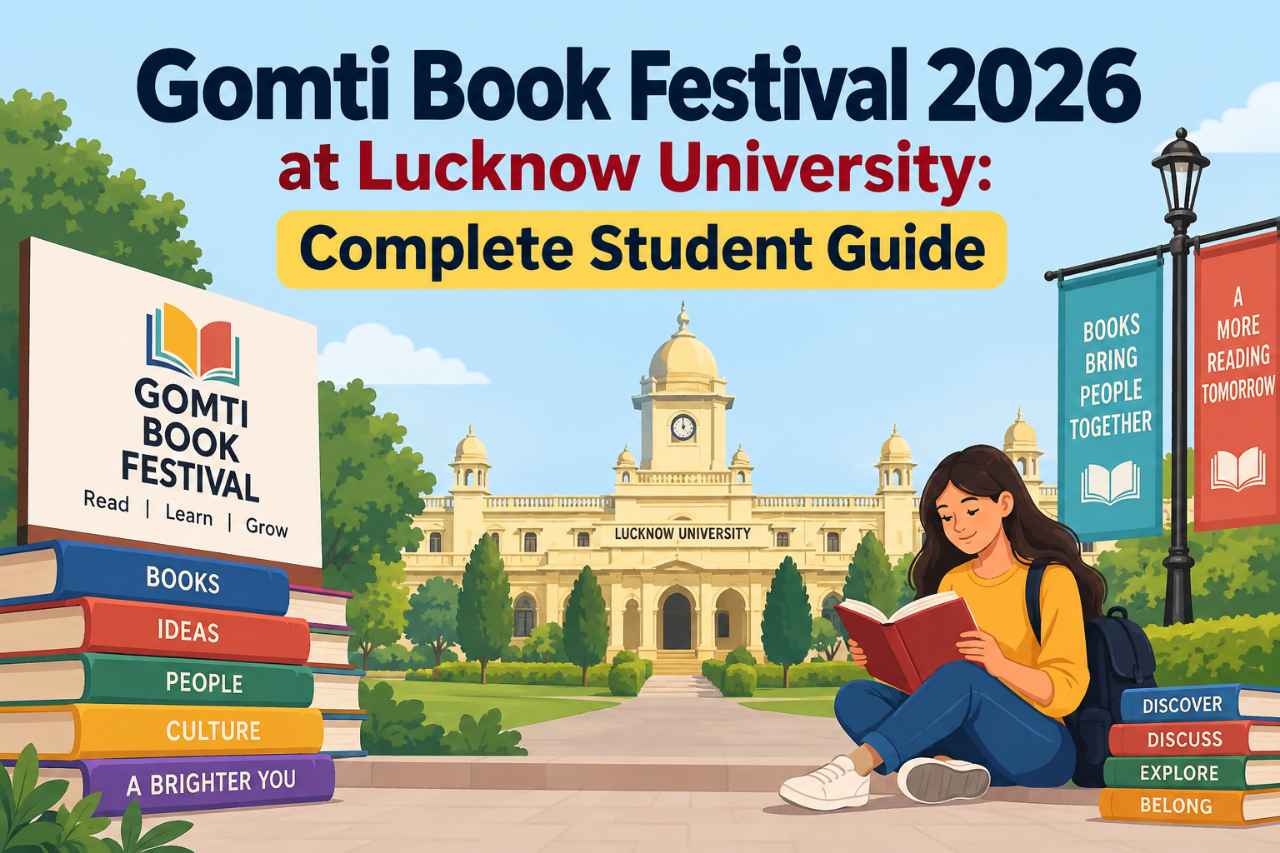
The fifth edition of the Gomti Book Festival 2026 opens today, September 12, at the University of Lucknow, turning the historic campus into one of North India's largest open-air literary gatherings. Uttar Pradesh Chief Minister Yogi Adityanath is scheduled to inaugurate the event, which runs through September 20 and is organised by the National Book Trust (NBT), India, in partnership with the Uttar Pradesh government and the University.
For students, teachers, parents, and book lovers in Lucknow and across Uttar Pradesh, this festival is more than a weekend outing. It is a free, city-wide classroom where Hindi, English, Urdu, Awadhi, and other Indian languages meet publishing, poetry, science writing, and children's literature. Whether you are preparing for board exams, exploring humanities courses, or simply building a reading habit before college admissions season, the Gomti Book Festival offers practical value alongside cultural enrichment.
This guide explains dates, venue details, what to expect on the ground, how the event connects with Lucknow's higher-education ecosystem, and actionable tips to make the most of your visit written for Indian students and families seeking reliable, exam-season-friendly information.
Gomti Book Festival 2026 at a Glance
Before you plan your schedule, here is a quick reference snapshot designed for search clarity and easy sharing with classmates or school groups.
| Detail | Information |
|---|---|
| Edition | 5th Gomti Book Festival |
| Dates | September 12 to 20, 2026 |
| Venue | University of Lucknow campus, Lucknow |
| Inauguration | Chief Minister Yogi Adityanath (September 12, 2026) |
| Organisers | National Book Trust (NBT), UP Government, Lucknow University |
| Book stalls | Around 250 stalls from 121 publishers |
| Languages | Hindi, English, Urdu, Awadhi, and other Indian languages |
| Entry fee | Free |
The scale roughly 250 stalls representing 121 publishers makes this one of the most significant book fairs in Uttar Pradesh this year. For comparison, many University-level literary fests on smaller campuses host a fraction of that inventory. The Gomti festival's breadth supports everything from NCERT-aligned school texts and competitive exam guides to regional literature, translation titles, and independent publishing.
Who Is Organising the Festival and Why It Matters
The National Book Trust (NBT), India, is the primary organising body. NBT has a long mandate to promote reading, support Indian languages, and connect publishers with readers nationwide. Collaborating with the Uttar Pradesh government and Lucknow University gives the festival institutional backing, campus infrastructure, and statewide visibility.
Role of Lucknow University as Host
Lucknow University is one of India's older public universities, with strong programmes in arts, sciences, commerce, and professional courses. Hosting the Gomti Book Festival on its campus reinforces the university's position as a cultural anchor in Uttar Pradesh's capital not only an admissions destination but also a public space for dialogue, literature, and civic learning.
Students already considering LU for undergraduate or postgraduate admission can use the festival as an informal campus visit. Walking the grounds during a major event helps you gauge accessibility, crowd management, and the general atmosphere beyond brochure photos or virtual tours.
State-Level Support and Reading Culture
State-supported book festivals signal policy priority for literacy, Indian languages, and affordable access to books. Free entry removes a common barrier for school and college students on tight budgets. When governments partner with NBT, publishers often offer exhibition discounts, bundle deals on reference sets, and preview titles that later appear in library catalogues and university syllabi.
What You Will Find at the Festival: Stalls, Languages, and Genres
Organisers expect around 250 book stalls from 121 publishers. That diversity matters for readers with different goals:
- School students: Supplementary readers, Olympiad material, language practice books, and illustrated science titles.
- Board and entrance exam aspirants: Guides for JEE, NEET, CUET, CLAT, UPSC foundation, and state-level tests often at festival pricing.
- College students: Textbooks, research monographs, poetry, fiction, and career-skills paperbacks.
- Teachers and parents: Pedagogy resources, children's literature, and bilingual dictionaries.
- General readers: Awadhi heritage titles, Urdu classics, Hindi contemporary fiction, English non-fiction, and spiritual or science popularisation.
Books will be showcased in Hindi, English, Urdu, Awadhi, and other Indian languages, reflecting Lucknow's multilingual identity. For humanities applicants especially those eyeing literature, history, or law programmes exposure to regional language publishing can shape project ideas, optional subjects, and long-term reading lists.
Publishers and Stall Strategy for Students
With more than a hundred publishers, wandering randomly can be overwhelming. Use this practical approach:
- List your priorities the night before: one exam guide, one leisure read, one gift or children's title.
- Visit language-specific zones early if you need Urdu or Awadhi material; popular stalls sell out of niche titles quickly.
- Compare editions print year, syllabus alignment, and binding quality matter more than cover price alone.
- Ask about institutional discounts if you represent a school or college book club; some publishers extend bulk rates during fairs.
- Collect publisher catalogues even if you do not buy immediately; they help library committees and faculty reading lists.
Literary Sessions, Speakers, and Themes
NBT Director Yuvraj Malik has highlighted a rich programme of literary discussions spanning women's identity, youth literature, translation, heritage, science, spirituality, and contemporary journalism. These panels are especially useful for students who need seminar exposure, interview talking points, or inspiration for college essays and debate competitions.
Notable Participants
Scheduled guests include Group Captain Shubhanshu Shukla (astronaut), folk singer Malini Awasthi, author Shantanu Gupta, and Padma Shri awardee Vidya Vindu Singh, among others. The mix of science, folk arts, political writing, and classical scholarship mirrors the interdisciplinary flavour modern universities encourage.
Actionable tip: Check the daily session board at the venue entrance or the university's official announcements each morning. Prioritise two panels per visit one aligned to your academic interest and one outside your comfort zone. That balance builds general knowledge for exams like CUET's general test and improves spoken English or Hindi articulation for interviews.
Themes That Connect to Higher Education
- Youth literature: Useful for education and psychology students exploring adolescent readership.
- Translation: Relevant for comparative literature, media, and publishing careers.
- Heritage: Supports history, archaeology, and tourism management coursework.
- Science: Bridges STEM aspirants with popular science writing a skill tested in B.Sc. communications and outreach roles.
- Contemporary journalism: Valuable for mass communication, law, and political science students.
Children's Pavilion: Learning Beyond the Classroom
A dedicated children's pavilion will host storytelling sessions, puppet shows, creative workshops, quizzes, and competitions. For families in Lucknow, this zone makes the festival a full-day plan: parents browse academic titles while younger siblings stay engaged in supervised activities.
School teachers can observe how storytelling and puppetry reinforce language acquisition ideas transferable to classroom pedagogy and CBSE activity-based learning. College volunteers in education departments often find such pavilions useful for internship networking with NGOs and children's publishers.
Why Students Should Not Skip the Children's Section
Even if you are a senior secondary or undergraduate student, the children's pavilion demonstrates how complex ideas are simplified a core skill in teaching, content writing, and exam coaching. Quiz formats may also mirror school-level competitive events, offering practice in fast recall under light pressure.
Cultural Programmes: Kathak, Theatre, Mushaira, and More
Daily cultural programmes include Kathak, folk performances, theatre, mushaira, and dastangoi. Lucknow's performing-arts heritage makes these sessions authentic rather than decorative add-ons. Performing arts students at universities across Uttar Pradesh and visitors from institutions like Babasaheb Bhimrao Ambedkar University Lucknow or Integral University Lucknow can study stagecraft, audience engagement, and traditional form in a public setting.
Mushaira and dastangoi evenings appeal to Urdu and Hindi literature enthusiasts. If you are preparing for language electives or cultural society auditions at college, attending one live session beats rehearsing only from textbooks.
Gomti Book Festival and Lucknow's Higher-Education Landscape
Lucknow is a major education hub in North India. The festival sits alongside a cluster of universities and professional colleges that attract students from across Uttar Pradesh and neighbouring states.
Key Institutions Students Often Compare
While visiting the festival, many aspirants also research local colleges. These Lucknow institutions frequently appear in admission conversations:
- University of Lucknow central public university hosting the festival; broad UG and PG portfolio.
- Dr APJ Abdul Kalam Technical University Lucknow state technical university affiliating engineering and pharmacy colleges.
- Harcourt Butler Technical University known for engineering and technology programmes in the region.
- Dr Ram Manohar Lohiya National Law University Lucknow NLU option for CLAT aspirants.
- Babu Banarsi Das University Lucknow private university with multi-disciplinary courses.
- Integral University Lucknow and Integral University Engineering options for professional and technical degrees.
Reading festival catalogues alongside college brochures helps you align electives literature, journalism, law, design, or engineering with the intellectual climate of the city you may study in for three to five years.
Connecting the Festival to Admissions and Exams
Although the Gomti Book Festival is not an admissions event, it supports exam preparation indirectly:
- Discounted reference material for CUET, CLAT, JEE, NEET, and UPSC foundation.
- Language exposure that strengthens comprehension sections in bilingual tests.
- Speaker sessions that build confidence for personal interviews and extempore rounds.
- Campus familiarity for students shortlisting Lucknow University or nearby hostels.
Students from other cities Delhi NCR, Jaipur, or Gorakhpur sometimes combine a festival trip with college reconnaissance. If you are comparing institutions nationally, you might also review profiles such as GGSIPU Delhi, Amity University Noida, or Mahayogi Gorakhnath University Gorakhpur to contextualise Lucknow's value proposition: affordable living, rich culture, and growing professional education infrastructure.
How to Plan Your Visit: Dates, Timing, and Logistics
The festival runs from September 12 to 20, 2026. Entry is free, but planning improves safety, savings, and learning outcomes.
Best Days for Different Visitors
- September 12 (opening day): High media presence and inauguration events; expect larger crowds but maximum stall freshness.
- Weekends (September 13–14, 19–20): Family-friendly; children's pavilion and cultural evenings peak.
- Weekday afternoons: Better for serious browsing and panel attendance with shorter queues.
What to Carry
- Reusable water bottle and light snacks if you plan a long stay.
- Eco-friendly bag for books publishers may charge for carry bags.
- Notebook or phone notes app for session takeaways and ISBN numbers.
- Student ID for possible discounts or academic networking.
- Cash and UPI-enabled payment apps; some small stalls prefer digital payments.
Getting to Lucknow University
The University of Lucknow is centrally located in the state capital. Auto-rickshaws, city buses, and ride-hailing apps connect most Lucknow localities to the campus area. Outstation visitors often arrive via Lucknow Charbagh railway station or Chaudhary Charan Singh International Airport, then use local transport. During large events, arrive early to find parking or use drop-off points recommended by campus volunteers.
Daily Schedule Tips: Mapping Nine Days of Programmes
With nine full days of activity, repeat visits are realistic for Lucknow residents and hostel students. A simple day-plan keeps you focused without missing high-value sessions.
Suggested Half-Day Itinerary for First-Time Visitors
- Hour 1: Enter via the main campus gate, collect any handout or map from the information desk, and walk the central stall rows to understand layout.
- Hour 2: Buy priority titles first competitive exam guides and limited-language editions sell fastest.
- Hour 3: Attend one literary panel; sit near the aisle if you may leave early for another zone.
- Hour 4: Explore the children's pavilion or catch a short folk performance before exit.
Second visits can target evening mushaira or dastangoi slots, which suit students who attend classes until afternoon. Teachers from affiliated colleges under AKTU or private universities such as BBD University Lucknow often prefer weekend slots for group visits.
Smart Shopping and Reading Tips for Exam Season
September coincides with academic momentum school semesters in progress, college admissions wrapping up, and many aspirants starting long-term exam calendars. Use the festival strategically:
- Set a budget before entering; book fairs trigger impulse purchases.
- Verify syllabus editions for CBSE, ICSE, or state boards; an outdated guide wastes money.
- Prioritise primary sources for humanities original texts over excessive summary guides.
- Build a shared purchase list with classmates to split costs on expensive reference sets.
- Follow up digitally many publishers sell e-editions; ask if bundles include online test access.
Developing a disciplined reading habit now pays dividends in university coursework, where self-study ratios are higher than in school. Literary festivals reward curiosity the same trait that helps in research projects, moot courts at NLUs, and innovation labs at technical universities.
Gomti Book Festival and Career Paths in Publishing
Beyond exams, the festival exposes careers students rarely discuss in standard career counselling: editing, translation, rights management, independent bookselling, and library sciences. Speaking with stall managers about print runs, regional demand, and e-book licensing gives practical insight no textbook chapter fully captures.
Mass communication, English literature, Hindi, Urdu, and fine arts students should treat networking here as lightly structured field work. Carry a simple question Which titles sell most to undergraduate readers? and note answers for internship applications or college society events.
Safety, Crowd Management, and Inclusivity
Large public festivals require basic precautions. Stay hydrated, identify meeting points if visiting with school groups, and follow organiser instructions during peak hours. Free entry increases inclusivity, allowing students from diverse economic backgrounds to participate a public-good aspect aligned with NBT's mission.
If you have accessibility needs, contact festival help desks on arrival. Major campus events often provide volunteer assistance, though specifics may vary daily. Teachers coordinating school trips should maintain attendance rolls and brief students on respectful behaviour in academic spaces especially near library zones and session halls.
Why Book Festivals Still Matter in a Digital Age
E-books, PDF notes, and YouTube tutorials dominate student workflows, yet physical book festivals remain relevant. Tangible browsing helps you discover titles algorithms never recommend. Meeting authors and editors humanises publishing a career path students rarely explore in standard career counselling.
For Indian languages, print ecosystems depend on events like Gomti to sustain publishers of Urdu, Awadhi, and Hindi regional works. Your purchase or even active browsing supports that supply chain, which in turn keeps language options alive in university syllabi and public libraries.
Conclusion: Make the Gomti Book Festival Part of Your Learning Calendar
The Gomti Book Festival 2026 at Lucknow University offers nine days of free access to hundreds of stalls, multilingual publishing, expert panels, children's activities, and daily cultural performances. Inaugurated by Chief Minister Yogi Adityanath on September 12 and organised by the National Book Trust with the Uttar Pradesh government, it stands out as a must-visit event for students, educators, and families in Lucknow.
Treat your visit as more than entertainment: map books to your upcoming exams, attend two literary sessions with a notebook, explore the children's pavilion for communication ideas, and use the occasion to experience one of India's respected public university campuses during a living cultural moment. Whether your next admission target is LU, RMLNLU, AKTU, or a college outside Uttar Pradesh, the reading habits you build here will travel with you.
Mark September 12–20 on your calendar, plan weekday or weekend slots based on your goals, and arrive curious. Lucknow's river of stories much like the Gomti itself flows best when you step in and read.
Editor's note for CollegeDwar readers: Event timings, speaker line-ups, and stall maps may be updated daily during the festival. Cross-check the latest announcements from Lucknow University and the National Book Trust before you travel, especially if you are visiting from outside Lucknow for a single planned day.