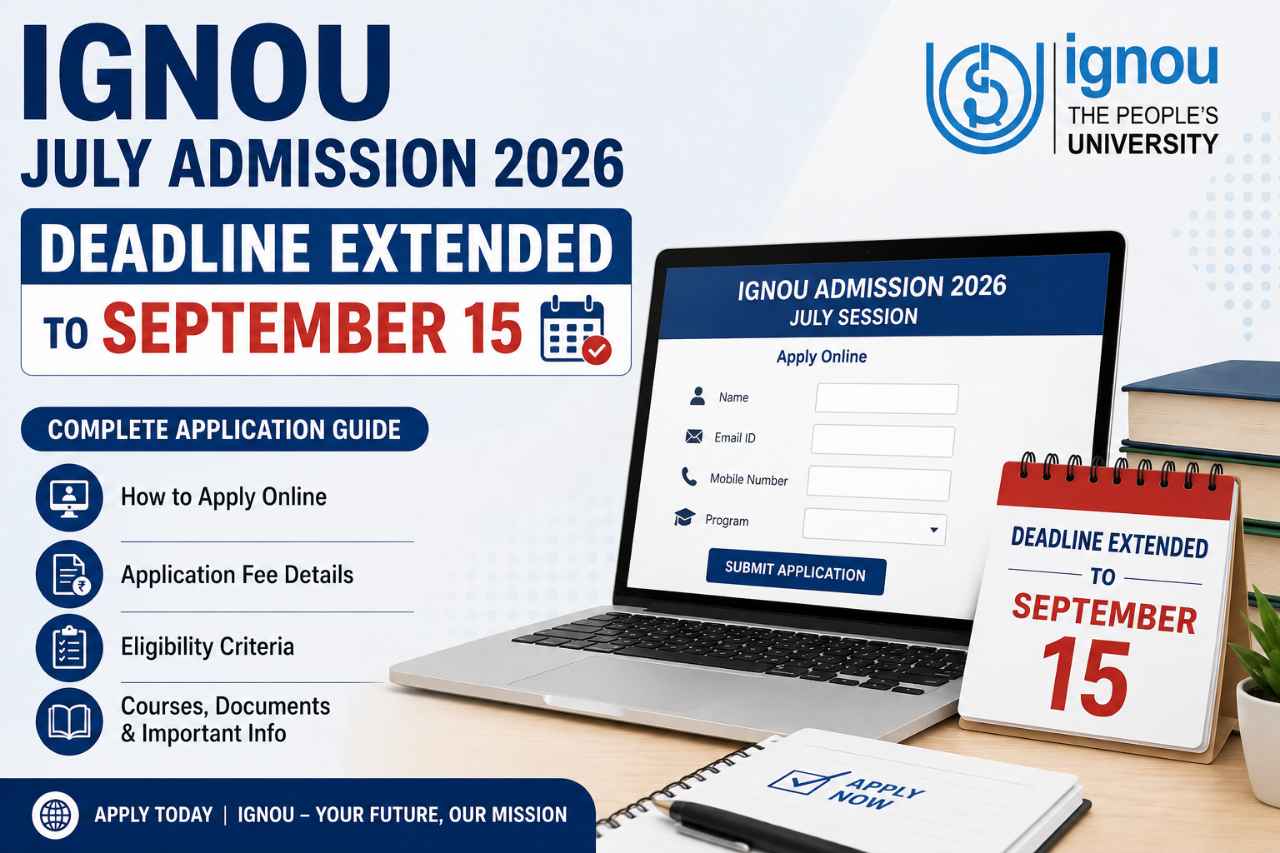
The Indira Gandhi National Open University (IGNOU) has extended the application submission deadline for its July 2026 admission cycle to September 15, 2026. If you missed the earlier cut-off or were still comparing programmes, this extension gives working professionals, recent school pass-outs, and career switchers extra time to complete registration without waiting for the January 2027 session.
IGNOU remains India's largest open university, offering degrees, diplomas, and postgraduate programmes through Open and Distance Learning (ODL) and fully online modes. The July session typically suits learners who want to begin academic work in the second half of the year. With the revised deadline, candidates can still secure admission for a wide range of UG, PG, diploma, and advanced certificate-level offerings—though standalone certificate courses are excluded from this extended window.
This CollegeDwar guide explains what changed, who can apply, which portal to use, documents you need (including APAAR ID), fees, and practical tips so you can submit a correct application before the new last date.
What Is the IGNOU July 2026 Admission Deadline Extension?
According to the official update reported on September 1, 2026, IGNOU pushed back the application submission deadline for the July 2026 admission cycle to 15 September 2026. The extension applies to programme applications submitted through the university's Samarth-based admission portals.
Important clarifications for applicants:
- The extension covers most IGNOU programmes under the July 2026 cycle.
- Certificate courses are not included in this extended opportunity—check programme category before you start.
- Two separate portals exist: one for ODL (Open and Distance Learning) programmes and one for online mode programmes.
- Candidates should treat September 15 as a firm cut-off; late submissions are generally not accepted once the portal closes.
For students comparing IGNOU with conventional campus colleges, the extension is especially useful. Many learners in cities such as Kota—where coaching hubs like those near MD Mission College Kota attract full-time aspirants—choose open learning to prepare simultaneously for competitive exams or to earn a degree while working.
Who Should Apply for IGNOU July 2026 Admission?
IGNOU's July session attracts a diverse applicant pool. You may benefit from applying now if you fall into any of these groups:
Working Professionals and Distance Learners
If you cannot attend regular lectures, IGNOU's ODL model lets you study from home with printed or digital study material, periodic assignments, and term-end examinations at designated centres. This suits bank employees, government staff, teachers, and private-sector workers upgrading qualifications.
Recent 10+2 or Graduate Pass-Outs
Students who did not secure a seat in a conventional college—or who want an affordable backup degree—often enrol in programmes such as BA, BCom, BSc, or technology-oriented courses. Those interested in computing may explore IGNOU's offerings alongside resources on Computer Applications or a structured Bachelor of Computer Application (BCA) pathway at other institutions for comparison.
Aspirants Preparing for Competitive Exams
Many students pursue an IGNOU degree while preparing for exams like the CAT or other national-level tests. Open learning reduces attendance pressure, though you must still manage assignment deadlines and exams alongside your preparation schedule.
Learners Seeking Flexible Postgraduate Options
MA, MSc, MBA, MCA, and specialist diplomas through IGNOU help graduates add credentials without leaving employment. Always verify recognition status and whether your target employer or higher-studies institution accepts IGNOU qualifications.
ODL vs Online Mode: Which Portal Should You Use?
A common mistake is applying on the wrong website. IGNOU operates distinct admission channels depending on delivery mode:
| Mode | Portal | Best For |
|---|---|---|
| ODL (Open and Distance Learning) | ignouadmission.samarth.edu.in | Traditional distance programmes with regional centre support, printed study material option, and centre-based exams |
| Online Programmes | ignouiop.samarth.edu.in | Programmes designed for fully online delivery with digital-first learning experience |
Before registering, open the official IGNOU prospectus or programme page and confirm whether your chosen course is listed under ODL or online mode. Applying through the incorrect portal can delay processing or require you to restart registration.
Documents and Details Required Before You Apply
IGNOU's Samarth admission system asks for accurate personal, academic, and identity information. Gather these before you begin:
- APAAR ID (Automated Permanent Academic Account Registry) — IGNOU advises keeping your APAAR ID ready. This national academic ID helps map learner records across institutions and aligns with broader higher-education digitisation efforts in India.
- Valid email address and mobile number — Both are verified through OTP during registration. Use active contact details you will retain for the full programme duration.
- Educational qualification certificates and marksheets — Scanned copies in prescribed format and file size.
- Category or reservation certificates — If applicable (SC/ST/OBC/EWS/PwD), upload valid proof.
- Passport-size photograph and signature — Follow portal specifications for dimensions and background.
- Identity proof — Aadhaar, passport, or other government-issued ID as listed in the form.
- Experience certificates — Required for select professional or PG programmes; check programme-specific eligibility.
Scan documents clearly. Blurry uploads are a leading cause of form rejection or verification delays at regional centres.
Step-by-Step: How to Apply for IGNOU July 2026 Admission
Follow the official process carefully. Minor errors in programme code or study centre preference can be difficult to change after submission.
- Visit the correct portal: ignouadmission.samarth.edu.in for ODL or ignouiop.samarth.edu.in for online programmes.
- Click "Click Here for New Registration" on the homepage.
- Fill the registration form with your name, email, mobile number, and other basic details; submit to receive login credentials via OTP-verified channels.
- Log in using the user ID and password sent to your registered email and mobile number.
- Select your programme, specialisation (if any), and preferred study material mode (printed, digital, or as offered).
- Enter academic details exactly as they appear on board or university certificates.
- Upload documents in the prescribed format and size limits shown on the portal.
- Pay the application or programme fee through available online payment modes.
- Click Submit and download or print the confirmation page for your records.
After submission, monitor your email and SMS for acknowledgement, document verification updates, and enrollment confirmation from your regional centre or online programme office.
Programmes Covered and Excluded Under the Extension
The September 15 extension is described as open to all programmes except certificate courses. In practical terms:
Likely Covered
- Undergraduate degrees: BA, BCom, BSc, BBA, BCA, and related programmes
- Postgraduate degrees: MA, MCom, MSc, MBA, MCA, and similar offerings
- Diplomas and advanced diplomas where listed in the July 2026 cycle
- PG diplomas and professional programmes under ODL or online mode
Excluded
- Certificate courses — These short-duration programmes fall outside the extended application window per the official announcement.
If you are unsure whether a programme is classified as a certificate course, refer to the official IGNOU admission brochure or contact the regional centre helpline before paying fees.
Fee Structure, Payment, and Cancellation Policy
IGNOU programme fees vary widely—from affordable certificate-level courses to higher-priced professional programmes. During application, the portal displays the fee payable for your selected programme.
Key financial points every applicant should understand:
- Payment is typically completed online during the application process on the Samarth portal.
- Keep digital receipts and bank transaction references until enrollment is confirmed.
- Cancellation after admission confirmation: IGNOU deducts an amount equivalent to 15% of the course fee, subject to a maximum of Rs 2,000, if a cancellation request is received after admission is confirmed.
- Soft copy study material option: If you opted for digital study material, refunds (where applicable) may be processed only after deducting the registration fee component.
Read the refund and cancellation rules on the official portal before submitting payment. Treat fee payment as final unless you clearly understand the deduction structure.
Why IGNOU Remains a Popular Choice in Indian Higher Education
IGNOU's scale and reach make it a cornerstone of open learning in India. Learners choose it for several reasons:
- Affordability compared with many private universities and autonomous colleges
- Nationwide regional centre network for academic support and examinations
- Flexibility for employed learners, homemakers, and those in remote areas
- Wide programme catalogue spanning humanities, sciences, management, education, and vocational fields
That said, open learning demands self-discipline. Unlike residential campuses such as DMI College of Engineering Chennai or research-focused institutes like Ramakrishna Mission Vivekananda Educational and Research Institute, Howrah, IGNOU places greater responsibility on the student to follow self-study schedules, submit assignments on time, and appear for term-end exams without daily classroom reminders.
Actionable Tips to Complete Your Application Before September 15
Use these practical steps to avoid last-minute errors as the extended deadline approaches:
- Shortlist two or three programmes and compare eligibility, duration, and career relevance before registering.
- Create or retrieve your APAAR ID early—do not wait until the final day when support systems may be overloaded.
- Use a desktop or laptop for form filling and document uploads; mobile browsers sometimes cause formatting issues.
- Double-check programme codes and regional centre preferences; corrections after confirmation can be slow.
- Complete payment in one session and save the confirmation PDF immediately.
- Avoid unofficial agents promising guaranteed admission; use only IGNOU's official Samarth portals.
- Apply at least three to five days before September 15 to handle OTP delays, payment failures, or document re-uploads.
After You Apply: What Happens Next?
Submission is not the same as final enrollment. After the application deadline closes, IGNOU typically undertakes document verification, fee reconciliation, and generation of enrollment numbers for confirmed candidates.
Expect communication through your registered email and mobile number. You may need to visit your regional centre for original document verification depending on programme requirements. Once enrolled, collect or download your identity card, programme guide, and assignment submission schedule.
New learners should mark assignment last dates and term-end exam windows on a calendar at the start of the session. Missing assignment submissions can affect term-end exam eligibility in many IGNOU programmes.
Understanding APAAR ID and Why It Matters for IGNOU Applicants
The Automated Permanent Academic Account Registry (APAAR ID) is part of India's broader effort to create a unified digital identity for learners across schools, colleges, and universities. For IGNOU July 2026 applicants, keeping this ID ready is no longer a optional convenience—it is a practical requirement flagged by the university at the time of registration.
APAAR helps link your academic achievements, credit transfers, and enrollment records across institutions. If you have recently completed Class 12 or a undergraduate degree from another board or university, your APAAR profile may already exist through your previous institution's onboarding process. Students who do not yet have an APAAR ID should create one through the official government academic registry channels before starting the IGNOU form, as last-minute ID generation can add hours or days to your application timeline.
When entering APAAR details on the Samarth portal, match the ID exactly as issued. Typos can cause mismatches during verification. If your name on APAAR differs from your board certificate due to spelling variations, resolve the discrepancy with supporting documents before applying rather than after admission confirmation.
Eligibility Criteria: What You Need for Popular IGNOU Programmes
Each IGNOU programme carries specific eligibility norms listed in the official prospectus. While exact rules vary, the following overview helps you self-assess before the September 15 deadline:
Undergraduate Programmes
Most bachelor's degrees require a 10+2 pass from a recognised board. Some science programmes may prefer or require specific subjects at the senior secondary level. Technology-oriented UG options may appeal to students who also research conventional Computer Applications degrees at campus colleges. There is generally no upper age limit for UG admission at IGNOU, which benefits returning learners.
Postgraduate Programmes
Master's degrees typically require a relevant bachelor's degree with minimum aggregate marks as specified per programme. MBA and other management programmes may additionally require work experience or entrance components depending on the current admission policy. Always read the latest programme guide because eligibility norms can change between sessions.
Diploma and PG Diploma Programmes
Diplomas often accept 10+2 or graduation depending on level. PG diplomas usually require a bachelor's degree in a related or any discipline as stated in the prospectus. These programmes suit learners seeking shorter, skill-focused credentials before committing to a full degree.
How IGNOU's Academic System Works After Enrollment
Successful admission is only the starting point. IGNOU learners progress through a structured cycle of self-study, assignments, and examinations that differs significantly from daily attendance-based colleges.
After enrollment, you receive programme study material—printed, digital, or both depending on your selection at admission. Each course includes tutor-marked assignments (TMAs) that must be submitted by published deadlines. Failure to submit assignments on time can make you ineligible to sit for the corresponding term-end theory examination in many programmes.
Term-end exams are held twice a year for most courses, at designated examination centres across India. You choose exam slots during the exam form window and pay applicable exam fees separately in many cases. Results are published on the official IGNOU website, and grade cards or degree certificates follow after completing all required credits.
Planning ahead matters. If you are simultaneously preparing for a high-stakes test such as the CAT, map IGNOU assignment weeks against your mock-test schedule to avoid clashes during peak preparation months.
Common Mistakes Applicants Should Avoid
Even experienced applicants make errors that delay enrollment. Watch out for these frequent issues during the extended July 2026 admission window:
- Wrong portal selection — ODL and online applications use different websites; starting on the wrong one wastes time.
- Programme code confusion — Similar programme names may have different codes; verify against the prospectus PDF.
- Name mismatch — Enter your name exactly as on your Class 10 or graduation certificate to avoid document rejection.
- Incorrect category claims — Upload valid reservation certificates; unsupported claims can lead to cancellation.
- Poor-quality scans — Low-resolution uploads of marksheets or photos cause verification failure.
- Ignoring confirmation email — Save login credentials and payment receipts immediately after submission.
- Assuming certificate courses are included — They are excluded from this extension; confirm programme type first.
- Last-day rush — Server load and payment gateway timeouts spike on final days; apply early.
IGNOU vs Regular College: Making the Right Choice
Choosing between IGNOU and a conventional campus institution depends on your goals, finances, and schedule. IGNOU excels when flexibility and affordability are priorities. Residential colleges—whether engineering institutes like DMI College of Engineering Chennai or multidisciplinary campuses—offer structured timetables, peer networks, placements, and lab access that open universities cannot fully replicate.
Many students use a hybrid strategy: pursue IGNOU for a BA or BCom while attending coaching in academic hubs, or complete a IGNOU PG diploma while working full time. Others choose a regular BCA programme when they want campus placements and daily faculty interaction. Neither path is universally superior; align your choice with career stage and learning style.
IGNOU July 2026 Admission at a Glance
| Detail | Information |
|---|---|
| Admission Cycle | July 2026 |
| Extended Application Deadline | September 15, 2026 |
| ODL Portal | ignouadmission.samarth.edu.in |
| Online Programmes Portal | ignouiop.samarth.edu.in |
| Certificate Courses | Not covered under extension |
| Key Requirement | APAAR ID, OTP-verified email and mobile |
| Cancellation Charge (post-confirmation) | 15% of course fee, max Rs 2,000 |
Conclusion
The extension of IGNOU's July 2026 admission application deadline to September 15, 2026 is a meaningful second chance for learners who want to begin or continue higher education through open and online modes. Whether you are a working professional, a student balancing exam preparation, or a graduate seeking an affordable PG qualification, the key is to act early, use the correct portal, and submit accurate documents—including your APAAR ID.
Certificate courses remain outside this extended window, so verify your programme category before payment. Read cancellation and refund rules carefully, keep confirmation printouts, and plan your study schedule realistically. With organised preparation, you can secure your seat in India's premier open university before the revised cut-off date passes.