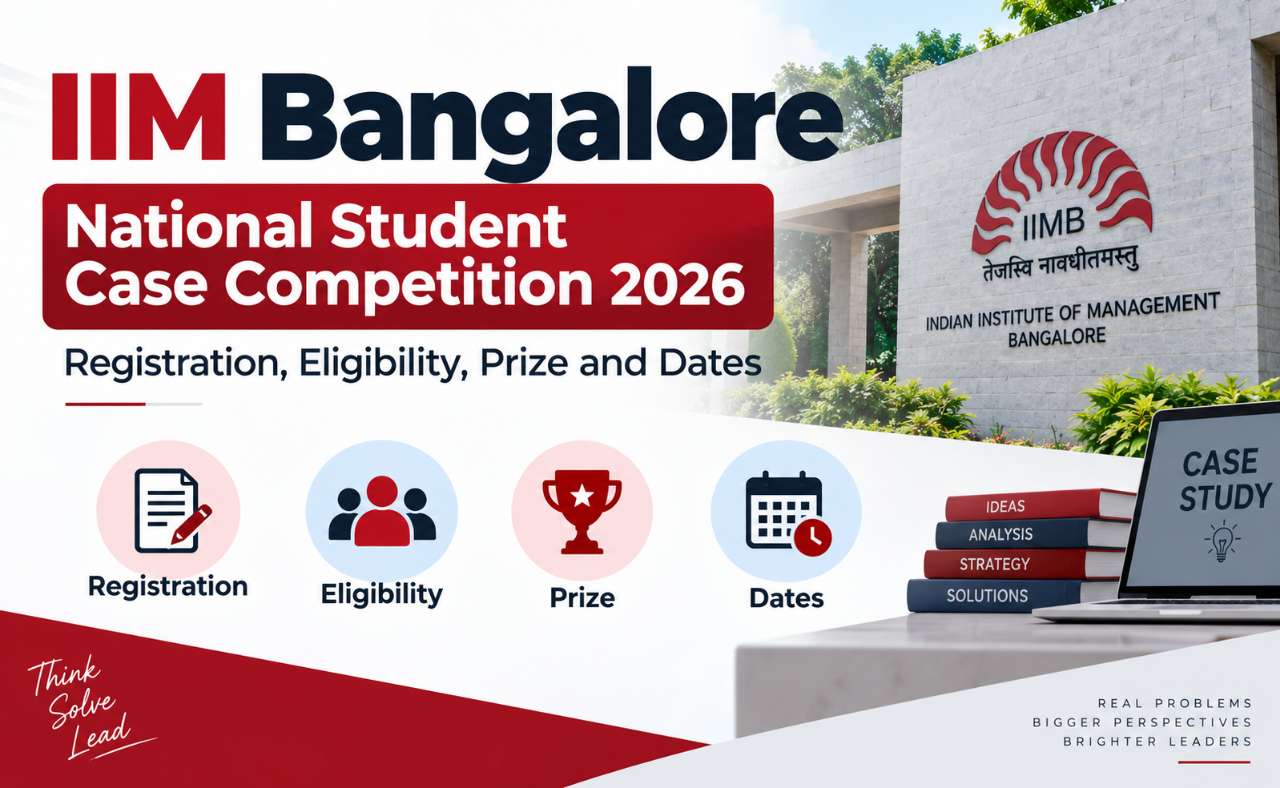
The Indian Institute of Management Bangalore (IIM Bangalore) has opened registration for the National Student Case Competition 2026, one of India's most visible student-led platforms for solving real policy and technology problems. Organised by the Centre for Digital Public Goods (CDPG) at the campus with support from Perfios Anumati Account Aggregator, the competition invites undergraduate and postgraduate students from any recognised college or university to design practical solutions around India's Digital Public Infrastructure (DPI).
With a ₹5 lakh prize pool for the winning team, a National shortlist announcement on 15 September 2026, and the grand finale on 30 September 2026 at the IIM Bangalore campus, the event offers far more than prize money. Participants gain exposure to policymakers, academics, and industry practitioners while building analytical, teamwork, and presentation skills that recruiters value. If you are a student in management, law, economics, design, public policy, or social sciences, this guide explains eligibility, deadlines, team rules, preparation tips, and how to register before the 7 September 2026, 6:00 PM cutoff.
What Is the IIM Bangalore National Student Case Competition 2026?
The National Student Case Competition is an annual, all-India case challenge hosted by Indian institute of Management Bangalore. Unlike textbook case studies confined to classrooms, this competition asks teams to respond to live challenges linked to Digital Public Infrastructure—the shared digital systems that power services such as identity verification, payments, data exchange, and consent-based financial information sharing across India.
DPI has reshaped how citizens access banking, healthcare records, government benefits, and digital commerce. The competition reflects that reality. Students are expected to think like consultants and policy analysts: understand a complex ecosystem, identify friction points, propose scalable solutions, and defend their recommendations before expert judges.
The 2026 edition is particularly relevant for students who want experience at the intersection of technology, governance, and social impact. Whether you study at a business school, a National Law University, an IIT or NIT, or a liberal arts programme, the competition rewards clarity of thinking over brand-name institutions alone.
About the Organisers: CDPG and Perfios Anumati
The announcement for NSCC 2026 was made by the Centre for Digital Public Goods (CDPG) at IIM Bangalore. CDPG works on research, education, and outreach around digital public goods and infrastructure that serve broad public interest rather than private profit alone. Their involvement signals that submissions will be evaluated on social impact, scalability, and governance quality—not only commercial viability.
Support from Perfios Anumati Account Aggregator connects the competition to India's live fintech and account aggregation ecosystem. Account aggregators enable consent-based sharing of financial information between institutions, a core layer of India's DPI stack. Students who understand how aggregation, consent, and trust intersect will be better prepared for case prompts and judge questions during the finale.
Why Digital Public Infrastructure Matters for Students
India's DPI stack—including initiatives around identity, payments, and account aggregation—has become a reference model globally. For students, understanding DPI is no longer niche. It connects directly to careers in fintech, public policy, product management, compliance, cybersecurity, and social entrepreneurship.
Participating in this case competition helps you:
- Translate abstract policy concepts into actionable recommendations
- Learn how regulators, startups, and public institutions interact
- Build a portfolio-worthy project for internships and placements
- Network with mentors who work on live DPI deployments
Students from institutions such as the International Institute of Information Technology Bangalore or India institute of Science Bangalore often excel in technology-heavy cases, while law and policy students from places like National Law School of India University Bangalore bring regulatory and ethical depth. The competition explicitly welcomes this diversity.
Key Dates and Timeline for NSCC 2026
Missing a deadline can disqualify an otherwise strong team. Mark these dates on your calendar and share them with every team member and faculty mentor.
| Event | Date | Details |
|---|---|---|
| Registration opens | Early September 2026 | Apply via the official IIM Bangalore website (iimb.ac.in) |
| Registration deadline | 7 September 2026, 6:00 PM | Late entries are typically not accepted |
| Shortlist announcement | 15 September 2026 | Selected teams notified by the institute |
| Grand finale | 30 September 2026 | Final competition held on the IIM Bangalore campus |
The compressed timeline means teams should begin internal preparation immediately after registration. Use the gap between 7 September and 15 September to refine your problem understanding, even before official case materials arrive for shortlisted teams.
Eligibility Criteria: Who Can Apply?
IIM Bangalore has kept eligibility broad to reflect the multidisciplinary nature of DPI challenges. According to the official notification, the following students may apply:
- Current enrolment: You must be actively pursuing a bachelor's or master's degree at the time of registration
- Recognised institution: Your college or university must be recognised in India
- Programme type: Both full-time and part-time programmes are eligible
- Discipline: Open to all fields, including management, public policy, law, economics, design, and social sciences
- Geography: Open to students from any state or union territory
This means a part-time MBA student at Indira Gandhi National Open University can compete alongside a BBA student from Christ University Bangalore or an engineering undergraduate from Malaviya National Institute of Technology MNIT Jaipur.
Who Cannot Apply?
While the competition is inclusive, typical restrictions in such events may include:
- Students who have already graduated or completed their final examinations
- Individuals registered in more than one team simultaneously
- Teams with fewer than five members
Always verify the latest fine print on the official registration portal before submitting, as organisers may update clauses each year.
Team Formation Rules and Composition Tips
Every team must have at least five members. There is no cap mentioned on maximum team size in the public notification, but lean teams of five to seven often coordinate faster during intense case prep.
Official Team Guidelines
- Minimum size: 5 students per team
- Single-team rule: Each student may belong to only one team
- Institutional entries: No limit on how many teams from the same college can register
- Diversity encouraged: IIM Bangalore recommends gender-balanced teams with members from different academic years and programmes
The diversity recommendation is strategic. DPI problems touch law, product design, economics, operations, and user experience. A team mixing a law student from Gujarat National Law University Gandhinagar, an economics postgraduate, and a computer science student mirrors how real-world DPI projects are staffed.
How to Build a Winning Team Structure
Assign clear roles early:
- Research lead: Maps DPI ecosystem, stakeholders, and data sources
- Policy and compliance lead: Handles regulatory framing and risk analysis
- Financial modelling lead: Builds cost-benefit and sustainability arguments
- Design and presentation lead: Creates slides, visuals, and user journeys
- Project captain: Owns timelines, submission quality, and rehearsal schedules
Teams from Bangalore institutions—such as Bangalore University Bangalore, Azim Premji University Bangalore, or Alliance University Bangalore—have a logistics advantage for the on-campus finale, but outstation teams from National Institute of Technology Delhi NIT Delhi or Maulana Azad National Institute of Technology Bhopal regularly compete at national case events and win on merit.
Prize Pool, Recognition, and Career Benefits
The headline reward is a ₹5 lakh prize pool for the winning team. While the exact split among team members is determined by organisers, even dividing across five students represents meaningful financial recognition for a student competition.
Beyond cash, benefits include:
- Participation certificates for students, useful for CVs and LinkedIn profiles
- Direct exposure to policymakers, academics, and practitioners working on DPI
- Expert feedback that sharpens your consulting and public-speaking skills
- Institutional visibility for your college when shortlisted teams are announced nationally
For students targeting MBA admissions, public policy fellowships, or fintech roles, listing a national shortlist or finalist position at IIM Bangalore signals analytical rigour and real-world relevance—qualities admissions committees and recruiters actively seek.
Understanding the Theme: Digital Public Infrastructure Cases
Digital Public Infrastructure refers to shared digital building blocks that enable society-wide services at scale. In the Indian context, think of interoperable systems that let a citizen prove identity, receive benefits, authorize payments, or share financial data securely—with consent.
What Problem Areas Might Appear?
While exact case prompts are released to shortlisted teams, preparation should cover:
- Financial inclusion: Expanding credit access through account aggregation and alternative data
- Consent architecture: Designing user-friendly consent flows that protect privacy
- Interoperability: Connecting siloed databases across states and departments
- Fraud prevention: Balancing security with accessibility for rural users
- Gender and inclusion: Ensuring DPI serves women, seniors, and persons with disabilities
- Sustainability: Funding models for public digital rails without over-burdening users
Students at National Academy of Legal Studies Research Nalsr University Hyderabad might focus on consent law and data protection, while design students emphasise UX for low-literacy populations. Both angles strengthen a single submission.
Framework for Analysing Any DPI Case
Use this five-step approach during prep:
- Define the stakeholder map: citizens, banks, fintechs, regulators, government agencies
- Identify the pain point: cost, trust deficit, latency, exclusion, or fraud
- Benchmark global parallels: compare with models from Estonia, Singapore, or Brazil where relevant
- Propose a phased solution: pilot, measure, scale— with realistic budgets
- Address risks upfront: privacy, cybersecurity, political feasibility, and digital literacy
Recommended Reading Before Registration
You do not need to be a technology expert to compete, but baseline literacy helps. Explore publicly available material on India's Unified Payments Interface (UPI), account aggregator frameworks, Aadhaar-enabled services, and the Digital Personal Data Protection Act. Free reports from NITI Aayog, RBI bulletins, and NPCI white papers offer credible citations for your slides. Faculty at Rai Technology University Bangalore or Jaipur National University Jaipur may also guide literature reviews if your team lacks a technical member.
How to Register for NSCC 2026 on iimb.ac.in
Registration is conducted online through the official IIM Bangalore website. No third-party portals should be used. Gather documents and team details before starting the form to avoid incomplete submissions near the deadline.
Documents and Details to Keep Ready
- Full names and email IDs of all five or more team members
- College or university name and programme details for each member
- Contact number of the team captain
- Proof of current enrolment if requested (student ID or bonafide certificate)
- Team name and brief description of member roles (if the form asks)
Double-check that no member is registered in another team. Violating the one-team rule can lead to disqualification of both entries.
Preparation Strategy: From Registration to Finale
Strong teams treat the competition like a six-week consulting engagement compressed into days. Here is a practical roadmap.
Phase 1: Before 7 September (Registration Week)
- Finalize team roster and roles
- Assign one member to complete registration before 6 PM on 7 September
- Begin reading RBI, NPCI, and MeitY publications on DPI and account aggregation
- Schedule two internal workshops on case analysis and slide design
Phase 2: 8 15 September (Shortlist Waiting Period)
- Study past public case competitions for structure and judging patterns
- Practice guesstimates on Indian digital adoption statistics
- Prepare a generic executive-summary template you can adapt quickly
- Confirm travel plans to Bangalore if shortlisted, including budget for accommodation
Phase 3: After Shortlist Announcement
- Divide the official case into workstreams immediately
- Set internal deadlines 24 hours before the actual submission to allow review time
- Rehearse a 10 15 minute presentation with strict timekeeping
- Prepare for Q&A on implementation risks, data privacy, and cost assumptions
Phase 4: Finale on 30 September
- Arrive at the IIM Bangalore campus early to test presentation equipment
- Bring printed backups of slides and one-page executive summaries
- Dress professionally—first impressions matter in case competitions
- Engage respectfully during other teams' presentations; judges notice teamwork culture
Travel and Logistics for Outstation Teams
If you are travelling from cities such as Jaipur, Delhi, Lucknow, or Hyderabad, book refundable transport early because the September shortlist leaves limited time to arrange travel. Budget for two nights in Bangalore around the finale date. Student hostels and shared accommodations near Bannerghatta Road or Koramangala are popular options. Carry both digital and printed copies of your college ID, shortlist confirmation, and presentation files on separate devices.
Why Colleges Should Encourage Multiple Teams
IIM Bangalore has placed no restriction on the number of teams per institution. Deans, placement cells, and faculty advisors should treat this as a low-cost, high-impact opportunity.
Benefits for colleges include:
- Enhanced brand visibility when teams are shortlisted nationally
- Stronger placement narratives around practical learning
- Cross-department collaboration among law, management, and technology schools on the same campus
Institutions such as Cmr University Bangalore, Reva University Bangalore, and Ms Ramaiah University Of Applied Sciences Bangalore can nominate several teams across faculties rather than limiting participation to a single commerce or MBA cohort.
Common Mistakes Teams Should Avoid
- Registering with exactly five members but no backup: illness during the finale can derail your presentation
- Ignoring gender and interdisciplinary balance: weak teams often share the same syllabus and perspective
- Over-indexing on jargon: judges value clarity over buzzwords like "blockchain" without context
- Skipping financial realism: solutions without cost estimates appear ungrounded
- Waiting for the case release to start DPI reading: start now to build foundational knowledge
- Submitting registration at 5:59 PM without verification: portal traffic spikes can cause failures
How NSCC Compares to Other Student Competitions in India
India's higher-education calendar includes hundreds of B-plan contests, hackathons, and moot courts. The IIM Bangalore National Student Case Competition stands out because:
- It is anchored to a live national priority—DPI—not generic business scenarios
- It welcomes all disciplines, not only MBA students
- It culminates on the campus of a top Indian Institute of Management, adding credibility
- It connects students directly to policy and industry stakeholders
Law students might simultaneously prepare for moot courts at Dr Ram Manohar Lohiya National Law University Lucknow or Hidayatullah National Law University Raipur, while management students balance internship season—yet NSCC rewards those who can integrate cross-functional thinking, a skill rare in single-discipline contests.
Quick Reference: NSCC 2026 at a Glance
- Organiser: Centre for Digital Public Goods (CDPG), IIM Bangalore
- Theme: Digital Public Infrastructure challenges in India
- Eligibility: UG and PG students at recognised Indian institutions
- Team size: Minimum 5 members; one team per student
- Registration portal: iimb.ac.in
- Deadline: 7 September 2026, 6:00 PM
- Shortlist: 15 September 2026
- Finale: 30 September 2026, IIM Bangalore campus
- Prize: ₹5 lakh for the winning team
Conclusion
The IIM Bangalore National Student Case Competition 2026 is a timely opportunity for India's undergraduate and postgraduate students to engage with Digital Public Infrastructure—the backbone of modern governance and finance. With registration open until 7 September 2026 at 6:00 PM, a ₹5 lakh prize pool, shortlist results on 15 September, and the campus finale on 30 September, the timeline is tight but manageable for prepared teams.
Form a gender-balanced, interdisciplinary team of at least five, register only through iimb.ac.in, and begin studying India's digital public stack today. Whether you study at a premier national institution or a regional university, your ideas can reach policymakers and practitioners who shape how millions of Indians access digital services. Do not wait until the last hour—strong registrations and strong cases both start early.