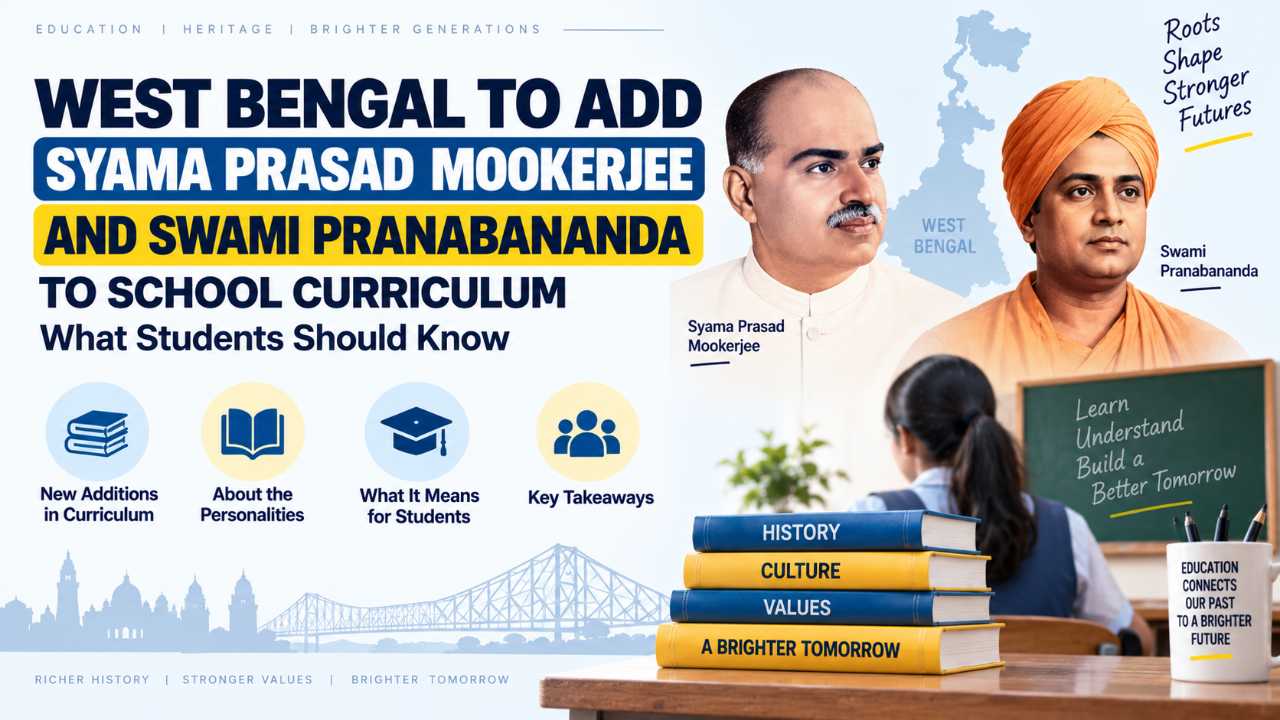
On National Teachers' Day, September 5, 2026, West Bengal Chief Minister Suvendu Adhikari announced a major shift in school education policy: the state will introduce the contributions of Syama Prasad Mookerjee and Swami Pranabananda into the school curriculum. Alongside this, the government pledged Rs 300 crore in composite grants for state-run and aided schools. For students, parents, and educators tracking Indian education from school boards to college admissions this announcement signals how political transitions can reshape what children learn and how institutions are funded.
This guide explains what was announced, who these historical figures were, how curriculum changes typically roll out in India, and what it means for learners preparing for boards, competitive exams, and higher education. Whether you are a Class 10 student in Kolkata, a teacher in Siliguri, or a parent planning admissions after school, understanding policy shifts like this helps you stay ahead academically and make informed choices about colleges and courses across India.
What Did the West Bengal Government Announce?
Addressing a National Teachers' Day event in Kolkata, CM Suvendu Adhikari stated that his government would formally include the contributions and sacrifices of Syama Prasad Mookerjee and Swami Pranabananda in the school curriculum. He argued that without their roles during Partition and the formation of West Bengal, the state's identity and the safety of millions during that turbulent period would have looked very different.
In the same address, the Chief Minister announced Rs 300 crore as composite grants for government and aided schools. He claimed that infrastructure and basic amenities in many institutions had deteriorated under the previous Trinamool Congress (TMC) administration, which he said prioritised sports events, fairs, puja grants, and specific religious allowances over core school needs. The BJP-led government positioned its approach as repair-focused and inclusive.
Key Points at a Glance
- Curriculum change: Contributions of Syama Prasad Mookerjee and Swami Pranabananda to be added to school syllabus.
- Funding: Rs 300 crore composite grants for state-run and aided schools.
- Timing: Announced on National Teachers' Day, September 5, 2026.
- Policy framing: Emphasis on inclusive education and infrastructure restoration.
Who Was Syama Prasad Mookerjee?
Dr Syama Prasad Mookerjee (1901–1953) was a barrister, academic administrator, and political leader closely associated with Bengal's transition during Partition. He served as the first Minister for Industry and Supply in independent India's cabinet and later founded the Bharatiya Jana Sangh, a predecessor organisation to the modern Bharatiya Janata Party (BJP).
Historians and political scholars often discuss Mookerjee in three contexts relevant to school and college learners:
- Partition and Bengal: His advocacy during the division of Bengal and debates over whether Hindu-majority districts would join India or Pakistan.
- Education leadership: He was Vice-Chancellor of the University of Calcutta at a young age, linking his legacy to higher education governance.
- Political ideology: His views on national integration, Article 370, and federalism remain part of India's post-Independence political discourse.
Students exploring institutions named after him may refer to resources such as Dr Shyama Prasad Mukherjee University in Jharkhand or the Dr Shyama Prasad Mukherjee International Institute of Information Technology in Naya Raipur, which reflect how his name continues in India's higher education landscape.
Who Was Swami Pranabananda?
Swami Pranabananda (1896–1941) was a monk and social reformer who founded the Bharat Sevashram Sangha, a volunteer organisation known for disaster relief, healthcare camps, and community service across India and abroad. Born in what is now Bangladesh, he worked extensively in Bengal and emphasised seva (selfless service), youth mobilisation, and spiritual discipline.
For curriculum purposes, educators typically highlight:
- His role in organising relief during floods, famines, and communal disturbances.
- Establishment of ashrams and seva centres that still operate today.
- Contributions to Bengali spiritual and cultural life in the early 20th century.
West Bengal's decision to pair a political figure with a seva-oriented spiritual leader suggests an attempt to blend state formation narratives with social service traditions. Students interested in social work and community development can draw parallels with institutions like the Madras School of Social Work in Chennai, which trains professionals for grassroots and institutional roles.
Why Do School Curriculum Changes Matter for Higher Education?
School syllabus revisions are not isolated events. They shape board exam questions, influence competitive exam general knowledge sections, and affect how students interpret history, civics, and social science before entering college.
Direct Impact on Students
- Board exams: West Bengal Board of Secondary Education (WBBSE) and West Bengal Council of Higher Secondary Education (WBCHSE) may update textbooks once the curriculum framework is approved.
- Competitive exams: UPSC, state PSC, and teaching eligibility tests (TET) often include regional history and freedom-movement figures.
- Foundation for college: Arts, law, and humanities programmes assume familiarity with political history taught at the school level.
Aspirants targeting premier institutions whether National Law School of India University in Bangalore or Delhi-based management schools like FORE School of Management benefit from reading beyond textbooks. Policy-aware students perform better in interviews and essay components where contemporary education debates arise.
Timeline: How Curriculum Updates Usually Happen
After a political announcement, several administrative steps typically follow before students see new content in classrooms:
- State education department issues a formal notification or curriculum revision order.
- Expert committees draft learning outcomes and age-appropriate content for each class.
- Textbook corporations publish revised editions or supplementary modules.
- Teacher training programmes are conducted through DIETs and block-level workshops.
- Board exam blueprints are updated for the academic session in which the change takes effect.
As of the September 2026 announcement, specific class levels, textbook titles, and implementation dates had not yet been published in detail. Students should monitor official notifications from the West Bengal School Education Department rather than relying on social media summaries alone.
Rs 300 Crore Composite Grants: What Schools Can Expect
The Chief Minister's pledge of Rs 300 crore in composite grants targets infrastructure repair in government and aided schools. Composite grants in Indian school finance usually cover multiple heads classroom maintenance, furniture, sanitation, drinking water, boundary walls, and basic digital equipment rather than a single line item.
Why Infrastructure Funding Matters
Quality school infrastructure correlates with better attendance, safer learning environments, and smoother transitions to higher education. Schools with functional labs, libraries, and internet access help students prepare for entrance exams such as JEE, NEET, and CUET. A student in a well-equipped higher secondary school is more likely to access coaching resources and career counselling before applying to colleges.
The announcement implicitly connects school renewal with curriculum reform: better buildings and clearer historical narratives are presented as two pillars of the new government's education agenda. Critics of previous administrations often argue that event-heavy spending diverted funds from classrooms; supporters of the new policy hope grants will reach block and district levels transparently.
What Parents and School Management Committees Should Watch
- Grant allocation criteria per-school amount vs. need-based formula.
- Public dashboards or RTI-accessible utilisation reports.
- Whether aided schools receive parity with fully government-run institutions.
- Timeline for disbursement before the 2026–27 academic session ends.
Political Context and Inclusive Education Debate
CM Adhikari alleged that the previous TMC government favoured students of a particular community in religious educational institutions as part of an appeasement policy. He contrasted this with his government's stated commitment to an inclusive approach. Such statements reflect broader national debates on secular curriculum design, representation of religious and regional histories, and equitable fund distribution.
For educators and college aspirants, the takeaway is practical: curriculum politics affects content selection. Inclusive education means presenting multiple perspectives, citing verified sources, and encouraging critical thinking skills valued at institutions ranging from Jesus and Mary College in Delhi to technical universities like Chhattisgarh Swami Vivekanand Technical University in Bhilai.
Students should learn to distinguish between political rhetoric at announcement events and finalized syllabus documents approved by academic bodies. Reliable study material comes from board-prescribed textbooks, NCERT reference standards where applicable, and peer-reviewed historical accounts.
West Bengal Education Landscape: Boards, Exams, and College Pathways
West Bengal operates one of India's largest state school systems, with millions of learners across Bengali, English, Hindi, and Urdu mediums. After Class 10 (Madhyamik) and Class 12 (Higher Secondary), students pursue undergraduate programmes in universities such as Calcutta University, Jadavpur University, and numerous affiliated colleges.
Major School-Level Examinations
- WBBSE Madhyamik – Class 10 state board examination.
- WBCHSE Higher Secondary – Class 12 examination for college admission.
- ICSE/ISC and CBSE – National boards with schools across Kolkata, Darjeeling, and other districts.
Curriculum changes under the state board directly affect WBBSE and WBCHSE students. CBSE and ICSE schools in West Bengal follow central or council syllabi unless the state mandates supplementary modules a less common but possible scenario for specific themes.
Link to Teacher Recruitment and Training
West Bengal periodically recruits school teachers through examinations such as the Teacher Eligibility Test (TET) and state-level selection processes. When new curriculum content is introduced, teacher training becomes essential. The National Council for Teacher Education (NCTE) and recent Supreme Court directives on annual appraisal reports for teacher training institutes underscore nationwide quality expectations.
Aspiring teachers should track BPSC and state education department notifications similar to how candidates elsewhere follow Jharkhand JAC results or CBSE CTET schedules. Updated syllabi mean updated pedagogy requirements in training colleges and B.Ed. programmes.
Comparing Curriculum Reforms Across Indian States
West Bengal is not alone in revisiting school history content. Several states have updated textbooks to highlight regional leaders, reformers, and freedom fighters. Understanding these patterns helps students in multi-state exam preparation.
| Aspect | Typical State Approach | Student Action |
|---|---|---|
| Historical figures | Addition of state-specific leaders to social science units | Update notes when official textbooks release |
| Funding announcements | Composite grants or smart-class schemes | Verify implementation via school committees |
| Board alignment | State boards revise first; national boards may differ | Confirm which board your school follows |
| Exam weightage | 1–3 questions in HS civics/history papers | Practice short-answer formats |
Institutions named after national figures illustrate how history intersects with branding in higher education. Beyond Mookerjee-linked universities, India hosts many colleges honouring spiritual and social leaders such as Swami Vivekananda University, Swami Vivekanand College of Management in Jaipur, and Swami Shraddhanand College in Delhi showing how educational nomenclature reflects cultural priorities.
Actionable Tips for Students, Parents, and Teachers
For School Students (Classes 8–12)
- Follow official WBBSE and WBCHSE websites for syllabus notifications.
- Maintain a current affairs notebook linking state policy news to history chapters.
- Use map work and timeline charts for Partition-related topics often asked in board exams.
- Balance textbook study with NCERT social science books for competitive exam overlap.
For College Aspirants
- If applying to BA History, Political Science, or Sociology programmes, demonstrate awareness of Bengal's Partition history in entrance interviews where applicable.
- Explore interdisciplinary options economics schools like Madras School of Economics in Chennai or Bengaluru Dr. B.R. Ambedkar School of Economics value analytical writing on policy topics.
- Consider law programmes at universities such as Dr Rajendra Prasad National Law University if constitutional history interests you.
For Teachers and Trainers
- Participate in DIET workshops once curriculum training schedules are released.
- Develop age-appropriate lesson plans that present facts with source citations.
- Encourage classroom debate with ground rules for respectful discussion of sensitive historical events.
- Connect local seva organisations' community work when teaching about Swami Pranabananda's legacy.
SEO and Exam-Oriented Quick Facts (Featured Snippet Ready)
When was the WB curriculum announcement made? September 5, 2026, on National Teachers' Day in Kolkata.
Who announced it? West Bengal Chief Minister Suvendu Adhikari.
Which figures will be added? Syama Prasad Mookerjee and Swami Pranabananda.
How much funding was announced? Rs 300 crore in composite grants for state-run and aided schools.
Which board students are most affected? Primarily WBBSE and WBCHSE learners; confirm with your school for CBSE/ICSE status.
Broader Implications for Education Policy in India
Curriculum decisions sit at the intersection of federal structure and state autonomy. While the National Education Policy (NEP) 2020 provides a framework for competency-based learning and multidisciplinary education, states retain significant control over school syllabi. West Bengal's latest move illustrates how electoral outcomes can accelerate specific content priorities.
For higher education planners, sustained school quality affects the pipeline of students entering engineering, medical, law, and arts colleges. Infrastructure grants may reduce dropout rates and improve science lab access indirectly supporting STEM pathways to institutes like IIT (ISM) Dhanbad or Galgotias College of Engineering and Technology.
Design and architecture aspirants can note how institutional identity shapes campuses compare legacy art schools such as Sir J J School of Art, Architecture and Design with planning institutes like School of Planning and Architecture, New Delhi or School of Architecture, Anna University Chennai. Education policy, much like campus design, builds on historical choices made decades earlier.
What Happens Next? Watch These Official Channels
Until the West Bengal School Education Department publishes detailed orders, treat the Chief Minister's speech as a policy intent statement. Reliable next steps include:
- Notification in the Kolkata Gazette or department website.
- Textbook revision meetings involving SCERT West Bengal.
- Budget line-item confirmation in state finance documents.
- Integration into teacher training calendars for 2026–27 or 2027–28 sessions.
Students elsewhere in India whether studying at Swami Vivekananda College in Sikar, exploring design courses at International School of Design in Jaipur, or preparing for health sciences through Dr NTR University of Health Sciences in Vijaywada can use this development as a case study in how state politics influences school education, a recurring theme in UPSC GS Paper II.
Connecting School Reforms to College Planning
Education policy announcements like this one are most useful when translated into a personal academic plan. If you are in Class 11 or 12, map how revised history or civics units may appear in your board exam blueprint and adjust revision timetables accordingly. If you are a working professional considering a career shift into teaching, explore B.Ed. and D.El.Ed. routes at established institutions such as Thiagarajar School of Management in Chennai for management upskilling or teacher-training colleges in your district. Strong school foundations reduce the adjustment gap when entering undergraduate programmes, whether in humanities, sciences, or professional courses.
Conclusion
West Bengal's plan to introduce Syama Prasad Mookerjee and Swami Pranabananda into the school curriculum, coupled with Rs 300 crore in composite grants for government and aided schools, marks a significant education policy statement early in the BJP-led administration. For students and families, the practical priorities are clear: watch for official syllabus releases, ensure school infrastructure funds translate into better classrooms, and build strong historical and civic knowledge that supports board exams and college admissions alike.
Curriculum changes can feel political, but your academic response can stay grounded use verified textbooks, ask teachers for clarity, and connect school learning to broader higher education goals. Whether you aim for a management programme at Delhi School of Management or Galgotias Business School, a nursing diploma through Swami Keshwanand College of Nursing in Sikar, or an advanced research path at TERI School of Advanced Studies in New Delhi, the foundation remains the same: stay informed, study critically, and plan ahead.