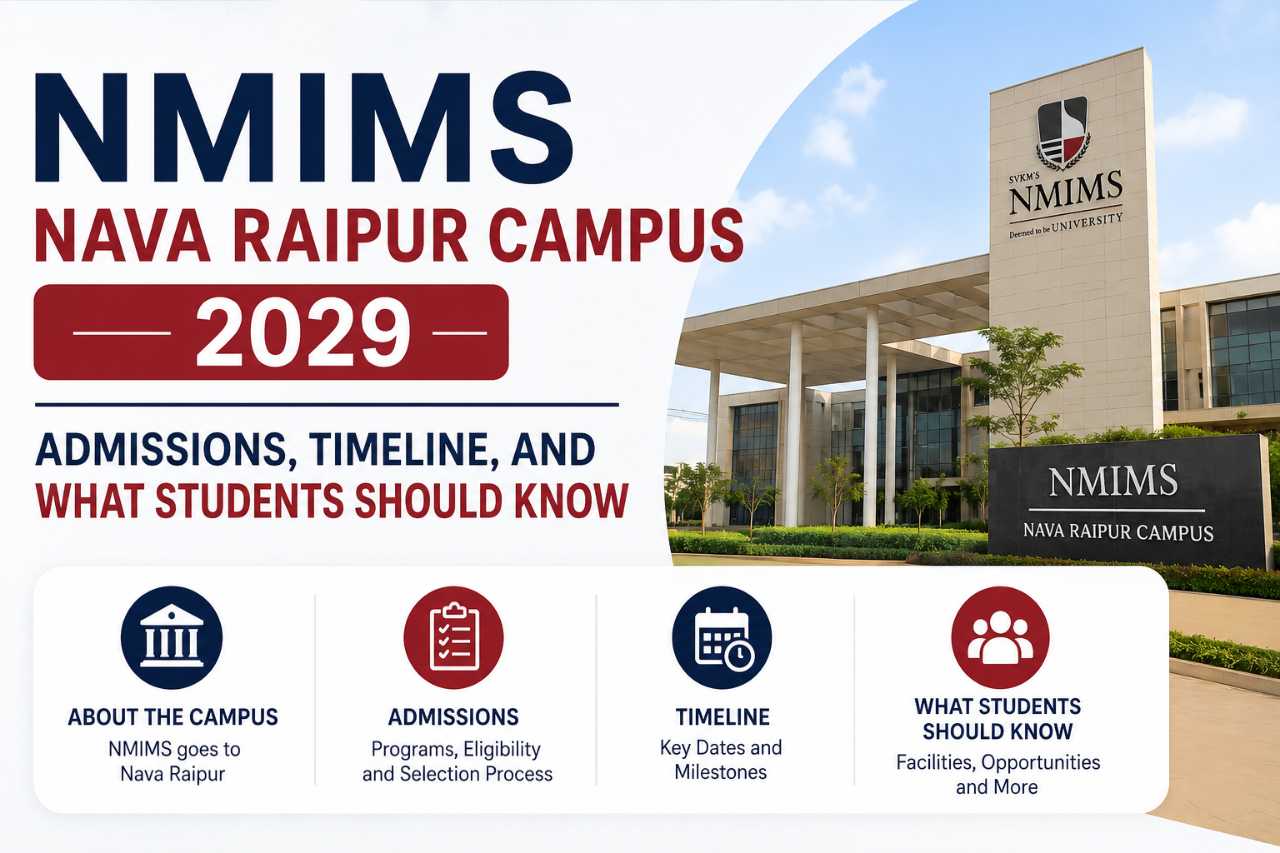

Chhattisgarh's higher education landscape is set for a major upgrade. NMIMS (Narsee Monjee Institute of Management Studies) has formally moved ahead with plans to establish a full-fledged campus in Nava Raipur Atal Nagar, with land registration and a 90-year lease agreement completed in September 2026. For students across central India who currently travel to Mumbai, Delhi, or Bangalore for reputed management and professional degrees, this development could bring a nationally recognised institution much closer to home.
This guide explains what has been officially announced, what the timeline looks like, how the campus fits into Raipur's growing education hub, and what aspiring students can realistically prepare for over the next two to three years before the first academic batch is expected to begin.
NMIMS Nava Raipur Campus: What Has Been Officially Announced?
According to official statements reported in September 2026, Shri Vile Parle Kelavani Mandal's Narsee Monjee Institute of Management Studies (NMIMS) Mumbai will develop a new campus in Nava Raipur Atal Nagar, Chhattisgarh. The milestone that unlocked the project was the completion of land registration together with a 90-year lease agreement in favour of SVKM, the trust that operates NMIMS institutions across India.
Chief Minister Vishnu Deo Sai, who was present when the formalities were completed, emphasised that the state wants young people in Chhattisgarh to access quality, modern higher education without having to relocate to metro cities. The proposed NMIMS campus is being positioned as a flagship step in that direction—offering not only degrees but also skill development and employment-oriented training aligned with industry needs.
Key Details at a Glance
| Parameter | Official Information |
|---|---|
| Institution | NMIMS (operated by SVKM) |
| Location | Sector 18, Nava Raipur Atal Nagar, Chhattisgarh |
| Land Area | Approximately 40 acres |
| Lease Duration | 90 years |
| Expected Student Capacity | Around 10,000 (at full development) |
| First Academic Batch | Expected in 2–3 years (around 2028–2029) |
| Full Campus Completion | Targeted within 7 years |
| Cabinet Approval | Chhattisgarh Cabinet approved land allotment on 21 January |
These figures come from government statements and official reporting. Exact programme lists, fee structures, and admission routes will be announced closer to launch. Until then, students should treat published timelines as indicative rather than final.
Why Nava Raipur? The Logic Behind the Location
Nava Raipur—also known as Atal Nagar—is not an accidental choice. The Chhattisgarh government has long planned it as a planned smart city and an emerging knowledge corridor alongside the older capital, Raipur. Several nationally important institutions already operate in or near the region, creating an ecosystem where a large private deemed university can collaborate across management, law, technology, and health sciences.
Raipur's Existing Education Ecosystem
Students comparing options in central India should look at the full picture, not just the upcoming NMIMS campus. The region already hosts respected institutions such as:
- Indian Institute of Management (IIM) Raipur — premier management education and executive programmes
- National Institute of Technology (NIT) Raipur — strong engineering and technology base
- Dr Shyama Prasad Mukherjee International Institute of Information Technology (IIIT Naya Raipur) — focused IT and computer science education
- Hidayatullah National Law University (HNLU) Raipur — national law school with competitive admissions
- All India Institute of Medical Sciences (AIIMS) Raipur — tertiary healthcare and medical education
- Pt Ravishankar Shukla University Raipur — the state's major public university with wide programme coverage
Alongside these, private universities such as Kalinga University Raipur and Mats University Raipur already serve local and outstation students. NMIMS enters this mix as a brand with established national visibility—similar in spirit to how other metros have attracted satellite campuses from well-known trusts.
Connectivity and Livability Advantages
Nava Raipur offers relatively newer infrastructure, wider roads, and planned residential zones compared with congested parts of old Raipur. For a 40-acre campus expected to eventually host 10,000 students, such planning matters. Hostels, faculty housing, industry tie-ups, and startup incubation spaces all benefit from being in a city designed with expansion in mind.
From a student perspective, the practical advantage is straightforward: access to a Mumbai-headquartered institution's curriculum and brand recognition while living in a lower-cost region than Maharashtra's financial capital. Whether that translates into identical placements and faculty depth as the flagship campus will depend on how SVKM resources the new site—something worth monitoring over the next few years.
Timeline: From Land Allotment to First Batch in 2029
Understanding the project timeline helps students and parents plan realistically. The process did not begin overnight; it followed structured government approvals and is now entering the construction and academic design phase.
Major Milestones So Far
- 21 January 2026: Chhattisgarh Cabinet approved the proposal to allot land for NMIMS in Nava Raipur.
- Following weeks: Administrative formalities were expedited to move from approval to registration.
- September 2026: Land registration and the 90-year lease to SVKM were completed, with state leadership present at the ceremony.
- Next 2–3 years: Initial academic operations and the first student intake are expected.
- Within 7 years: Full campus establishment is targeted, scaling toward the 10,000-student capacity.
The phrase "first batch expected by 2029" reflects the 2–3 year window from mid-2026. Some infrastructure—labs, library blocks, sports facilities—may still be under construction when early batches arrive, which is common for large greenfield campuses across India.
What Typically Happens During the Build Phase
Between lease signing and the first admission notification, institutions usually:
- Appoint a project director and founding dean team
- Finalise affiliations and approval from the University Grants Commission (UGC) and relevant statutory bodies
- Design programme portfolios—often starting with high-demand courses such as BBA, MBA, B.Com (Hons), and professional integrated programmes
- Build temporary or phased academic blocks while permanent structures are completed
- Sign memoranda of understanding (MoUs) with local and national employers for internships and placements
Students should follow official NMIMS and Chhattisgarh higher education channels for verified updates rather than relying on unconfirmed social media posts about "confirmed courses" or "fixed fees."
Expected Academic Offerings and Campus Capacity
While the September 2026 announcement focused on land and policy rather than a detailed academic bulletin, the scale of the project offers useful clues. A 40-acre campus designed for roughly 10,000 students is unlikely to offer only one or two programmes. NMIMS institutions elsewhere deliver management, commerce, economics, pharmacy, engineering, liberal arts, and law—often under the broader SVKM NMIMS Global University framework.
Programmes Students Might Expect
Based on NMIMS's established portfolio at campuses in Mumbai, Bengaluru, Hyderabad, and other cities, the Nava Raipur campus could initially emphasise:
- Management and commerce: BBA, MBA, PGDM-style programmes, M.Com, and executive education
- Professional undergraduate degrees: B.Sc Finance, B.Com (Hons), and integrated five-year pathways
- Technology and analytics: B.Tech or B.Sc IT/data science streams, subject to approval
- Skill and entrepreneurship centres: Short certifications aligned with MSME and startup policies
- Liberal arts and social sciences: Including programmes linked to a BA curriculum where market demand exists
The reference to "10,000 management seats" in public discourse reflects the project's heavy orientation toward business and professional education—not that every seat will literally be an MBA place. Rather, management, commerce, and allied professional programmes are expected to form the core intake volume.
Capacity Phasing: Why 10,000 Is a Long-Term Figure
Ten thousand students is a full-build enrolment target, not Day One intake. Most new campuses ramp up gradually:
- Year 1–2: A few hundred to one thousand students across a handful of programmes
- Year 3–5: Expansion into additional schools and postgraduate centres
- Year 6–7: Approaching full capacity as residential, academic, and recreation infrastructure stabilises
This phased model mirrors how other private universities have scaled in tier-2 cities. It also means early batches may enjoy smaller class sizes and closer faculty interaction—a potential advantage if the institution commits senior professors to the founding years.
Impact on Students, Employment, and Industry in Chhattisgarh
The state's stated goal goes beyond building classrooms. Officials frame NMIMS as a lever for employment-oriented education, innovation, and industry-academia collaboration. For a state where many graduates historically migrated to Pune, Mumbai, Hyderabad, or Delhi for campus placements, a national brand locally could slow that outflow.
Benefits for Local and Regional Students
- Reduced relocation costs: Tuition plus living expenses in Nava Raipur are generally lower than in major metros.
- Internship access: Proximity to Raipur's industrial belt, MSME clusters, and public-sector offices can support local internships.
- Network effects: Sitting alongside IIM Raipur and NIT Raipur may foster joint seminars, hackathons, and guest lectures.
- Entrepreneurship: NMIMS campuses elsewhere run incubation and entrepreneurship cells; similar facilities would align with Chhattisgarh's startup policy push.
Broader Economic and Social Effects
Large campuses generate demand for housing, retail, transport, and ancillary services. Faculty and staff relocation can boost the local rental market. Over time, a stronger graduate pool may attract companies setting up regional offices—especially in logistics, mining services, agribusiness, and public administration, sectors relevant to the state economy.
That said, placement outcomes will depend on active corporate relations, not brand name alone. Students evaluating NMIMS Nava Raipur against established campuses should compare internship data, alumni networks, and recruiter lists once they become available—likely only after the first graduating batch.
How NMIMS Nava Raipur Compares With Other NMIMS and Satellite Campuses
NMIMS is not new to multi-city expansion. Understanding how other campuses operate helps set expectations for Nava Raipur.
Flagship vs New Campuses
The Mumbai NMIMS campus remains the oldest and most established, with deep recruiter relationships and extensive alumni networks. Newer sites often share curriculum frameworks and examination systems but may differ in:
- Faculty seniority mix (founding campuses sometimes rotate experienced professors to new locations)
- Placement recruiter diversity in the first five years
- Campus infrastructure maturity
- Student competition levels in entrance exams
Comparable dynamics appear when other trusts open satellite campuses—for example, technical and professional institutions expanding beyond their original city. Students researching similar expansion models can also explore profiles such as Delhi Technical Campus or Rathinam Technical Campus Chennai to understand how regional campuses build identity over time.
How It Fits Among Management-Focused Options
Aspirants often compare NMIMS with other management-oriented institutions. While names like IMS Management College or IMS Unison University serve different regions and admission pathways, NMIMS typically attracts students seeking a deemed university structure with multiple schools under one umbrella. The Nava Raipur campus, if it follows the same pattern, could become the default NMIMS option for students from Chhattisgarh, Odisha, Jharkhand, and parts of Madhya Pradesh.
Admissions: What We Know and What to Watch For
No official admission notification for NMIMS Nava Raipur had been released as of the September 2026 land-registration announcement. However, NMIMS's national admission patterns provide a reasonable preview of what future applicants might encounter.
Likely Admission Routes (Based on NMIMS Practice)
- NPAT (NMIMS Programs After Twelfth): The common entrance test for undergraduate programmes across multiple NMIMS campuses. Nava Raipur will likely be listed as a campus preference once programmes are confirmed.
- NMAT: For postgraduate management programmes, especially if MBA intake is offered from early years.
- Merit-based or board-score criteria: Possible for select programmes, depending on approval and intake size.
- Direct university application: For diploma or certificate skill courses, if launched under continuing education centres.
Students preparing for university entrance exams in other states—for instance through tests like IPU CET for Delhi institutions—should note that NMIMS generally uses its own national tests rather than state CETs. That centralised approach simplifies multi-campus choice but requires dedicated preparation.
Actionable Tips for 2026–2028 Aspirants
- Target Class 12 boards seriously: Even entrance-heavy systems often use board scores as tie-breakers.
- Start NPAT/NMAT familiarisation early: Practice quantitative ability, reasoning, and language sections consistently.
- Follow only verified sources: Check nmims.edu and official Chhattisgarh government higher education portals.
- Visit Nava Raipur when construction begins: Physical campus visits reveal connectivity and hostel proximity better than brochures.
- Keep backup options: Apply to established Raipur institutions such as Indira Gandhi Krishi Vishwavidyalaya Raipur or Kushabhau Thakre Patrakarita Avam Jansanchar Vishwavidyalaya Raipur if your field aligns—do not put all plans on an unreleased admission bulletin.
Chhattisgarh's Push to Build a Knowledge Hub in Central India
The NMIMS project aligns with a wider policy narrative: transforming Nava Raipur into a destination where school-leavers can pursue law at HNLU, engineering at NIT, management at IIM, medicine at AIIMS, and—soon—professional degrees at NMIMS without leaving the state. That clustering effect has worked elsewhere in India, such as Pune's education corridor or Jaipur's university belt, where multiple institutions create a critical mass of student talent that attracts employers.
Other states pursuing similar hub strategies include Rajasthan, where institutions like Mewar University Jaipur Campus, SKNAU Jaipur Campus, and DSRRAU Jaipur Campus serve specialised and professional streams. The lesson for students is geographic: central India's new campuses are increasingly viable alternatives to coastal metros, provided you verify accreditation, faculty, and outcomes independently.
Role of Public Policy and Long-Term Leases
The 90-year lease structure signals long-term commitment from both SVKM and the state government. Long leases are common for large educational townships because they justify capital investment in buildings, equipment, and faculty housing. For parents, this reduces the risk of abrupt relocation or closure—concerns that sometimes surround shorter-term arrangements.
Land allotment in Sector 18 also suggests integration with the master plan for Nava Raipur, potentially placing the campus near other knowledge institutions and administrative zones. Exact maps will become clearer when construction commences and access roads are finalised.
What Parents and Counsellors Should Verify Before Advising Students
Education journalism and government announcements establish credibility for the project's intent, but counselling should rely on documented facts at the time of application—not early speculation. Before recommending NMIMS Nava Raipur as a primary choice, verify the following:
- UGC and statutory approvals for each programme offered at the new campus
- Degree nomenclature (whether degrees are awarded through the deemed university structure as at Mumbai NMIMS)
- Fee structure and scholarship policies published in official prospectuses
- Residential facility readiness for female and male students from year one
- Transport and safety infrastructure around Sector 18, especially for late-evening library or lab hours
Counsellors comparing management education might reference established options like Jharkhand Rai University, Rai University, or Rai Technology University Bangalore to illustrate how regional private universities compete—but NMIMS's national ranking and brand recognition place it in a different consideration set for many urban middle-class families in central India.
Conclusion: A Landmark Project Worth Tracking, Not Rushing
The NMIMS campus in Nava Raipur represents one of the most significant private higher-education investments announced for Chhattisgarh in recent years. With 40 acres in Sector 18, a 90-year lease to SVKM, cabinet approval in January 2026, and formal land registration completed in September 2026, the project has moved from proposal to execution stage. The first academic batch is expected within two to three years—around 2028 or 2029—while full development toward a 10,000-student capacity may take up to seven years.
For students in Raipur, Bilaspur, Durg, and neighbouring states, the campus could eventually offer NMIMS-quality professional education without the cost and distance of Mumbai. For now, the smartest approach is informed patience: track official NMIMS announcements, strengthen entrance-exam preparation, explore existing Raipur institutions as backups, and revisit campus infrastructure in person once construction is visible.
Central India's education map is changing quickly. NMIMS Nava Raipur is a headline worth following closely—especially for anyone planning undergraduate or management studies who would prefer to study closer to home while earning a degree from a nationally known institution.