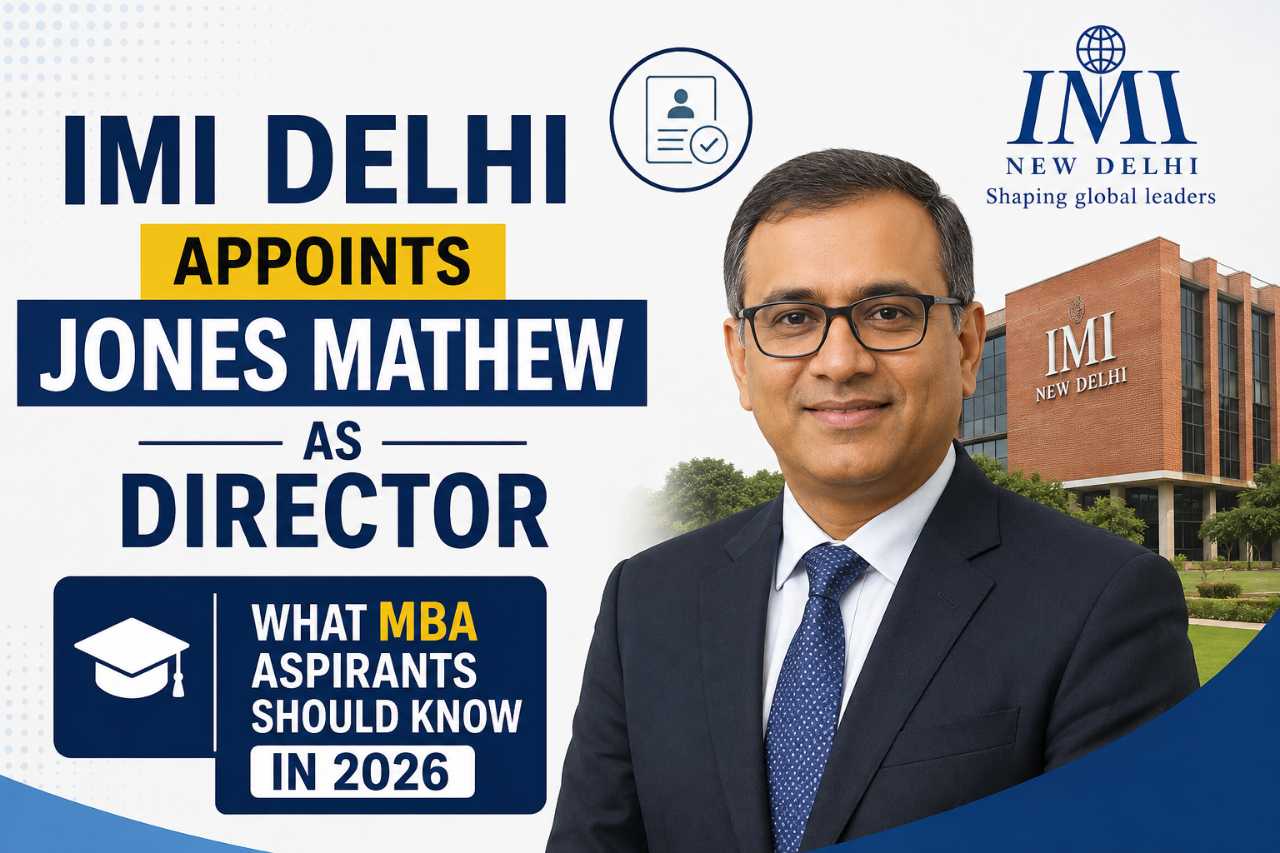
In a significant leadership transition for one of Delhi NCR's established business schools, the International Management Institute (IMI) Delhi has appointed Jones Mathew as its new director, effective August 3, 2026. The move comes at a time when management education in India is under pressure to prove relevance employers want job-ready graduates, students want strong return on investment, and institutes want global visibility through accreditations and rankings.
IMI Delhi, part of the RP-Sanjiv Goenka Group, describes itself as India's first corporate-sponsored business school and carries a legacy of more than four decades in management education. For MBA and PGDM aspirants evaluating B-schools in the national capital region, understanding who leads an institute and what priorities they set can be as important as comparing fees, cut-offs, and placement reports. This article breaks down Mathew's background, the institute's stated direction under his leadership, and what the appointment means for students, faculty, and the wider Delhi management education ecosystem.
Key Highlights: Jones Mathew's Appointment at IMI Delhi
- Effective date: August 3, 2026
- Role: Director, IMI Delhi
- Experience: 18 years in corporate roles and 15+ years in academic teaching and administration (marketing)
- Previous leadership role: Principal and Head of Institution, Great Lakes Institute of Management, Gurgaon
- Academic credential: PhD from the Indian Institute of Foreign Trade (IIFT) Delhi
- Stated focus areas: Industry-aligned curriculum, pedagogical innovation, student experience, faculty research, and stronger industry partnerships
Who Is Jones Mathew? Background and Career Path
Jones Mathew brings a profile that blends corporate marketing experience with senior academic leadership a combination increasingly valued at Indian B-schools that aim to bridge classroom theory and workplace practice.
Corporate Experience Across Leading Brands
Before building his academic career, Mathew spent roughly 18 years in the corporate sector, working with organisations that span technology, engineering consultancy, and consumer brands. His professional stints include roles at HCL Ltd., MECON, Yonex, and Reebok India. This background in marketing and brand management gives him firsthand insight into how companies hire, train, and evaluate managers knowledge that typically shapes curriculum design, live projects, and corporate guest lecture programmes.
For students, a director with deep industry exposure often signals stronger employer networks, more practical case-based learning, and placement teams that understand recruiter expectations. It does not guarantee outcomes on its own, but leadership with corporate roots can accelerate internship pipelines and executive mentoring initiatives.
Academic Leadership at Great Lakes Gurgaon
Immediately before joining IMI Delhi, Mathew served as Principal and Head of Institution at Great Lakes Institute of Management, Gurgaon. During his tenure, the campus achieved notable milestones: AACSB and AMBA accreditations, NBA accreditation, and a position among the NIRF top 50 management schools.
Accreditation journeys require sustained faculty development, rigorous quality audits, and alignment with global benchmarking standards. Aspirants comparing institutes in Delhi NCR often weigh triple-accreditation status heavily because it affects international mobility, employer perception, and eligibility for certain global exchange programmes. Mathew's track record in this area suggests IMI Delhi may intensify efforts around quality assurance, audit readiness, and rankings visibility.
Doctoral Training from IIFT Delhi
Mathew holds a PhD from IIFT New Delhi, one of India's premier institutions for international business and trade education. Doctoral training in this environment typically emphasises research rigour, policy analysis, and global market dynamics competencies that align with IMI's stated goal of strengthening intellectual output among faculty.
Delhi hosts several respected management institutes, including Fore School of Management Delhi, New Delhi Institute of Management, and university-affiliated schools such as the Delhi School of Management. Mathew's IIFT connection places him within a network of trade, export, and strategy scholars that could support new specialisations or research centres at IMI.
About IMI Delhi: Legacy, Ownership, and Positioning
To evaluate any leadership change, it helps to understand the institution itself. IMI Delhi is part of the broader IMI group and operates under the RP-Sanjiv Goenka Group, one of India's large diversified conglomerates. The institute has long marketed itself as India's first corporate-sponsored business school, a positioning that emphasises industry linkage from its founding ethos.
45 Years of Management Education
In his statement on joining, Mathew referred to IMI Delhi's 45-year legacy in management education. Legacy matters in Indian higher education because it affects alumni depth, recruiter familiarity, and brand recall during campus drives. However, legacy alone does not secure future placements institutes must continuously update electives, analytics modules, and experiential learning formats to stay competitive against newer, tech-forward programmes.
Why Corporate Sponsorship Still Matters
Corporate-backed B-schools often benefit from board-level industry input, sponsorship for centres of excellence, and informal recruiting relationships. For students, the practical advantage shows up in live consulting projects, leadership talks, and sector-specific immersion weeks. Mathew's mandate explicitly includes aligning teaching with changing corporate requirements, which suggests further integration of skills such as data-driven marketing, digital transformation, and cross-functional leadership into core courses.
Leadership Vision: What IMI Delhi Plans Under the New Director
Both group leadership and the new director have outlined priorities that give MBA aspirants a roadmap of likely institutional changes over the next few academic cycles.
Strategic Direction from the IMI Group CEO
Suresh Ramanathan, CEO of IMI, noted that management education is evolving quickly and that IMI Delhi is well positioned to build on its existing foundation. He highlighted Dr. Mathew's role in taking forward a new curriculum, strengthening the academic environment, deepening industry partnerships, and expanding IMI's visibility among industry ecosystems and the general public.
For applicants, new curriculum language usually translates into revised core courses, updated specialisation tracks, and possibly new certificates in emerging domains such as AI in business, supply chain resilience, or ESG reporting. Watch official programme brochures and admission announcements in the 2026–27 cycle for concrete changes rather than assuming immediate overhauls.
Mathew's Four-Pillar Priority Framework
Jones Mathew articulated a clear multi-stakeholder vision:
- Students: Engage with real business challenges and enjoy a memorable, holistic student experience beyond placements.
- Faculty: Adopt pedagogical innovations and produce high-quality intellectual output through research and case writing.
- Staff: Build a workplace culture where administrative and professional teams thrive.
- Institution: Strengthen IMI as a higher education brand of excellence with wider public recognition.
This framework reflects a balanced E-E-A-T approach to institutional governance experience (industry and accreditation wins), expertise (marketing and doctoral research), authoritativeness (leadership at a ranked B-school), and trustworthiness (transparent focus on student and faculty welfare). Aspirants should track how these pillars convert into measurable outcomes: internship quality, research publications, student club funding, and campus infrastructure upgrades.
What This Appointment Means for MBA and PGDM Aspirants
Leadership transitions can feel abstract until they affect admission criteria, fees, or placement patterns. Here is a practical lens for students planning to apply to IMI Delhi or comparing it with other institutes in the region.
Industry-Aligned Programmes and Career Outcomes
Mathew's corporate and marketing background aligns with IMI's push for career-aligned programmes. Students should expect continued emphasis on:
- Live industry projects and capstone consulting assignments
- Marketing, brand, and sales leadership roles in placement portfolios
- Executive interactions through guest lectures and mentorship networks
- Skill certifications that recruiters recognise on résumés
When researching any B-school, verify placement data on the official website, ask alumni about role quality (not just salary headlines), and compare sector diversity across institutes. Delhi NCR remains one of India's most competitive management education hubs, alongside national institutions such as IIT Delhi (for management programmes) and multidisciplinary universities like Jamia Millia Islamia New Delhi, which also attract aspirants seeking urban campus exposure.
Accreditation and Rankings Momentum
Given Mathew's accreditation achievements at Great Lakes Gurgaon, IMI Delhi may accelerate efforts toward global benchmarks. Accreditation benefits include:
| Accreditation | Typical Benefit for Students |
|---|---|
| AACSB | Global recognition; stronger exchange and dual-degree options |
| AMBA | Employer trust in MBA-specific quality standards |
| NBA | National quality assurance; relevant for Indian regulatory frameworks |
| NIRF Ranking | Visibility in government rankings; used by many aspirants for shortlisting |
Aspirants should treat rankings and accreditations as shortlisting tools, not sole decision factors. Fit, specialisation strength, fee structure, and location matter equally for most working professionals and fresh graduates.
Student Experience Beyond Placements
Mathew explicitly mentioned creating a memorable student experience a signal that co-curricular life, leadership opportunities, and campus culture are strategic priorities. This may include stronger student governance, international immersion, entrepreneurship cells, and wellness support. Prospective students can assess this during open days by speaking with current cohorts about club activity, hostel life, and faculty accessibility.
IMI Delhi in the Delhi NCR B-School Landscape
Choosing a management institute in Delhi requires context. The region combines legacy private B-schools, university departments, and newer institutes with modern infrastructure.
How IMI Compares With Peer Institutes
IMI Delhi competes for talent with institutes such as Fore School of Management, NDIM, and other established PGDM providers. It also sits in an ecosystem where aspirants cross-apply to nationally ranked programmes and specialised schools. Unlike undergraduate-focused colleges such as St Stephen's College Delhi or Lady Shri Ram College for Women (LSR) Delhi, IMI is a postgraduate management institute so admission pathways typically involve national exams, group discussions, and personal interviews rather than Class 12 board cut-offs alone.
Delhi as an Education Hub
Delhi NCR concentrates premier institutions across disciplines from engineering at Delhi Technological University (DTU) and Netaji Subhas University of Technology (NSUT) Delhi to medical campuses such as AIIMS Delhi. For management students, this density creates internship opportunities across sectors: consulting, FMCG, fintech, logistics, media, and public policy. Mathew's focus on industry partnerships could leverage Delhi's employer base for year-round engagement rather than placement-season-only recruiting.
Actionable Tips for Prospective IMI Delhi Applicants
If you are targeting admission in the coming cycles, use this leadership change as a prompt to research deeply rather than react to headlines alone.
- Review official announcements: Check IMI Delhi's website and admission portal for updated programme structures, specialisations, and intake details.
- Prepare for standard MBA selection stages: Most PGDM programmes evaluate exam scores (such as CAT, XAT, or GMAT depending on institute policy), academic records, work experience, and interview performance.
- Map your career goals to institute strengths: Mathew's marketing and brand expertise may strengthen certain tracks verify whether your target specialisation has strong faculty and alumni in that domain.
- Ask about industry projects: During interactions with admissions or alumni, inquire about live projects, corporate mentors, and summer internship conversion rates.
- Compare total cost of attendance: Include tuition, accommodation, travel, and opportunity cost when comparing IMI with peer institutes in Delhi and other metros.
- Track accreditation updates: If global mobility matters to you, monitor AACSB, AMBA, and NBA status on official channels.
- Visit campus if possible: Open days reveal culture, infrastructure, and student community in ways brochures cannot.
Broader Trends in Indian Management Education
IMI Delhi's appointment reflects wider shifts across Indian B-schools in 2026 and beyond.
From Generic MBAs to Skill-Stacked Credentials
Employers increasingly expect graduates to arrive with analytics fluency, communication skills, and domain exposure. Institutes led by professionals with corporate tenure often redesign courses around skill stacks combining core management foundations with tool-based learning in Excel, Python, CRM platforms, or digital marketing suites.
Industry Partnerships as a Differentiator
Partnerships are no longer limited to final placements. Leading schools co-create curricula with companies, sponsor labs, and fund research chairs. Mathew's stated emphasis on deepening industry ties suggests IMI may expand such models benefiting students who prefer learning through real business problems rather than textbook-only pedagogy.
Leadership Stability and Institutional Trust
Director-level appointments also influence stakeholder confidence. Faculty recruitment, international collaborations, and lender or sponsor relationships often depend on visible, credible leadership. Mathew's combination of corporate credibility and proven accreditation leadership may help IMI Delhi attract senior professors, visiting scholars, and research partnerships. For students, stable and experienced leadership reduces the risk of abrupt policy reversals that can disrupt batch planning, exchange programmes, or scholarship commitments mid-degree.
PGDM vs MBA: What Aspirants Should Clarify
Many Delhi institutes offer PGDM programmes approved by AICTE, while university-affiliated MBAs follow a different regulatory pathway. Both can deliver strong careers, but the labels are not interchangeable. When comparing IMI Delhi with alternatives such as the Delhi Metropolitan Education ecosystem or university management departments, verify degree nomenclature, approving body, and equivalence for higher studies abroad. Leadership messaging around curriculum renewal often affects elective breadth, credit transfer rules, and dual-degree options details that matter if you plan doctoral studies or international employment later.
Faculty Innovation and Research Output
Quality faculty development improves classroom delivery and institutional reputation. PhD-led leadership often prioritises case publications, conference participation, and funded research activities that indirectly benefit students through updated reading material and stronger academic networks. Institutes of eminence and research-intensive universities such as the Shiv Nadar Institution of Eminence demonstrate how research culture can elevate brand value; private B-schools adopt similar strategies at different scales.
Timeline: What to Watch After the August 2026 Transition
Leadership changes unfold over months, not days. Aspirants and current students can monitor these milestones:
- First 100 days: Internal academic council meetings, faculty retreats, and partnership MoUs often surface early.
- Admission season: Marketing campaigns, scholarship announcements, and any exam score policy updates.
- Curriculum bulletins: Revised course outlines for incoming batches.
- Placement season: Sector-wise hiring trends and PPO (pre-placement offer) data.
- Accreditation filings: Public disclosures related to NBA, AACSB, or AMBA review cycles.
Checklist: Questions to Ask Before You Apply to IMI Delhi
Use this quick checklist during webinars, alumni meets, or campus visits. It converts leadership announcements into practical due diligence.
- Which entrance exam scores does the current admission cycle accept, and what were last year's typical cut-off ranges?
- Has the core curriculum changed for the incoming batch, especially in analytics, marketing, and leadership courses?
- What percentage of summer internships convert to pre-placement offers in your target sector?
- Does the institute publish audited placement reports with role titles and sector breakdown not only salary figures?
- Are there active tie-ups with Delhi-based employers for live projects throughout the year?
- What student support exists for entrepreneurship, international exposure, and mental wellness?
- How transparent is the institute about fees, hostel costs, and scholarship eligibility?
Answering these questions helps you separate brand perception from evidence a habit that serves aspirants well whether they apply to IMI Delhi, Fore School of Management, or institutes outside the capital such as the Poddar Group of Institution Jaipur for comparative perspective on programme structure and ROI.
Conclusion
The appointment of Jones Mathew as director of IMI Delhi, effective August 3, 2026, marks a deliberate bet on blended leadership someone who has marketed global brands, led a Gurgaon campus to major accreditations and NIRF recognition, and earned a doctorate from IIFT Delhi. For MBA and PGDM aspirants, the development is less about a headline hire and more about directional signals: sharper industry alignment, curriculum renewal, stronger partnerships, and a renewed push for institutional brand building.
As with any B-school decision, students should combine this news with primary research official placement reports, fee structures, faculty profiles, and alumni conversations. Delhi remains a vibrant management education market, and IMI Delhi's next chapter under Mathew will be shaped by how quickly strategic priorities translate into tangible student outcomes. Staying informed through credible sources and institute communications is the best way to turn leadership transitions into smart admission choices.