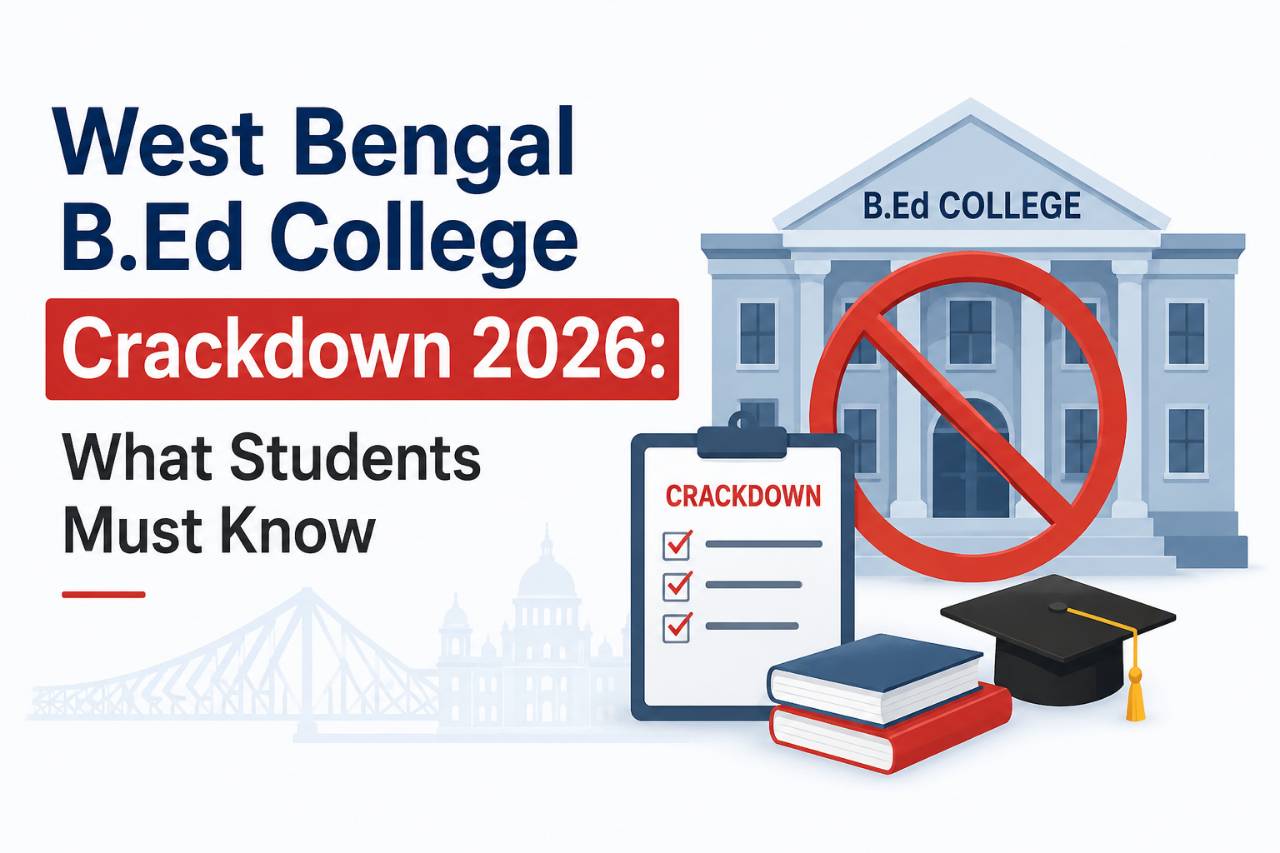

The West Bengal governemnt has launched a statewide crackdown on alleged irregularities in Bachelor of Education (B.Ed) colleges, with HIgher Education Minister Jagannath Chattopadhyay warning that education will not be allowed to become a commodity. Following large-scale inspections in July and August 2026, show-cause notices were issued to more than 450 institutions after serious gaps were found in infrastructure, faculty attendance, and academic compliance. For aspiring teachers and parents planning admissions in 2026–27, this development is not just news—it is a practical checklist moment. Before you pay fees or relocate for a B.Ed programme, understanding what triggered the crackdown, which colleges are under scrutiny, and how to verify legitimacy can protect your career, your money, and your eligibility for government teaching jobs.
What Triggered the West Bengal B.Ed College Crackdown?
The inspection drive did not begin in isolation. According to officials cited in recent reports, a neighbouring state's chief secretary wrote to West Bengal authorities alleging that students from outside the state were obtaining B.Ed, polytechnic, ITI, and pharmacy degrees by paying money without attending regular classes. That cross-border complaint pushed the Higher Education Department to assess B.Ed institutions across West Bengal on a structured basis rather than relying on paper approvals alone.
Minister Jagannath Chattopadhyay, speaking at a press conference in Kolkata, made the government's position clear: institutions functioning without adequate infrastructure or involved in the clandestine sale of degrees would face strict action. The department emphasized that show-cause notices were issued following principles of natural justice, giving colleges an opportunity to respond before harsher measures such as admission bans or de-affiliation recommendations.
Key Numbers from the 2026 Inspection Drive
To help students and counsellors grasp the scale of the problem, here is a summary of reported findings from the July–August 2026 inspections:
- 602 B.Ed colleges inspected statewide
- 450+ show-cause notices issued to colleges
- 53 colleges found non-existent at registered addresses
- 17 cases where NOCs were issued at flats or drawing rooms
- 114 colleges scored below 30 out of 100
- 265 institutions classified as effectively non-functional or unfit
- 121 colleges with seriously deficient infrastructure
- 151 colleges scored between 65% and 85%—comparatively satisfactory
- Average score: 51.5% on a 100-point evaluation matrix
- ~62,000 B.Ed degrees issued annually in West Bengal
These figures underline why students cannot treat every approved B.Ed college as equally reliable. A low inspection score or a missing campus is a red flag that paperwork alone will not reveal.
How B.Ed Colleges Were Evaluated: The 100-Point Matrix
West Bengal's Higher Education Department did not conduct casual spot checks. Inspectors used a 100-point matrix covering infrastructure, teaching standards, teacher attendance, and related academic parameters. This approach mirrors broader quality-assurance practices seen across Indian higher education, where regulators increasingly combine physical verification with documented compliance.
Colleges were not judged on a single parameter. An institution might have a building but fail on faculty presence; another might show attendance records but lack basic teaching-learning facilities. The average score of 51.5% suggests that many colleges met minimum paperwork requirements but fell short on ground-level academic delivery—exactly the gap that hurts students who expect classroom training before entering schools.
What Inspectors Found on the Ground
Reports from the department describe several alarming patterns:
- Phantom campuses: 53 B.Ed colleges had no physical existence at their registered addresses—premises were locked or used for unrelated activities.
- Residential addresses as colleges: 17 institutions received registration or NOC at flats or drawing rooms.
- Signboard swapping: Multiple institutions—B.Ed, polytechnic, and pharmacy—allegedly operated from the same premises by changing signboards.
- Out-of-state enrolment without attendance: Students from Goa, northeastern states, and neighbouring states reportedly enrolled but did not attend regular classes, yet appeared for exams and obtained degrees.
The minister publicly questioned how a Konkani-speaking student from Goa could legitimately earn a B.Ed from a Bengali-medium institution without regular attendance. That example highlights a broader national concern: degree mills that exist on registers but not in classrooms.
Why B.Ed Quality Matters for Teaching Careers in India
B.Ed is not a casual postgraduate add-on for most teacher aspirants—it is often a mandatory qualification for school teaching posts, especially in government and aided schools. State Teacher Eligibility Tests (TET), Central Teacher Eligibility Test (CTET), and recruitment boards verify both your degree and the recognizing body's legitimacy. A degree from a college later de-affiliated or exposed as non-functional can create painful delays during document verification, sometimes years after graduation.
In West Bengal, as in Rajasthan and other states with large private B.Ed sectors, students frequently compare institutions across regions. While colleges like Vidya Bharti BEd College Sikar and Shekhawati BEd College Sikar represent the kind of localized options students evaluate in other states, West Bengal's inspection results show that proximity and advertised approval are insufficient filters. You need evidence of functioning infrastructure, qualified faculty, and transparent attendance.
B.Ed and the NCTE Framework
B.Ed programmes in India fall under norms set by the National Council for Teacher Education (NCTE). Recognition, intake capacity, faculty ratios, and infrastructure benchmarks are supposed to be enforced before and after affiliation. State governments and universities grant affiliation, but NCTE recognition remains the central gatekeeper for teacher education validity.
When a state government initiates de-affiliation or stops admissions, the ripple effect reaches NCTE records, university degree verification, and employer databases. Students who graduate during or after such action may face scrutiny even if they personally attended classes diligently. Always download and save NCTE recognition orders and affiliation letters at the time of admission.
West Bengal's Higher Education Landscape: Context for Students
West Bengal hosts a mix of state universities, private universities, and affiliated colleges spread from Kolkata to North Bengal. Institutions such as West Bengal State University Barasat North 24 Parganas and North Bengal University Darjeeling anchor academic ecosystems that include education faculties and affiliated B.Ed colleges across districts.
Private universities like Techno India University West Bengal and Maulana Abul Kalam Azad University of Technology West Bengal represent a different segment—technology and professional education—yet they illustrate how diverse West Bengal's higher education map is. Teacher education sits alongside law, health, and professional streams; The West Bengal National University of Juridicial Sciences Kolkata and The West Bengal University of Health Sciences Kolkata show how specialized universities maintain distinct regulatory pathways compared to mass-market B.Ed colleges.
Even niche institutions such as West Bengal University of Animal and Fishery Sciences Kolkata remind us that every professional degree in the state is governed by its own council and inspection culture. B.Ed students should expect similar rigour—and be alarmed when a college cannot demonstrate basic teacher-education infrastructure.
What Happens After Show-Cause Notices?
Issuing a show-cause notice is an intermediate step, not the final penalty. Colleges must explain deficiencies—missing faculty, absent infrastructure, irregular attendance records, or address mismatches—and propose corrective action. If replies are unsatisfactory, officials have indicated that the government may:
- Stop fresh admissions for one or more academic sessions
- Recommend de-affiliation to the affiliating university
- Initiate further regulatory action against management
- Escalate cases involving fraudulent degree issuance to appropriate authorities
For current students enrolled in flagged colleges, the immediate question is whether classes, exams, and degrees will remain valid. While each case will be decided on facts, historical patterns in Indian states suggest that colleges scoring below critical thresholds face the highest risk. Students already admitted should document attendance, fee receipts, assignment submissions, and internal assessment records as personal evidence of genuine participation.
Possible Outcomes by Inspection Score Band
Based on reported classification, students can think in terms of risk bands—not as official legal categories, but as practical planning tools:
| Score Range | Reported Classification | Student Action |
|---|---|---|
| 65%–85% | Comparatively satisfactory infrastructure | Still verify NCTE and affiliation; lower risk but due diligence advised |
| 30%–64% | Serious deficiencies possible | Visit campus, confirm faculty, ask for inspection-related disclosures |
| Below 30% | Particularly poor condition | Avoid new admission; existing students should seek legal and academic counselling |
| No campus at registered address | Non-existent / phantom institution | Do not enroll; report concerns to university and NCTE |
Cross-State Enrolment: A Growing Regulatory Concern
One of the most discussed angles in the current crackdown is enrolment of out-of-state students who allegedly pay fees, skip regular classes, and still sit for examinations. West Bengal produces around 62,000 B.Ed degrees each year—a large number relative to many states—making it an attractive destination for students seeking faster or easier pathways to a teaching qualification.
This is not unique to West Bengal. Across India, teacher education has struggled with ghost attendance, proxy exam culture, and diploma mills. States from Rajasthan to Uttar Pradesh have seen similar cleanup drives. Colleges in Sikar and elsewhere face their own regulatory frameworks, and students comparing Govt JDB Girls College Kota or Govt College Ramganj Mandi Kota with B.Ed options elsewhere should apply the same scepticism when an agent promises degree completion without attendance.
If you are from outside West Bengal and considering a B.Ed there, ask yourself whether you can genuinely attend classes in the medium of instruction, complete practicum hours in affiliated schools, and pass rigorous verification during TET or state recruitment. Shortcuts that seem convenient during admission often become expensive during employment verification.
How to Choose a Safe B.Ed College in West Bengal: Actionable Checklist
Use this checklist before paying any capitation or full-year fee:
- Verify NCTE recognition on the official NCTE portal using the college name, course, and academic session.
- Confirm university affiliation with the affiliating state university—not just a letter from the college office.
- Physically visit the campus on a working day; observe classrooms, library, ICT lab, and psychology/resource rooms required for B.Ed.
- Check faculty lists against university approval and interact with at least one faculty member.
- Ask about practicum tie-ups with local schools; B.Ed without school practice is structurally incomplete.
- Review fee structure on stamped receipts; avoid cash payments without documentation.
- Search for inspection news or show-cause notices involving the institution in 2025–26.
- Compare with established universities in the region such as West Bengal State University affiliated colleges versus unknown standalone B.Ed shops.
- Speak to current students without college staff present.
- Keep copies of every document from admission form to identity proofs submitted.
Students comparing options nationally—for example, evaluating Delhi's reputed arts and science colleges like St Stephens College Delhi, Hindu College Delhi, or women's institutions such as Lady Shri Ram College for Women LSR Delhi and Kirori Mal College Delhi for postgraduate pathways—should apply the same verification discipline to B.Ed, even if the brand name is less familiar.
Impact on Admissions for 2026–27 and Beyond
The crackdown arrives at a sensitive time for admissions. Many B.Ed colleges in West Bengal accept students through university counselling, management quota, or direct application. If admissions are frozen at hundreds of institutions, seat availability and fee levels may shift toward the roughly 151 colleges that scored between 65% and 85% on inspections.
Expect tighter scrutiny of out-of-state applicants, attendance tracking through biometric or digital systems, and possible delays in affiliation renewals. Counsellors guiding students from Assam, Odisha, Bihar, Jharkhand, Goa, and northeastern states should update their recommended college lists immediately rather than recycling last year's brochures.
What Current B.Ed Students Should Do Now
If you are already enrolled in a West Bengal B.Ed college:
- Maintain at least 75% attendance if your university requires it—and keep proof.
- Participate in micro-teaching, practicum, and internal exams without exception.
- Save screenshots of online classes if your programme uses hybrid delivery.
- Monitor official university notifications about affiliation status.
- Contact the affiliating university's examination branch for degree verification procedures early, especially if you plan out-of-state recruitment.
Role of Affiliating Universities and State Oversight
B.Ed colleges in West Bengal typically operate under affiliating universities that approve syllabi, conduct examinations, and award degrees. When the Higher Education Department flags an institution, the affiliating university must decide whether to continue affiliation, impose conditions, or recommend withdrawal. This dual-layer governance means students should monitor both state government orders and university notifications.
Universities with large affiliate networks—including North Bengal University and West Bengal State University—often publish lists of affiliated B.Ed colleges on their official websites. Cross-checking college claims against these lists takes minutes and can prevent costly mistakes. If a college name is missing or marked disaffiliated, do not proceed regardless of agent assurances.
Warning Signs of a Risky B.Ed College
Beyond official inspection scores, watch for behavioural red flags during the admission process. Agents who guarantee degrees without attendance, colleges that refuse campus visits, fees demanded entirely in cash, or prospectuses that omit affiliating university names should trigger immediate caution. A legitimate institution welcomes scrutiny because it invests in long-term reputation—not quick enrolment targets.
Students targeting government teaching posts should remember that CTET and state TET certificates remain valid for limited periods, but degree verification has no expiry on scrutiny. A questionable B.Ed can block you at the final document-check stage even after you clear written exams and interviews. Treat college verification as part of exam preparation, not a separate optional task. Parents financing B.Ed fees should accompany students on campus visits and insist on meeting the principal or teacher-in-charge directly.
Broader Lessons for Indian Teacher Education Reform
West Bengal's 2026 action fits a national pattern of states waking up to teacher education fraud after years of rapid private college expansion. Rajasthan, Uttar Pradesh, Maharashtra, and others have periodically cancelled affiliations or banned admissions to B.Ed and D.El.Ed colleges that lacked basic facilities. The underlying lesson for policymakers and students is identical: teacher quality cannot be outsourced to address labels on maps.
For education reform to succeed, inspections must be routine—not crisis-driven. Students benefit when scores, show-cause outcomes, and admission bans are published in accessible formats. Transparency turns a headline about 450 notices into a practical tool for college choice.
From an E-E-A-T perspective, students should trust guidance that cites official inspection findings, names regulatory bodies, and offers verifiable steps—not promises of guaranteed degrees. CollegeDwar's college pages help you compare institutions across states, but final responsibility rests on cross-verifying government records yourself.
Conclusion: Verify First, Enroll Second
The West Bengal government's crackdown on alleged B.Ed college irregularities is a wake-up call for anyone treating teacher education as a formality. With 602 colleges inspected, 53 found missing at their registered addresses, and more than 450 show-cause notices issued, the message is clear: approval on paper does not equal education on the ground. Minister Jagannath Chattopadhyay's warning that degrees will not be sold in the shadows reflects public interest in credible teaching professions.
If you plan to pursue B.Ed in West Bengal—or anywhere in India—prioritize institutions with verified campuses, strong inspection scores, transparent attendance, and stable affiliation. Use university resources, NCTE databases, and trusted college directories together. The roughly 151 colleges that performed comparatively well on the 100-point matrix may represent safer starting points, but your personal visit and document checks remain essential. Share this checklist with classmates and school counsellors so fewer students fall prey to degree-selling schemes. In teacher education, the cheapest or fastest option is often the costliest when recruitment officers reject your degree. Choose carefully, document everything, and treat this crackdown as guidance rather than panic.