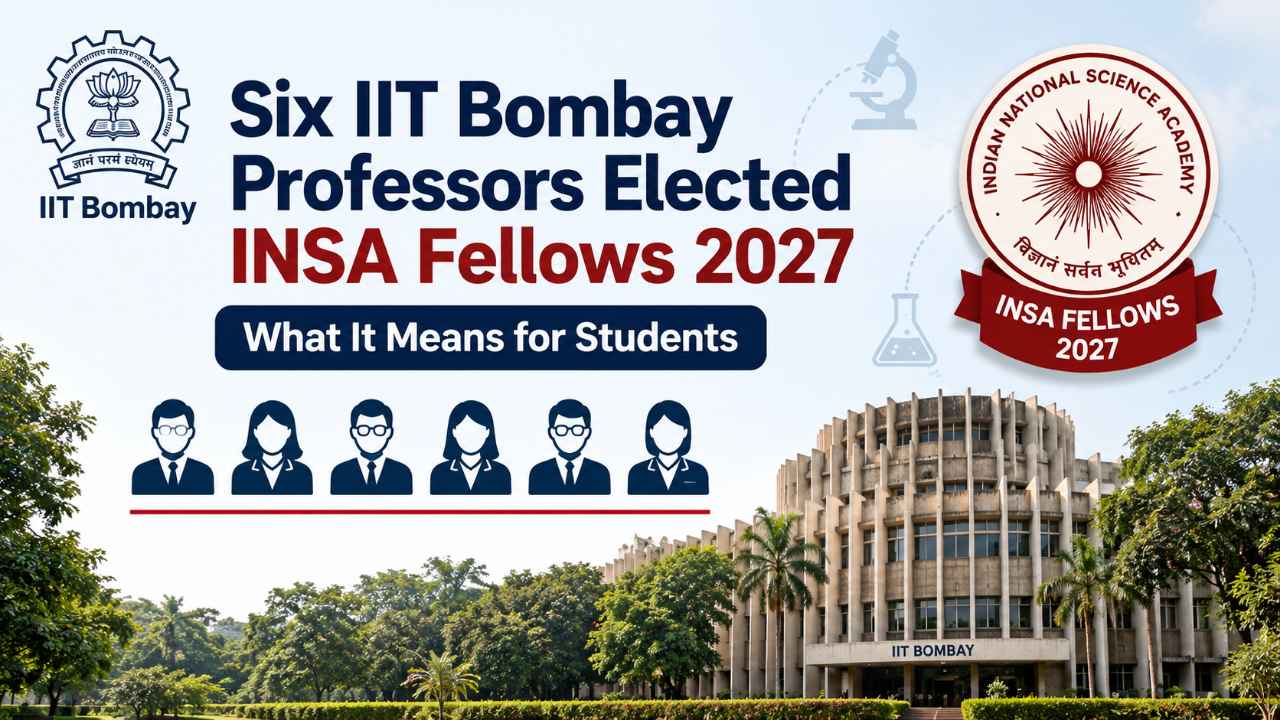
Six faculty members at the Indian Institute of Technology Bombay (IIT Bombay) have been elected Fellows of the Indian National Science Academy (INSA), one of India's most respected honours in scientific research. The fellowship becomes effective from January 1, 2027, and recognises sustained contributions across biosciences, computer science, climate studies, chemistry, environmental engineering, and earth sciences.
For students preparing for JEE Advanced, exploring M.Tech or PhD pathways, or comparing top research universities in India, this announcement is more than campus news. It signals where cutting-edge science is being done, which departments are producing nationally recognised scholars, and what kind of faculty mentorship you can expect at a premier institute. This guide explains what INSA fellowship means, profiles the six professors, and connects the news to admissions, careers, and India's broader research ecosystem.
What Is the Indian National Science Academy (INSA)?
The Indian National Science Academy (INSA) is a premier scientific body in India that promotes research, publishes journals, advises policymakers, and recognises outstanding scientists through its fellowship programme. Election as an INSA Fellow is considered a career-defining honour because membership is limited and based on peer evaluation of original research, publications, and impact on science and society.
INSA sits alongside other National academies such as the Indian Academy of Sciences and the National Academy of Sciences, India. Together, these bodies represent the highest tier of scientific recognition in the country. For engineering and science students, INSA fellows often lead National committees, review major research grants, and shape curriculum and innovation policy.
Why INSA Fellowship Matters in Indian Higher Education
In India's competitive higher-education landscape, academy fellowships help distinguish institutions that combine teaching with world-class research. When six professors from a single IIT are elected in one cycle, it reflects depth across multiple departments not just one star lab. That depth matters for postgraduate students who need diverse supervisors, interdisciplinary projects, and strong publication cultures.
Parents and counsellors frequently ask whether IITs are only about placements. News like this answers clearly: premier IITs are also research powerhouses. Institutes such as Indian Institute of Science Bangalore, IIT Delhi, and IIT Bombay consistently produce academy fellows, National awards, and globally cited papers alongside strong industry recruitment.
IIT Bombay: Six New INSA Fellows for 2027
According to official announcements reported in September 2026, the following IIT Bombay faculty members have been elected INSA Fellows, effective January 1, 2027:
- Prof. Anirban Banerjee Department of Biosciences and Bioengineering
- Prof. Supratik Chakraborty Department of Computer Science and Engineering
- Prof. Subimal Ghosh Department of Civil Engineering and Centre for Climate Studies
- Prof. Debabrata Maiti Department of Chemistry and Centre for Climate Studies
- Prof. Suparna Mukherji Department of Environmental Science and Engineering
- Prof. Malay Mukul Department of Earth Sciences
IIT Bombay stated that the recognition honours the institute's sustained contributions to advancing science and engineering research and to addressing challenges of national and global significance. The spread of departments from bioengineering to earth sciences highlights how modern research problems require collaboration across fields.
Research Themes Behind the Recognition
Although INSA elections are based on detailed scientific records rather than single projects, the departmental affiliations point to major research frontiers:
- Biosciences and bioengineering work at the intersection of biology, medicine, and engineering, increasingly relevant for biotechnology careers and healthcare innovation in India.
- Computer science and engineering foundational and applied computing, including areas tied to verification, systems, and data-driven methods that support India's digital economy.
- Climate studies and civil/environmental engineering research on weather extremes, water resources, urban infrastructure, and environmental sustainability, directly linked to national priorities such as climate resilience and clean water.
- Chemistry molecular science with applications in materials, catalysis, and green chemical processes.
- Earth sciences geology, geophysics, and natural resource understanding, important for energy, disaster preparedness, and environmental planning.
Students interested in these domains should look beyond course titles and explore centre-level research groups. IIT Bombay's Centre for Climate Studies, for example, connects faculty from multiple departments a model also seen at dedicated research institutes such as IISER Pune and IISER Kolkata, where interdisciplinary science is central to the academic culture.
How INSA Fellows Are Elected: A Transparent Peer Process
INSA fellowship is not an application trophy you can purchase or fast-track. Scientists are nominated and evaluated by existing fellows and expert committees. The process typically considers:
- Original research contributions papers, patents, and discoveries that advance knowledge.
- Scientific leadership guiding PhD students, postdocs, and national projects.
- Impact influence on industry, policy, healthcare, environment, or education.
- Peer reputation assessments from scientists who know the work deeply.
Because the bar is high, even top institutes may see only a handful of elections in a given year. Six fellowships from one campus in a single cycle is therefore notable and reflects a mature research environment with strong mentorship pipelines.
INSA Fellowship vs Other National Honours
Students sometimes confuse INSA fellowship with university awards or conference prizes. The table below clarifies common distinctions:
| Recognition | Who Grants It | Typical Career Stage | What It Signals |
|---|---|---|---|
| INSA Fellow | Indian National Science Academy | Mid to senior faculty | Sustained, peer-validated research excellence |
| INS Young Scientist Award | Indian National Science Academy | Early-career researchers | High potential and emerging contributions |
| Shanti Swarup Bhatnagar Prize | CSIR | Scientists under 45 (category rules apply) | Outstanding applied and basic science in India |
| Padma Awards | Government of India | Varied | Public service or distinguished contribution to nation |
Understanding these layers helps postgraduate applicants evaluate faculty profiles intelligently. A professor's INSA fellowship suggests long-term research credibility; younger faculty with INS young scientist awards may offer rapidly growing labs and hands-on mentoring.
What This Means for JEE Aspirants and IIT Bombay Applicants
If you are preparing for JEE Main and JEE Advanced with IIT Bombay as a dream campus, this news reinforces three practical points:
- Faculty quality is a differentiator at the top All old IITs have strong programmes, but research recognition shows which campuses are pushing scientific frontiers today.
- Branch choice is not the whole story Climate, environment, and computing touch almost every branch. Minor programmes, electives, and research centres often matter more than the label on your degree.
- IIT life includes research early Undergraduate Research Awards, summer projects, and B.Tech theses can connect you with labs led by nationally recognised scientists.
Admission to Indian Institute of Technology Bombay remains highly competitive. Cutoffs vary by category and branch, and Mumbai's cost of living should be part of family planning. Still, for students who want both strong placements and serious research exposure, IIT Bombay continues to offer one of India's best combinations.
Actionable Tips for School Students
- Build fundamentals in Physics, Chemistry, and Mathematics rather than shortcut tricks alone.
- Read about IIT research centres in areas you enjoy robotics, climate, biotechnology, or computing.
- Join science clubs, Olympiads, or coding contests to develop problem-solving stamina.
- Follow official IIT Bombay pages for open house events and department talks.
- Compare alternatives realistically: IIEST Shibpur and NITs offer excellent engineering pathways even if academy fellow counts differ.
Implications for M.Tech, PhD, and Research Career Seekers
Postgraduate students choose supervisors, not just institutes. INSA fellows often run well-funded labs, attract strong collaborators, and publish in high-impact journals. That can shape your thesis quality, conference travel, and post-PhD options in academia, industry R&D, or national labs.
When evaluating IIT Bombay for M.Tech or PhD:
- Review recent publications from the department and centre websites.
- Check whether professors accept students in your preferred intake and funding mode (institute fellowship, project fellowship, external sponsorship).
- Speak with current PhD students about lab culture, graduation timelines, and placement support for research roles.
- Consider interdisciplinary centres climate and environmental work may sit across civil, chemistry, and earth science groups.
India's research ecosystem extends beyond IITs. IISc Bangalore remains a gold standard for pure research degrees. Homi Bhabha National Institute Mumbai connects academic training with nuclear and allied sciences. Legacy institutions such as the Indian Association for the Cultivation of Science remind us that India's scientific excellence has deep historical roots, not only recent IIT expansion.
From PhD to National Recognition: A Realistic Pathway
Most INSA fellows spend years building credentials: doctoral work (often at premier institutes), postdoctoral training (in India or abroad), faculty appointments, grant leadership, and consistent publication. There is no shortcut, but the pathway is clearer than many students assume:
- Strong undergraduate and postgraduate fundamentals.
- Admission to a research-intensive programme with active labs.
- Peer-reviewed publications and conference presentations.
- Independent faculty position and national/international collaborations.
- Nomination and election to the academy after sustained impact.
For students who love deep inquiry, this pathway can be as rewarding as corporate leadership tracks especially in sectors such as semiconductors, climate tech, pharmaceuticals, and advanced materials where India is investing heavily.
IIT Bombay in India's Broader Research Map
No single news item defines an institute, but INSA elections are useful signals when comparing research cultures. IIT Bombay shares the Mumbai region with specialised centres and universities that contribute to science and technology in different ways. Nearby and thematic peers include the Homi Bhabha National Institute and national law, medical, and forensic universities that serve distinct missions.
On the national stage, students often benchmark IIT Bombay against IIT Delhi, IIT Madras, IIT Kanpur, and IISc. Each campus has signature strengths. Climate and environmental research, for instance, connects IIT Bombay's civil and earth science departments with national missions on water, heat stress, and urban flooding issues every Indian city faces.
Space and atmospheric science enthusiasts may also follow institutes such as the Indian Institute of Space Science and Technology, Thiruvananthapuram, while students leaning toward integrated science education may explore IISER campuses including IISER Bhopal, IISER Mohali, and IISER Tirupati through CollegeDwar profiles.
Recent Recognition Culture at IIT Bombay
The INSA fellowships follow other high-profile recognition linked to the IIT Bombay community. In June 2026, IIT Bombay alumnus Shashi Shekhar Vempati received the Padma Shri from the President of India for contributions to public service, media transformation, and institution-building. Such milestones faculty academy fellowships and distinguished alumni honours together strengthen an institute's reputation among employers, graduate schools, and funding agencies.
Climate, Environment, and Computing: Why These Fields Matter Now
Three threads run through several of the newly elected fellows: climate studies, environmental engineering, and computer science. That is not accidental. India's policy and industry agendas increasingly depend on:
- Climate resilience better forecasting, hydrology, and infrastructure design for extreme weather.
- Environmental quality clean air and water technologies, waste management, and health-linked engineering.
- Digital infrastructure reliable computing systems for science, finance, transport, and governance.
For career planning, this means demand for graduates who combine domain knowledge with quantitative skills. Civil and environmental engineers who understand data; chemists who work on sustainable materials; computer scientists who engage with real-world verification and systems all fit national needs.
Students who cannot secure an IIT seat should still pursue these themes. Programmes at NITs, IIEST, and state universities can lead to strong M.Tech and PhD profiles if you maintain research focus. Explore options such as NIT Delhi or MNIT Jaipur as part of a wider college list, then aim for postgraduate entry into top labs.
How Students and Parents Should Read This News
News headlines about faculty honours can feel distant from exam preparation. Yet they are directly relevant if you treat college choice as a long-term decision rather than a rank-list checkbox.
For Parents
- Ask whether your child prefers applied jobs, research, or a mix both paths exist at IIT Bombay.
- Factor in city costs, distance, and mental health support, not only prestige.
- Recognise that faculty awards correlate with research opportunities, not guaranteed packages in every branch.
For Counsellors and Teachers
- Use such news to introduce careers in climate science, bioengineering, and academic research.
- Encourage reading official institute statements rather than rumour on social media.
- Link national recognition to syllabus topics environmental chemistry, algorithms, geoscience to make JEE preparation meaningful.
Understanding Faculty Excellence Through an E-E-A-T Lens
Google's helpful content and E-E-A-T (Experience, Expertise, Authoritativeness, Trustworthiness) guidelines encourage education publishers to go beyond headlines and provide context students can act on. In that spirit, this article draws on publicly reported facts from IIT Bombay's announcement and widely accepted norms of Indian scientific recognition, without speculating about unpublished research details.
Experience matters because INSA fellowship reflects decades of laboratory work, teaching generations of students, and navigating real-world problems from monsoon variability to environmental remediation. Expertise is validated by peers who examine publication records and national contributions. Authoritativeness comes from INSA itself, a national body trusted by universities and funding agencies. Trustworthiness requires transparent sourcing; we cite the original news report and encourage readers to verify details on official IIT Bombay channels.
Department-Wise Takeaways for College Shortlists
If you are building a college list beyond IIT Bombay, map your interests to institute strengths rather than brand alone:
- Bioengineering and life sciences IIT Bombay, IISc, and select NIT biomedical programmes; consider postgraduate mobility later.
- Computer science top IITs, IIITs, and strong NIT CSE departments; faculty honours indicate research depth but internships matter too.
- Climate and environment IIT Bombay, IIT Delhi, IISERs, and IISER Thiruvananthapuram offer growing ecosystems.
- Earth and planetary sciences IIT KGP, IIT Bombay, IIST, and university geoscience departments serve different career tracks in resources, academia, and policy.
Using CollegeDwar profiles to compare faculty research areas, city living costs, and programme structures helps families make balanced decisions instead of relying on social-media rank memes alone.
Quick Reference: Key Facts at a Glance
Who got INSA fellowship from IIT Bombay? Six professors: Anirban Banerjee, Supratik Chakraborty, Subimal Ghosh, Debabrata Maiti, Suparna Mukherji, and Malay Mukul.
When will they become INSA Fellows? The fellowship is effective from 1 January 2027.
What fields do they represent? Biosciences, computer science, climate studies, chemistry, environmental engineering, and earth sciences.
These concise facts help search and AI overview systems surface accurate answers while the longer sections above provide the depth human readers need for admissions and career planning.
Finally, remember that faculty honours reflect past achievement; your success will depend on effort, mentorship fit, and opportunity. Use this news as a starting point for deeper exploration, not as the only reason to choose a campus.
Conclusion
The election of six IIT Bombay professors as INSA Fellows, effective from January 1, 2027, marks an important moment for Indian science. Professors Anirban Banerjee, Supratik Chakraborty, Subimal Ghosh, Debabrata Maiti, Suparna Mukherji, and Malay Mukul represent diverse yet interconnected fields from bioengineering and computer science to climate studies, chemistry, environmental engineering, and earth sciences.
For aspirants, the takeaway is clear: IIT Bombay is not only a destination for competitive placements but also a hub where faculty push the frontiers recognised by India's highest scientific peers. Whether you are a JEE candidate, a postgraduate applicant, or a parent mapping options, use this development to ask better questions about departments, research centres, and long-term goals. Compare institutes thoughtfully IISc Bangalore, IIT Delhi, IISERs, and other national institutions each offer distinct strengths. In a research-rich ecosystem, the best choice is the one that matches your curiosity, not just your rank.