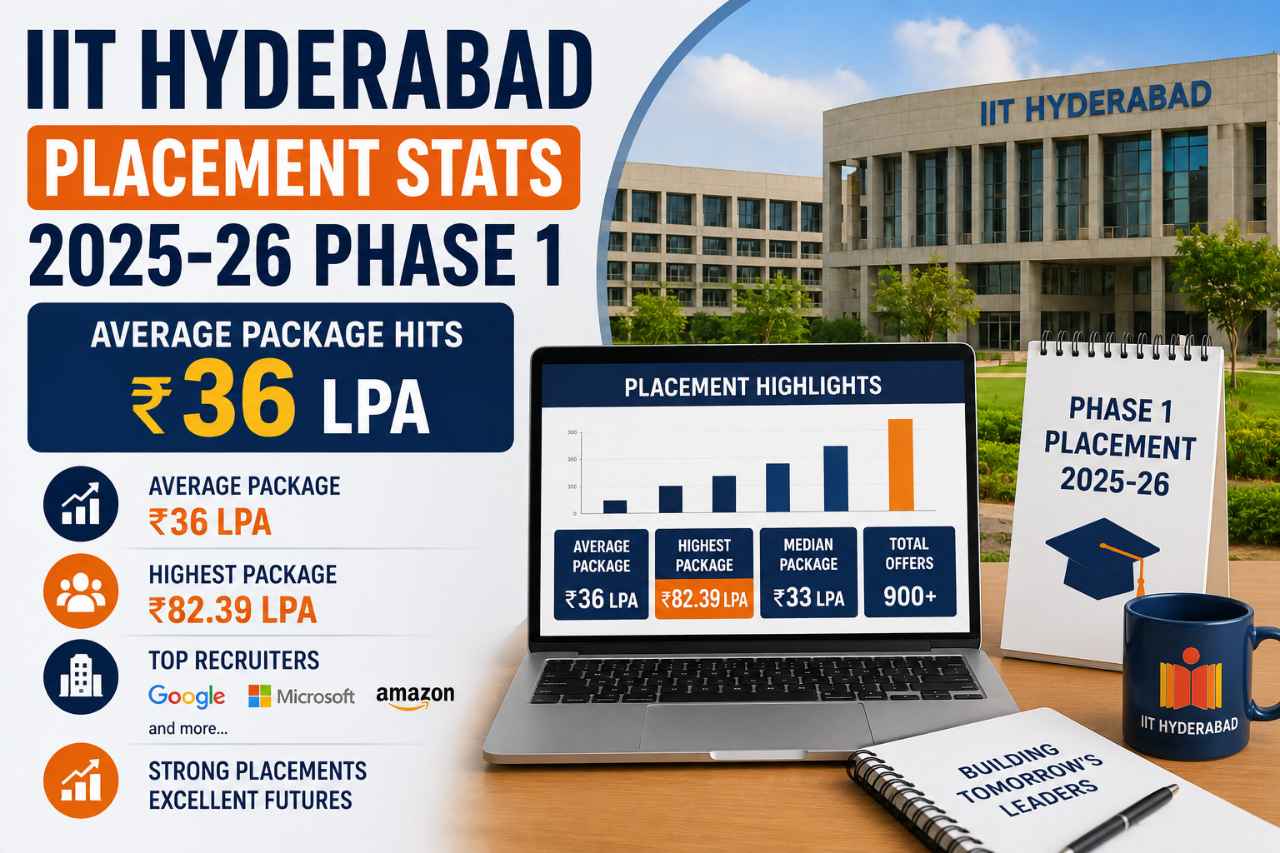
The Indian Institute of Technology Hyderabad (IIT Hyderabad) has published Phase 1 placement statistics for the 2025-26 academic session, and the numbers signal one of the strongest hiring seasons in the Institute's history. According to the Office of Career Services (OCS), roughly 62 percent of the registered batch has already secured job offers, with the Phase 1 average package reaching Rs 36 lakh per annum (LPA). The highest international offer touched Rs 2.5 crore per annum, while the top domestic package stood at Rs 1.58 crore per annum.
For JEE Advanced aspirants, parents, and current students tracking campus outcomes, these figures matter because they reflect real recruiter confidence—not just brochure claims. IIT Hyderabad, established in 2008 as one of India's younger IITs, has steadily closed the placement gap with legacy campuses like IIT Bombay and IIT Delhi. This guide breaks down the Phase 1 data, branch-wise trends, year-on-year comparisons, internship pipeline, and what students should do next—all in plain, actionable language.
IIT Hyderabad Placements 2025-26 Phase 1: Key Highlights at a Glance
Phase 1 typically covers the first major window of the placement season, when top recruiters—including product companies, investment banks, consulting firms, and core engineering giants—visit campus and roll out offers. IIT Hyderabad's OCS released the official brochure on ocs.iith.ac.in, giving verified numbers for the current cycle.
Here is a quick snapshot of the headline figures:
- Placement rate (registered batch): 62 percent in Phase 1
- Average package: Rs 36 LPA
- Highest international offer: Rs 2.5 crore per annum
- Highest domestic offer: Rs 1.58 crore per annum
- International offers made: 24
- Registered recruiters: 353 companies
The breadth of recruiter participation is worth noting. Roles spanned software engineering, product management, quantitative finance, management consulting, data science, and core engineering sectors such as semiconductor design, automotive, and energy. A strong Phase 1 often sets the tone for Phase 2, when manufacturing, public-sector undertakings (PSUs), and niche domain recruiters typically expand hiring.
What Does "62 Percent Placement Rate" Actually Mean?
Placement percentages can confuse first-time readers. At IIT Hyderabad, the 62 percent figure refers to students who registered for placements and received at least one offer during Phase 1—not the entire graduating batch including those pursuing higher studies, entrepreneurship, or deferred placement.
This distinction is important for fair comparison. A student preparing for GATE, GRE, or startup ventures may opt out of the placement process entirely. When evaluating any institute, always check whether the published rate covers registered students, eligible students, or the full batch. IIT Hyderabad's OCS follows the registered-batch convention, which is standard across most IIT placement reports.
Branch-Wise Performance: CSE, AI, and Mathematics Lead Phase 1
Not every department sees identical hiring momentum in Phase 1. Circuit and computing branches traditionally attract the highest volume of tech and finance recruiters early in the season. At IIT Hyderabad this cycle, three departments led the chart:
- Computer Science and Engineering (CSE)
- Artificial Intelligence (AI)
- Mathematics and Computing
These branches reported Phase 1 placement rates between 78 and 83 percent, with an average package of approximately Rs 40 LPA. That is roughly Rs 4 LPA above the campus-wide Phase 1 average—a meaningful gap that reflects both skill demand and role type (software and quant roles often carry higher cash components than many core profiles).
Why Core Engineering Branches Lag Slightly in Phase 1
Mechanical, civil, chemical, and materials engineering students should not read lower early-cycle numbers as weak outcomes. Core-sector hiring—automotive R&D, process engineering, infrastructure, oil and gas, and advanced manufacturing—often peaks in Phase 2 or through off-campus drives and PSU recruitment.
Students in these branches benefit from building strong fundamentals, pursuing relevant internships, and preparing for GATE if PSU roles interest them. Institutes like University of Petroleum and Energy Studies and regional engineering colleges such as Krishna Institute of Engineering and Technology also place emphasis on core-sector pipelines, but IIT Hyderabad's research ecosystem and recruiter network give its core branches a distinct advantage over most private counterparts.
Actionable Tips for Branch Selection (JEE Aspirants)
If you are filling JoSAA choices for JEE Advanced 2026 or 2027, use placement data as one input—not the only input:
- Match branch to career goal: Software/product roles favour CSE, AI, and Mathematics and Computing; hardware and R&D favour EE and related branches.
- Check Phase 1 vs final reports: Phase 1 shows early momentum; wait for consolidated OCS reports before drawing final conclusions.
- Factor in cutoffs: Higher packages in CSE often come with significantly higher JEE Advanced closing ranks.
- Consider dual-degree and research tracks: IIT Hyderabad's research culture supports students aiming for PhD or deep-tech careers beyond immediate placement peaks.
Year-on-Year Comparison: A 44 Percent Jump in Average Package
One of the most striking takeaways from the 2025-26 Phase 1 report is the sharp rise in average compensation compared with recent years. IIT Hyderabad recorded a 44 percent increase over the previous placement cycle—a jump that places the institute closer to compensation bands traditionally associated with older top-tier IITs.
Historical average package trends (as reported for recent seasons) look like this:
- 2023-24: Rs 22.5 LPA
- 2024-25: Rs 20.81 LPA
- 2025-26 (Phase 1 only): Rs 36 LPA
Several factors likely contributed to this surge. Global tech hiring recovered in select domains—AI/ML, cloud infrastructure, and cybersecurity—while domestic product companies and fintech firms expanded campus intake. International offers (24 this cycle) also pull up average figures when converted to rupee equivalents for reporting. Additionally, IIT Hyderabad's growing reputation in research, entrepreneurship, and industry collaboration has made recruiters more willing to compete aggressively for its talent pool.
How IIT Hyderabad Compares With Other Premier Institutes
Direct one-to-one salary comparison across institutes requires caution—methodologies differ, and Phase 1 averages are not final consolidated numbers. Still, the directional trend is clear: IIT Hyderabad is no longer a "second tier" choice in recruiter perception for high-paying tech and finance roles.
Legacy IITs such as IIT Madras Chennai continue to set benchmarks in overall recruiter volume and international visibility. However, the narrowing pay gap benefits students who secure a seat at IIT Hyderabad at a relatively lower JEE Advanced rank than what Bombay or Delhi might demand for the same branch. For many Telangana and Andhra Pradesh students, Hyderabad also offers geographic convenience and a thriving local tech ecosystem anchored by Microsoft, Google, Amazon, and a growing startup corridor.
Private universities—including SRM Institute of Science and Technology Chennai, Galgotias College of Engineering and Technology, and Graphic Era University Engineering—offer alternative pathways for students who miss IIT cutoffs. Those institutes can deliver solid outcomes in niche domains, but the Phase 1 data from IIT Hyderabad illustrates why top JEE ranks still translate into disproportionate recruiter access and compensation ceilings.
International vs Domestic Offers: Reading the Rs 2.5 Crore and Rs 1.58 Crore Figures
Headline "highest package" numbers attract attention—and skepticism. Understanding their structure helps you interpret them responsibly.
International Offers (Rs 2.5 Crore Top)
The highest international package of Rs 2.5 crore per annum typically reflects total compensation for roles based outside India—often in the United States, Europe, or Singapore. These packages may include base salary, signing bonus, stock units (RSUs), and relocation benefits spread over a vesting schedule. Media headlines usually annualise the figure for comparison, but students should read offer letters carefully to understand fixed versus variable components.
With 24 international offers in Phase 1, IIT Hyderabad demonstrates that its graduates compete globally—not only in India-centric hiring. Students targeting international roles should prioritise strong CGPA, impactful projects, open-source contributions, and internship experience at multinational firms.
Domestic Offers (Rs 1.58 Crore Top)
The highest domestic offer of Rs 1.58 crore per annum generally comes from high-paying Indian offices of global tech firms, quantitative trading firms, or elite product companies. Domestic super-packages often cluster in CSE, AI, Mathematics and Computing, and occasionally in dual-degree profiles with exceptional skill sets.
Remember: highest packages represent a handful of outliers. The more useful metrics for most students are median salary, branch average, and percentage placed—not the single top offer.
Recruiter Landscape: 353 Companies and Role Diversity
Three hundred and fifty-three registered recruiters signal deep market interest. Phase 1 hiring at IIT Hyderabad was not dominated by a single sector. Instead, offers were distributed across:
- Software and product engineering — backend, frontend, full-stack, mobile, and platform roles
- Data science and AI/ML — model development, MLOps, research engineering
- Quantitative finance — trading, risk, and research profiles
- Consulting and analytics — management consulting and business analytics
- Core engineering — semiconductor, automotive, aerospace, chemical process, and energy
This diversity protects students from sector-specific downturns. When one industry slows hiring, others may compensate—provided students remain flexible about role type and location.
What Recruiters Look for Beyond CGPA
IIT tag opens doors, but interview performance closes offers. Based on common OCS preparation patterns across IITs, recruiters consistently evaluate:
- Problem-solving speed in coding and aptitude rounds
- Depth in at least one technical domain (systems, ML, embedded, etc.)
- Internship outcomes and project impact
- Communication clarity in HR and managerial rounds
- Cultural fit for product-centric versus service-centric organisations
Students at institutes like Sathyabama Institute of Science and Technology Chennai or RMK College of Engineering and Technology Chennai can replicate many of these preparation strategies through coding clubs, hackathons, and industry certifications—even if peak compensation differs from IIT benchmarks.
Internship Pipeline for the 2027 Batch: Early Signals for Next Year's Placements
Placements do not begin in final year—they are built over three to four years of consistent performance. IIT Hyderabad's OCS also shared internship statistics for the 2027 batch, offering a forward-looking indicator of recruiter sentiment.
- Total internship offers: 279
- Highest monthly stipend: Rs 7.5 lakh per month
A robust internship season often precedes strong final placements. Many companies use summer internships as extended interviews, converting high performers into pre-placement offers (PPOs) before Phase 1 even begins. The Rs 7.5 lakh monthly stipend figure—while an outlier—shows that elite internships now rival entry-level salaries at many mid-tier companies.
How Current Pre-Final Year Students Should Respond
If you are in the 2027 batch at IIT Hyderabad or any engineering programme:
- Apply early to internship drives on the OCS portal; popular roles fill quickly.
- Build a resume narrative around two or three substantial projects rather than ten superficial ones.
- Prioritise skills in data structures, algorithms, and domain fundamentals before internship season peaks.
- Network with alumni on LinkedIn for referral-backed internship opportunities.
- Treat internships as PPO auditions—performance matters more than stipend branding.
Students at private management and technology institutes—such as University of Petroleum and Energy Studies Management or Fairfield Institute of Management and Technology—should follow the same internship-first logic, even though peak stipends and PPO rates will vary by campus tier.
What Is Phase 2—and Why Should You Wait for Final Numbers?
IIT placement seasons typically unfold in multiple phases. Phase 1 captures early, high-volume hiring—especially from tech, finance, and consulting. Phase 2 often includes:
- Core engineering and manufacturing companies
- PSUs and government-linked organisations
- Smaller high-growth startups and mid-cap firms
- Deferred or additional rounds from Phase 1 recruiters
Core branches, in particular, should expect meaningful updates when Phase 2 concludes. The OCS usually publishes a consolidated annual report after all phases complete. Until then, treat Phase 1 averages as directional—not final.
How to Access the Official IIT Hyderabad Placement Brochure
Always rely on primary sources for placement claims. Third-party articles (including this one) should point you to official documents. The IIT Hyderabad OCS hosts the latest brochure as a downloadable PDF titled IITH_PB_26-27 on its website. Refer to the HowTo section in this article's structured data for step-by-step access instructions.
Implications for JEE Advanced and JoSAA Counselling Strategy
If you are a JEE Advanced aspirant evaluating IIT Hyderabad against other options, integrate placement data into a broader decision framework:
When IIT Hyderabad Makes Strong Sense
- You want a top IIT experience with improving placement trajectories and Hyderabad's lower living costs compared to Mumbai or Delhi
- Your rank aligns with CSE, AI, or Mathematics and Computing at IIT Hyderabad but not at older IITs
- You are interested in research, entrepreneurship, or dual-degree programmes supported by IITH's campus culture
When to Weigh Alternatives Carefully
- Your priority is a specific branch (e.g., aerospace, certain dual degrees) unavailable or weaker in preference order
- You prefer the alumni network density of decades-old IITs for overseas graduate school pathways
- You are comparing IIT Hyderabad with NITs, IIITs, or strong private programmes on scholarship or financial grounds
Also explore regional options and course pathways on portals like CollegeDwar when building a balanced college list—whether for engineering, management, or arts programmes such as a BA degree at universities like Jesus and Mary College Delhi, depending on your academic goals.
Understanding Package Components: CTC vs In-Hand Salary
Indian campus placement reports almost always cite Cost to Company (CTC). CTC includes basic salary, house rent allowance, performance bonus projections, stock options, joining bonus, and sometimes one-time benefits. Your monthly in-hand figure will be lower—sometimes substantially—after tax, provident fund deductions, and variable pay conditions.
When comparing IIT Hyderabad's Rs 36 LPA Phase 1 average with another institute's headline number, ask:
- Is the figure mean or median?
- Does it include international offers converted at a fixed exchange rate?
- Are stock components counted at grant value or vesting value?
- Is the report Phase 1 partial or final consolidated?
Transparent institutes answer these questions in their official brochures. That is why downloading the OCS PDF matters.
Campus Preparation Ecosystem at IIT Hyderabad
Strong placement outcomes reflect institutional support—not luck. IIT Hyderabad's OCS typically coordinates resume reviews, mock interviews, aptitude boot camps, and recruiter briefing sessions. Student clubs and coding communities supplement official training with peer-led preparation.
Students who start preparation in second or third year—rather than cramming in final semester—consistently report better outcomes. Skills that transfer across IITs and even to ambitious private colleges include competitive programming, system design basics, and polished resume storytelling.
What to Watch Next: Phase 2 and Consolidated Reports
Phase 2 placement figures and the final consolidated OCS report from IIT Hyderabad are expected in the coming weeks. Key updates to monitor include:
- Final placement percentage across all registered students
- Branch-wise median and average packages after Phase 2
- PPO conversion rates from the 2027 internship cohort
- Sector-wise offer distribution and top recruiter list
Bookmark the OCS portal, follow official LinkedIn announcements, and avoid relying on unverified social media screenshots for salary claims.
Conclusion
IIT Hyderabad's Phase 1 placement statistics for 2025-26 paint a picture of accelerating recruiter confidence and sharply rising compensation. With 62 percent of registered students placed, an average package of Rs 36 LPA, 353 recruiting organisations, and standout international and domestic peak offers, the institute has reinforced its position among India's most sought-after engineering destinations. CSE, AI, and Mathematics and Computing led branch-level outcomes, while core branches await broader Phase 2 hiring.
For aspirants, the takeaway is balanced: celebrate the trend, verify numbers through official OCS documents, and choose branches based on long-term career fit—not headline crore packages alone. For current students, the internship pipeline for the 2027 batch shows that preparation today shapes placement outcomes tomorrow. Stay tuned for Phase 2 updates—and use credible sources when making decisions that will define your professional trajectory.